May 18, 2026
Gulf energy markets face unprecedented volatility as global supply chains navigate geopolitical tensions and infrastructure bottlenecks across traditional production centres. The region's non-OPEC producers have emerged as critical stability anchors, with their operational flexibility becoming increasingly valuable in maintaining consistent output levels. This dynamic has fundamentally altered investment flows and strategic partnerships throughout the Middle East energy corridor, creating new opportunities for nations positioned outside traditional cartel structures.
Understanding how individual producers adapt their extraction strategies reveals broader shifts in regional energy architecture and export capacity planning. The intersection of domestic consumption growth and export optimisation presents complex trade-offs that influence long-term infrastructure development and market positioning across the Gulf region.
Strategic Energy Infrastructure Drives Production Optimisation
Oman's energy sector demonstrates how dedicated gas infrastructure development can reshape production profiles independently of oil market dynamics. The Sultanate's focus on non-associated gas expansion reflects broader industry trends toward specialised extraction facilities that operate independently from traditional oil-linked production systems.
Current Production Metrics and Infrastructure Performance
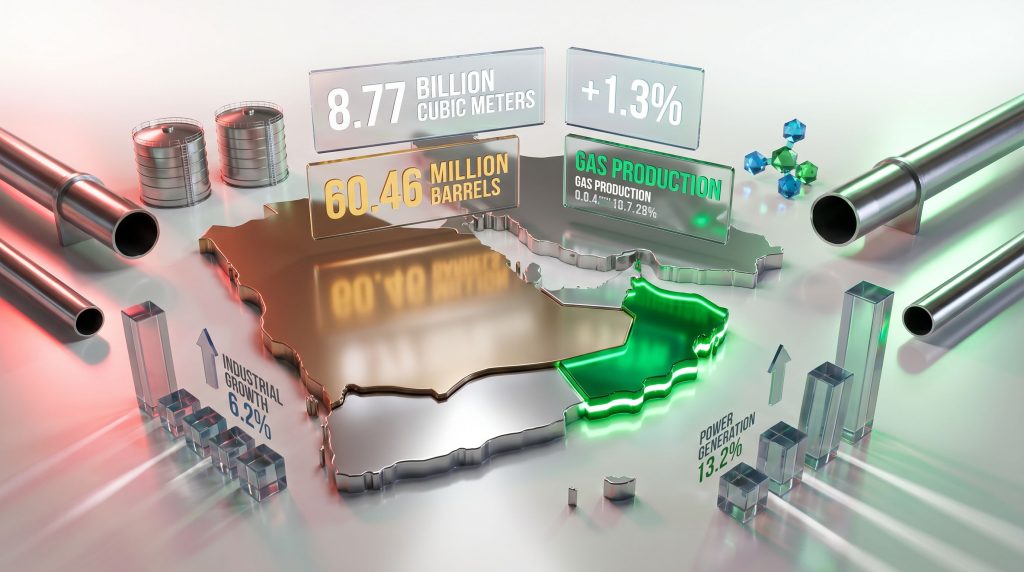
Recent data from Oman's National Centre for Statistics and Information reveals significant shifts in the country's gas production composition. Non-associated gas output reached 6.94 billion cubic metres in February 2026, representing a 4.3% increase from 6.66 billion cubic metres recorded in February 2025. This growth occurred alongside an 8.5% decline in associated gas production, which fell to 1.83 billion cubic metres from 2.00 billion cubic metres year-over-year.
The divergence between these production streams illustrates how modern gas extraction strategies prioritise dedicated facilities over byproduct capture from oil operations. Non-associated gas originates from independent reservoir systems requiring specialised drilling techniques, compression systems, and processing infrastructure that can operate continuously regardless of crude oil production schedules.
| Gas Production Source | February 2026 (BCM) | February 2025 (BCM) | Annual Change |
|---|---|---|---|
| Non-Associated Gas | 6.94 | 6.66 | +4.3% |
| Associated Gas | 1.83 | 2.00 | -8.5% |
| Total Output | 8.77 | 8.65 | +1.3% |
Technical Infrastructure Advantages
The expansion of dedicated gas production facilities provides operational advantages that extend beyond simple volume metrics. Non-associated gas wells typically deliver more consistent flow rates and pressure profiles compared to associated gas systems, which fluctuate based on oil extraction schedules and reservoir depletion patterns.
Advanced compression and processing technologies enable producers to maintain steady output levels throughout varying seasonal demand cycles. Furthermore, Oman gas output increases demonstrate how modern gas processing plants incorporate modular designs that allow capacity adjustments based on reservoir performance and market requirements, providing flexibility that associated gas systems cannot match.
When big ASX news breaks, our subscribers know first
Industrial Consumption Patterns Signal Economic Diversification
The steady rise in domestic consumption patterns reflects broader economic transformation strategies across Gulf nations. Industrial project consumption reached 4.88 billion cubic metres in February 2026, marking a 6.2% increase from 4.59 billion cubic metres in the previous year.
Power Generation Demand Acceleration
The most significant consumption growth occurred in electricity generation, where gas usage surged 13.2% to 2.26 billion cubic metres compared with 1.99 billion cubic metres in February 2025. This expansion reflects several intersecting factors:
• Peak cooling demand management during extreme weather periods
• Grid capacity expansion to support industrial zone development
• Enhanced electricity export capabilities to neighbouring markets
• Integration of gas-fired backup systems for renewable energy installations
The substantial increase in power generation consumption indicates infrastructure investments designed to support long-term industrial expansion rather than temporary demand fluctuations. Modern combined-cycle gas turbines achieve efficiency rates exceeding 60%, making natural gas an economically attractive baseload power source for energy-intensive manufacturing operations.
Operational Efficiency Improvements
Oil field gas consumption, including operational losses and measurement discrepancies, declined dramatically by 20.8% to 1.60 billion cubic metres from 2.02 billion cubic metres year-over-year. This reduction demonstrates successful implementation of advanced leak detection systems, improved metering accuracy, and enhanced gas capture technologies.
Modern petroleum operations utilise sophisticated monitoring systems that detect fugitive emissions at concentrations as low as parts per million, enabling rapid response to potential leaks and minimising operational waste.
The efficiency improvements extend beyond environmental compliance to deliver measurable economic benefits. Captured gas that previously represented operational losses now contributes to productive consumption or export revenue, improving overall project economics and resource utilisation rates.
| Consumption Sector | February 2026 (BCM) | February 2025 (BCM) | Growth Rate |
|---|---|---|---|
| Industrial Projects | 4.88 | 4.59 | +6.2% |
| Power Generation | 2.26 | 1.99 | +13.2% |
| Oil Field Operations | 1.60 | 2.02 | -20.8% |
| Industrial Zones | 0.032 | 0.045 | -29.9% |
Oil Production Volumes Counter Price Volatility Impact
Strategic volume management has emerged as a critical tool for maintaining revenue stability amid fluctuating commodity prices. Oman's crude oil exports increased 2.2% to 50.31 million barrels in February 2026, while total production expanded 3.8% to 60.46 million barrels compared with previous year levels.
Production Capacity Optimisation
Daily output averaged approximately 1.02 million barrels per day in February 2026, representing a 33,000 barrel per day increase from 987,000 barrels per day recorded in February 2025. This 3.3% production growth reflects systematic capacity optimisation rather than emergency response to market conditions.
Enhanced oil recovery techniques, including carbon dioxide injection and advanced water flooding systems, enable mature fields to maintain production levels that would otherwise decline due to natural reservoir pressure depletion. In addition, secondary recovery methods can extend field productive life by decades while improving ultimate recovery factors.
Price Environment and Revenue Management
Average Omani crude prices declined 13.1% to $63.3 per barrel from $72.8 per barrel year-over-year, creating significant headwinds for export revenue generation. However, the volume increases partially offset these price pressures through enhanced production efficiency and expanded export capacity.
The relationship between production costs and commodity prices remains favourable at current output levels. Consequently, oil price stagnation concerns in global markets have been somewhat mitigated by Omani crude's typical premium trading position due to its low sulfur content and favourable refining characteristics.
| Oil Sector Metric | February 2026 | February 2025 | Change |
|---|---|---|---|
| Crude Exports (million barrels) | 50.31 | 49.23 | +2.2% |
| Total Production (million barrels) | 60.46 | 58.24 | +3.8% |
| Daily Output (thousand bpd) | 1,020 | 987 | +3.3% |
| Average Price ($/barrel) | 63.3 | 72.8 | -13.1% |
Regional Energy Security and Market Positioning
Gulf energy producers face increasing pressure to maintain supply reliability while managing domestic consumption growth and export commitments. Oman's position outside OPEC+ production quotas provides strategic flexibility that becomes particularly valuable during periods of regional instability or supply disruptions.
Strategic Independence Benefits
Non-OPEC status allows producers to adjust output levels based on commercial considerations rather than cartel allocation agreements. This flexibility becomes especially important when domestic energy demand competes with export revenue opportunities, requiring careful balance between internal consumption and international market obligations.
The ability to respond quickly to market signals provides competitive advantages in contract negotiations with Asian customers who prioritise supply security over short-term pricing fluctuations. Furthermore, considerations around Saudi exploration licenses and regional production dynamics highlight how long-term agreements typically include volume flexibility clauses that reward reliable suppliers with premium pricing structures.
Infrastructure Investment Implications
Sustained production growth requires continuous investment in extraction technology, processing capacity, and transportation infrastructure. Modern gas processing facilities incorporate carbon capture systems and enhanced efficiency technologies that reduce operational emissions while improving economic performance.
Export terminal expansions and pipeline network development enable producers to access multiple market destinations, reducing dependence on individual customer relationships. Diversified export infrastructure provides negotiating leverage and risk mitigation capabilities that support long-term revenue stability.
Economic Transformation Through Energy Sector Development
Industrial gas consumption growth signals broader economic diversification efforts that extend beyond traditional hydrocarbon exports. Manufacturing sector expansion requires reliable energy supplies at competitive prices, creating opportunities for domestic value-added production across multiple industry segments.
Industrial Zone Development Patterns
While industrial zone gas consumption declined 29.9% to 31.6 million cubic metres, this reduction likely reflects efficiency improvements and operational optimisation rather than reduced industrial activity. Modern industrial facilities incorporate advanced energy management systems that minimise gas consumption while maintaining production output levels.
Petrochemical complexes and metal processing facilities represent particular growth opportunities due to their substantial energy requirements and export potential. These industries create employment opportunities while generating foreign exchange earnings that reduce dependence on crude oil exports.
Technology Transfer and Knowledge Development
Energy sector expansion facilitates technology transfer relationships with international partners that extend beyond simple production agreements. Joint ventures in gas processing, renewable energy integration, and industrial development create knowledge transfer opportunities that support long-term economic transformation.
Advanced training programmes and technical education initiatives develop local expertise in energy sector operations, reducing dependence on expatriate labour while building domestic capacity for future expansion projects. Moreover, energy transition and security considerations drive innovation in sustainable energy practices.
The next major ASX story will hit our subscribers first
Investment Framework and Risk Assessment
Energy sector investment decisions require careful evaluation of geological factors, market dynamics, and regulatory frameworks that influence project economics over multi-decade timeframes. Successful projects balance production growth potential with infrastructure development costs and market access considerations.
Geological Resource Assessment
Oman's gas reserves include both conventional and unconventional resources that require different extraction approaches and economic models. Conventional reserves typically offer lower development costs and faster production ramp-up periods, while unconventional resources may provide longer-term production sustainability.
Reservoir engineering advances, including horizontal drilling and hydraulic fracturing adaptations for tight gas formations, expand recoverable resource estimates and improve project economics. Enhanced seismic imaging and formation evaluation technologies reduce exploration risks while optimising well placement strategies.
Market Access and Pricing Dynamics
Asian gas markets demonstrate strong long-term demand growth driven by industrial expansion and environmental regulations that favour natural gas over coal consumption. Supply diversification strategies among major importers create opportunities for new suppliers who can demonstrate reliable delivery capabilities.
Price volatility management through portfolio approaches that combine spot sales with long-term contracts provides revenue stability while capturing market opportunities during periods of strong demand. However, challenges related to energy exports challenges in global markets require flexible contract structures that accommodate seasonal demand variations while ensuring minimum revenue thresholds.
The intersection of production optimisation, consumption growth, and strategic positioning demonstrates how energy sector development can support broader economic transformation objectives while maintaining operational flexibility in volatile global markets. Oman gas output increases exemplify how investment framework strategies must balance resource development with infrastructure investment and market diversification objectives for sustained success.
Are You Tracking Energy Sector Investment Opportunities on the ASX?
Discovery Alert's proprietary Discovery IQ model provides instant notifications when significant energy and mineral discoveries are announced on the ASX, helping investors identify actionable opportunities in Australia's dynamic resource sector. Explore historic examples of major discoveries and begin your 14-day free trial today to gain the market-leading edge you need for informed investment decisions.