July 29, 2026
The Infrastructure Race to Reroute Global Oil: Why Private Capital Is Betting Big on Gulf Refining
The history of global energy trade is defined not just by who produces oil, but by who controls the corridors through which it moves. For decades, the Strait of Hormuz has represented one of the most consequential geographic bottlenecks in the world economy, a narrow waterway through which a significant share of global petroleum flows each day. The concentration of such enormous trade volumes through a single chokepoint has always been a structural vulnerability. Now, as ongoing conflict involving Iran continues to disrupt energy flows across the region, private capital is beginning to respond — and the US-Saudi consortium advances plans for $5 billion Gulf refinery stands as one of the most compelling examples of this shift.
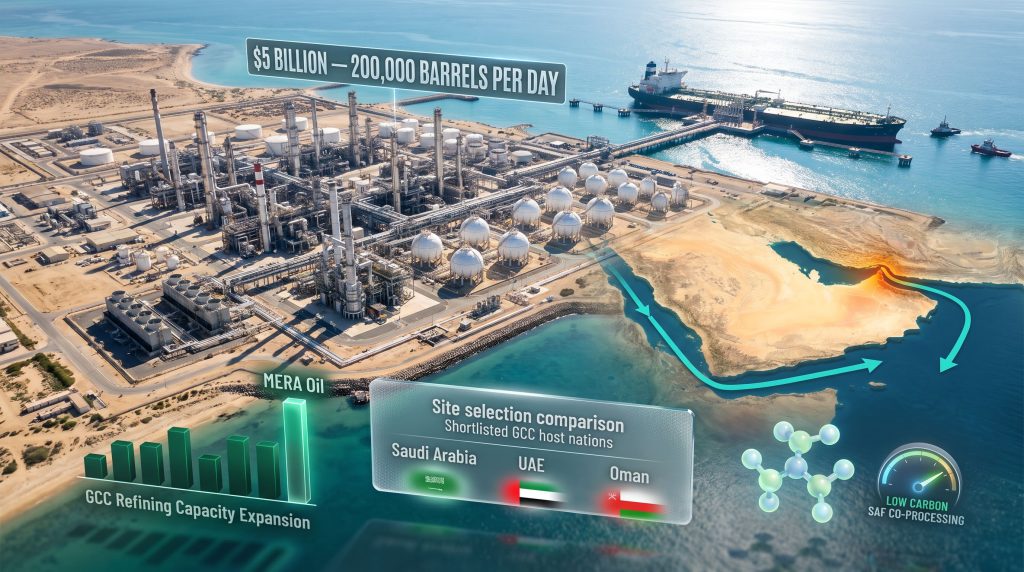
The MERA Oil consortium is one of the most significant examples of this trend. Comprising Texas-based MWG Group, the Patel Family Office, and PWS, an associate company of Saudi industrial conglomerate AHQ Group, the consortium is advancing plans for a $5 billion integrated refinery and export corridor designed to process 200,000 barrels of crude oil per day within the Gulf Cooperation Council region. The project has entered the final stage of site selection, with three GCC locations under active evaluation and a preferred host expected to be confirmed before the end of 2026.
When big ASX news breaks, our subscribers know first
What the MERA Oil Consortium Actually Represents
Understanding MERA Oil requires looking at what this kind of partnership structure means in practice. This is not a state-owned enterprise expanding its domestic refining footprint, nor is it a supermajor like Aramco or TotalEnergies integrating production downstream into a national energy strategy. MERA Oil is a privately structured, cross-border capital consortium assembling complementary expertise across US energy development, international private capital deployment, and Saudi industrial operations.
Furthermore, the broader geopolitical context matters here. Shifting geopolitical trade tensions are increasingly motivating private investors to back infrastructure that reduces exposure to volatile transit corridors, and MERA Oil reflects precisely that logic.
MWG Group: Texas-Based Project Development
MWG Group brings energy project development expertise from one of the world's most commercially mature hydrocarbon environments. Texas-based developers operating in this space understand complex project financing, contractor management at scale, and the commercial discipline required to move a greenfield facility from concept to commissioning.
Patel Family Office: Cross-Border Private Capital
The involvement of a family office structure is particularly notable. Family offices increasingly play a role in long-duration infrastructure projects that require patient capital, particularly where institutional investors may be constrained by short-term return horizons or ESG mandate conflicts. Private capital structures like this can move with a flexibility that sovereign funds or listed companies sometimes cannot.
AHQ Group and PWS: Saudi Industrial Execution Capacity
AHQ Group, the Saudi industrial conglomerate behind associate entity PWS, adds a critical dimension that purely Western-led consortiums often lack in Gulf infrastructure projects: local regulatory familiarity, established supply chain relationships, and operational credibility within the GCC business environment. This is not incidental to the project's viability; it is foundational to it.
The Scale Question: What 200,000 Barrels Per Day Actually Means
At 200,000 barrels per day, the proposed MERA Oil facility would rank among the largest greenfield refinery announcements globally in the 2020s. To contextualise that figure:
- A typical mid-scale regional refinery processes between 50,000 and 100,000 barrels per day
- Major export-oriented refineries in Asia, such as those developed in India and South Korea, typically operate in the 300,000 to 650,000 bpd range at full build-out
- The 200,000 bpd threshold signals a facility designed primarily for export rather than domestic consumption
This distinction matters enormously. A refinery sized for domestic supply is a utility asset. A refinery sized for export is a trading and logistics platform, one whose economics depend on margin capture between upstream crude acquisition costs and international refined product prices. For a broader crude oil market overview, these dynamics are already reshaping investment priorities across the region.
The commercial logic here is straightforward but powerful: the GCC sits on vast crude reserves, but the value-add from refining those barrels into jet fuel, diesel, and marine fuel historically accrues to importers further down the supply chain. Building export-oriented refining capacity within the region is a structural shift in where that margin is captured.
The Integrated Infrastructure Stack
The refinery itself is only one component of what MERA Oil is proposing. The full complex integrates a range of strategic infrastructure:
| Infrastructure Component | Strategic Function |
|---|---|
| Deepwater Port Facilities | Direct access to international shipping lanes without Hormuz transit |
| Large-Scale Crude and Product Storage | Buffers supply disruptions, supports trading flexibility |
| Marine Export Terminals | Connects refined output directly to global commodity markets |
| Energy-Efficient Refining Technology | Reduces operating costs and lifecycle emissions intensity |
| Advanced Emissions-Control Systems | Positions project for ESG-aligned debt and equity financing |
Each layer of this infrastructure stack reinforces the others. Storage capacity allows the operator to time product releases to market, a capability that pure refiners without storage lack. Deepwater port access eliminates dependence on third-party terminals. The emissions-control architecture is not merely a regulatory compliance measure; it is a financing instrument, broadening the universe of institutional capital that can participate in the project.
Why Hormuz Avoidance Is the Commercial Core of This Proposal
Approximately 20 to 21% of global petroleum liquids transit the Strait of Hormuz annually, according to data from the US Energy Information Administration. That single statistic explains why any sustained disruption to the strait creates immediate and severe price volatility across international energy markets.
The Iran conflict has materially elevated the geopolitical risk premium embedded in Gulf-origin energy. Tanker operators, insurers, and commodity traders have all adjusted their pricing and routing behaviours in response. This creates a measurable commercial premium for infrastructure that can deliver refined products to international markets via routes that entirely bypass the strait. Indeed, oil price movements in recent months have reflected precisely these supply chain anxieties.
The Premium of Hormuz-Independent Infrastructure
This is not a theoretical benefit. When Hormuz transit risk is elevated, the freight rate differential between Hormuz-routed cargoes and Red Sea or Indian Ocean-routed cargoes widens significantly. A refinery with marine export infrastructure positioned outside the strait captures that differential directly in its logistics cost structure, every day that risk premiums remain elevated.
From a pure commercial perspective, ongoing regional instability does not simply threaten projects like MERA Oil. For a Hormuz-bypass facility, elevated geopolitical tension may paradoxically strengthen the commercial case by widening the cost advantage of its export routing.
Comparing MERA Oil to Other Gulf Export Bypass Proposals
Saudi Arabia's East-West Pipeline, which links Gulf-side production to Red Sea export terminals at Yanbu, is the most established example of Hormuz-bypass infrastructure in the region. The UAE has similarly invested in pipeline capacity connecting Abu Dhabi to Fujairah on the Gulf of Oman. MERA Oil's proposal is conceptually adjacent to these strategic corridors, but it operates as a private, refinery-integrated export platform rather than a crude transit pipeline.
In addition, OPEC's market influence over regional production levels will inevitably shape feedstock availability and pricing for any new GCC refinery of this scale, making supply-side coordination a critical background variable.
GCC Site Selection: Where the Refinery Could Be Built
The consortium has narrowed its site selection to three GCC locations, though specific sites have not been disclosed. The evaluation criteria likely span several overlapping dimensions:
- Proximity to deepwater shipping corridors outside Hormuz transit risk zones
- Feedstock supply chain access and the economics of crude delivery to the chosen site
- Regulatory and fiscal frameworks including investment protection, repatriation of returns, and tax treatment
- Existing port and logistics infrastructure that can be integrated or expanded efficiently
- Environmental permitting timelines and land availability for a facility of this footprint
The comparative landscape across GCC nations offers a useful frame for understanding where the balance of these factors may point:
| GCC Nation | Refining Infrastructure Maturity | Strategic Port Access | Openness to Foreign Direct Investment |
|---|---|---|---|
| Saudi Arabia | Very High | High (Red Sea and Gulf) | Moderate to High under Vision 2030 |
| UAE | High | Very High (Jebel Ali, Fujairah) | Very High |
| Oman | Moderate | High (Duqm, Salalah) | High |
| Qatar | Moderate | Moderate | Moderate |
| Kuwait | High | Moderate | Moderate |
| Bahrain | Low to Moderate | Moderate | High |
Oman's position is arguably underappreciated in this analysis. The Port of Duqm is specifically positioned outside the Strait of Hormuz on the Arabian Sea, making it one of the few deep-water facilities in the GCC with inherent Hormuz-bypass geography. Salalah similarly offers Indian Ocean access. For a project explicitly designed around Hormuz avoidance, Oman's coastal geography carries structural advantages.
The UAE's port infrastructure at Fujairah, also on the Gulf of Oman, represents another compelling option given the country's existing oil storage hub status and highly developed financial and logistics ecosystem.
Sustainable Aviation Fuel and the Green Refining Dimension
The evaluation of sustainable aviation fuel co-processing within the MERA Oil complex is a signal worth examining carefully. SAF is currently one of the most supply-constrained segments of the global energy transition. Aviation accounts for roughly 2.5% of global CO2 emissions, but the sector faces far fewer viable decarbonisation pathways than road transport.
Blended SAF from co-processed feedstocks within a conventional refinery represents a near-term, commercially viable route to SAF production without requiring entirely separate facilities. Moreover, green fuel transition trends across the broader energy sector are creating growing commercial demand for facilities that can credibly demonstrate low-carbon output.
Integrating SAF capability alongside conventional refining also serves a financing function. ESG-oriented capital pools, including green bond markets and sustainability-linked loan structures, become accessible to a project that can credibly demonstrate low-carbon product output. Carbon management systems being evaluated for the complex reinforce this positioning.
The next major ASX story will hit our subscribers first
Key Risks Facing a $5 Billion Greenfield Project
Projects of this scale carry risks that deserve direct examination rather than footnote treatment.
Greenfield refinery projects of this scale typically require five to eight years from final investment decision to first barrel of production. The geopolitical conditions, financing environment, and energy market structure at the time of announcement may differ substantially from those prevailing at commissioning.
The principal risk categories include:
- Feedstock security: The consortium is still in negotiations with crude suppliers. Long-term feedstock arrangements at economics that support project viability have not yet been finalised. This is among the most consequential outstanding variables.
- Financing concentration risk: A $5 billion greenfield in a geopolitically active region requires sophisticated capital structuring. Lender appetite, insurance availability, and equity co-investment terms will all be shaped by the regional security environment.
- Regulatory and permitting complexity: Selecting a site across three candidate GCC jurisdictions means the permitting pathway, construction timeline, and operational framework remain uncertain until the site decision is confirmed.
- Energy transition headwinds: Long-lived refinery assets commissioned in 2030 or later will face growing policy pressure on refined fossil fuel products in key export markets, particularly in Europe.
This article does not constitute financial advice. The MERA Oil project remains in early-stage development with key decisions including site selection, feedstock arrangements, and financing structures yet to be finalised. Readers should independently verify all information before making investment decisions.
What a 200,000 bpd Export Refinery Means for Global Refined Product Markets
At full capacity, a 200,000 bpd complex would produce substantial daily volumes of jet fuel, diesel, and potentially marine fuel, all of which flow into globally traded commodity markets. The directional impact on Mediterranean and Asian trade flows depends heavily on where the facility sits within GCC geography and which shipping lanes it connects to directly.
For Asian buyers of Middle Eastern crude who currently import refined products from European or Indian refiners, a new GCC-based export refinery positioned on Indian Ocean shipping lanes represents a potential supply source with advantaged logistics economics. For European refined product importers already adjusting to post-Ukraine supply chain restructuring, additional Middle Eastern refinery capacity entering Atlantic Basin trade flows adds a new pricing reference point.
It is also worth noting that Aramco has already signed up to $90 billion in US deals during the recent Gulf tour, signalling that the broader US-Saudi energy investment relationship is entering a period of significant momentum. Consequently, the US-Saudi consortium advances plans for $5 billion Gulf refinery represents more than a single infrastructure announcement. It signals a broader structural shift in how private capital is responding to geopolitical disruption in global energy trade, channelling investment not just into production, but into the export infrastructure that determines where refined product margins ultimately settle.
Frequently Asked Questions
What is the MERA Oil consortium?
MERA Oil is a joint venture comprising Texas-based MWG Group, the Patel Family Office, and PWS, an associate entity of Saudi industrial conglomerate AHQ Group. The consortium is developing a proposed $5 billion integrated refinery and export corridor within the Gulf Cooperation Council region.
How large will the refinery be?
The planned facility is designed to process 200,000 barrels of crude oil per day, placing it among the largest greenfield refinery proposals announced globally during the 2020s.
Why is Hormuz bypass positioning so important to this project?
Approximately 20 to 21% of global petroleum liquids transit the Strait of Hormuz annually. Ongoing conflict in the region has elevated freight costs and insurance premiums for Hormuz-routed cargoes, creating a direct commercial premium for infrastructure that can access international shipping lanes without transiting the strait.
When will the final site be selected?
The consortium has narrowed its evaluation to three GCC locations, with the preferred host site expected to be confirmed before the end of 2026.
What green energy components is the project evaluating?
The complex is assessing sustainable aviation fuel co-processing and carbon management systems as potential integrated components, reflecting both energy transition considerations and the financing advantages associated with demonstrable ESG credentials.
How does this project differ from sovereign-backed Gulf refinery expansions?
Unlike state-affiliated or supermajor-backed projects typically integrated into national oil company strategies, the US-Saudi consortium advances plans for $5 billion Gulf refinery as a privately structured, cross-border consortium seeking to function as an independent export-oriented refining platform. This allows it to capture margin between upstream crude costs and international refined product demand independently of national energy policy objectives. For further context, Saudi Aramco's broader US refinery ambitions offer a useful comparison point for understanding the scale and direction of Gulf-to-US energy investment.
Want to Stay Ahead of the Next Major Resource Discovery Powering the Energy Transition?
While private capital races to build the infrastructure reshaping global energy trade, Discovery Alert's proprietary Discovery IQ model instantly alerts subscribers to significant ASX mineral discoveries — from the copper and lithium fuelling the energy transition to the rare earths underpinning advanced industrial supply chains. Start your 14-day free trial at Discovery Alert and explore historic discovery returns to understand just how transformative the right alert at the right moment can be.