
July 29, 2026
When Operational Momentum Meets Market Re-Rating: Understanding the MIN Share Price Surge
Across the global mining sector, few phenomena capture investor attention quite like a diversified producer delivering record output volumes while simultaneously shrinking its debt load. In capital-intensive industries, these two achievements rarely occur together. When they do, markets tend to respond with outsized enthusiasm, often repricing the entire risk profile of the business in a compressed timeframe.
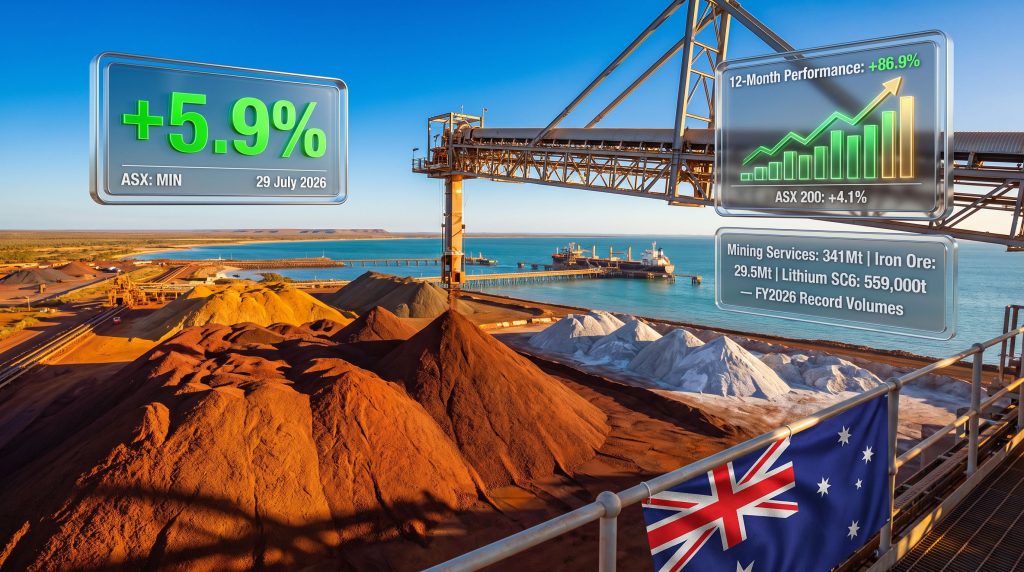
That is precisely the dynamic unfolding with Mineral Resources Ltd (ASX: MIN) on 29 July 2026. Shares climbed approximately 5.9% in morning trade, moving from $53.10 to $56.25, on the back of a June quarter operating update that confirmed record annual volumes across all three of its core business divisions. But to understand why Mineral Resources shares are leaping higher today, it is necessary to look well beyond a single quarterly report.
When big ASX news breaks, our subscribers know first
A Rally Built Across Four Distinct Phases
The ~87% appreciation in Mineral Resources shares over the preceding 12 months dwarfs the ASX 200's gain of approximately 4.1% over the same period, representing outperformance of more than 80 percentage points. This is not the product of a single catalyst. It reflects a sequential re-rating process driven by layered, compounding developments across balance sheet repair, operational execution, commodity sentiment, and strategic project advancement.
| Metric | Mineral Resources (ASX: MIN) | ASX 200 (XJO) |
|---|---|---|
| Single-day gain (29 Jul 2026) | ~+5.9% | ~+1.2% |
| 12-month price appreciation | ~+86.9% | ~+4.1% |
| Relative outperformance (12 months) | ~+82.8 percentage points | N/A |
Understanding the architecture of this multi-phase re-rating is critical for any investor attempting to assess whether the current valuation reflects fair value or whether further upside potential remains.
Phase 1 involved balance sheet stabilisation. At peak debt concern, markets assigned a significant risk premium to Mineral Resources shares, pricing in scenarios of financial stress. Evidence of active deleveraging progressively compressed that premium.
Phase 2 centred on operational credibility. Consistent guidance delivery across multiple consecutive quarters rebuilt institutional trust in management's ability to execute at scale.
Phase 3 reflected commodity sentiment improvement. Iron ore price stabilisation and early signs of lithium market recovery shifted the macro backdrop from headwind to neutral, and in some scenarios, tailwind.
Phase 4, now underway, involves the repricing of strategic project optionality as growth assets transition from construction and care-and-maintenance back into active production and development.
Record FY2026 Volumes: What the Numbers Actually Mean
The June quarter operating update confirmed that Mineral Resources achieved or exceeded every volume and cost guidance target across its three business segments for FY2026. In the mining industry, this kind of clean sweep is genuinely uncommon for a company managing simultaneous large-scale project activity across multiple commodity types.
Annual Volume Scorecard
| Business Segment | FY2026 Volume | Result Classification |
|---|---|---|
| Mining Services | 341 million tonnes | Record annual volume |
| Iron Ore Operations | 29.5 million tonnes | Record annual volume |
| Lithium (SC6 equivalent dmt) | 559,000 tonnes | Record annual volume |
The Mining Services division deserves particular attention from an analytical perspective. Unlike the iron ore and lithium segments, which generate revenue tied directly to commodity prices, Mining Services operates on contracted volume-based arrangements. This means the 341 million tonne record represents a revenue stream with a degree of pricing stability that partially insulates the overall business from spot market volatility.
This contractual revenue architecture is a structural feature that is often underappreciated by investors who assess Mineral Resources primarily through a commodity producer lens. The Mining Services division functions, in effect, as an internal stabiliser during commodity price downturns, continuing to generate cash flow based on the volume of material moved rather than the price at which that material is sold.
Onslow Iron: The Dual Achievement That Markets Reward Most Heavily
The Onslow Iron operation produced the most operationally significant result in the quarterly update. However, context matters here — the Onslow Iron project halt earlier in the project's timeline made this turnaround all the more remarkable to institutional observers.
- Q4 FY2026 production: 8.8 million tonnes
- Q4 FY2026 shipments: 9.6 million tonnes on a 100% basis, a new quarterly shipment record
- Full-year FY2026 attributable shipments: 19.7 million wmt, exceeding the upgraded guidance range of 17.7 to 19.4 million wmt
- Full-year FOB costs: $52 per wmt, below the guidance range of $54 to $59 per wmt
Delivering shipment volumes above the top end of guidance while simultaneously undercutting the cost guidance range is a dual operational achievement that carries a specific signal to institutional investors: the operation has moved past its ramp-up inefficiencies and is generating positive operating leverage.
In iron ore operations, this transition from ramp-up cost drag to steady-state cost efficiency is where the most dramatic margin expansion occurs. The $52 per wmt full-year cost compares favourably to broader industry benchmarks for comparable Pilbara-region iron ore operations, and positions Onslow Iron to remain cash flow positive across a wider range of iron ore price scenarios. Furthermore, the Onslow transhipper expansion has been instrumental in supporting the record shipment volumes recorded this quarter.
Pilbara Hub: Upper-End Delivery and Lamb Creek Contribution
The Pilbara Hub contributed meaningfully to the full-year result, with the Lamb Creek ramp-up playing a notable role in Q4 shipment volumes. In addition, the Onslow haul road update has provided important infrastructure improvements that underpin the operational gains recorded across the broader iron ore division.
- Q4 FY2026 shipments: 2.7 million wmt, supported by Lamb Creek operational progress
- Full-year FY2026 shipments: 9.9 million wmt, at the upper end of guidance of 9.0 to 10.0 million wmt
- Full-year FOB costs: $79 per wmt, at the upper end of the $75 to $80 per wmt guidance range
The cost performance at the Pilbara Hub sits at the higher end of guidance, which is worth monitoring as Lamb Creek continues its operational maturation. As volumes increase through mine ramp-up, fixed cost dilution typically drives FOB costs progressively lower, suggesting potential for cost improvement in FY2027 if production targets are maintained.
Balance Sheet Repair: The Critical Re-Rating Catalyst
For much of FY2025 and into the early part of FY2026, the primary overhang on Mineral Resources shares was not operational performance but financial structure. Net debt at elevated levels created a perception of vulnerability, particularly during periods of commodity price softness. The June quarter update provided concrete evidence that this structural concern is being systematically addressed.
| Balance Sheet Metric | 31 March 2026 | 30 June 2026 | Change |
|---|---|---|---|
| Net Debt | $4.5 billion | $4.3 billion | Reduced by $200 million |
| Liquidity | $1.8 billion | $2.4 billion | Increased by $600 million |
| Revolving Credit Facility | $800 million | $800 million (fully undrawn) | Unchanged |
The $600 million liquidity improvement in a single quarter is the most striking figure in the balance sheet update. It signals that operating cash generation has accelerated to a point where the company is not only servicing its debt obligations but building financial headroom simultaneously.
In resource sector investing, the trajectory of net debt carries as much analytical weight as its absolute level. A company actively reducing leverage while expanding production volumes signals that free cash flow generation is genuinely accelerating, a combination that compresses risk premiums and expands valuation multiples.
The fully undrawn $800 million revolving credit facility provides an additional dimension of financial optionality. In practical terms, it means Mineral Resources holds approximately $2.4 billion in liquidity against near-term operational needs, giving the company meaningful capacity to fund growth capital expenditure without requiring equity dilution or emergency debt facilities.
Beyond operational cash flows, the broader multi-month recovery in the share price has also been supported by strategic asset monetisation, debt maturity restructuring that has reduced near-term refinancing risk, and the gradual restoration of creditor confidence evidenced by the fully undrawn revolving facility.
Lithium Optionality: Two Strategic Developments Repricing the Growth Story
The lithium segment delivered two developments during the June quarter that are contributing materially to positive market sentiment around Mineral Resources shares, each carrying distinct strategic implications.
Bald Hill: From Care and Maintenance to First Concentrate
Bald Hill was placed on care and maintenance during the lithium price downturn, a period during which spodumene concentrate prices fell sharply from their 2022 to 2023 peak levels. The decision to recommence construction and produce first concentrate in June 2026 is not merely an operational event. It is a signal that the internal economics of the operation have reached a threshold where resumption is justified.
Bald Hill produces spodumene concentrate, the primary hard-rock feedstock for lithium chemical conversion. As a SC6-equivalent product, its market value is closely tied to the benchmark spodumene concentrate price, which has been recovering from cyclical lows. The timing of the restart suggests management holds a constructive view on near-term pricing dynamics.
Mt Marion: The FID That Signals Long-Term Confidence
The Final Investment Decision made in May 2026 to construct a flotation plant and develop underground mining at Mt Marion carries different strategic significance. An FID is a formal commitment of capital based on a long-term economic model, meaning it reflects management's assessment of lithium market fundamentals across a multi-year horizon rather than a near-term price call.
The addition of a flotation plant at Mt Marion is technically significant. Flotation processing improves the recovery rate of spodumene from ore, increasing the proportion of lithium-bearing minerals captured in the concentrate product. This directly improves the economics of the operation by reducing the quantity of ore that must be mined and processed to produce a tonne of saleable concentrate.
Underground mining development at Mt Marion extends the accessible ore body beyond what open-pit mining can reach, providing a pathway to higher-grade mineralisation zones that typically reside at depth. Higher-grade ore reduces processing costs per tonne of concentrate produced, which is a critical competitive advantage as lithium market conditions evolve.
Lithium Price Dynamics and Operating Leverage
Mineral Resources operates with significant natural leverage to lithium prices through its spodumene concentrate production. With FY2026 lithium volumes reaching a record 559,000 tonnes (dmt SC6 equivalent), even modest improvements in spot pricing translate into meaningful revenue uplift at the mine gate.
The lithium market is currently navigating a rebalancing cycle. The broader lithium market downturn created supply additions during the 2022 to 2023 price surge, resulting in a period of oversupply that compressed margins across the industry. Consequently, as higher-cost operations reduce output or cease production, the supply-demand balance is gradually tightening, a process that historically precedes a recovery in concentrate pricing. For further context, the lithium stock performance of comparable ASX-listed producers illustrates just how broadly the sector has been affected by these pricing dynamics.
How Mineral Resources Compares to ASX Mining Peers
The scale of the MIN re-rating becomes more instructive when viewed against comparable ASX-listed resource producers:
| Company | 12-Month Approximate Performance | Primary Commodity Exposure |
|---|---|---|
| Mineral Resources (MIN) | ~+87% | Lithium, Iron Ore, Mining Services |
| BHP Group (BHP) | Broadly index-aligned | Iron Ore, Copper, Coal |
| Rio Tinto (RIO) | Moderate outperformance | Iron Ore, Aluminium, Copper |
| S32 (S32) | Commodity-dependent | Base Metals, Manganese |
The diversification embedded in Mineral Resources' business model is a key differentiator. Unlike pure-play commodity producers whose fortunes are entirely tied to a single price benchmark, the Mining Services division provides contracted volume revenue that continues generating cash flow independent of whether iron ore or lithium prices are rising or falling. This structural characteristic has been a meaningful contributor to the scale of the re-rating relative to single-commodity peers. Analysts at Morningstar note that this diversified model has proven resilient through multiple commodity cycles.
The next major ASX story will hit our subscribers first
SC6 Spodumene: Understanding the Product at the Heart of the Lithium Story
For investors less familiar with lithium mining terminology, SC6 refers to spodumene concentrate grading approximately 6% lithium oxide (Li2O) by weight. This is the industry standard benchmark grade for hard-rock spodumene concentrate, and it is the product form in which Mineral Resources sells its lithium output.
The significance of grade consistency cannot be overstated in lithium supply chains. Lithium chemical converters — the facilities that transform spodumene concentrate into battery-grade lithium hydroxide or lithium carbonate — calibrate their processing equipment around specific feed grades. Operations that consistently deliver on-specification SC6 material command price premiums and stronger offtake relationships compared to producers delivering off-specification or variable-grade product.
The record 559,000 tonne SC6 output in FY2026 positions Mineral Resources as one of the larger spodumene producers globally, giving it meaningful scale in commercial negotiations with chemical converters and battery material supply chains.
Key Risks That Remain Material
A complete investment perspective on why Mineral Resources shares are leaping higher today requires an honest assessment of the risks that have not disappeared alongside the positive momentum:
- Net debt remains substantial. At $4.3 billion, the absolute debt level is still significant relative to operating cash flows. Any sustained deterioration in iron ore or lithium prices could slow deleveraging progress and put renewed pressure on financial metrics.
- Lithium price recovery is not guaranteed. While market rebalancing is underway, the timeline for a sustained recovery in spodumene concentrate pricing remains uncertain. Forecasts vary considerably among commodity analysts, and new supply sources could delay price recovery.
- Simultaneous project execution risk. Managing the Onslow Iron construction restart, Bald Hill production ramp-up, and Mt Marion flotation plant construction concurrently demands significant management bandwidth and capital allocation discipline. Execution slippage on any one of these could affect both costs and market confidence.
- Iron ore price sensitivity to Chinese steel demand. A meaningful portion of Mineral Resources' revenue depends on iron ore prices, which are heavily influenced by construction and infrastructure activity in China. Macroeconomic uncertainty in China remains an ongoing variable.
Frequently Asked Questions: Mineral Resources Shares
Why are Mineral Resources shares leaping higher today?
Mineral Resources shares rose approximately 5.9% on 29 July 2026 following a June quarter operating update confirming record annual volumes across all three business divisions, below-guidance iron ore production costs of $52 per wmt, attributable Onslow Iron shipments of 19.7 million wmt above the top of upgraded guidance, net debt reduction to $4.3 billion, and a liquidity improvement to $2.4 billion.
What does the 12-month performance of Mineral Resources shares reflect?
The approximately 87% gain over 12 months reflects a multi-phase re-rating process encompassing balance sheet stabilisation, consecutive quarters of guidance delivery, commodity sentiment improvement, and the strategic advancement of growth projects including Onslow Iron, Bald Hill, and Mt Marion.
What is SC6 spodumene concentrate and why does it matter?
SC6 refers to spodumene concentrate grading approximately 6% lithium oxide, the industry benchmark product grade for hard-rock lithium. It is the primary feedstock for lithium chemical converters that produce battery-grade lithium compounds. Mineral Resources produced a record 559,000 tonnes (dmt) of SC6-equivalent material in FY2026.
What is the significance of the Mt Marion FID?
The Final Investment Decision made in May 2026 to construct a flotation plant and develop underground mining at Mt Marion represents a long-term capital commitment based on multi-year lithium market economics. The flotation plant improves lithium recovery rates from ore, while underground development extends access to higher-grade mineralisation zones at depth.
What is the Bald Hill lithium restart?
Bald Hill is a spodumene concentrate operation that was placed on care and maintenance during the lithium price downturn. Construction recommenced during the June 2026 quarter, with first concentrate produced in June 2026, marking the beginning of its operational recovery as lithium market conditions improve.
This article contains general information only and does not constitute financial advice. Past performance is not indicative of future returns. Investors should consider their own circumstances and seek independent financial advice before making investment decisions. Forward-looking statements and projections involve inherent uncertainty and actual outcomes may differ materially from those discussed.
Want to Catch the Next Major ASX Mining Re-Rating Before the Market Does?
Discovery Alert's proprietary Discovery IQ model delivers real-time alerts the moment significant mineral discoveries and major operational milestones are announced on the ASX, transforming complex data across 30+ commodities into clear, actionable insights for both short-term traders and long-term investors. Explore historic discoveries and the extraordinary returns they generated, then start your 14-day free trial at Discovery Alert to position yourself ahead of the next major market re-rating.