August 5, 2026
When Peace Deals Don't Move Markets: The Gulf Tanker Crisis Reshaping Asian Energy Strategy
There is a persistent misconception in energy markets that geopolitical resolution translates directly into commercial normalisation. History repeatedly challenges this assumption. The resumption of diplomatic agreements rarely moves at the same pace as the risk calculations of vessel operators, insurance underwriters, and refinery procurement desks. The current crude oil market situation unfolding across Gulf crude shipping lanes is a textbook example of this disconnect, and its consequences are reverberating through the procurement strategies of Asia's two largest crude-importing nations.
When big ASX news breaks, our subscribers know first
The Gap Between a Ceasefire and a Commercially Viable Shipping Corridor
An interim agreement between the United States and Iran to end hostilities and restore freedom of navigation through the Strait of Hormuz has technically reopened one of the world's most critical maritime arteries. Yet PetroChina and Indian Oil fail to secure tankers for Iraqi crude, despite the political settlement, exposing a market reality that diplomats rarely account for: commercial shipping does not operate on geopolitical timelines.
The Strait of Hormuz is the conduit through which an estimated 20 to 21 percent of global seaborne oil trade passes. Its disruption during the conflict that began in late February 2026 sent freight markets into a repricing spiral that has not unwound simply because a deal was struck. Vessel operators, war risk insurers, and crew unions are independent actors with their own risk tolerances. Their return to normalised pricing behaviour requires sustained, observed operational safety, not just a signed agreement.
A political ceasefire establishes intent. A commercially viable shipping corridor requires demonstrated operational certainty, sustained over time, before vessel operators and their underwriters revise their risk pricing downward.
Understanding Worldscale Pricing and the Rate Shock Facing Asian Buyers
To appreciate the scale of the current disruption, it is necessary to understand how tanker freight rates are expressed and benchmarked. The worldscale system is a standardised index used globally across the tanker industry. A worldscale rate of 100 represents the flat reference rate for a given voyage. Rates above this figure indicate a premium above the baseline, and rates below it indicate a discount.
Under normal conditions, Very Large Crude Carrier (VLCC) freight from Gulf loading terminals to Asian destinations would trade at a modest premium or discount to worldscale 100, reflecting prevailing supply-and-demand dynamics in the vessel market. What has emerged in late June 2026 is a radically different environment. Furthermore, the oil geopolitics and supply dynamics at play have compounded the commercial paralysis significantly.
The Triple-Rate Shock: What PetroChina Was Actually Quoted
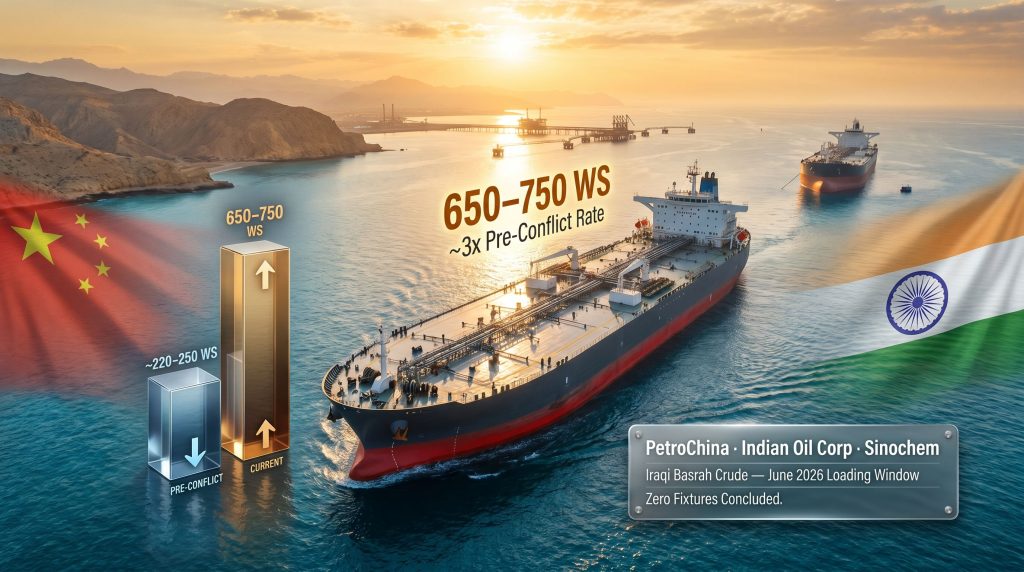
PetroChina sought a VLCC to load from Iraq's Basrah Oil terminal between June 25 and 30. Each VLCC carries approximately 2 million barrels of crude oil. The company received at least six separate offers from vessel operators, with every bid falling in the range of 650 to 750 worldscale points, representing rates approximately three times higher than those prevailing before the conflict began.
| Metric | Pre-Conflict Level | Late June 2026 | Change |
|---|---|---|---|
| Worldscale Points (VLCC, Gulf-Asia) | ~220-250 WS | 650-750 WS | ~3x increase |
| Cargo Capacity per VLCC | 2 million barrels | 2 million barrels | Unchanged |
| Effective Freight Cost vs Baseline | Normalised | Approximately 3x | +200% |
A PetroChina official acknowledged the core tension directly: tankers are physically present and available, but the problem is the cost combined with the absence of any guarantee that a vessel can safely exit the strait once loaded. This is a critically important distinction. The market failure is not one of vessel supply; it is one of pricing viability and contractual risk allocation.
Two Structural Barriers Preventing Cargo Liftings
Barrier One: The Delivered-Cost Inversion
Iraqi Basrah crude is ordinarily priced at a discount to Brent crude to attract Asian buyers who face long voyage distances and carry significant volume risk. This discount is the economic rationale for Gulf crude procurement. When freight rates triple, that discount advantage is entirely neutralised and in many cases inverted, making Gulf crude measurably more expensive on a delivered-cost basis than competing alternatives.
Asian refiners evaluate crude procurement on a delivered cost basis, meaning the combined landed price of crude plus all freight components. When Gulf freight rates are elevated by 200 percent, a crude grade that offered a $3 to $5 per barrel price advantage can become $6 to $10 per barrel more expensive than West African, US Gulf Coast, or Pacific Basin alternatives on a delivered basis. This arithmetic drives substitution behaviour with considerable speed.
Barrier Two: The Transit Risk Clause Impasse
Even where freight rate negotiations might theoretically reach agreement, a second structural barrier exists in the contractual domain. According to reporting on Strait of Hormuz conditions, vessel operators require that both parties in a charter fixture agree to special contractual clauses governing Strait of Hormuz transit risk before any deal can be concluded. These clauses introduce several compounding cost and liability layers:
- War risk insurance surcharges, which have surged substantially for Gulf transit routes and add directly to voyage economics
- Force majeure and voyage interruption provisions, which shift liability for cargo loss or delivery failure under conflict conditions
- Crew hazard pay requirements mandated by maritime labour agreements, reducing the pool of vessels and operators willing to commit
- Hull insurance exclusions that may leave vessel owners partially uninsured for damage sustained during a contested transit
Shipping sources have confirmed that securing Gulf supplies is expected to remain operationally complex even following the peace agreement, because both parties to any charter must first reach consensus on these special transit provisions, a negotiation that has so far produced no concluded fixtures.
Indian Oil's Force Majeure Declaration: What It Really Means
Indian Oil Corp (IOC), India's largest refiner, took a significant contractual step when it declared force majeure on an Iraqi Basrah cargo following a failed tender process. IOC had sought a VLCC to load on June 22 and 23 for delivery to Paradip port on India's eastern coastline. The company received zero offers in response to its tender.
Force majeure in crude procurement is not a routine administrative action. It is a formal contractual declaration that extraordinary circumstances have made the fulfilment of a supply obligation impossible, releasing the declaring party from penalty or liability. The fact that a state-controlled refiner of IOC's scale and procurement sophistication received no bids at any price level in a formal VLCC tender is a remarkable signal about the current state of the freight market.
Why Paradip Matters Beyond One Missed Cargo
Paradip is not simply a receiving terminal. It is the primary crude intake point for IOC's 300,000 barrel per day refinery complex in Odisha. A missed cargo creates cascading operational decisions:
- Crude slate adjustments to accommodate alternative feedstocks on short notice
- Refinery run rate reductions if substitute cargoes cannot be sourced and delivered in time
- Product output disruptions that flow through to domestic fuel supply schedules
- Procurement cost benchmarking distortions that complicate Q3 2026 planning and budget assumptions
India imported approximately 900,000 barrels per day of Iraqi crude in the period preceding the current disruption, making Iraq one of its largest single crude suppliers by volume. A sustained inability to lift Gulf barrels places immediate pressure on feedstock security for India's entire refining sector, not just IOC.
China and India's Combined Gulf Exposure: A Systemic Risk Map
The simultaneous failure of PetroChina and Indian Oil to complete Gulf crude liftings in the same loading window is not coincidental. It reflects a structural concentration risk that has been embedded in Asian energy procurement for decades but rarely stress-tested at this severity. In addition, the broader crude oil price geopolitics shaping this period have amplified the vulnerability of both nations' supply chains considerably.
| Importing Country | Estimated Iraqi Crude Imports (Pre-Disruption) | Primary Receiving Ports |
|---|---|---|
| China | ~1.1 million barrels per day | Qingdao, Ningbo, Zhoushan |
| India | ~900,000 barrels per day | Paradip, Vadinar, Mundra |
| Combined Total | ~2 million barrels per day | Multiple deepwater terminals |
This combined dependency of approximately 2 million barrels per day represents a substantial portion of Iraq's total export capacity. Iraq's export infrastructure is heavily concentrated around the Basrah Oil Terminal in the northern Arabian Gulf, an inherently concentrated configuration that provides almost no ability to redirect volumes away from the Strait of Hormuz chokepoint. Unlike producers with Atlantic Basin or Mediterranean export options, Iraq's geographic export profile creates a near-total dependency on Hormuz transit.
The next major ASX story will hit our subscribers first
Sinochem's Active Search and the Broader Market Dynamic
China's Sinochem was also actively seeking a VLCC in mid-June 2026 to load Gulf crude between June 20 and 30 for delivery to Asian ports. Whether the company succeeded in securing a vessel remained unconfirmed at the time of initial reporting, adding a third major Chinese state energy buyer to the roster of companies experiencing Gulf crude procurement difficulties.
The pattern across PetroChina, IOC, and Sinochem reveals something significant about VLCC market structure: this is not a situation where a single buyer faces idiosyncratic procurement challenges. Three of Asia's largest state-controlled energy companies, with substantial procurement teams, sovereign backing, and deep relationships with vessel operators, are all encountering the same commercial impasse simultaneously.
Alternative Supply Routes: How Asian Refiners Are Responding
Faced with Gulf procurement paralysis, Asian refiners are accelerating evaluation of alternative crude supply origins. Furthermore, the oil prices and trade war pressures already weighing on margins have made swift diversification commercially imperative. Each alternative carries its own delivered-cost profile and operational complexity:
- West African crude (Nigeria, Angola): Longer voyage distances but entirely free of Hormuz transit exposure; competitive on a delivered basis when Gulf freight premiums are elevated to current levels
- US Gulf Coast grades (WTI Midland, Mars Blend): Growing export infrastructure and zero Hormuz dependency; increasingly attractive for Asian refiners conducting delivered-cost analysis against elevated Gulf freight
- Russian ESPO Blend: Available via Pacific pipeline loading at Kozmino port with no Gulf transit requirement, though subject to ongoing sanctions-related complications for certain Asian buyers navigating secondary sanctions risk
- North Sea and Norwegian grades: Viable for Indian west coast refinery intake via Cape of Good Hope routing, adding voyage distance but eliminating transit risk entirely
The Tanker Owner Perspective: Why 650-750 Worldscale Makes Commercial Sense to Them
It is worth examining why vessel operators are quoting rates that cargo buyers find prohibitive. From a shipowner's standpoint, the 650 to 750 worldscale pricing reflects a rational accumulation of actual cost increases and opportunity costs:
- War risk insurance premiums for Gulf transit routes have increased significantly since the conflict began and have not yet normalised following the ceasefire announcement
- Crew hazard pay requirements imposed by international maritime labour agreements add a fixed voyage cost that scales with crew size and voyage duration
- Opportunity cost of committing a high-value VLCC asset to a contested corridor when safer, lower-risk voyages are available across Atlantic Basin and Pacific routes
- Potential vessel detention risk if conditions deteriorate following loading, creating stranded asset scenarios that standard hull insurance may not adequately cover
- Reputational and regulatory exposure for operators whose vessels become involved in transit incidents during a period of formal geopolitical tension
The market is not malfunctioning. It is pricing observable risk at observable cost, creating a gap between what cargo buyers can afford to pay and what vessel operators require to assume the risk. However, as coverage of supertanker movements through the Persian Gulf illustrates, some vessels are cautiously attempting transits as diplomatic talks progress.
Strategic Implications for Asian Energy Security Architecture
The events of late June 2026 may serve as a catalyst for structural changes in how China and India approach energy security planning. Consequently, the trade war oil markets context layered on top of physical supply disruptions is likely to accelerate several strategic responses:
- Strategic Petroleum Reserve drawdowns to bridge near-term supply gaps while commercial solutions are negotiated
- Accelerated crude supply diversification away from Gulf concentration toward Atlantic Basin, Pacific, and domestic alternatives
- Long-term vessel charter programmes by state energy companies designed to insulate procurement from spot freight market volatility during geopolitical episodes
- Bilateral shipping arrangements between state energy firms and sovereign-linked tanker operators capable of operating under specialised risk frameworks
- Insurance market reform discussions focused on creating durable coverage structures for critical energy supply route transits
The current disruption may ultimately accelerate a structural shift already underway in Asian energy procurement: state refiners building dedicated tanker fleets or securing long-dated charter arrangements that reduce dependence on a spot freight market subject to acute volatility during geopolitical episodes.
Key Facts at a Glance
| Issue | Detail |
|---|---|
| Affected Buyers | PetroChina, Indian Oil Corp, Sinochem |
| Crude Grade | Iraqi Basrah Crude |
| Vessel Type | VLCC (~2 million barrel capacity) |
| Loading Window | June 20-30, 2026 |
| Freight Rate Quoted | 650-750 worldscale points |
| Pre-Conflict Rate Comparison | Approximately 3x increase from pre-February 2026 levels |
| IOC Action | Force majeure declared on unlifted cargo |
| IOC Receiving Terminal | Paradip port, Odisha, India |
| Root Causes | Rate unviability and Strait of Hormuz transit risk clause impasse |
| Background Trigger | US-Iran interim agreement; Hormuz reopened without commercial normalisation |
Frequently Asked Questions
Why Did PetroChina Fail to Secure a Tanker for Iraqi Crude?
PetroChina received at least six VLCC offers for a Basrah loading in late June 2026, but all bids came in at 650 to 750 worldscale points, roughly three times pre-conflict freight levels. Beyond the cost problem, vessel operators are also requiring special contractual clauses covering Strait of Hormuz transit risk before committing to any fixture, and no agreement on those terms has been reached.
Why Did Indian Oil Corp Declare Force Majeure on Its Iraqi Cargo?
IOC issued a formal force majeure declaration after its tender for a VLCC loading on June 22 and 23 for delivery to Paradip port attracted zero offers at any price level. With no vessel willing to participate in the tender, the company exercised its contractual right to declare the cargo delivery impossible under the prevailing extraordinary market conditions.
Has the US-Iran Deal Resolved the Tanker Market Problem?
The interim agreement has restored technical access to the Strait of Hormuz but has not normalised commercial shipping conditions. Freight rates remain approximately three times their pre-conflict levels, and vessel operators continue to require special risk clauses for Hormuz transit. The commercial shipping market has not yet incorporated the ceasefire as a durable resolution to the underlying transit risk.
What Alternatives Do Asian Refiners Have if Gulf Crude Procurement Remains Disrupted?
Asian refiners can source replacement crude from West Africa, the US Gulf Coast, Russian Pacific pipeline exports, and North Sea grades, all of which carry no Strait of Hormuz transit exposure. The delivered-cost economics of these alternatives improve relative to Gulf crude when Gulf freight premiums remain elevated at current levels.
Readers seeking further context on Gulf oil shipping dynamics and the Strait of Hormuz's ongoing role in global energy markets can find relevant analysis through ET EnergyWorld's oil and gas coverage at energy.economictimes.indiatimes.com.
Disclaimer: This article contains forward-looking analysis and market observations based on publicly reported information as of June 2026. Freight rates, geopolitical conditions, and procurement outcomes are subject to rapid change. Nothing in this article constitutes financial or investment advice.
Want to Identify ASX Resource Opportunities Before the Broader Market Does?
Discovery Alert's proprietary Discovery IQ model delivers real-time alerts on significant ASX mineral discoveries — transforming complex resource data into clear, actionable insights for investors at every level. Explore why historic mineral discoveries have generated extraordinary returns and begin your 14-day free trial at Discovery Alert to position yourself ahead of the market.