June 30, 2026
The global energy landscape increasingly reflects the emergence of non-traditional supply centres, fundamentally altering established trading patterns and competitive dynamics. Latin American crude production has experienced unprecedented acceleration, with deepwater developments challenging conventional supply-demand equilibria across major consuming regions. Furthermore, the oil price crash 2025 has intensified market volatility as rising Guyanese crude flows reshape traditional energy security frameworks and pricing mechanisms that will define commodity markets through the decade.
Medium-sweet crude specifications have become particularly significant as production growth concentrates in gravity ranges between 30-35° API, creating direct substitution pressure against established benchmarks. The velocity of this supply expansion, combined with infrastructure capabilities enabling global distribution, has generated pricing volatility and market access patterns not observed since the North Sea development era of the 1980s.
Guyana's Unprecedented Production Acceleration
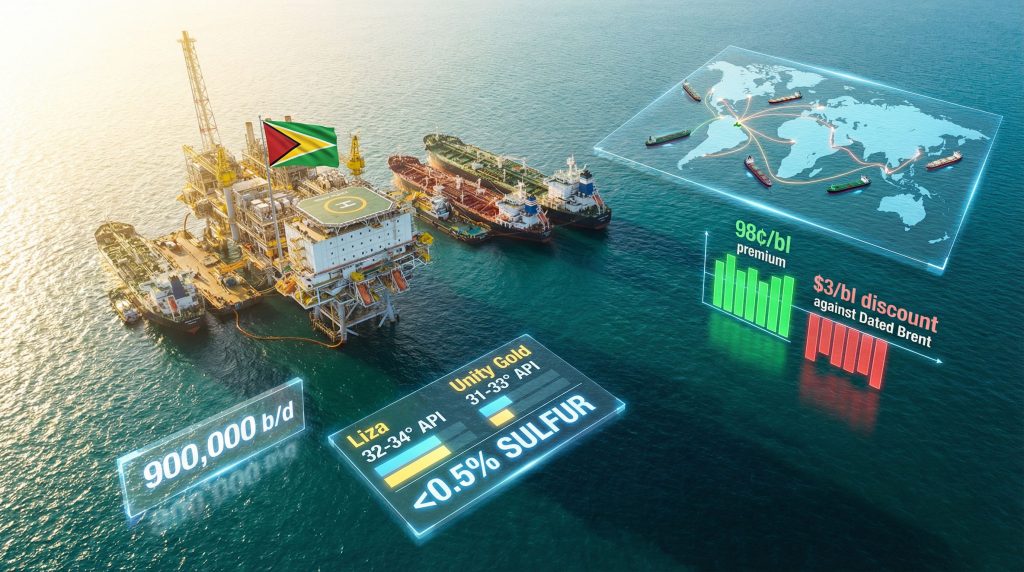
The Stabroek Block offshore development represents one of the fastest production ramps in modern petroleum history, transforming from zero commercial output to approximately 900,000 barrels per day within six years. This trajectory surpasses comparable deepwater projects globally, with scheduled exports projected to reach 964,000 b/d by February 2026.
The production acceleration occurred through modular FPSO (Floating Production, Storage and Offloading) vessel deployments, enabling rapid capacity scaling without conventional onshore infrastructure constraints. Export volumes jumped from 709,000 b/d in July 2025 to over 860,000 b/d by September 2025, demonstrating the operational efficiency of this development model.
Strategic significance extends beyond volume metrics to include the consistent medium-sweet specification across all grades, positioning Guyanese crude as a direct substitute for European refinery configurations designed for similar gravity processing. The deepwater nature of these fields, operating at approximately 1,600 metres water depth, represents significant technical achievement in production efficiency and reliability.
Production Milestones:
- December 2019: Initial Liza production commenced
- March 2024: Unity Gold production startup
- January 2024: Payara Gold field activation
- August 2025: Golden Arrowhead production initiation
- 2027 target: 1.4 million b/d total capacity
- 2030 projection: 1.7 million b/d ultimate capacity
The consortium leadership by ExxonMobil, supported by Chevron-Hess integration following the August 2025 acquisition completion, provides operational continuity and enhanced marketing reach across North American refining systems. This corporate structure enables long-term capacity planning and investment commitment essential for sustained production growth. Moreover, analysis suggests the Guyana oil boom's transformative impact extends beyond production metrics to encompass broader economic development.
When big ASX news breaks, our subscribers know first
Crude Quality Portfolio and Market Positioning
Guyanese crude grades maintain remarkably consistent specifications across the portfolio, with all four active grades classified as medium-sweet with sulphur content below 0.5%. This uniformity provides strategic market advantages in European and North American refinery configurations designed for medium gravity processing.
| Grade | API Gravity | Sulphur Content | Production Capacity | Market Focus |
|---|---|---|---|---|
| Liza | 32-34° | <0.5% | 220,000 b/d | Europe, US Gulf |
| Unity Gold | 31-33° | <0.5% | 220,000 b/d | Europe, Asia-Pacific |
| Payara Gold | 32-34° | <0.5% | 220,000 b/d | Europe, US West Coast |
| Golden Arrowhead | 30-32° | <0.5% | 169,000 b/d | Europe, emerging Asia |
The sweet crude classification eliminates expensive desulphurisation requirements in standard European refinery configurations, reducing processing margin pressure relative to sour alternatives. API gravity measurements in the 31-34° range position these grades competitively between light Nigerian crudes (typically 32-35° API) and heavier North Sea Brent-system grades.
Technical Specifications Advantage
Medium-sweet crudes represent the largest subset of global production by volume and processing infrastructure compatibility. The consistent sulphur specification below 0.5% provides operational cost advantages, as sulphur removal incurs processing expenses and requires specialised sulphur recovery units in refinery configurations.
Blending characteristics remain favourable for yield optimisation, with asphaltene content and viscosity specifications meeting European and North American refinery requirements. Pour point specifications enable transportation across varying climatic conditions without heating requirements, reducing logistics costs.
The August 2025 introduction of Golden Arrowhead at slightly heavier 30-32° API specification provided portfolio balancing capabilities as European demand contracted during seasonal maintenance periods. This grade flexibility demonstrates operational responsiveness to market conditions.
Price Evolution and Market Dynamics
Guyanese crude pricing experienced dramatic volatility throughout 2025, reflecting the market absorption challenges associated with rapid supply expansion. The transformation from premium pricing to significant discounts illustrates fundamental supply-demand imbalance dynamics, whilst oil price movements 2025 have added additional complexity to market conditions.
Pricing Timeline:
- H1 2025: 98 cents per barrel premium to North Sea Dated Brent
- H2 2025: 33 cents per barrel discount to North Sea Dated
- November 2025: $2.80-$3.00 per barrel discount (widest since assessments began)
- Asian arbitrage threshold: Sub-$2.50 per barrel discount required for buyer interest
The 131-cent per barrel negative price movement within six months represents approximately 12-14% value deterioration, reflecting European market saturation with medium-sweet alternatives. This pricing deterioration accelerated when European refineries reduced import requirements during summer maintenance seasons, forcing sellers to lower prices to maintain volume.
Seasonal Demand Patterns
European refinery utilisation exhibits predictable seasonal fluctuation, with reduced demand during summer maintenance periods (July-August) and increased demand during winter heating seasons. The August 2025 introduction of Golden Arrowhead coincided with weak summer demand, creating unfavourable market timing for new supply introduction.
Freight economics significantly influence Asian arbitrage opportunities, with VLCC rates affecting delivered costs to Asia-Pacific markets. Higher VLCC rates since September 2025 increased transportation costs, reducing arbitrage window effectiveness despite widening price discounts. Additionally, the oil price rally 2025 created further market uncertainty.
Competition from Norwegian Johan Sverdrup medium-sour crude and Brazilian Buzios medium-sweet grades intensified as Guyanese prices weakened, indicating buyer preference for lowest-cost alternatives within comparable specification ranges.
Global Export Destination Diversification
The expansion of rising Guyanese crude flows into Asia-Pacific markets represents a fundamental shift in global distribution patterns, driven by price arbitrage economics rather than traditional long-term supply agreements.
Regional Distribution (2025):
- Europe: 60% of total exports (primary destination)
- Central/North America: 25% combined
- Asia-Pacific: 15% (emerging growth market)
Asia-Pacific Market Development:
- 2024: Zero cargoes to Asia-Pacific
- 2025: 24 total cargoes, with 13 in H2 2025
- Chinese buyers: 1-2 monthly cargoes since September 2025
- Indian purchases: Selective acquisition during November 2025
The Asian market opening reflects opportunity-cost evaluation by Chinese and Indian refiners, who acquire Guyanese supplies only when prices fall below the $2.50 per barrel discount threshold to Dated Brent. This pricing discipline indicates substitution benefit analysis relative to traditional Russian, Middle Eastern, or West African alternatives. Notably, China's strategic positioning in Guyanese crude markets has reached record levels, demonstrating significant market evolution.
US Market Redistribution
American market dynamics shifted significantly following the Chevron-Hess acquisition integration, enabling US Gulf Coast refineries to source Guyanese crude at lower transportation costs relative to West Coast alternatives.
- 2025 US imports: Approximately 20% of total Guyanese exports
- US Gulf Coast: 37% of US imports (vs. 21% in 2024)
- US West Coast: 60% of US imports (vs. 75% in 2024)
Asian Buyer Strategic Considerations
Chinese acquisitions established regular purchasing patterns from late September 2025, typically securing cargoes toward month-end when pricing generally reaches lowest levels within loading programmes. Indian refiners utilised Guyanese crude as substitution for Russian supplies following US sanctions against Rosneft and Lukoil announced in late October 2025.
Infrastructure Development and Logistics Capabilities
Infrastructure enhancements have proven critical for enabling global market access, particularly the removal of VLCC loading restrictions during winter months since mid-2025. This capability improvement allows Asian buyers to utilise larger 2 million-barrel vessels rather than smaller Aframax/Panamax vessels, significantly improving freight unit economics for long-haul deliveries.
Loading and Transportation Metrics:
- Asian delivery time: 45-50 days voyage duration
- Atlantic Basin delivery: 2-4 days to US Gulf, 12-15 days to Europe
- VLCC freight costs: $8-12 per barrel equivalent for long-haul routes
- Storage capacity: Current terminal accommodates VLCC loading year-round
The modular FPSO development model provides production flexibility without conventional pipeline infrastructure requirements. Each FPSO vessel operates independently, enabling production optimisation and maintenance scheduling without system-wide disruptions.
Operational Advantages
FPSO deployment eliminates onshore processing facility requirements, reducing environmental impact and regulatory complexity. The floating infrastructure model enables rapid capacity scaling through additional vessel installations as reserve development progresses.
Terminal capacity constraints during peak loading periods require scheduling coordination, but winter-month VLCC restrictions removal since mid-2025 enhanced operational flexibility. Storage capacity expansion remains under evaluation as production approaches 1 million b/d capacity.
Production Expansion Timeline and Capacity Additions
Near-term capacity additions will further accelerate rising Guyanese crude flows, with multiple projects approaching startup phases through 2027.
Confirmed Project Pipeline:
- Uaru project: +250,000 b/d (2026 startup)
- Whiptail development: +250,000 b/d (2027 target)
- Hammerhead project: +150,000 b/d (2029 projection)
- Longtail development: Subject to regulatory approval
Production Trajectory:
- Current capacity: ~900,000 b/d
- 2026 target: 1.15 million b/d
- 2027 projection: 1.4 million b/d
- 2030 ultimate target: 1.7 million b/d
The Uaru project represents the next major milestone, scheduled for 2026 commissioning with 250,000 b/d additional capacity. This project will utilise proven FPSO technology consistent with existing operations, maintaining operational continuity and technical risk management.
Reserve Base Sustainability
Stabroek Block discoveries continue expanding the resource base, with over 30 significant discoveries announced since 2015. Estimated recoverable resources exceed 11 billion barrels, supporting production sustainability through the 2030s at projected capacity levels.
Development phasing enables capital efficiency optimisation, with each FPSO project generating cash flow to support subsequent phases. The consortium partners maintain long-term development commitment, evidenced by continued exploration investment and infrastructure expansion.
The next major ASX story will hit our subscribers first
Regional Competition and Supply Dynamics
Latin American crude production expansion extends beyond Guyana, creating regional competition dynamics that influence global pricing and market access patterns. Moreover, the US oil production decline has created additional market opportunities for Latin American suppliers.
Brazilian Production Growth
Brazil achieved 4 million b/d total crude production in October 2025, with pre-salt fields accounting for 81.4% of national output. Primary exported grades include medium-sweet Tupi, Buzios, and Mero, competing directly with Guyanese specifications in European markets.
Brazilian sellers increasingly target Asia-Pacific markets as Atlantic Basin competition intensifies, creating parallel arbitrage dynamics to Guyanese market development strategies. Pre-salt production efficiency improvements continue reducing breakeven costs, enhancing competitive positioning.
Argentine Vaca Muerta Development
Argentina targets 1.5 million b/d production capacity by 2030 from current 800,000 b/d levels, led by light-sweet Medanito output expansion. Despite lighter quality specifications, pricing trends suggest Medanito competes with Guyanese grades in US West Coast markets.
Argentine export ambitions include Asia-Pacific market penetration over time, potentially creating additional competition for Guyanese crude in emerging Asian destinations. Infrastructure development remains critical for Argentine export capacity expansion.
Competitive Positioning Analysis
The concentration of Latin American medium-sweet production creates substitution pressure across traditional benchmarks, potentially generating sustained discount pricing in oversupplied markets. Regional producers must differentiate through logistics efficiency, quality consistency, or long-term supply agreements.
Market participants increasingly evaluate crude acquisition based on delivered cost optimisation rather than traditional supplier relationships, enhancing price competition among regional alternatives.
Strategic Market Implications
The acceleration of rising Guyanese crude flows represents broader transformation in global energy supply patterns, with implications extending beyond immediate pricing dynamics. However, the OPEC production impact 2025 continues to influence global supply management strategies.
Supply-Side Transformation
Latin American contribution to non-OPEC growth fundamentally alters supply security calculations for major consuming regions. Enhanced supply chain diversification reduces dependency on traditional Middle Eastern suppliers, particularly significant for European and North American markets.
The deepwater production model proves increasingly viable across multiple regions, suggesting expanded global capacity potential from similar geological formations. Technical expertise transfer and infrastructure replication enable accelerated development timelines in comparable basins.
Regional Arbitrage Dynamics
Freight economics increasingly determine market access patterns, with VLCC transportation costs influencing Asian arbitrage thresholds. Regional price differentials must exceed transportation and insurance costs to justify long-haul deliveries, creating natural market boundaries.
Seasonal demand variations in European markets generate predictable arbitrage windows for Asian destinations, enabling strategic cargo allocation optimisation. Market participants develop flexible marketing strategies accommodating these cyclical patterns.
Pricing Mechanism Evolution
Traditional pricing benchmarks face pressure from expanding medium-sweet supply options, potentially requiring benchmark revision or new reference point establishment. Price discovery mechanisms adapt to accommodate increased spot market activity and reduced long-term contract proportions.
Corporate Strategic Positioning
Major oil companies adapt operational and marketing strategies to capitalise on Guyanese production growth and changing market dynamics.
ExxonMobil Operational Leadership
ExxonMobil's consortium leadership provides technical expertise and project execution capability demonstrated across four producing assets. The company's deepwater development experience and global marketing network enable efficient capacity scaling and market access optimisation.
Long-term resource commitment supports continued exploration investment and infrastructure expansion planning through 2030. Technical innovations in FPSO operations and subsea development enhance operational efficiency and cost competitiveness.
Chevron-Hess Integration Impact
The August 2025 acquisition completion enhanced US Gulf Coast market access through Chevron's refining system integration. Strategic positioning in the Stabroek Block consortium provides long-term supply security for North American operations.
Enhanced marketing reach across integrated refining networks enables value optimisation through crude selection and processing margin enhancement. The acquisition provides operational scale advantages and marketing flexibility.
Industry Adaptation Strategies
Refinery configurations require optimisation for medium-sweet crude processing as supply availability increases. Investment in processing flexibility enables crude slate diversification and margin optimisation across varying market conditions.
Trading strategies adapt to increased Latin American supply volatility, incorporating seasonal arbitrage opportunities and freight economic considerations. Risk management frameworks evolve to address extended supply chain complexity and market volatility.
Risk Assessment and Mitigation Strategies
Multiple risk factors could constrain future growth of rising Guyanese crude flows, requiring comprehensive mitigation strategies.
Geopolitical Stability Considerations
Regional political stability remains critical for sustained production growth and market access. Border disputes with Venezuela and domestic political transitions require monitoring for operational impact assessment.
International sanctions regimes affecting regional trade patterns could influence market access and pricing dynamics. Compliance frameworks must adapt to evolving regulatory requirements across multiple jurisdictions.
Environmental and Regulatory Factors
Deepwater development faces increasing environmental scrutiny and regulatory requirements that could affect project timelines and costs. Carbon emissions regulations may influence long-term project economics and market access.
Climate change adaptation requirements for offshore infrastructure increase operational complexity and capital requirements. Insurance costs and availability could affect project viability assessments.
Market and Economic Risks
Currency fluctuations and fiscal policy changes impact project economics and government revenue calculations. Economic stability in consuming markets affects demand patterns and pricing sustainability.
Risk Mitigation Approaches:
- Diversified export destination portfolio development
- Long-term supply agreement negotiations with creditworthy counterparties
- Infrastructure investment in storage and loading capacity expansion
- Technical cooperation agreements for operational expertise sharing
- Environmental compliance and sustainability programme implementation
Market Preparation and Strategic Recommendations
Market participants must adapt strategies and infrastructure to accommodate continued expansion of rising Guyanese crude flows through the decade.
Refinery Optimisation Requirements
Processing facilities require configuration assessment for medium-sweet crude compatibility and yield optimisation. Investment in processing flexibility enables crude slate diversification and margin enhancement opportunities.
Quality control systems must accommodate specification variations across Guyanese grades and competing Latin American alternatives. Blending optimisation capabilities provide operational advantages in varying market conditions.
Trading Strategy Adaptations
Portfolio diversification strategies should incorporate Latin American supply options alongside traditional supplier relationships. Risk management frameworks require evolution to address extended supply chain complexity and freight cost volatility.
Seasonal arbitrage opportunity identification enables strategic positioning for Asian market penetration during European demand weakness. Long-term supply agreement structures must balance price discovery mechanisms with volume security requirements.
Infrastructure Investment Considerations
Storage terminal capacity expansion near major consuming centres could capture arbitrage opportunities and provide supply flexibility. Transportation infrastructure investment in VLCC-capable facilities enhances market access options.
Related infrastructure projects, including pipeline connections and processing facilities, present investment opportunities aligned with supply growth trajectories. Strategic partnerships with established operators provide expertise access and risk sharing benefits.
"Market participants should evaluate the sustained impact of rising Guyanese crude flows on traditional supply relationships and pricing mechanisms. The structural nature of this supply expansion suggests permanent rather than cyclical market changes, requiring strategic adaptation rather than tactical responses."
Market Intelligence Requirements
Enhanced monitoring of Latin American production trends and export patterns provides competitive intelligence for strategic planning. Real-time freight rate tracking enables arbitrage opportunity identification and logistics optimisation.
Government policy monitoring across producing and consuming regions affects regulatory compliance and market access planning. Environmental regulation evolution requires proactive adaptation strategies and risk assessment updates.
The continued acceleration of rising Guyanese crude flows will fundamentally reshape global oil market dynamics through 2030, requiring comprehensive strategic adaptation across the energy value chain. Market participants who anticipate and prepare for these structural changes will capture competitive advantages in an increasingly complex and interconnected global energy system.
Ready to Capitalise on Latin America's Energy Revolution?
Discovery Alert's proprietary Discovery IQ model delivers real-time alerts on significant ASX mineral discoveries, instantly empowering subscribers to identify actionable opportunities ahead of the broader market as global energy dynamics reshape investment landscapes. Begin your 30-day free trial with Discovery Alert today to position yourself ahead of evolving commodity markets and secure your competitive advantage.