June 16, 2026
When Industrial Minerals Become Strategic: The Supply Chain Logic Behind Gypsum's Reclassification
For most of the twentieth century, gypsum occupied a quiet corner of the industrial minerals world. It was abundant, unglamorous, and rarely discussed in the same breath as copper, lithium, or gold. Yet the material is embedded in nearly every wall panel in every home, every cement pour in every highway overpass, and every soil amendment programme on every large-scale farm. When eastern North American construction supply chains buckled under pandemic-era import disruptions and freight cost spikes, the vulnerability of relying on overseas gypsum became impossible to ignore. The result has been a quiet but consequential policy shift across Atlantic Canada, one that Nova Scotia has now acted on with the formal clearance of the Nova Scotia clears Antrim gypsum mine decision.
The broader lesson is structural: supply chain resilience for housing construction cannot be achieved through battery metals policy alone. Industrial minerals that sit at the physical foundation of built infrastructure carry their own strategic weight. Furthermore, jurisdictions that recognise this early gain a durable competitive advantage in attracting long-duration industrial capital.
When big ASX news breaks, our subscribers know first
Gypsum's Expanding Role in Industrial Supply Chains
Gypsum (calcium sulfate dihydrate, CaSO₄·2H₂O) is not a single-use material. Its application profile spans construction, agriculture, manufacturing, and personal care, which is precisely why its strategic classification has become defensible from a policy standpoint. Nova Scotia's updated 2025 Critical Mining Strategy formally recognised this breadth by elevating gypsum alongside conventional metals and energy minerals within the province's priority development framework. This shift also mirrors broader trends in critical minerals demand globally, where industrial inputs are being reassessed for their supply chain significance.
The downstream use cases that drove this reclassification include:
- Wallboard and drywall manufacturing, which consumes the largest share of gypsum globally and represents the primary feedstock demand driver in eastern North America
- Portland cement production, where gypsum acts as a set-retarding agent, controlling hydration rates and final compressive strength
- Agricultural soil amendment, where gypsum improves soil structure, reduces compaction, and delivers sulphur as a plant nutrient without altering soil pH
- Dust suppression in open industrial environments such as unpaved roads, quarry haul routes, and mine sites
- Plaster and mold-making for industrial casting, medical device manufacturing, and artisan trades
- Personal care product formulation, including cosmetic fillers and abrasive compounds
The supply chain logic behind prioritising a domestic deposit is straightforward but consequential. Eastern Canada has historically relied on imported gypsum from sources including the United States Gulf Coast, Mexico, and transatlantic shipments from Turkey and Spain. Transportation costs add a meaningful premium to landed material costs in Atlantic ports, and single-point-of-failure risk from port congestion or geopolitical trade friction amplifies pricing volatility for downstream manufacturers. Strengthening resource export supply chains has become a priority across multiple jurisdictions for precisely these reasons. A large-scale domestic deposit capable of supplying 1.5 to 2.0 million tonnes annually changes that equation materially.
The Antrim Deposit: Location, Scale, and Geological Context
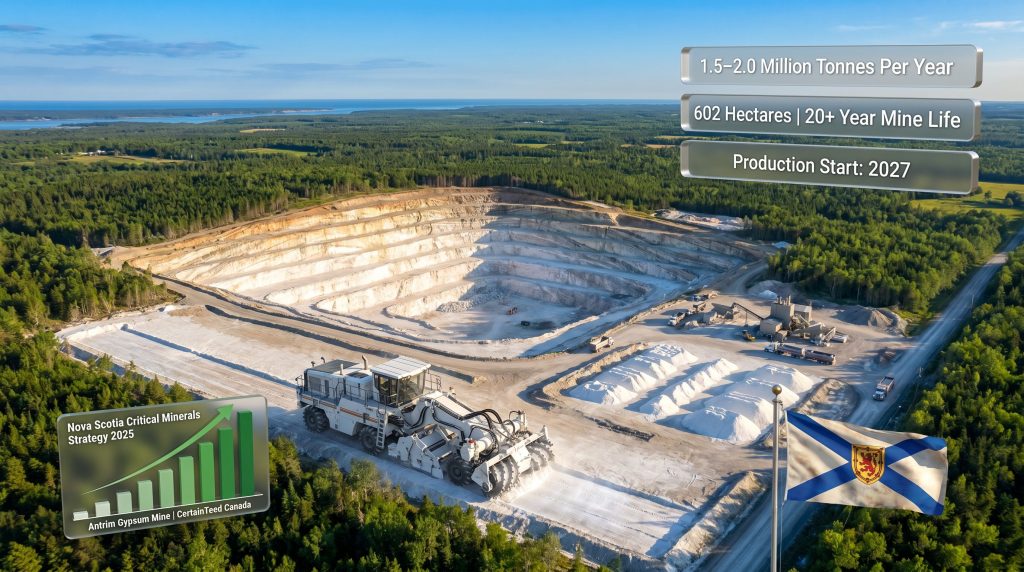
The Antrim gypsum project is located within the Cooks Brook area of Halifax County, approximately 50 kilometres northeast of Halifax, near the communities of Lake Egmont and Gays River along Lake Egmont Road. The deposit sits within Nova Scotia's Appalachian margin geology, where Paleozoic marine evaporite sequences have produced accumulations of naturally occurring gypsum and anhydrite (the dehydrated form of calcium sulfate, CaSO₄) of commercial significance.
The co-occurrence of gypsum and anhydrite within the same deposit is geologically common in evaporitic settings, but it carries operational implications. Anhydrite requires calcination at temperatures of 190 to 250 degrees Celsius to convert to usable gypsum, adding processing complexity. However, anhydrite also serves as a directly usable feedstock in cement manufacturing without conversion, which expands the effective market for extracted material and supports the flexibility of the project's offtake strategy.
The Antrim deposit has been described in project documentation as eastern North America's only known major high-purity gypsum resource at commercial scale, a designation that carries significant implications for regional supply chain security and competitive positioning relative to imported alternatives.
The project footprint reflects the scale of the undertaking:
| Project Metric | Detail |
|---|---|
| Total Project Area | 602 hectares |
| Active Mine Footprint | ~170 hectares |
| Open-Pit Operational Zone | 27 hectares |
| Distance from Halifax | ~50 km northeast |
| Target Annual Output | 1.5 to 2.0 million tonnes |
| Projected Mine Life | 20+ years (to ~2050) |
| Full-Time Jobs Created | 60+ |
| Construction Start | 2026 |
| Production Start Target | 2027 |
The proximity to Sheet Harbour's port infrastructure is a critical logistics enabler. All extracted and processed material will be trucked from the Carrolls Corner mine site to Sheet Harbour, where it will be loaded for shipment to manufacturing customers across eastern Canada and the United States. This logistics model keeps value within the provincial economy while serving a continental customer base.
Nova Scotia Clears Antrim Gypsum Mine Through a Dual-Stage Permitting Process
The regulatory pathway that brought Nova Scotia to clear the Antrim gypsum mine for a 2027 production start involved two distinct approval stages under the provincial Environment Act, each addressing different dimensions of project impact and operational governance.
Stage one centred on environmental assessment. CertainTeed Gypsum Canada Inc. lodged its Environmental Assessment registration on September 10, 2024, triggering a structured review process under Section 13(1)(b) of Nova Scotia's Environment Act. EA approval was granted on October 25, 2024, attaching conditions governing operational monitoring, mitigation execution, and contingency protocols. The speed of that initial approval — roughly six weeks from registration to decision — reflects either strong pre-application stakeholder alignment or a well-prepared registration submission that addressed potential objections before they could crystallise into formal disputes.
Stage two involved the issuance of an industrial permit, which functions as the final operational licence authorising construction mobilisation and subsequent production. That permit was issued in May 2026, completing the regulatory sequence approximately 19 months after EA approval. Understanding mining permitting basics helps contextualise why this timeline is considered notably efficient by industry standards.
The complete approval timeline from EA registration to industrial permit spans roughly 20 months, a notably compressed schedule compared to federal Impact Assessment Act processes, which typically require 24 to 36 months for comparable-scale extractive projects.
The regulatory milestone sequence looks like this:
- September 2024 — EA Registration filed with Nova Scotia Environment and Climate Change
- October 2024 — Environmental Assessment approval granted under Section 13(1)(b) with conditions attached
- 2025 — Detailed design, pre-construction engineering, and condition compliance verification phases
- 2026 — Industrial permit issued; construction commences
- 2027 — Target first production
- ~2050 — Projected mine closure and progressive reclamation completion
Public consultation conducted during the EA review period revealed broadly supportive sentiment from neighbouring communities, a finding that likely contributed to the speed of the first-stage decision. Mi'kmaq rights-holder engagement formed a required component of the consultation architecture under Nova Scotia's duty-to-consult framework, and proponent responsiveness to Indigenous community input shaped several of the environmental conditions attached to approval. The specific terms of those accommodations are documented in the project's EA approval file maintained by Nova Scotia Environment and Climate Change.
Surface Mining Technology and the Low-Carbon Operating Model
CertainTeed's operational design reflects a deliberate departure from conventional quarry methodology. Rather than employing drill-and-blast techniques, the Antrim project uses surface miner machines, a continuous cutting technology that breaks rock through mechanical action rather than explosive fragmentation. This choice delivers measurable environmental performance advantages that directly address the concerns most commonly raised during community consultation processes near open-pit operations.
The performance differences between the two approaches are significant:
- Noise: Surface miners typically generate 80 to 90 decibels at 100 metres; drill-and-blast operations routinely exceed 100 to 110 decibels at equivalent distances. The logarithmic nature of the decibel scale means this represents a 90 to 99 percent reduction in acoustic energy reaching neighbouring properties.
- Dust: Surface mining generates primarily rolling and stockpile dust, manageable through water truck deployment and standard suppression protocols. Blast fragmentation produces a pulse of airborne fine material that requires timing restrictions and surface sealing measures to control.
- Vibration: Blast-induced ground vibration typically registers 5 to 50 millimetres per second peak particle velocity in the frequency range of 10 to 100 Hz. Surface miner vibration is negligible by comparison, removing a significant community concern for residential land users in proximity to the operation.
Operating hours are structured to reinforce community coexistence: active quarrying runs from 7:00 AM to 5:30 PM on weekdays, with truck movements permitted until 8:00 PM. This framework limits noise exposure during evening hours and eliminates overnight operational impact entirely.
On-Site Environmental Infrastructure
The project's environmental management system incorporates several engineering controls:
- Segregated stockpile system: Till and organic overburden materials are stored separately, preserving the biological properties of topsoil for progressive reclamation use. Mixing these materials would degrade their rehabilitation utility.
- On-site rock-processing plant: Crushing and sizing infrastructure processes extracted material before trucking, reducing haulage volume and conditioning product to manufacturer specifications. This eliminates secondary processing requirements at receiving mills and reduces gross transport tonnage.
- Water management infrastructure: Engineered controls address runoff, sediment mobilisation, and groundwater interaction. Specific controls govern stormwater routing, sediment settling, and monitoring well networks.
- Species protection commitments: Black Ash tree preservation protocols reflect conditions attached to EA approval, addressing specific biodiversity concerns identified during assessment.
Scope 3 Emissions and Saint-Gobain's 2050 Net-Zero Pathway
CertainTeed Gypsum Canada is a subsidiary of Saint-Gobain, the France-headquartered global construction materials group. Saint-Gobain has committed to achieving net-zero carbon emissions by 2050, a target that encompasses Scope 1 (direct operational), Scope 2 (purchased energy), and Scope 3 (value chain) emissions. Domestic sourcing of raw gypsum from a nearby deposit rather than importing from overseas sources reduces the embedded transportation emissions in every tonne of gypsum delivered to eastern Canadian manufacturing customers.
This Scope 3 emissions reduction mechanism aligns the Antrim project's operational logic directly with the parent company's decarbonisation roadmap, meaning the mine's sustainability case extends beyond its own operational boundary. The broader case for mining decarbonisation benefits is increasingly well-evidenced across the sector, and the Antrim project's design reflects that momentum.
The 2025 Critical Mining Strategy: Nova Scotia's Policy Shift Toward Industrial Minerals
Nova Scotia's updated 2025 Critical Mining Strategy represents a meaningful evolution in provincial mineral policy, one that broadens the definition of strategically important resources beyond conventional metals and energy commodities. By formally including gypsum within its critical minerals framework, the province acknowledges that supply chain security for housing construction, infrastructure, and industrial manufacturing depends on reliable domestic access to industrial minerals, not just battery metals or precious metals.
The Antrim approval does not stand alone as a policy signal. The near-concurrent provincial approval of Atlantic Mining Nova Scotia to process approximately three million tonnes of stockpiled gold ore at the Touquoy site in Moose River represents a second data point in what appears to be a deliberate effort to accelerate mine development timelines across commodity categories.
| Approved Project | Operator | Commodity | Scale | Approval Period |
|---|---|---|---|---|
| Antrim Gypsum Mine | CertainTeed Gypsum Canada | Gypsum / Anhydrite | 1.5 to 2.0M tonnes per year | 2024 to 2026 |
| Touquoy Gold Processing | Atlantic Mining Nova Scotia | Gold Ore | ~3M tonne stockpile | 2026 |
The dual approval pattern suggests Nova Scotia is actively working to reduce the gap between project identification and production start. This form of regulatory efficiency functions as a competitive advantage when attracting long-duration industrial capital. Mining investors evaluating jurisdictional risk place significant weight on permitting predictability, and a province that demonstrates the capacity to move projects through a structured, well-governed approval process within a compressed timeline sends a credible signal to investors weighing Atlantic Canada against competing jurisdictions.
Regulatory predictability is not just an administrative virtue; it is an economic asset. For projects with 20-plus year operational lives, investors discount future cash flows against jurisdictional risk, and provinces that demonstrate process clarity and timeline consistency command a lower risk premium from capital allocators.
The next major ASX story will hit our subscribers first
Economic Implications for Nova Scotia's Regional Economy
The direct employment figure of more than 60 full-time positions at the operational mine site understates the total economic contribution of a project of this duration and scale. Mine-adjacent employment multipliers in Atlantic Canadian contexts typically range from 2.5 to 4 indirect and induced jobs per direct mining position, meaning the Antrim operation could support 150 to 240 total employment equivalents across the regional economy when transport, port operations at Sheet Harbour, equipment servicing, and supply chain functions are included.
The significance of the 20-plus year operational horizon deserves particular emphasis for regional workforce planning purposes. Short-cycle construction projects create temporary employment; multi-decade mining operations, in contrast, create durable career pathways and stable tax revenue bases. For rural Halifax County communities near the mine corridor, this duration distinction carries genuine household economic weight.
From a supply chain perspective, the Antrim mine functions as a domestic anchor supplier for North American wallboard and cement manufacturers currently dependent on imported feedstock. Eastern Canadian housing construction uses gypsum wallboard as a fundamental input material in virtually every residential and commercial building project, and the volume of that demand is expected to grow materially as federal and provincial housing intensification commitments translate into elevated construction starts over the coming decade.
Environmental Conditions, Post-Closure Obligations, and Progressive Reclamation
The conditions attached to Antrim's Section 13(1)(b) Environmental Assessment approval are not formalities. They establish a legally binding operational compliance framework that governs monitoring frequency, reporting requirements, mitigation maintenance, and contingency response protocols throughout the mine's operational life and beyond its projected 2050 closure date.
Progressive mine reclamation is the practice of rehabilitating disturbed land areas concurrent with active mining rather than deferring all rehabilitation to the post-closure period. This approach carries several advantages over end-of-life rehabilitation:
- Topsoil and overburden materials retain higher biological quality when stockpiled and reapplied within shorter timeframes, improving vegetation establishment success rates.
- Financial liability for reclamation is reduced progressively rather than accumulating as a single large post-closure obligation, improving the project's financial assurance posture.
- Community and regulatory confidence in the proponent's environmental commitment is reinforced through observable, measurable rehabilitation progress during the operational period.
- Regulatory risk of mid-project closure leaving a large unremediated footprint is materially reduced.
Nova Scotia's regulatory framework for long-duration operations typically requires financial assurance mechanisms, such as reclamation bonds or security deposits, to ensure that rehabilitation obligations can be fulfilled even in scenarios involving early project termination or corporate insolvency. The specific financial assurance conditions attached to the Antrim approval are documented within the industrial permit and EA approval files.
Frequently Asked Questions: Antrim Gypsum Mine and Nova Scotia Mining Approvals
What is the Antrim Gypsum Mine and who owns it?
The Antrim Gypsum Mine is an open-pit gypsum and anhydrite quarrying project located approximately 50 kilometres northeast of Halifax, Nova Scotia, in the Cooks Brook area of Halifax County. It is developed by CertainTeed Gypsum Canada Inc., a subsidiary of Saint-Gobain, the France-headquartered global construction materials group. Saint-Gobain Canada's approval announcement provides further detail on the company's regional strategy.
When will the Antrim Gypsum Mine begin production?
The project is scheduled to commence production in 2027, following a construction phase beginning in 2026. The mine is expected to operate for more than 20 years, with a projected closure horizon around 2050.
How much gypsum will the mine produce annually?
The project is designed to produce between 1.5 and 2.0 million tonnes of gypsum and anhydrite per year once fully operational.
What approvals were required before the mine could proceed?
Two primary regulatory approvals were required: an Environmental Assessment approval under Nova Scotia's Environment Act, granted in October 2024, and an industrial permit issued in May 2026. Together, these constitute the complete provincial authorisation to proceed with construction and operations.
How will the gypsum be transported to market?
All extracted and processed material will be transported by truck from the Carrolls Corner mine site to a port facility at Sheet Harbour, Nova Scotia, where it will be shipped to manufacturing customers across eastern Canada and the United States.
What environmental measures are in place?
The project incorporates surface miner technology to reduce noise, dust, and ground vibration; segregated overburden stockpiles for reclamation use; on-site water management infrastructure; Black Ash tree preservation protocols; and a progressive reclamation programme running concurrently with active mining operations.
How does this project connect to Nova Scotia's critical minerals strategy?
Gypsum was formally included in Nova Scotia's updated 2025 Critical Mining Strategy, recognising its role as a strategic industrial mineral embedded in housing construction, agricultural, and manufacturing supply chains. The Antrim project represents the province's most significant industrial mineral development to emerge from that policy framework.
This article contains forward-looking statements regarding production timelines, employment projections, and operational parameters. These reflect project planning assumptions and are subject to change based on construction outcomes, regulatory conditions, market factors, and other variables. Readers should not treat forward-looking projections as guarantees of future outcomes.
Want to Track the Next Major Mineral Discovery Before the Market Moves?
Discovery Alert's proprietary Discovery IQ model delivers real-time alerts on significant ASX mineral discoveries — from gypsum and industrial minerals to gold and battery metals — instantly transforming complex geological data into actionable investment insights for traders and long-term investors alike. Explore historic examples of exceptional discovery returns and begin your 14-day free trial today to position yourself ahead of the broader market.