June 16, 2026

The transformation of remote mining operations through advanced digital infrastructure represents a fundamental shift in how the industry approaches both technological capability and workforce management. As mining companies navigate increasingly competitive talent markets and complex operational demands, the integration of ultra-high-speed connectivity has evolved from operational convenience to strategic necessity. This evolution reflects broader mining industry evolution recognition that Hancock Iron Ore Horizon fibre connectivity serves as the foundation for next-generation mining technologies, autonomous systems, and data-driven decision-making processes that define modern resource extraction operations.
Bandwidth Requirements Reshaping Remote Mining Operations
Modern mining operations demand unprecedented data transmission capabilities that traditional connectivity solutions struggle to support. The Hancock Iron Ore Horizon fibre project exemplifies this shift, delivering 100Gbps capacity across a 2,000-kilometer route from Geraldton to Port Hedland. This infrastructure represents a quantum leap beyond conventional satellite connectivity, which typically provides limited bandwidth and higher latency unsuitable for real-time industrial applications.
| Connectivity Type | Typical Bandwidth | Latency | Reliability | Data Volume Capacity |
|---|---|---|---|---|
| Traditional Satellite | 1-10 Mbps | 600-800ms | Weather dependent | Limited |
| Fiber Optic (Horizon) | 100 Gbps | <10ms | 99.9%+ uptime | Unlimited |
| Metro-grade Broadband | 100-1000 Mbps | 5-20ms | High | High |
The significance of this bandwidth enhancement becomes apparent when considering the data requirements of autonomous haulage systems, which continuously transmit vehicle positioning, load monitoring, and safety protocol information. Furthermore, these systems generate massive data streams requiring instantaneous processing for fleet coordination and collision avoidance protocols.
Geographic challenges in the Pilbara region compound connectivity infrastructure complexity. The harsh Australian environment demands specialised engineering approaches that account for extreme temperatures, seasonal weather patterns, and vast distances between operational sites. Consequently, the Horizon project's diverse path architecture addresses these challenges through redundant routing between Perth and the Pilbara, ensuring operational continuity despite environmental disruptions.
Weather Resilience and Installation Complexities
Pilbara's extreme climate conditions necessitate specialised fiber-optic cable specifications capable of withstanding temperatures exceeding 45°C and seasonal cyclonic weather patterns. Installation procedures must account for terrain obstacles including rocky outcrops, seasonal flooding zones, and protected environmental areas requiring specialised routing solutions.
The figure-eight network topology implemented in the Horizon project provides geographic diversity that protects against regional infrastructure failures. Northern and southern route separation ensures that single-point failures cannot compromise entire network availability, a critical consideration for mining operations that require continuous connectivity for safety systems and autonomous equipment.
When big ASX news breaks, our subscribers know first
FIFO Workforce Connectivity as Competitive Advantage
Fly-in, fly-out workforce management has become increasingly dependent on digital amenities that match urban connectivity standards. Mining companies operating in remote locations face intense competition for skilled personnel, with connectivity quality emerging as a primary differentiator in recruitment and retention strategies.
The Hancock Iron Ore approach transforms on-site living conditions through metro-grade broadband that enables high-definition video streaming, family communication, and seamless access to digital entertainment platforms. This connectivity standard directly addresses the isolation challenges traditionally associated with remote mining employment.
Industry analysis reveals that enhanced connectivity correlates with improved employee satisfaction metrics and reduced turnover rates. Workers increasingly evaluate employment opportunities based on digital amenities, placing connectivity on par with traditional compensation considerations. Mining companies that fail to provide adequate connectivity face significant disadvantages in talent acquisition and retention.
ROI Analysis for Employee Experience Investments
Mining companies calculate connectivity infrastructure returns through multiple value streams including:
- Reduced recruitment costs through improved employer brand positioning
- Lower employee turnover rates and associated training expenses
- Enhanced productivity from improved worker satisfaction and morale
- Competitive positioning in skilled labour markets
- Long-term workforce stability supporting operational continuity
Cost-benefit analysis for connectivity investments must account for the substantial expenses associated with FIFO workforce replacement, including recruitment, training, accommodation, and transportation costs that can exceed $50,000 per employee turnover incident.
Technology Integration Enabling Autonomous Operations
Ultra-high-speed mining networks serve as the backbone for artificial intelligence implementation across multiple operational domains. However, predictive maintenance algorithms require continuous data streams from equipment sensors, processing millions of data points to identify potential failures before they impact production schedules.
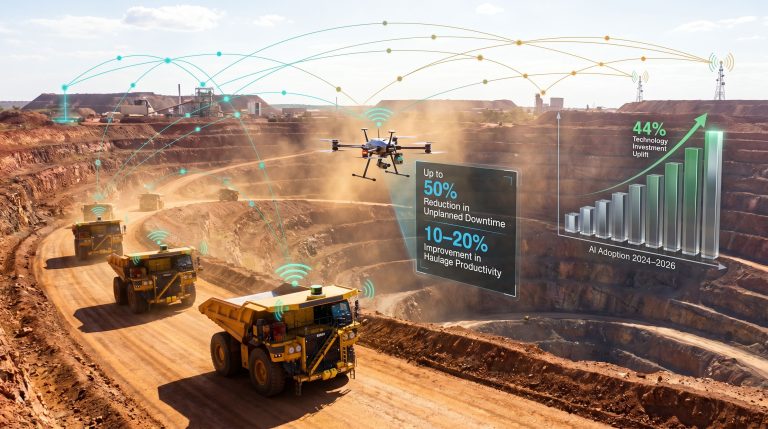
Autonomous haulage systems represent the most bandwidth-intensive mining technology, requiring real-time communication for fleet coordination, route optimisation, and safety monitoring. In addition, these systems generate continuous telemetry data including vehicle positioning, load weights, fuel consumption, and operational status information that must be processed instantaneously for effective fleet management.
AI Implementation Across Mining Operations
The AI-powered mining efficiency strategy encompasses AI deployment across maintenance, commercial operations, and safety monitoring systems. Each application domain requires specific connectivity characteristics:
Predictive Maintenance Systems:
- Continuous sensor data collection from heavy machinery
- Real-time analysis of vibration patterns, temperature variations, and performance metrics
- Integration with maintenance scheduling and parts inventory systems
- Historical data analysis for pattern recognition and failure prediction
Process Optimisation Algorithms:
- Real-time production monitoring and adjustment recommendations
- Integration with crushing, screening, and transportation systems
- Market price analysis and production schedule optimisation
- Quality control monitoring and adjustment protocols
Safety Monitoring Infrastructure:
- Personnel tracking and emergency response coordination
- Environmental monitoring including air quality and noise levels
- Equipment safety status monitoring and alert systems
- Integration with autonomous vehicle safety protocols
These AI applications collectively require substantial bandwidth for data transmission and low latency for real-time response capabilities. Traditional connectivity solutions lack the capacity to support simultaneous operation of multiple AI systems across large mining operations.
Network Architecture for Operational Continuity
Mining operations require network architectures that prioritise reliability and redundancy over cost optimisation. For instance, the Horizon project's diverse path protection system exemplifies industry best practices for mission-critical connectivity infrastructure.
The figure-eight topology provides multiple routing options between operational sites and external connectivity points. This architecture ensures that single cable cuts, equipment failures, or regional disruptions cannot isolate mining operations from critical communication systems.
International Connectivity Integration
Integration with the Darwin-Jakarta-Singapore undersea cable system provides international connectivity options that extend beyond traditional Australian telecommunications infrastructure. This integration enables:
- Direct access to Asian commodity markets for real-time trading
- Global supply chain coordination with international suppliers
- Remote technical support from equipment manufacturers worldwide
- Data backup and disaster recovery through offshore facilities
- International telecommunications redundancy independent of domestic infrastructure
The strategic value of international connectivity extends beyond operational requirements to encompass market positioning and global competitiveness considerations that influence long-term business strategy.
Infrastructure Investment ROI Calculations
Mining companies evaluate connectivity infrastructure investments through comprehensive financial models that encompass both quantifiable returns and strategic value considerations. These calculations must account for the long-term nature of mining operations and the extended payback periods typical of major infrastructure investments.
Productivity enhancement metrics focus on operational efficiency improvements achievable through real-time data availability and AI in drilling & blasting systems. Furthermore, reduced equipment downtime through predictive maintenance can generate substantial cost savings, with unplanned maintenance events typically costing 3-5 times more than scheduled maintenance activities.
Scalability Benefits for Future Technology Adoption
Infrastructure investments must accommodate future technology requirements that exceed current operational needs. The 100Gbps capacity of the Horizon project provides substantial headroom for technology expansion including:
- 5G network integration for enhanced mobile connectivity
- Expanded IoT sensor networks across mining operations
- Edge computing implementation for reduced latency applications
- Virtual and augmented reality applications for training and remote operations
- Advanced automation systems requiring higher bandwidth allocations
Long-term strategic value assessment recognises that connectivity infrastructure enables business model evolution and competitive positioning that may not be quantifiable through traditional financial metrics.
Industry Standards and Competitive Responses
The Hancock Iron Ore Horizon fibre connectivity deployment establishes new connectivity benchmarks that influence competitive responses across the Australian mining industry. Major operators including BHP, Rio Tinto, and Mineral Resources face pressure to match or exceed these connectivity standards to maintain competitive positioning in talent markets and operational efficiency.
Furthermore, Hancock Prospecting's innovations demonstrate how technology adoption acceleration reflects the competitive dynamics where early adopters of advanced connectivity gain operational advantages that force industry-wide responses. This cycle drives continuous improvement in mining technology implementation and operational efficiency standards.
Regulatory Considerations for Digital Infrastructure
Mining connectivity infrastructure must comply with Australian telecommunications regulations and environmental protection requirements that influence deployment strategies and operational procedures. Regulatory frameworks encompass:
- Environmental impact assessments for cable routing through protected areas
- Aboriginal heritage site consultation and protection protocols
- Telecommunications infrastructure safety and technical standards
- Data sovereignty requirements for international connectivity systems
- Emergency communication requirements for remote operations
These regulatory considerations influence infrastructure design decisions and operational protocols that extend beyond purely technical requirements.
The next major ASX story will hit our subscribers first
Implementation Challenges and Integration Complexities
Advanced connectivity implementation requires comprehensive integration planning that addresses legacy system compatibility and staff training requirements. Mining operations typically include equipment and systems spanning multiple technology generations, creating integration challenges that require specialised technical solutions.
Cybersecurity protocols become increasingly critical as mining operations integrate with high-speed networks that provide greater access to external systems. Enhanced connectivity creates expanded attack surfaces that require sophisticated security architectures and monitoring systems.
Staff Training and Technology Adoption
Workforce adaptation to enhanced connectivity requires training programs that address both technical skills and operational procedure changes. Mining personnel must develop competencies in:
- AI-assisted decision-making processes and interpretation
- Autonomous system monitoring and intervention procedures
- Enhanced safety protocols for technology-integrated operations
- Data analysis and performance optimisation techniques
- Cybersecurity awareness and threat recognition
The success of connectivity infrastructure investments depends heavily on workforce capability development that enables effective utilisation of enhanced technological capabilities.
Future Transformation in Australian Mining
Enhanced connectivity infrastructure positions Australian mining operations for accelerated adoption of emerging technologies that will define the industry's competitive landscape. Autonomous operation expansion timelines are directly influenced by connectivity infrastructure availability, with high-speed networks enabling faster technology deployment and scaled implementation.
Regional economic development implications extend beyond individual mining operations to encompass broader Pilbara community benefits including improved telecommunications access, technology sector growth opportunities, and enhanced international competitiveness for the Western Australian resources sector. In addition, data-driven mining operations will likely showcase innovations at the upcoming mining innovation expo 2025.
Industry transformation predictions indicate that connectivity infrastructure will become as fundamental to mining operations as traditional infrastructure elements including roads, power supply, and water systems. This evolution reflects the central role of data and artificial intelligence in modern resource extraction operations.
Technology Integration Roadmap
Future mining operations will likely integrate multiple advanced technologies that require substantial connectivity infrastructure:
- Fully autonomous mining operations with minimal human intervention
- Real-time optimisation of entire value chains from extraction to delivery
- Predictive analytics that anticipate market conditions and adjust production accordingly
- Integrated environmental monitoring that ensures compliance and optimisation
- Global supply chain integration that responds to international market dynamics in real-time
The Hancock Iron Ore Horizon fibre connectivity represents a foundational investment that enables this technological evolution while establishing competitive advantages that influence industry-wide transformation patterns across the Australian mining sector.
Ready to Capitalise on Mining Technology Breakthroughs?
Discovery Alert's proprietary Discovery IQ model delivers real-time notifications on significant ASX mineral discoveries, helping investors identify companies at the forefront of mining innovation before broader market recognition. Explore how historic discoveries have generated substantial returns and begin your 14-day free trial today to gain immediate access to actionable investment opportunities in this rapidly evolving sector.