July 28, 2026
The Hidden Treasury Logic Driving Mining's Shift to Multicurrency Debt Structures
Global mining finance is undergoing a quiet but consequential transformation. As major producers expand across multiple continents, the Harmony multicurrency credit facilities approach illustrates how the mismatch between where capital is raised and where it is actually deployed has become one of the most underappreciated sources of financial risk in the sector. Single-currency debt structures, once the default for even large diversified miners, are increasingly giving way to sophisticated multicurrency arrangements. These mirror the geographic complexity of modern mining portfolios, and Harmony Gold's 2026 refinancing transaction is a textbook illustration of this evolution.
When big ASX news breaks, our subscribers know first
Understanding How Multicurrency Syndicated Facilities Work in Practice
Before examining the strategic rationale behind Harmony Gold's specific transaction, it is worth understanding what a multicurrency syndicated credit facility actually is and why it occupies a distinct category in corporate finance.
A multicurrency syndicated facility is a consolidated borrowing arrangement where a single loan agreement governs access to capital across several currency denominations simultaneously. Instead of maintaining separate bilateral credit lines in Johannesburg, New York, and Sydney, a company negotiates one unified structure with a consortium of lenders, drawing down in whichever currency best matches its operational needs at a given time.
The core structural features that define these instruments include:
- Multicurrency drawdown capability allowing a borrower to access USD, AUD, ZAR, or other denominations from the same facility pool
- Syndicated risk distribution spreading lender exposure across a group of financial institutions rather than concentrating credit risk with one counterparty
- Revolving and term loan components providing both flexible working capital access and longer-duration capital for project development
- Sustainability-linked interest rate mechanics tying the margin paid on the loan to measurable environmental, social, and governance performance targets
- Extension optionality giving the borrower contractual rights to extend maturity dates under pre-agreed conditions
"Key Insight for Investors: The multicurrency structure is not merely an administrative convenience. For mining companies with revenue streams denominated in multiple currencies, it creates a natural alignment between liabilities and assets, reducing the translation losses that can silently erode reported earnings when exchange rates move against a company."
Why the 2022 Facility Was No Longer Adequate
Harmony Gold's previous syndicated facilities, put in place during 2022, were designed for a fundamentally different version of the company. At that time, the primary purpose of the debt structure was to refinance the bridge loan used to complete the MAC Copper acquisition, which carried a total transaction value of approximately $1.25 billion. The 2022 structure was built around two currencies: the US dollar and the South African rand.
By mid-2026, however, that description no longer captured the company's reality. The Eva Copper Project in Queensland, Australia, with a capital development estimate of between $1.55 billion and $1.75 billion, had grown into a central pillar of Harmony's long-term production pipeline. Operating costs, engineering contracts, labour, and future copper revenues associated with the Eva project are denominated primarily in Australian dollars.
Carrying USD and ZAR debt to fund an AUD-denominated asset creates a structural currency mismatch that compounds financial risk over time. The 2026 refinancing addressed this directly by introducing a third currency tranche for the first time in Harmony's syndicated debt history. Furthermore, understanding commodity prices and mining performance helps contextualise why currency alignment in debt structures has become so critical for large diversified miners.
Breaking Down the Three-Tranche Structure
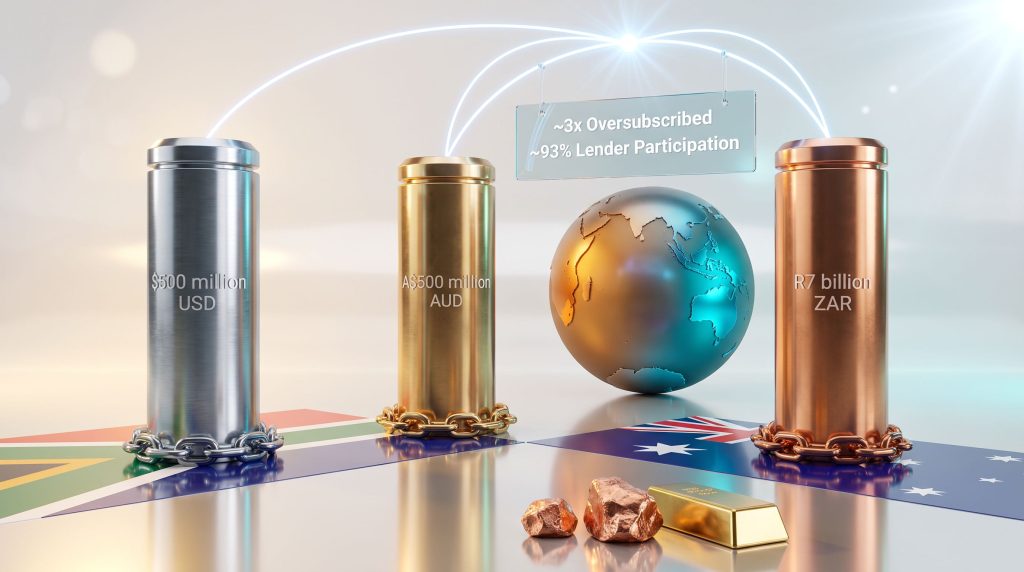
The new facility is organised into three distinct currency-denominated components, each serving a specific operational and strategic function within Harmony's capital structure.
| Tranche | Currency | Facility Amount |
|---|---|---|
| Tranche 1 | US Dollar (USD) | $500 million |
| Tranche 2 | Australian Dollar (AUD) | A$500 million |
| Tranche 3 | South African Rand (ZAR) | R7 billion |
Comparing this architecture against the 2022 predecessor facility reveals the scale of structural evolution:
| Metric | 2022 Facility | 2026 Facility |
|---|---|---|
| USD component | $400 million | $500 million |
| ZAR component | R4 billion | R7 billion |
| AUD component | None | A$500 million |
| Number of currencies | 2 | 3 |
| Sustainability linkage | Yes | Yes (progressive targets) |
| Oversubscription level | Not disclosed | Approximately 3x targeted amount |
| Lender participation rate | Not disclosed | Approximately 93% |
The USD tranche increase from $400 million to $500 million reflects Harmony's expanded corporate liquidity requirements as a dual-continent operator. The near-doubling of the ZAR tranche from R4 billion to R7 billion corresponds to the ongoing capital intensity of South African gold operations and the rand-denominated cost base that accompanies them.
The Australian Dollar Tranche: A Natural Hedging Mechanism in Action
The introduction of the AUD tranche is arguably the most analytically significant element of this transaction. In treasury management, natural hedging refers to the practice of structuring a company's liabilities in the same currencies as its underlying cash flows and asset valuations, thereby reducing net foreign exchange exposure without relying entirely on derivative instruments such as currency forwards or options.
For Harmony, the Eva Copper Project represents a long-duration capital commitment with expenditure and eventual revenue both overwhelmingly denominated in Australian dollars. By funding a portion of this exposure with AUD-denominated debt, the company creates an organic offset. When AUD depreciates relative to other currencies, the value of AUD-denominated liabilities falls in proportion to the reduced AUD value of the underlying asset.
Conversely, AUD appreciation increases asset values and simultaneously increases the liability in foreign currency terms, but the net position remains more stable than it would under a mismatched structure. This is a meaningfully more sophisticated approach than what many mid-tier miners deploy. In addition, those exploring copper investment strategies will recognise that currency-aligned debt structures are increasingly a hallmark of well-managed copper-focused mining companies.
A significant number of mining companies operating in Australia still carry predominantly USD debt, creating asymmetric balance sheet exposure to AUD/USD movements that can materially distort reported financial results without reflecting any change in underlying operational performance.
According to research on multicurrency note facilities, the ability to draw across currencies within a single agreement significantly reduces administrative friction whilst improving balance sheet precision for multinational borrowers.
"Industry Insight: Mining companies that rely exclusively on derivative hedging to manage cross-currency debt risk carry ongoing mark-to-market volatility in their financial statements, as well as counterparty risk and rollover costs associated with maintaining those hedge books. Structural natural hedging through currency-aligned debt eliminates these secondary risks at the source."
How the Sustainability-Linked Loan Mechanics Work
All four sustainability-linked loan components embedded within the new facility operate under a ratchet mechanism consistent with the Loan Market Association Sustainability-Linked Loan Principles. Under this framework, the interest rate margin paid by the borrower adjusts based on whether pre-agreed sustainability performance indicators (SPIs) are met, missed, or exceeded.
How Does the Ratchet Mechanism Work?
The directional mechanics function as follows:
- Targets achieved: Interest rate margin is reduced, lowering Harmony's cost of capital as a direct financial reward for ESG progress
- Targets missed: Interest rate margin is increased, creating a concrete financial penalty for underperformance against sustainability commitments
Harmony's specific sustainability targets for this facility are structured around three measurable dimensions, assessed progressively across the next three financial years:
- Cumulative renewable electricity installed capacity tracking the company's transition away from fossil-fuel energy sources across South African and Australian operations
- Reduction in potable water consumption from external sources addressing water scarcity risks that are particularly acute in South Africa's mining regions
- Annual spend on mine community development initiatives quantifying social investment commitments in host communities across both operating jurisdictions
What makes these targets analytically interesting is their operational specificity. Sustainability-linked loans in mining have historically faced criticism for incorporating generic or easily achievable targets that function more as reputational tools than genuine financial incentives. Renewable electricity capacity and potable water reduction are capital-intensive commitments that require sustained operational change, lending the mechanism considerably more credibility than softer ESG metrics sometimes deployed by peers.
Harmony's approach to ESG-linked lending also aligns with the broader trajectory of critical minerals demand driving the energy transition, as lenders increasingly reward miners demonstrating credible decarbonisation pathways. Furthermore, Harmony's earlier ESG-linked loan programme and solar plant construction demonstrated the company's commitment to embedding sustainability into its financing structures well before 2026.
"Speculative Perspective: As renewable energy infrastructure continues to scale in both South Africa and Australia, the marginal cost of achieving renewable electricity capacity targets is likely to decline over the facility's term, potentially making the sustainability reward mechanism more accessible than it appears at inception. This asymmetry could provide Harmony with margin savings that exceed initial market expectations."
The next major ASX story will hit our subscribers first
What the Lender Response Signals About Harmony's Credit Profile
The transaction attracted lender commitments totalling approximately three times the targeted facility amount, with approximately 93% participation from the existing lending group. These figures are not merely flattering statistics; they carry meaningful analytical content for investors assessing Harmony's financial health and strategic credibility.
Why Does Oversubscription Matter as a Credit Signal?
- Syndicated lenders conduct independent, proprietary credit analysis before committing capital. An approximately 3x oversubscription rate implies that numerous institutions independently concluded that Harmony's risk-adjusted return profile is attractive.
- A 93% participation rate from the existing lender group indicates that financial institutions with the deepest visibility into Harmony's operational and financial performance chose to maintain and extend their exposure. Lenders who are uncomfortable with a borrower's trajectory typically reduce or exit their positions at refinancing events.
- Reduced funding costs relative to the 2022 facilities confirm that credit spreads tightened in Harmony's favour, reflecting improved perceived creditworthiness or stronger market demand for the credit, or both.
Citi and Nedbank Corporate and Investment Banking acted as joint global coordinators and mandated lead arrangers for the transaction. This pairing reflects the dual-jurisdiction nature of Harmony's business: Citi brings international capital markets reach and USD/AUD structuring capability, while Nedbank brings deep South African corporate banking relationships and rand market expertise.
Capital Allocation Strategy: Where the Facility Sits in Harmony's Broader Framework
Understanding the Harmony multicurrency credit facilities in isolation understates their strategic importance. This refinancing is one component of a multi-year capital allocation framework designed to fund a fundamental corporate transformation.
| Strategic Priority | How the Facility Supports It |
|---|---|
| Eva Copper Project development | AUD tranche provides currency-aligned construction funding |
| South African gold operations | ZAR tranche supports rand-denominated operating and capital needs |
| MAC Copper integration | USD tranche maintains broader corporate liquidity |
| ESG transition targets | Sustainability-linked structure creates financial incentives for progress |
| General corporate flexibility | Revolving components provide working capital access as needed |
The three-year base maturity, combined with two one-year extension options, is deliberately structured to cover the most capital-intensive phase of the Eva Copper Project development without forcing Harmony into a refinancing exercise at an operationally inconvenient moment. If both extension options are exercised, the company could benefit from up to five years of runway from the facility's inception date, a meaningful cushion for a project of this capital scale.
Broader Implications for Mining Finance and ESG Debt Trends
Harmony's 2026 refinancing transaction reflects several structural trends reshaping institutional mining finance. However, these trends extend well beyond one company's balance sheet decisions, signalling a wider recalibration across the sector.
- ESG integration is becoming a commercial prerequisite, not a marketing feature. Lenders at Citi and Nedbank's tier now routinely price ESG performance into loan structures, and borrowers without credible sustainability targets face a widening cost-of-capital disadvantage relative to peers.
- Geographic diversification demands debt structure diversification. As resource companies expand from single-country operations into multi-continent enterprises, the currency mismatch risk embedded in legacy debt structures becomes increasingly material.
- Strong banking market appetite for quality mining credits persists. Despite broader macroeconomic uncertainty, the approximately 3x oversubscription signals that institutional lenders view well-managed, diversified mining companies as attractive credit counterparties.
- Natural hedging through debt structure is gaining favour over derivative-dependent strategies, particularly as companies seek to reduce balance sheet complexity and the mark-to-market noise that accompanies large derivative hedge books.
In addition, gold as a strategic investment continues to underpin the financial rationale for maintaining deep South African operations, complementing Harmony's broader diversification into copper. Consequently, the mining industry consolidation trend suggests that multicurrency debt structures will become increasingly standard as more mid-tier miners pursue cross-border growth strategies.
"Disclaimer: This article is intended for informational purposes only and does not constitute financial advice, investment recommendations, or a solicitation to buy or sell any securities. Forward-looking statements, scenario projections, and financial estimates discussed in this article involve inherent uncertainty. Readers should conduct independent research and consult qualified financial advisers before making any investment decisions. Past performance and banking market conditions referenced are not necessarily indicative of future outcomes."
Frequently Asked Questions: Harmony Multicurrency Credit Facilities
What Does Harmony Gold's Multicurrency Credit Facility Consist Of?
The facility comprises three currency-denominated tranches: a $500-million US dollar component, an A$500-million Australian dollar component, and a R7-billion South African rand component. The structure was designed to reduce funding costs, extend the company's debt maturity profile, and align borrowing currencies with the geographic footprint of Harmony's asset base.
Why Did Harmony Introduce an Australian Dollar Tranche for the First Time?
The AUD tranche reflects the growing capital and revenue significance of Harmony's Australian copper operations, particularly the Eva Copper Project in Queensland. Denominating debt in Australian dollars creates a natural hedge, aligning liability servicing requirements with AUD-denominated project cash flows and reducing foreign currency translation risk.
What Sustainability Targets Are Attached to the Loan?
Progressive targets are assessed over three financial years, focused on cumulative renewable electricity installed capacity, reduction in potable water consumption from external sources, and annual spend on mine community development initiatives. Meeting these targets reduces the interest rate margin; missing them increases it.
How Oversubscribed Was the Facility and What Does That Indicate?
Lender commitments reached approximately three times the targeted facility amount, with approximately 93% participation from the existing lender group. This level of demand from institutional lenders, who conduct independent credit analysis, represents a meaningful third-party validation of Harmony's financial health and strategic credibility.
What Is the Maturity Structure of the New Facilities?
The facilities carry an original three-year term to maturity, with two one-year extension options that could extend the final maturity by up to two additional years, providing a potential total runway of five years from inception.
Want to Stay Ahead of the Next Major Mining Discovery?
Discovery Alert's proprietary Discovery IQ model scans ASX announcements in real time, instantly converting complex mineral data across more than 30 commodities into clear, actionable investment insights — giving subscribers a decisive edge the moment significant discoveries are announced. Explore how historic mineral discoveries have generated substantial returns and begin your 14-day free trial today to position yourself ahead of the broader market.