June 14, 2026
Macro-Economic Forces Shaping Indonesia’s HBA Coal Price Adjustments
Global energy markets are influenced by shifting supply routes, evolving demand, and recalibrating fiscal policies. Indonesia raises HBA coal prices as a key signal to regulators and buyers. Furthermore, pressures from rising commodity trade volatility commodity trade volatility inform market strategies.
The HBA pricing mechanism was developed by Indonesia’s Ministry of Energy and Mineral Resources. This formalised index establishes benchmark rates for coal of varying calorific values and underpins transparent contract settlements. In addition, it helps stabilise fiscal outcomes and trade agreements.
Breakdown of HBA Price Adjustments (April 2026)
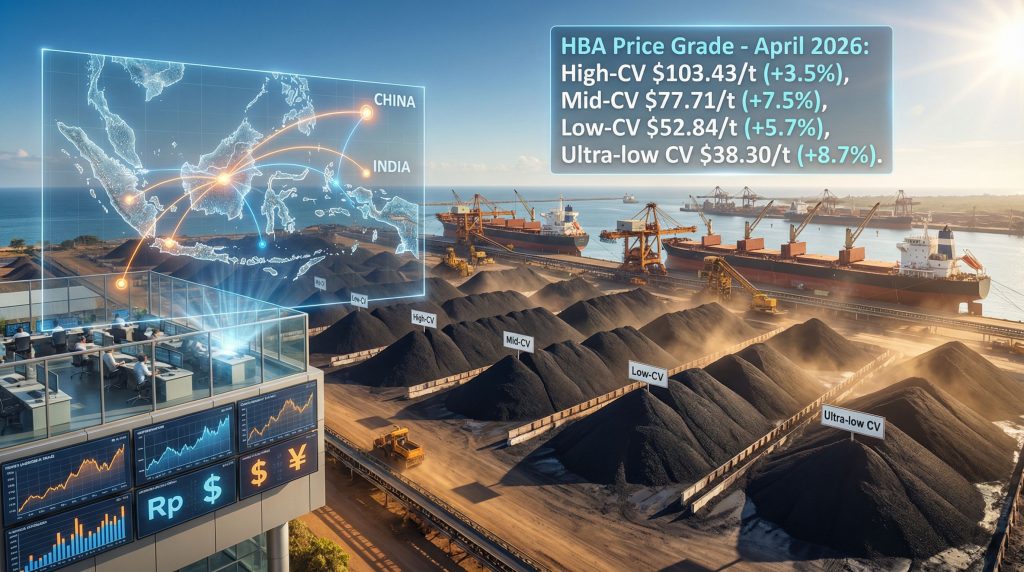
Indonesia’s recent revision in the pricing mechanism shows upward adjustments across various grades. For instance, the high-CV grade increased to $103.43/t with a +3.5% month-on-month change. The ultra-low grade recorded an +8.7% rise, reflecting persistent market tightness.
- High-CV (6,322 kcal/kg): $103.43/t (+3.5% MoM)
- Mid-CV (5,300 kcal/kg): $77.71/t (+7.5% MoM)
- Low-CV (4,100 kcal/kg): $52.84/t (+5.7% MoM)
- Ultra-low CV (3,400 kcal/kg): $38.30/t (+8.7% MoM)
These adjustments are concurrent with indications of US-China trade war impact US-China trade war impact. Global shifts are, therefore, instrumental in shaping pricing decisions.
Influences Driving These Adjustments
Several factors contribute to the recalibration of prices. International demand from China, India, and ASEAN nations plays a central role. Moreover, currency swings such as USD/IDR volatility influence fiscal planning and exporter returns. Additionally, commodity prices impact on mining commodity prices impact on mining further underlines market dynamics.
Global energy transition trends and regional competition also contribute. For instance, producers in Australia, Russia, and South Africa introduce energy exports challenges energy exports challenges. Consequently, adjustments in HBA function as both market stabilisers and competitive benchmarks.
Technical Snapshot: HBA Grading System
Below is the grading breakdown with key statistics:
| Grade | Reference CV (GAR kcal/kg) | Price April 2026 | MoM Change |
|---|---|---|---|
| HBA | 6,322 | $103.43/t | +3.5% |
| HBA I | 5,300 | $77.71/t | +7.5% |
| HBA II | 4,100 | $52.84/t | +5.7% |
| HBA III | 3,400 | $38.30/t | +8.7% |
Secondary FOB Kalimantan prices for similar grades, such as $115.93/t for 6,500 kcal/kg coal, illustrate persistent demand. Furthermore, these figures provide insights into global royalty dynamics global royalty dynamics affecting fiscal distributions.
Insight: The leap of +8.7% for ultra-low CV coal highlights acute supply-demand imbalances in specific market segments.
Fiscal and Trade Balance Impacts: How HBA Prices Affect Indonesia’s Revenue
The HBA serves as a cornerstone for calculating state royalties. Higher reference prices directly boost government revenues, given constant export volumes. Subsequently, producers experience increased margins when selling above index levels. Moreover, adjustments reinforce investor confidence in predictable fiscal inflows.
Royalty payments rely on the multiplication of extracted tonnage by the indexed price per grade. In addition, royalties are a fixed percentage of this calculated amount. Efficient management of pricing propels fiscal stability and shapes overall trade competitiveness.
Trade and Export Competitiveness
Indonesia’s pricing updates influence export contracts for both long-term and spot agreements. This ripple effect increases export values and supports a positive trade surplus. Furthermore, the revised HBA positions Indonesia competitively against benchmarks like Newcastle and Richards Bay, ensuring a robust market presence.
In practical terms, producers securing premium prices above $115.93/t for high-quality coal benefit from enhanced margins. For instance, established contracts monitor these benchmarks to accommodate shifting market trends. In addition, global market shifts are partly driven by expectations around the revised index.
International Market Impacts and Competitive Dynamics
Indonesia’s status as a thermal coal supplier critically shapes regional and international markets. The April adjustments, alongside measures addressing US-China trade war impact insights, have pronounced effects on buyer behaviour. For example, key importers in China and India reassess procurement strategies based on current trends.
Southeast Asian markets benefit through exposure to competitive Indonesian pricing while managing supply risks. Additionally, industry competitiveness is further bolstered by freight and currency considerations. Export contracts in USD help mitigate local currency fluctuations, ensuring stability in volatile markets.
Freight costs for Supramax and Panamax vessels also affect overall netback. Sharp rises in contractual freight rates may sometimes outweigh minor adjustments in HBA prices, especially for lower-grade coal. Furthermore, these dynamics underscore overall market resilience and strategic pricing.
Featured Data: A slight lag in monthly adjustments provides authorities a buffer to forecast fiscal inflows despite rapid spot market volatility.
Domestic Policy and Industry Actions in Response to HBA Shifts
Reference prices offer a dual role in fiscal management and resource rent optimisation. Regulatory responses and strategic planning shift with these price updates. Therefore, domestic allocation requirements and project feasibility studies are frequently revisited by policymakers.
Market participants rely on the HBA index for strategic stockpile decisions when price jumps provide a margin benefit. Moreover, robust indices encourage efficient operations among low-cost producers, promoting competitive market practices. In addition, planning for future infrastructure adjusts to the evolving price mechanisms.
Operational Incentives and Risk Assessment
Higher HBA levels reward operators capable of capturing spot market premiums. However, these adjustments also pose risks if buyer demand does not sustain high-price levels. Consequently, mine planning now focuses more on grades with the highest month-on-month gains, such as ultra-low CV coal.
Risk assessments now incorporate market forecasts and regulatory changes. In this context, strategies are adjusted to secure future profitability. Furthermore, efficient cost management remains a critical priority for market players.
Broader Implications: Energy Security and the Transition Landscape
HBA prices are pivotal not only for revenue but also for regional energy security. They contribute significantly to Southeast Asia’s power sector economics. In addition, national energy planning and tariff setting are increasingly benchmarked to these prices.
Energy security concerns persist even as renewable adoption grows. Nevertheless, coal remains an essential component for grid resilience. In parallel, shifts in the HBA mechanism shape infrastructure investments and strategic stockpile policies.
Influence on Regional Energy Planning
Southeast Asian utilities often establish long-term contracts linked to HBA levels. This approach aids in setting tariffs and planning infrastructural investments. Furthermore, energy planners use the updated figures to balance affordability with reliability in power generation.
Key components of regional planning include:
- Long-term contract benchmarks
- Tariff-setting mechanisms
- Infrastructure investment criteria
Moreover, external influences such as regulatory changes and market sentiment are critical in maintaining equilibrium.
Scenario Projections and Future Watchpoints
Looking ahead, industry observers note that enhanced fiscal inflows may prompt further adjustments in HBA calculations. Economic recovery in Asia and evolving decarbonisation policies create a complex trading environment. In addition, ongoing reforms to the HBA methodology might align reference prices more closely with spot-market dynamics.
- Decarbonisation Targets: May reduce thermal coal demand
- Emerging Demand: Could sustain robust pricing for mid and ultra-low CV coals
- Industry Consolidation: May drive further investments and market resilience
Investors and policymakers are advised to remain agile. For the latest coal pricing update, check sp global coal news. Additionally, insights into indonesian market trends can be found at databoks.
Frequently Asked Questions (FAQ)
What is the HBA and why is it important for global coal markets?
The HBA is Indonesia’s official coal pricing reference. It sets benchmarks for royalties and trade contracts, influencing both domestic fiscal results and procurement strategies.
How often is Indonesia’s coal reference price updated?
HBA prices typically update monthly or semi-monthly, reflecting current market and regulatory conditions.
Do HBA increases translate directly to higher consumer electricity prices?
Not necessarily. Domestic tariffs are regulated separately, although sustained HBA increases may create long-term trends.
What methods determine the HBA for different coal grades?
Methods include international price references, market transactions, and regulatory inputs based on calorific value.
How does Indonesia’s strategy compare with other major coal exporters?
Indonesia utilises a managed reference system that tempers volatility while maintaining market responsiveness.
Conclusion: Outlook for Indonesia’s HBA Coal Price System
Indonesia raises HBA coal prices in a manner that reinforces its stance in global markets. This marks the third mention of the primary indicator in our analysis. Such adjustments bolster fiscal inflows, drive competitive trade practices, and support broader energy security strategies.
Looking forward, stakeholders must weigh evolving commodity cycles, policy reforms, and technological advancements. The market’s resilience is evident in its capacity to adapt, ensuring that Indonesia raises HBA coal prices remains a pivotal benchmark.
Disclaimer: Coal market forecasts and investment perspectives involve inherent uncertainty and should be considered directional analysis rather than guarantees. Official figures and policy details should be verified through Indonesian governmental releases and independent market research.
Ready to Enhance Your Commodity Investment Strategy?
Explore how Discovery Alert’s Discovery IQ model can transform your approach by delivering real-time alerts on significant ASX mineral discoveries. Visit the Discoveries page today and start your 14-day free trial to gain a substantial market-leading advantage.