July 21, 2026
Heavy crude oil extraction presents unique opportunities for international operators willing to navigate complex technical and regulatory landscapes. Venezuela's petroleum sector offers substantial untapped potential, with field development strategies requiring sophisticated coordination between state entities and private operators. Understanding the mechanics of production scaling in heavy crude operations reveals critical insights into oil price dynamics and global energy market dynamics.
Strategic Energy Partnerships in Latin American Markets
International energy companies operating in Venezuela face multifaceted challenges requiring long-term commitment and specialised expertise. The framework established through recent agreements demonstrates how public-private partnerships can balance state ownership with operational efficiency. These arrangements typically involve extended negotiation periods, with contractual terms evolving through successive amendments to address changing market conditions and regulatory requirements.
Venezuelan petroleum operations demand particular understanding of heavy crude characteristics, which significantly impact extraction methods, processing requirements, and export logistics. Unlike light crude operations, heavy crude fields require sustained investment in specialised infrastructure and technical expertise developed over decades of regional experience.
Furthermore, the regulatory environment for international petroleum operations in Venezuela has evolved substantially. Framework agreements now provide mechanisms for concession extensions and operational continuity. These developments indicate policy shifts toward encouraging international investment while maintaining state control over strategic resources.
When big ASX news breaks, our subscribers know first
Economic Fundamentals of Heavy Crude Field Development
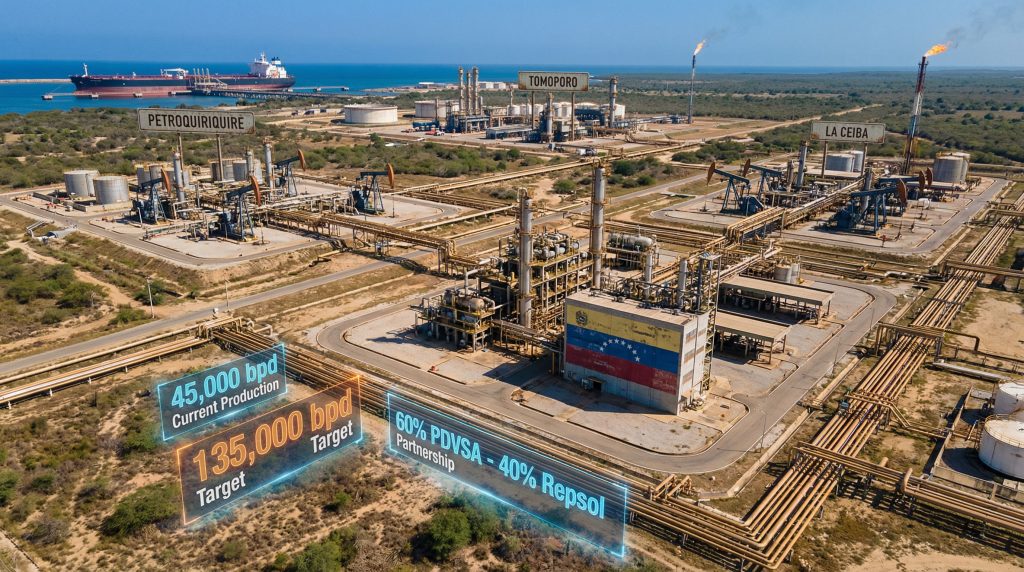
Repsol oil production increase in Venezuela demonstrates the economic viability of scaling heavy crude operations when proper infrastructure and partnerships align. Current production levels of approximately 45,000 barrels per day from the Petroquiriquire field complex provide a baseline for understanding expansion economics. The company targets increasing output to 67,500 barrels per day within twelve months, representing a 50% production boost requiring significant capital allocation and operational optimisation.
Production Scaling Timeline and Targets
The three-year expansion strategy aims to triple current production capacity, reaching approximately 135,000 barrels per day by 2029. This ambitious timeline requires coordinated development across multiple field locations, including the primary Petroquiriquire asset alongside Tomoporo and La Ceiba fields. Each phase of expansion presents distinct technical challenges and capital requirements.
Phase 1 (0-12 months): 67,500 bpd target requires enhanced extraction capacity and improved processing throughput. This initial phase focuses on optimising existing infrastructure while preparing for subsequent expansion phases.
Phase 2 (12-24 months): 90,000 bpd milestone demands expanded drilling programmes and upgraded pipeline systems connecting field locations to export terminals.
Phase 3 (24-36 months): 135,000 bpd represents full-scale development requiring comprehensive infrastructure upgrades across extraction, processing, and export systems.
Joint Venture Structure and Revenue Mechanisms
The operational framework establishes PDVSA holding 60% ownership in the Petroquiriquire concession while Repsol maintains 40% operational control. This structure separates ownership from management, allowing the Venezuelan state to retain revenue benefits while delegating technical execution to experienced international operators.
However, revenue sharing mechanisms within such frameworks typically incorporate production-based payments, royalty structures, and cost recovery provisions. The agreement's evolution from its 2023 establishment through 2024 amendments to 2026 operational commencement suggests iterative refinement of economic terms between parties.
Heavy Crude Transportation and Export Coordination
Venezuelan heavy crude presents specific logistical challenges directly impacting production economics and scaling potential. The conditional nature of production increases, dependent on PDVSA's scheduling of equivalent crude oil shipments, demonstrates how export logistics constrain field development rather than extraction capacity alone.
Heavy crude characteristics require specialised handling throughout the transportation chain. These petroleum products typically exhibit higher viscosity and density compared to light crude, necessitating heating systems for pipeline transport or dilution with lighter hydrocarbons to achieve pipelineable specifications. Export operations must accommodate these technical requirements while maintaining quality standards acceptable to international refineries.
Port Infrastructure and Shipping Coordination
Venezuelan heavy crude export operations depend on port facilities capable of handling increased throughput as production scales. The requirement that PDVSA schedule shipments equivalent to field production creates operational interdependence between extraction activities and export logistics. This coordination mechanism ensures production increases align with actual export capacity rather than theoretical extraction potential.
| Production Phase | Daily Output | Annual Volume | Export Requirements |
|---|---|---|---|
| Current Baseline | 45,000 bpd | 16.4 million barrels | Existing shipping schedules |
| Phase 1 Target | 67,500 bpd | 24.6 million barrels | 50% increase in vessel frequency |
| Phase 2 Target | 90,000 bpd | 32.9 million barrels | Enhanced port throughput capacity |
| Phase 3 Target | 135,000 bpd | 49.3 million barrels | Comprehensive logistics optimisation |
Quality assurance protocols ensure Venezuelan heavy crude meets international refinery specifications before export authorisation. These procedures involve testing for API gravity, sulphur content, and contamination levels, with results determining suitable destination refineries and pricing structures.
International Regulatory Framework Navigation
Operating in Venezuela's petroleum sector requires compliance across multiple jurisdictional frameworks, each presenting distinct requirements and constraints. The regulatory environment encompasses U.S. Treasury licensing, European Union regulations, Venezuelan petroleum law, and international sanctions considerations.
U.S. Treasury licences enable Venezuelan petroleum operations under specific conditions, with compliance requirements extending to production volumes, revenue repatriation procedures, and operational scope limitations. These licences typically require regular reporting and renewal processes, creating ongoing administrative obligations for international operators.
Legal Framework Evolution and Concession Extensions
The agreement framework provides mechanisms for extending Petroquiriquire field concessions while incorporating additional assets like Tomoporo and La Ceiba fields. Venezuelan petroleum law enables contractual arrangements extending operational authority beyond initial concession periods, reducing regulatory uncertainty for long-term capital investments.
Concession extension mechanisms offer critical risk mitigation for international operators requiring operational continuity to justify substantial infrastructure investments. The two-year evolution from initial 2023 agreements through 2024 amendments to 2026 operational implementation demonstrates regulatory negotiation complexity in Venezuelan petroleum operations.
Key Compliance Areas:
- Revenue repatriation procedures under U.S. Treasury licensing frameworks
- Environmental compliance standards meeting international operational requirements
- Employment regulations governing international technical personnel
- Export documentation requirements for heavy crude shipments
- Joint venture reporting obligations to Venezuelan regulatory authorities
Regional Production Trends and Competitive Context
Venezuela's petroleum sector recovery extends beyond individual field developments, with national output demonstrating systematic improvement across multiple operators. Recent production data indicates national output reaching 1.1 million barrels per day by April 2026, representing a 16.8% increase from 942,000 barrels per day in February 2026.
This production recovery reflects broader re-engagement by international operators, creating competitive dynamics for technical expertise, infrastructure capacity, and export logistics. Multiple foreign companies have resumed Venezuelan operations, indicating improved confidence in regulatory frameworks and economic viability.
International Operator Re-engagement Patterns
The return of experienced international operators to Venezuelan petroleum operations follows established patterns observed in post-sanction environments globally. Companies with pre-existing regional expertise, established relationships with state entities, and specialised heavy crude technical capabilities demonstrate competitive advantages in securing operational agreements.
"The framework agreement established the necessary conditions to advance the production targets set by the partners, subject to PDVSA's scheduling of heavy crude oil shipments equivalent to Petroquiriquire's production."
Repsol oil production increase in Venezuela occurs alongside similar expansions by other international operators, creating coordinated recovery across Venezuelan petroleum assets. This collective approach reduces individual operator risk while providing PDVSA with multiple technical partnerships for different field developments.
Technical Infrastructure Requirements for Production Tripling
Achieving 200% production increases from current baselines requires comprehensive infrastructure development across extraction, processing, and transportation systems. Heavy crude operations demand specialised equipment capable of handling high-viscosity petroleum products throughout the production chain.
Drilling and Extraction System Upgrades
Tripling production capacity necessitates expanded drilling programmes across Petroquiriquire, Tomoporo, and La Ceiba fields. Heavy crude extraction typically requires horizontal drilling techniques, enhanced oil recovery methods, and artificial lift systems to maintain production rates as reservoir pressure declines.
Critical Infrastructure Components:
- Advanced drilling rigs capable of horizontal and extended-reach drilling
- Downhole artificial lift systems (electric submersible pumps, progressive cavity pumps)
- Enhanced oil recovery equipment for steam injection or chemical flooding
- Wellhead facilities designed for high-viscosity crude handling
- Automated production monitoring systems for multi-well field management
Processing and Pipeline Infrastructure
Heavy crude processing requires specialised facilities for separation, heating, and quality optimisation before pipeline transport. Viscosity reduction through heating or dilution enables transportation through existing pipeline networks to export terminals.
Processing facility upgrades must accommodate increased throughput while maintaining product quality standards. These systems typically include crude oil heating units, separation equipment for removing water and sediment, and blending facilities for achieving export specifications.
In addition, pipeline infrastructure connecting field locations to export terminals requires capacity expansion and potentially upgraded materials to handle increased flow rates and heavy crude characteristics. Corrosion-resistant pipeline materials and enhanced pumping capacity become critical for sustained high-volume operations.
The next major ASX story will hit our subscribers first
Natural Gas Operations Integration Strategy
Repsol's Venezuelan portfolio extends beyond crude oil production to include substantial natural gas operations, creating operational synergies and revenue diversification. The Perla field produces 580 million cubic feet per day, representing significant natural gas output complementing crude oil expansion strategies.
Integrated oil and gas operations provide several strategic advantages, including shared infrastructure utilisation, combined expertise application, and diversified commodity exposure reducing single-product market risk. The March 2026 agreement with Eni regarding Cardón IV asset sustainability demonstrates coordinated approaches to maintaining natural gas production alongside crude oil expansion.
Operational Synergies and Resource Optimisation
Combined oil and gas operations enable infrastructure sharing, including processing facilities, pipeline networks, and export terminals where applicable. Technical expertise transfers between operations, with reservoir engineering, drilling techniques, and production optimisation knowledge applicable across both crude oil and natural gas assets.
Workforce development programmes benefit from integrated operations, providing career advancement opportunities across multiple energy sectors while reducing training costs through shared educational initiatives. Environmental compliance systems serve both oil and gas operations, creating economies of scale in regulatory management.
Global Market Implications and Supply Dynamics
Venezuela's production recovery contributes to global heavy crude supply availability, impacting international energy markets beyond regional considerations. Heavy crude products serve specific refinery configurations, with Venezuelan production increases affecting global supply balances for refineries designed to process high-sulphur, high-density petroleum products.
Furthermore, international energy security benefits from supply source diversification, with Venezuelan production recovery reducing dependence on alternative heavy crude suppliers in other regions. This diversification provides strategic flexibility for consuming nations while creating competitive pricing dynamics among heavy crude producers.
What Are the Refinery Market Integration and Pricing Dynamics?
Venezuelan heavy crude targets refineries equipped for high-sulphur crude processing, primarily located in the U.S. Gulf Coast, Caribbean, and specific Asian markets. Production increases impact pricing relationships between heavy crude benchmarks and light crude pricing, typically resulting in narrowed differentials during periods of heavy crude supply tightness.
The integration of increased Venezuelan production into global markets requires coordination with existing supply contracts, refinery maintenance schedules, and seasonal demand patterns. Heavy crude markets demonstrate different demand cycles compared to light crude, with winter heating oil demand and asphalt production creating seasonal consumption variations.
Market Impact Factors:
- Heavy crude supply balance changes affecting global pricing differentials
- Refinery utilisation improvements in facilities designed for heavy crude processing
- Regional energy security enhancement through diversified supply sources
- Competition among heavy crude producers creating pricing pressures
- Infrastructure capacity constraints limiting rapid market integration
However, these dynamics must also consider broader global tariff impacts on international trade flows and energy sector investments.
Investment Climate Indicators and Risk Assessment
The return of international capital to Venezuelan petroleum operations signals broader confidence in regulatory framework stability and economic recovery potential. Multi-year investment commitments require substantial confidence in political stability, regulatory continuity, and operational security.
Risk assessment for Venezuelan petroleum operations incorporates multiple variables including regulatory changes, sanctions evolution, operational security, and market access considerations. Successful operations require comprehensive risk management strategies addressing each potential disruption source.
Long-term Sustainability Metrics
Sustainable Venezuelan petroleum operations depend on maintaining operational excellence across technical execution, regulatory compliance, partnership management, and market access. Success metrics include production target achievement, cost management, regulatory compliance maintenance, and revenue optimisation.
The three-year expansion timeline provides sufficient flexibility for adapting to changing market conditions while establishing measurable milestones for progress assessment. Regular evaluation of technical performance, regulatory compliance, and market conditions enables strategic adjustments throughout the expansion period.
Critical Success Indicators:
- Monthly production achievement relative to phase targets
- Operating cost per barrel compared to industry benchmarks
- Regulatory compliance maintenance across all jurisdictions
- Market price realisation for heavy crude exports
- Partnership stability with Venezuelan state entities
- Infrastructure development milestone completion
- Workforce development and safety performance metrics
Economic sustainability requires balancing capital investment requirements with revenue generation potential across varying crude oil price environments. Sensitivity analysis incorporating different price scenarios enables robust decision-making throughout the expansion process.
The broader implications of successful Venezuelan petroleum sector recovery extend beyond individual operator performance to regional energy security, global supply diversity, and economic development in Latin America. Repsol oil production increase in Venezuela serves as an indicator of broader energy sector recovery potential, with successful execution potentially encouraging additional international investment across Venezuelan petroleum assets.
Consequently, these developments must be viewed within the context of broader oil price crash insights and OPEC meeting impact on global energy markets. Understanding WTI and Brent trends becomes essential for assessing long-term investment viability in Venezuelan heavy crude operations.
This analysis is based on publicly available information and should not be considered investment advice. Petroleum sector investments involve substantial risk including regulatory changes, market volatility, and operational challenges. Readers should consult qualified professionals before making investment decisions related to international energy operations.
What Opportunities Exist in ASX Energy and Resource Exploration?
Discovery Alert's proprietary Discovery IQ model delivers real-time alerts on significant ASX mineral and energy discoveries, instantly empowering subscribers to identify actionable opportunities ahead of the broader market. Begin your 14-day free trial today and secure your market-leading advantage in resource exploration investments.