July 21, 2026
The discovery of heavy rare earth elements at Kasiya represents a potential game-changer in global critical minerals supply chains. As industries worldwide grapple with supply chain vulnerabilities, this multi-commodity project in Malawi could address strategic dependencies while supporting African economic development. The intersection of rutile, graphite, and rare earth mineralization creates unique opportunities for integrated resource extraction.
Furthermore, the project's timing aligns with unprecedented demand growth for materials supporting the energy transition security agenda. Traditional supply chains face mounting pressure as nations seek alternatives to concentrated resource dependencies.
What Are Heavy Rare Earth Elements and Why Do They Matter?
Defining Heavy Rare Earths vs Light Rare Earths
Heavy rare earth elements occupy atomic positions 64-71 on the periodic table, distinguished from their lighter counterparts by significantly higher atomic weights and substantially different technological applications. Unlike light rare earths such as cerium and lanthanum, which are relatively abundant globally, heavy rare earths including dysprosium, terbium, and yttrium occur in much lower concentrations within most rare earth deposits.
The technical classification extends beyond atomic weight to encompass fundamental differences in magnetic properties, thermal stability, and electronic characteristics. Heavy rare earths maintain their magnetic strength at elevated temperatures, making them indispensable for high-performance applications where light rare earths would fail. This temperature tolerance proves critical in wind turbine generators, electric vehicle motors, and aerospace systems operating under extreme conditions.
Current supply chain vulnerabilities stem from the concentrated geographic distribution of economically viable heavy rare earth deposits. While light rare earths can be extracted profitably from numerous global locations, heavy rare earth production remains dominated by a handful of operations, creating strategic dependencies that governments and industries are increasingly viewing as unacceptable risks.
The Strategic Value of Dysprosium, Terbium, and Yttrium
Dysprosium functions as the key additive enabling permanent magnets to maintain their strength above 150°C, making it essential for applications ranging from electric vehicle drive systems to industrial wind turbines. Without dysprosium additions, neodymium-iron-boron magnets lose efficiency at operating temperatures common in modern clean energy systems. Current pricing for dysprosium oxide fluctuates between $350-450 per kilogram, reflecting both supply constraints and growing technological demand.
Terbium serves specialized roles in high-efficiency lighting systems, magnetostrictive devices, and advanced sonar applications. Its unique luminescent properties enable energy-efficient phosphors used in LED systems and display technologies. Military sonar systems rely on terbium-based magnetostrictive alloys that convert magnetic energy to mechanical motion with exceptional precision. Market pricing for terbium oxide typically ranges from $1,200-1,500 per kilogram.
Yttrium applications span superconductor manufacturing, laser systems, and specialized ceramic components for aerospace applications. Yttrium-stabilized zirconia ceramics withstand extreme temperatures in jet engines and industrial gas turbines. The element also enables yttrium-aluminum-garnet (YAG) lasers used in precision manufacturing and medical procedures. Yttrium oxide prices generally trade between $8-12 per kilogram, though specialized high-purity grades command significantly higher premiums.
| Element | Primary Applications | Temperature Stability | Price Range (per kg oxide) |
|---|---|---|---|
| Dysprosium | Permanent magnets, motors | Up to 200°C | $350-450 |
| Terbium | Phosphors, magnetostrictives | Up to 180°C | $1,200-1,500 |
| Yttrium | Superconductors, lasers | Up to 1,000°C | $8-12 |
When big ASX news breaks, our subscribers know first
How Does Kasiya's Heavy Rare Earth Discovery Change the Mining Landscape?
Monazite Recovery from Rutile Processing Streams
The heavy rare earth elements at Kasiya occur within monazite mineral grains that naturally associate with rutile mineralization in the weathered paragneiss host rock. Laboratory analysis demonstrates that standard rutile beneficiation processes naturally concentrate monazite into recoverable fractions without requiring complex additional separation techniques. This geological association creates opportunities for integrated processing that could dramatically reduce heavy rare earth production costs.
Monazite concentrate recovery from existing rutile tailings streams represents a fundamentally different approach compared to primary rare earth mining operations. Traditional rare earth projects must design entire processing facilities around rare earth extraction, while Kasiya's approach leverages infrastructure already required for rutile production. This integration could enable heavy rare earth recovery at marginal additional capital expenditure.
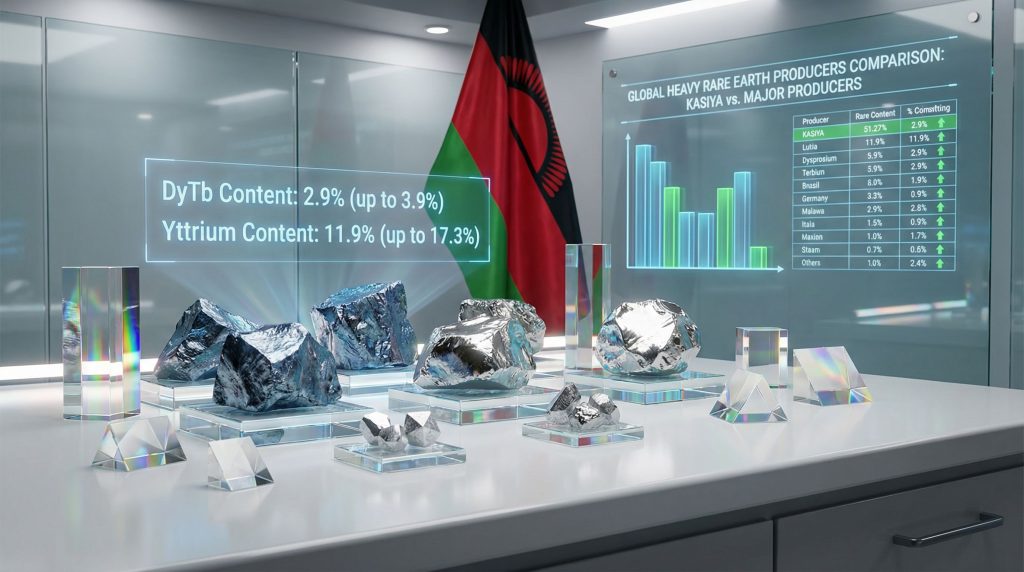
Technical analysis indicates that monazite concentrate containing 2.9% dysprosium-terbium content (reaching 3.9%) and 11.9% yttrium content (peaking at 17.3%) can be recovered from rutile processing streams. These concentrations substantially exceed those typical of major global rare earth operations, where heavy rare earth content often represents less than 5% of total rare earth inventories.
Multi-Commodity Resource Integration
Kasiya's potential as a rutile-graphite-rare earth operation creates multiple revenue streams from shared infrastructure investments. Rutile processing facilities can simultaneously beneficiate graphite and recover monazite concentrate, spreading capital costs across three distinct commodity markets. This diversification reduces exposure to individual commodity price cycles while maximizing asset utilisation.
The geological setting enables processing synergies where each commodity benefits from the others' extraction methods. Graphite floatation circuits can operate in parallel with rutile gravity separation, while monazite recovery utilises materials otherwise destined for tailings disposal. Such integration typically reduces per-unit production costs by 20-30% compared to single-commodity operations.
Revenue diversification becomes particularly valuable given the different market cycles affecting rutile, graphite, and rare earths. Rutile demand correlates with titanium dioxide pigment markets, graphite follows battery and steel industry trends, while rare earths track clean energy and defence spending. This commodity mix provides natural hedging against sector-specific downturns.
In addition, this integrated approach supports the green transition of materials by maximising resource efficiency from single mining operations. Infrastructure sharing encompasses not only processing facilities but also transportation, power systems, and environmental management.
What Makes Kasiya's Heavy Rare Earth Content Globally Significant?
Comparative Analysis Against Major Producers
| Operation | DyTb Content (%) | Yttrium Content (%) | Production Focus | Current Status |
|---|---|---|---|---|
| Kasiya (Malawi) | 2.9% (up to 3.9%) | 11.9% (up to 17.3%) | Heavy rare earths | Development |
| Mountain Pass (USA) | <0.1% | <0.1% | Light rare earths | Production |
| Bayan Obo (China) | 0.4% | 1.7% | Mixed rare earths | Production |
| Mount Weld (Australia) | 0.2% | 0.8% | Light rare earths | Production |
| Kvanefjeld (Greenland) | 0.1% | 0.3% | Light rare earths | Suspended |
The comparative analysis reveals that Kasiya's heavy rare earth concentrations exceed those of established producers by factors of seven to ten times. Mountain Pass, despite being the largest non-Chinese rare earth producer, contains virtually no heavy rare earth elements, focusing entirely on light rare earth extraction. Even Bayan Obo, China's flagship rare earth operation, shows substantially lower heavy rare earth grades than preliminary results from Kasiya.
This grade differential translates directly to economic advantages, as heavy rare earth elements command price premiums of 10-100 times those of light rare earths. A deposit containing 3% dysprosium-terbium content generates equivalent revenue per tonne to one containing 30% light rare earth content, assuming similar processing costs. Such economics explain why even modest heavy rare earth deposits attract significant strategic interest.
Supply Chain Diversification Implications
Current global heavy rare earth supply remains concentrated in Chinese operations, creating strategic vulnerabilities for Western technology and defence sectors. China controls an estimated 85-90% of global heavy rare earth production, despite holding only 30% of known reserves. This market concentration enables export restrictions and pricing manipulation that directly impact Western manufacturing capabilities.
Recent export control tightening by Chinese authorities has affected dysprosium, terbium, and yttrium availability for international buyers. These restrictions, implemented during late 2025, created supply disruptions across permanent magnet manufacturing, defence electronics, and clean energy sectors. Consequently, alternative sources outside Chinese control have become strategic priorities for Western governments and technology companies.
Kasiya's potential heavy rare earth production could address supply diversification objectives while providing economic benefits to African development. A single operation producing 5,000-10,000 tonnes annually of monazite concentrate could supply 10-15% of Western heavy rare earth demand, assuming typical processing yields. Such production levels would materially impact global supply dynamics and pricing structures.
The strategic importance extends beyond commercial considerations to national security implications. Advanced military systems, including precision-guided munitions, radar arrays, and electronic warfare equipment, depend on heavy rare earth elements for optimal performance. This development connects directly with evolving global mining geopolitics that increasingly prioritise supply security.
How Do Geopolitical Factors Influence Heavy Rare Earth Development?
China's Export Control Tightening
Chinese authorities implemented enhanced export licensing requirements for dysprosium, terbium, and yttrium during the December 2025 quarter, restricting availability for international purchasers. These controls require Chinese suppliers to obtain government approval for export contracts exceeding specified volume or value thresholds, creating uncertainty for Western manufacturers dependent on heavy rare earth supplies.
The export restrictions coincided with broader Chinese trade policies affecting critical minerals and advanced materials. Similar controls previously applied to gallium and germanium demonstrated China's willingness to leverage resource advantages for strategic objectives. Heavy rare earth restrictions carry potentially greater impact given the lack of established alternative suppliers outside China.
Price implications from export controls materialised rapidly, with monazite concentrate pricing exceeding US$8,500 per tonne delivered to China by early 2026. Historical precedents suggest that sustained supply restrictions could drive prices 50-100% higher within 12-18 months, assuming no major alternative sources achieve production. Such price increases create powerful incentives for non-Chinese project development.
International response strategies include accelerated rare earth project financing, strategic stockpiling programs, and technology development for heavy rare earth recycling. The United States, European Union, and allied nations have identified rare earth supply security as critical infrastructure priorities requiring government support and private sector collaboration.
Strategic Partnership Development
International Finance Corporation collaboration with Kasiya represents institutional recognition of the project's strategic importance for global supply chain security. The IFC agreement positions the project for potential development finance support while ensuring alignment with international environmental and social standards. Such institutional backing often attracts additional private sector investment and government support.
Moreover, US State Department engagement, including the December 2025 visit by Deputy Assistant Secretary Nick Checker, signals high-level American interest in African critical mineral development. These diplomatic initiatives typically precede formal development finance discussions and bilateral cooperation agreements. US government agencies, including the Development Finance Corporation, actively seek critical mineral projects that enhance supply chain resilience.
Development finance opportunities for critical mineral projects have expanded significantly since 2024, with Western governments allocating billions of dollars to secure alternative supply chains. The critical minerals executive order and similar legislation provide funding mechanisms for projects that reduce dependency on concentrated suppliers.
Strategic partnerships often encompass technology transfer, infrastructure development, and long-term offtake agreements. Western companies and governments seek integrated relationships with critical mineral projects that ensure supply security while supporting local economic development. Similarly, these relationships support strategic minerals reserve objectives for allied nations.
What Are the Technical Characteristics of Kasiya's Rare Earth Potential?
Geological Setting and Mineralisation
Kasiya's rare earth mineralisation occurs within weathered paragneiss formations where monazite grains naturally associate with rutile and graphite mineralisation. The weathering process has concentrated heavy rare earth elements at Kasiya in residual monazite while making the ore amenable to simple beneficiation techniques. This geological setting differs fundamentally from traditional rare earth deposits that require complex processing to separate rare earth minerals from host rock.
Weathered paragneiss provides advantages for mineral processing as the rock matrix has been naturally broken down by surface weathering processes. Monazite liberation occurs at relatively coarse particle sizes, reducing grinding requirements and energy consumption compared to fresh rock processing. The oxidised nature of the weathered zone also simplifies subsequent chemical processing steps.
Monazite distribution patterns within the deposit appear to correlate with rutile concentrations, suggesting similar geological processes concentrated both minerals. This association enables recovery of monazite from rutile processing streams without requiring separate mining or primary processing circuits. Such geological relationships are relatively uncommon and provide significant economic advantages.
Resource estimation for the rare earth component remains in early stages, with current work focusing on defining the scale and distribution of monazite mineralisation within the broader rutile-graphite resource. Future exploration programmes will need to establish continuity of heavy rare earth grades and quantify reserves suitable for commercial production.
Processing and Recovery Techniques
Laboratory-scale testing demonstrates that monazite concentrate containing elevated heavy rare earth levels can be recovered using conventional mineral processing techniques. Gravity separation, magnetic separation, and flotation methods successfully concentrate monazite from rutile tailings streams without requiring complex metallurgical processes. Recovery rates exceeding 70% appear achievable based on preliminary test work.
Integration with existing rutile beneficiation circuits offers processing synergies that reduce capital and operating costs. Monazite separation can utilise equipment already required for rutile production, including spirals, magnetic separators, and flotation cells. This shared infrastructure approach minimises additional processing investment while maximising equipment utilisation.
Furthermore, scalability considerations focus on integrating monazite recovery into commercial-scale rutile processing without disrupting primary commodity production. Pilot-scale testing will be required to optimise recovery circuits and quantify processing costs at commercial throughput rates. The goal is maintaining rutile and graphite recovery while adding monazite as a valuable by-product.
Processing flow sheets must accommodate varying monazite grades and distributions within the ore body. Adaptive processing systems enable optimisation of heavy rare earth recovery while maintaining consistent rutile and graphite production. Such flexibility becomes critical for maximising revenue from all commodity streams.
How Does By-Product Recovery Economics Work in Mining?
Capital and Operating Cost Advantages
By-product recovery leverages existing mining and processing infrastructure to extract additional value from ore bodies without proportional increases in capital expenditure. At Kasiya, monazite concentrate recovery utilises rutile processing circuits already required for the primary commodity, spreading infrastructure costs across multiple revenue streams. This approach typically reduces per-unit capital costs by 30-50% compared to standalone operations.
Operating cost advantages stem from shared mining, processing, and administrative expenses across all commodities produced. Fixed costs including labour, power, maintenance, and overhead distribute across rutile, graphite, and rare earth revenues rather than being borne entirely by a single commodity. Variable costs for rare earth recovery primarily involve reagents and additional processing time rather than completely separate operations.
Minimal additional processing infrastructure requirements mean that rare earth production can commence with modest incremental investment once rutile and graphite circuits achieve full operation. Additional equipment might include specialised gravity separators, magnetic separators, or flotation cells dedicated to monazite concentration. Such additions typically cost millions rather than hundreds of millions of dollars.
Shared operational costs create economies of scale that benefit all commodity streams. Transportation, environmental monitoring, community engagement, and regulatory compliance costs distribute across multiple products, reducing per-tonne expenses for each commodity. These synergies become particularly valuable for smaller-scale operations where fixed costs represent significant portions of total expenses.
Market Pricing and Revenue Projections
Monazite concentrate pricing reflects the contained heavy rare earth values rather than the concentrate itself, with current market prices exceeding US$8,500 per tonne for material delivered to Chinese processors. Heavy rare earth content drives premium valuations, with dysprosium and terbium contributing disproportionately to overall concentrate value despite representing smaller weight percentages.
Revenue projections for Kasiya's potential rare earth production depend on achievable concentrate production rates and sustained heavy rare earth pricing. Assuming 2.9% dysprosium-terbium content and 11.9% yttrium content in monazite concentrate, each tonne of concentrate could contain $2,000-3,000 worth of heavy rare earth elements at current market prices.
Long-term contract opportunities with Western rare earth processors could provide pricing premiums above spot market rates in exchange for supply security. Strategic buyers often pay 10-20% premiums for guaranteed supply from reliable, non-Chinese sources. Such arrangements provide revenue stability while supporting project financing and development.
Market pricing mechanisms for rare earth concentrates typically involve quarterly or semi-annual price negotiations based on contained rare earth oxide values. Pricing formulas account for processing costs, refining charges, and market conditions for individual rare earth elements. Heavy rare earth concentrates often command treatment and refining charges 20-30% lower than light rare earth concentrates due to their higher unit values.
The next major ASX story will hit our subscribers first
What Are the Development Timeline and Investment Considerations?
Definitive Feasibility Study Integration
Incorporating rare earth economics into Kasiya's definitive feasibility study requires comprehensive evaluation of processing options, capital requirements, and revenue projections for integrated multi-commodity production. The study must demonstrate technical feasibility, economic viability, and environmental compliance for simultaneous rutile, graphite, and rare earth extraction from a single operation.
Environmental and social impact assessments for rare earth recovery must address radioactive materials handling, waste management, and community engagement requirements. Monazite processing generates thorium-bearing residues that require specialised disposal or storage facilities. Regulatory approval processes in Malawi will need to encompass rare earth production alongside rutile and graphite extraction.
Technical studies must quantify resource estimates, processing recoveries, and production forecasts for each commodity stream. Metallurgical testing programmes will establish optimal processing conditions, equipment specifications, and operating parameters. Economic modelling must demonstrate project viability under various commodity price scenarios and financing structures.
Integration planning encompasses logistics, infrastructure, and market access for rare earth concentrates. Transportation and export facilities must accommodate the specific handling requirements for radioactive materials. Moreover, marketing studies will identify potential customers and establish preliminary offtake interest from Western rare earth processors.
Financing and Partnership Opportunities
World Bank Group involvement through the International Finance Corporation provides credibility and potential access to development finance for critical mineral projects. IFC participation often attracts additional institutional investors and sovereign development funds seeking exposure to strategic commodities. Development finance typically offers longer tenor and lower cost capital compared to commercial project financing.
Strategic investor interest from technology and defence sectors reflects the strategic importance of heavy rare earth supply security. Companies including permanent magnet manufacturers, wind turbine producers, and defence contractors seek direct investment in critical mineral projects to secure long-term supply. Such strategic investors often provide premium valuations and guaranteed offtake agreements.
Risk mitigation through diversified revenue streams reduces project financing costs and improves investor confidence. Multi-commodity projects demonstrate lower volatility and higher probability of meeting debt service requirements compared to single-commodity operations. Lenders typically offer improved terms for projects with multiple cash flow sources.
Government support programmes in Western nations provide financing assistance for critical mineral projects that enhance supply chain security. The US Development Finance Corporation, Export-Import Bank, and similar institutions offer debt financing, political risk insurance, and equity investments for qualifying projects. European development finance institutions provide comparable support for projects serving EU supply chain objectives.
How Do Heavy Rare Earths Fit Into Global Technology Supply Chains?
Critical Applications and End-Use Markets
Permanent magnet manufacturing represents the largest end-use market for dysprosium and terbium, with applications spanning wind turbine generators, electric vehicle drive motors, and industrial automation systems. Modern permanent magnets require heavy rare earth additions to maintain magnetic strength at operating temperatures exceeding 150°C. Without dysprosium additions, neodymium-iron-boron magnets lose efficiency and require oversized designs.
Wind turbine generators utilise permanent magnets containing 3-8% dysprosium by weight to maintain efficiency in variable temperature environments. A single 3MW wind turbine requires approximately 200-600 kg of permanent magnets, translating to 6-48 kg of dysprosium per turbine. Global wind turbine installations of 100+ GW annually create substantial dysprosium demand growth.
Electric vehicle drive systems depend on high-performance permanent magnets to maximise efficiency and minimise size. Each electric vehicle contains 1-3 kg of permanent magnets, requiring 30-240 grams of dysprosium depending on motor design and performance requirements. With global EV production targeting 30+ million units annually by 2030, automotive dysprosium demand could reach 1,000+ tonnes per year.
Defence and aerospace applications utilise heavy rare earths in specialised systems including precision guidance, electronic warfare, and advanced radar systems. Military applications often require premium-grade materials with stringent purity and traceability requirements. Defence demand represents smaller volumes but higher values compared to commercial applications.
Supply Chain Security Considerations
Western nations' critical mineral strategies identify heavy rare earths as essential materials requiring secured supply chains independent from potentially hostile sources. The US National Defense Authorization Act, European Critical Raw Materials Act, and similar legislation establish procurement preferences and financing support for domestic and allied sources.
Alternative sourcing initiatives include strategic stockpiling programmes, recycling technology development, and diplomatic engagement with resource-rich allied nations. The US Defense Logistics Agency maintains strategic reserves of critical materials, including rare earths, to ensure availability during supply disruptions. Stockpiling programmes typically target 3-5 years of consumption for the most critical materials.
Technology sector dependency on reliable heavy rare earth supplies creates vulnerability to supply disruptions and price manipulation. Major technology companies increasingly seek direct investment in rare earth projects or long-term supply agreements to ensure material availability. Such strategic arrangements often provide financing for project development in exchange for guaranteed supply.
Recycling technology development aims to recover heavy rare earths from end-of-life products including wind turbine magnets, electric vehicle motors, and electronic equipment. However, while recycling can supplement primary production, the rapid growth in clean energy applications means recycled supply cannot meet total demand growth through 2035.
What Are the Environmental and Social Implications?
Sustainable Mining Practices
Heavy rare earth recovery as a by-product of rutile and graphite production offers environmental advantages compared to primary rare earth mining. By-product recovery maximises resource utilisation from existing mining operations while avoiding the environmental impact of separate mining and processing facilities. This approach aligns with circular economy principles that emphasise resource efficiency and waste minimisation.
Monazite processing generates thorium-bearing residues requiring specialised management protocols. Thorium occurs naturally in monazite concentrates at levels of 0.2-0.4%, creating radioactive waste streams that must be handled according to international radiation safety standards. Proper waste management includes engineered storage facilities, environmental monitoring, and long-term stewardship programmes.
Water management becomes critical for rare earth processing due to chemical reagent usage and potential contamination risks. Processing circuits must include water treatment systems to remove dissolved metals and adjust pH levels before discharge. Closed-loop water systems minimise environmental impact while reducing operating costs through water reuse.
Rehabilitation planning must address the long-term management of rare earth processing facilities and waste storage areas. Site closure plans include landform reconstruction, revegetation programmes, and ongoing environmental monitoring. Rehabilitation bonds ensure adequate financing for closure activities regardless of project economics.
ESG Compliance and International Standards
International Finance Corporation performance standards provide frameworks for environmental and social management throughout project development and operation. IFC standards address biodiversity conservation, community consultation, labour practices, and cultural heritage protection. Compliance with these standards enables access to development finance and institutional investment.
Responsible sourcing certification requirements increasingly apply to rare earth materials used in technology and automotive applications. Certification programmes verify environmental compliance, labour practices, and community engagement throughout the supply chain. Companies purchasing rare earth materials face increasing pressure to demonstrate responsible sourcing practices.
Community engagement frameworks ensure local stakeholder participation in project planning and benefit sharing. Engagement programmes include consultation on project design, employment opportunities, infrastructure development, and environmental monitoring. Furthermore, effective community engagement reduces operational risks while supporting local development objectives.
Long-term sustainability metrics encompass environmental performance, social impact, and economic contribution to local and national development. Sustainability reporting requirements include greenhouse gas emissions, water usage, waste generation, employment creation, and tax payments. These metrics enable stakeholder assessment of project sustainability performance.
Frequently Asked Questions About Heavy Rare Earth Elements at Kasiya
What makes heavy rare earths more valuable than light rare earths?
Heavy rare earth elements command premium valuations due to their scarcity, specialised applications, and concentrated supply base. Unlike light rare earths, which occur in relatively high concentrations across numerous global deposits, heavy rare earths appear in economically viable quantities at only a few operations worldwide. This scarcity creates supply bottlenecks that drive pricing premiums.
The specialised applications for heavy rare earths cannot be substituted with light rare earth elements due to fundamental differences in magnetic and thermal properties. Dysprosium enables permanent magnets to function at high temperatures, while yttrium provides essential characteristics for superconductors and laser systems. These unique properties ensure sustained demand regardless of pricing levels.
How does monazite processing differ from other rare earth extraction methods?
Monazite processing typically requires less complex beneficiation compared to other rare earth mineral sources. Monazite occurs as discrete mineral grains that can be separated using conventional gravity, magnetic, and flotation techniques. This contrasts with rare earth deposits where rare earth elements are distributed throughout complex mineral matrices requiring chemical processing for extraction.
The heavy rare earth content in monazite provides direct economic value without requiring extensive element separation. While bastnasite and other light rare earth minerals require complex processing to separate individual elements, monazite concentrate can be sold directly to specialised processors. This simplifies project development and reduces capital requirements.
What are the main risks associated with heavy rare earth mining projects?
Regulatory approval processes represent the primary development risk for rare earth projects due to radioactive material handling requirements. Monazite concentrates contain thorium, which triggers nuclear materials regulations in most jurisdictions. Approval processes can extend project timelines and require specialised expertise for compliance demonstration.
Market volatility affects rare earth pricing due to the concentrated supplier base and limited demand substitution options. Price fluctuations can impact project economics, particularly during periods of oversupply or demand reduction. Long-term offtake agreements help mitigate pricing risks but may not be available for all production.
Technical processing risks include achieving target recovery rates and product specifications at commercial scale. Laboratory results may not translate directly to full-scale operations, requiring pilot testing and process optimisation. Equipment selection and process design must account for varying ore characteristics and processing conditions.
Future Outlook for Heavy Rare Earth Development at Kasiya
Market Demand Projections and Growth Drivers
Clean energy transition requirements create substantial growth in heavy rare earth demand through 2035. Wind turbine installations, electric vehicle production, and energy storage systems all require permanent magnets containing dysprosium and terbium. Industry projections suggest dysprosium demand could increase 8-12% annually, substantially exceeding supply growth from existing sources.
Defence technology advancement needs drive additional demand for specialised heavy rare earth applications. Next-generation radar systems, precision weaponry, and electronic warfare capabilities require high-performance materials that often specify heavy rare earth compositions. Military demand typically offers premium pricing and long-term contract stability.
Supply diversification imperatives for Western economies create policy support and financing advantages for non-Chinese rare earth projects. Government procurement preferences, development finance, and strategic partnerships provide market access and financial support that improve project economics. These policy drivers complement commercial demand growth.
Emerging applications including quantum computing, advanced manufacturing, and space technologies could create new demand categories for heavy rare earth elements at Kasiya. While these applications remain in development, they could materially impact long-term demand projections and pricing structures.
Strategic Positioning in Global Critical Mineral Markets
Multi-commodity production from Kasiya creates competitive advantages through revenue diversification and operational synergies. Few projects worldwide can simultaneously supply rutile, graphite, and heavy rare earth elements from integrated operations. This unique positioning provides marketing advantages and reduces single-commodity risks.
Geographic location in Malawi offers advantages for serving both Asian and Western markets while supporting African economic development. Malawi's political stability, established mining regulatory framework, and infrastructure development programmes create favourable conditions for large-scale mining projects. The country's participation in international development programmes provides additional support mechanisms.
Integration with international supply chain security initiatives positions Kasiya as a strategic asset for Western government and industry objectives. Projects that address critical mineral supply security often receive preferential treatment for financing, regulatory approval, and market access. Such strategic positioning can provide substantial value creation opportunities beyond commodity pricing alone.
Recent analyses from Sovereign Metals' quarterly report highlight the growing recognition of Kasiya's strategic importance. Additionally, detailed technical assessments confirm the project's potential to reshape global heavy rare earth supply chains.
Disclaimer: This analysis contains forward-looking statements and projections that involve risks and uncertainties. Actual results may differ materially from those projected. Mineral resource estimates, processing recoveries, and economic projections are subject to technical, regulatory, and market risks. Investors should conduct independent due diligence and consult qualified professionals before making investment decisions.
Ready to Position Yourself in the Critical Minerals Market?
Discovery Alert's proprietary Discovery IQ model delivers instant notifications when significant critical mineral discoveries hit the ASX, including projects that could reshape global supply chains like heavy rare earth elements at Kasiya. Subscribers receive rapid insights into actionable trading and investment opportunities across strategic commodities, ensuring they stay ahead of market developments. Begin your 14-day free trial at Discovery Alert today to secure your market-leading advantage.