July 23, 2026
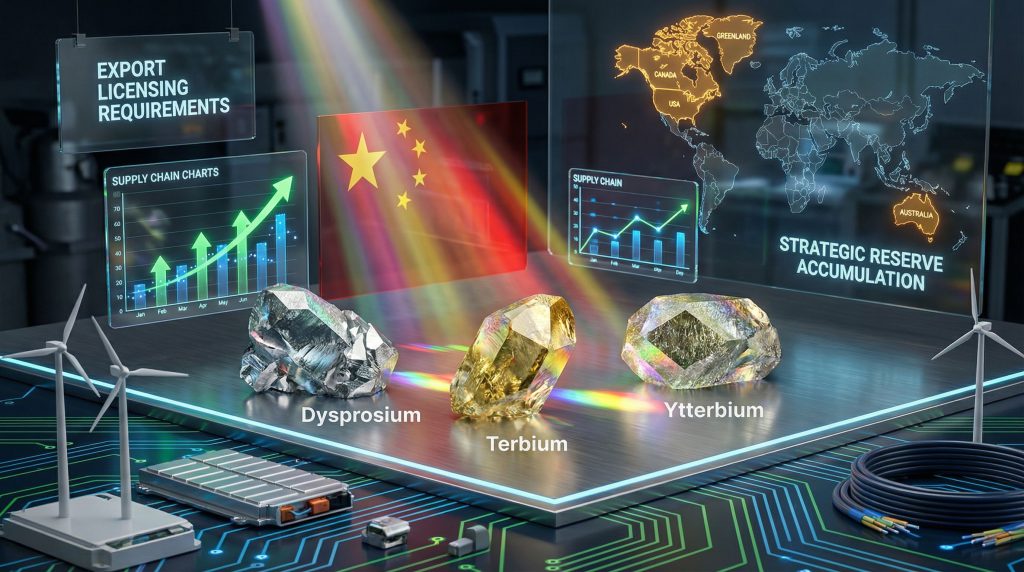
The rare earth elements market represents one of the most strategically complex resource systems in the global economy, where geological scarcity intersects with technological dependence and geopolitical leverage. Heavy rare earth elements, though comprising less than 10% of total rare earth production by volume, command disproportionate influence over critical technology sectors ranging from electric vehicles to defense systems. China export restrictions on heavy rare earths have fundamentally transformed these supply dynamics, creating unprecedented vulnerabilities for technology-dependent industries worldwide. The intricate supply chain architecture that connects mining operations in remote locations to high-tech manufacturing facilities has become increasingly vulnerable to regulatory disruption and strategic manipulation.
As manufacturing industries worldwide grapple with unprecedented supply chain volatility, understanding the mechanics of heavy rare earth element dependencies has become essential for strategic planning and risk management across multiple sectors. Furthermore, governments are implementing comprehensive critical minerals strategy frameworks to address these emerging vulnerabilities.
Understanding Heavy Rare Earth Elements and Their Strategic Importance
Heavy rare earth elements constitute a specialised subset of the 17-element rare earth family, distinguished by their atomic numbers above 63 and their exceptional technological properties. These elements include dysprosium, terbium, holmium, erbium, thulium, europium, and ytterbium, each serving critical functions in advanced manufacturing applications.
Critical Applications Across Technology Sectors
The strategic value of heavy rare earth elements stems from their unique electromagnetic and thermal properties that cannot be replicated through synthetic alternatives or conventional materials. In addition, recent developments in energy transition security have highlighted these dependencies.
| Element | Primary Applications | Critical Properties | Annual Global Demand |
|---|---|---|---|
| Dysprosium | Wind turbine magnets, EV motors | High-temperature coercivity | 280-320 metric tons |
| Terbium | LED phosphors, solid-state lighting | Green light emission efficiency | 45-55 metric tons |
| Holmium | Medical lasers, nuclear control rods | Magnetic pole strength | 15-20 metric tons |
| Erbium | Fiber optic amplifiers | Infrared light amplification | 85-100 metric tons |
| Thulium | Portable X-ray equipment | Radiation emission characteristics | 8-12 metric tons |
| Europium | Red phosphors, display technology | Colour rendering optimisation | 65-75 metric tons |
| Ytterbium | Industrial lasers, atomic clocks | Frequency stability | 25-35 metric tons |
Data compiled from USGS Mineral Commodity Summaries 2024 and International Energy Agency Critical Minerals Market Review 2024
Permanent Magnet Performance Enhancement
Dysprosium serves as the most critical heavy rare earth element in permanent magnet applications, where it functions as a dopant in neodymium-iron-boron (NdFeB) magnets. The addition of 6-8% dysprosium by weight increases magnetic coercivity by 25-35% and enables operation at temperatures exceeding 150°C without significant performance degradation.
This thermal stability proves essential for:
- Electric vehicle traction motors operating at winding temperatures of 150-180°C
- Wind turbine generators exposed to temperature variations from -40°C to +120°C
- Aerospace applications requiring consistent performance across extreme temperature ranges
- Industrial automation systems operating in high-heat manufacturing environments
Defence and Aerospace Applications
Heavy rare earth elements maintain strategic importance in defence applications due to their specialised electromagnetic properties and limited substitution possibilities. The U.S. Department of Defense designated dysprosium and terbium as critical minerals essential to national security, with military applications consuming approximately 500-800 metric tons annually across radar systems, missile guidance technology, and satellite communications.
The concentration of heavy rare earth processing capabilities in China creates strategic vulnerabilities for defence contractors and military equipment manufacturers worldwide, particularly for systems requiring long-term supply chain reliability and performance consistency.
When big ASX news breaks, our subscribers know first
How Export Licensing Systems Transform Global Supply Dynamics
China's implementation of export licensing requirements for heavy rare earth elements represents a fundamental shift in global resource governance, moving from market-based allocation to strategic regulatory control. The evolution of these restrictions throughout 2025 demonstrates escalating intent to leverage resource dominance for broader economic and geopolitical objectives.
Timeline of Regulatory Implementation
The progression of China export restrictions on heavy rare earths followed a systematic escalation pattern designed to maximise strategic impact while allowing time for compliance adaptation:
April 2025: Initial licensing framework applied to seven heavy rare earth elements, including dysprosium and terbium, with 30-day approval processes and discretionary denial provisions.
November 2025: Expansion to twelve total elements under export licensing, incorporating holmium, erbium, and other specialised heavy rare earths with enhanced documentation requirements.
December 2025: Implementation of extraterritorial compliance provisions requiring foreign manufacturers to demonstrate Chinese ownership stakes below 50% thresholds.
Current Status: Temporary suspension of export licences with ongoing enforcement framework and potential for rapid reactivation.
Market Price Response Mechanisms
The implementation of export licensing created immediate price volatility across heavy rare earth markets, with dysprosium oxide experiencing the most dramatic escalation:
- January 2025: Dysprosium oxide trading at $280-320/kg
- November 2025: Peak pricing reached $420-480/kg (representing 50-75% increases)
- Terbium oxide: Escalated from $650-750/kg to $950-1,050/kg over the same period
These price movements reflect not only supply scarcity but also strategic stockpiling behaviour by major industrial consumers and speculative positioning by commodity traders anticipating extended restrictions.
Export Licensing Compliance Requirements
China's Ministry of Commerce established standardised documentation protocols that effectively transform rare earth exports from commodity transactions to strategic resource transfers:
- End-use certification requiring detailed technical specifications demonstrating compliance with approved applications
- Quarterly allocation systems linking export licence volumes to previous-year export performance
- Technology audit provisions enabling Chinese authorities to review downstream applications and manufacturing processes
- Joint venture disclosure requirements documenting foreign ownership structures and technology-sharing arrangements
These compliance mechanisms create administrative barriers that effectively function as non-tariff trade restrictions whilst providing Chinese authorities with detailed intelligence regarding global heavy rare earth utilisation patterns.
Industrial Sectors Facing Critical Supply Vulnerabilities
The concentration of heavy rare earth processing in China creates asymmetric vulnerabilities across technology-dependent industries, with electric vehicle manufacturing, renewable energy infrastructure, and defence applications facing the most acute supply chain risks. However, recent policy developments including the critical minerals order have begun addressing these strategic vulnerabilities.
Electric Vehicle Manufacturing Dependencies
Electric vehicle production relies heavily on dysprosium-enhanced permanent magnets for traction motor performance and thermal stability. Global EV sales reached approximately 14 million units in 2024, with each vehicle requiring 8-12 kg of permanent magnets containing 0.5-1.2 kg of heavy rare earth elements.
Supply Chain Vulnerability Analysis:
- Projected 2025 EV Production: 18 million vehicles requiring 13.5 million kg of heavy rare earths
- Chinese Export Restriction Impact: 35-40% reduction in available global supply
- Potential Shortfall: 4.7-5.4 million kg deficit for 2025 production targets
The automotive supply chain demonstrates multi-tier vulnerability, where disruptions at magnet manufacturing levels cascade through component suppliers to final assembly operations. Recent analysis indicates that major automakers including General Motors and Ford have experienced production delays directly attributable to magnet supply constraints.
Renewable Energy Infrastructure Risks
Wind turbine manufacturing faces particular exposure to heavy rare earth supply disruptions due to the specialised magnet requirements for direct-drive generator systems. Global wind capacity installations exceeded 75 GW in 2024, with offshore installations requiring 600-800 kg of permanent magnets per MW of capacity.
Critical Supply Requirements:
- 2024 Offshore Wind Capacity: 20 GW requiring 1 million kg of dysprosium
- 2024 Onshore Wind Capacity: 55 GW requiring 825-1,100 million kg of dysprosium
- Total Wind Sector Consumption: 2-3 million kg of dysprosium annually
Wind turbine manufacturers including Vestas, Siemens Gamesa, and GE Renewable Energy face direct dependency on Chinese rare earth magnet suppliers, with approximately 65-70% of global wind turbine magnet supply originating from Chinese manufacturers or utilising Chinese rare earth inputs.
Defence and Aerospace Strategic Vulnerabilities
Military applications consume heavy rare earth elements across radar systems, missile guidance technology, satellite communications, and advanced fighter aircraft systems. The U.S. Department of Defense estimates annual consumption of 500-800 metric tons across these applications, with supply chain concentration in China creating strategic vulnerabilities.
Defence Sector Consumption Breakdown:
- Radar and communication systems: 35-40% of defence heavy rare earth consumption
- Missile guidance and seekers: 25-30%
- Satellite systems: 20-25%
- Advanced fighter aircraft: 10-15%
The extended development timelines and reliability requirements for defence systems make supply chain diversification particularly challenging, as qualification processes for alternative suppliers can require 2-3 years for critical components.
Alternative Supply Chain Development Strategies
Industrial response to Chinese export restrictions encompasses geographic diversification, recycling infrastructure development, and technology substitution research as complementary strategies for reducing supply chain vulnerabilities.
Geographic Supply Diversification
Non-Chinese heavy rare earth production capacity remains limited but expanding, with several projects advancing toward commercial production:
| Region | Project/Company | Development Status | Projected Capacity | Timeline |
|---|---|---|---|---|
| Australia | Lynas Corporation | Expansion planning | 500-750 MT HREEs | 2026-2027 |
| United States | Mountain Pass (MP Materials) | Processing upgrades | 200-300 MT HREEs | 2025-2026 |
| Canada | Appia Energy developments | Exploration/feasibility | 150-250 MT HREEs | 2027-2028 |
| Greenland | Kvanefjeld project | Regulatory approval | 1,000+ MT HREEs | 2028-2030 |
| Vietnam | Dong Pao deposit | Early exploration | Unknown capacity | 2029+ |
These alternative supply sources face significant development challenges including environmental permitting, processing technology deployment, and capital investment requirements that often exceed $500 million per facility.
Recycling and Urban Mining Solutions
End-of-life magnet recovery represents the most rapidly scalable alternative to primary mining for heavy rare earth supply. Current recycling rates for rare earth elements remain below 5% globally, indicating substantial expansion potential.
Recycling Infrastructure Development:
- Automotive magnet recovery: Programmes targeting hybrid and electric vehicle battery packs and motor systems
- Wind turbine decommissioning: Systematic recovery of generator magnets from end-of-life installations
- Electronic waste processing: Extraction from hard disk drives, speakers, and consumer electronics
- Industrial equipment refurbishment: Recovery from automation systems and manufacturing equipment
Advanced recycling technologies including hydrogen decrepitation and selective leaching can achieve 90-95% recovery rates for heavy rare earth elements from end-of-life magnets, though processing costs currently exceed primary production costs for most elements.
Technology Substitution Research
Long-term supply security strategies include development of alternative technologies that reduce or eliminate heavy rare earth dependencies:
- Ferrite magnet improvements achieving higher energy density through advanced ceramic formulations
- Rare earth-free motor designs utilising switched reluctance or induction motor architectures
- Advanced composite materials incorporating carbon fibre reinforcement for lightweight applications
- Synthetic element production through nuclear transmutation or advanced materials science
These substitution technologies face performance trade-offs including reduced energy density, increased weight, or higher manufacturing complexity that limit their applicability in performance-critical applications.
Extraterritorial Enforcement and Global Trade Implications
China's implementation of extraterritorial provisions in export licensing represents an unprecedented extension of sovereign authority over global supply chains, creating compliance burdens for international companies and potential conflicts with established trade law frameworks.
Compliance Framework for International Operations
The 50% ownership threshold requirement compels foreign manufacturers to document corporate structures and joint venture arrangements when purchasing Chinese rare earth materials. This creates administrative complexities for:
- Multinational corporations with complex subsidiary structures across multiple jurisdictions
- Joint ventures between Chinese and international partners in technology sectors
- Private equity investments involving Chinese capital participation in Western companies
- Supply chain partnerships requiring technology sharing or intellectual property licensing
Companies operating internationally face potential compliance conflicts where Chinese requirements contradict domestic regulatory frameworks or national security restrictions in their home countries.
Impact on Global Trade Architecture
The extraterritorial application of export controls challenges established principles of international trade law and creates precedents for resource-based economic coercion. Moreover, initiatives such as the proposed European CRM facility represent strategic responses to these challenges.
Trade Law Implications:
- WTO compliance questions regarding discriminatory treatment and export restriction justifications
- Bilateral trade agreement conflicts with existing resource trade provisions
- Investment treaty implications for foreign direct investment in Chinese rare earth processing
- National security exemptions potentially justifying retaliatory trade measures
International responses including trade complaints, diplomatic negotiations, and retaliatory measures are likely to shape the long-term framework governing critical mineral trade relationships.
Strategic Response Frameworks
Multinational corporations and government agencies are developing systematic approaches to navigate extraterritorial compliance requirements whilst maintaining operational flexibility:
- Corporate structure optimisation to minimise Chinese ownership exposure below threshold levels
- Alternative financing arrangements using non-Chinese capital sources for critical technology investments
- Supply chain segregation maintaining separate procurement channels for Chinese and non-Chinese inputs
- Technology compartmentalisation isolating sensitive applications from Chinese rare earth dependencies
These strategic adaptations require substantial organisational restructuring and may increase operational costs whilst reducing supply chain efficiency.
Economic Scenario Analysis and Market Implications
The long-term economic implications of Chinese heavy rare earth export restrictions vary significantly depending on enforcement duration, alternative supply development, and technology substitution progress across different scenario pathways.
Scenario 1: Extended Export Restrictions (24-36 Months)
Prolonged enforcement of export licensing with limited approvals would create sustained market disruption and accelerate structural changes across affected industries:
Economic Impacts:
- Price escalation: Heavy rare earth prices increasing 150-200% above 2024 baseline levels
- Manufacturing capacity reallocation: Production shifts toward regions with secured supply arrangements
- Technology innovation acceleration: Increased R&D investment in substitution technologies and recycling
- Geopolitical alliance restructuring: Enhanced cooperation between non-Chinese suppliers and consumers
This scenario would likely trigger significant government intervention including strategic reserve releases, emergency procurement programmes, and trade retaliation measures.
Scenario 2: Gradual Market Normalisation (12-18 Months)
Negotiated resolution leading to modified export licensing with increased quotas and streamlined approval processes:
Market Adjustments:
- Strategic stockpile establishment by major industrial consumers to buffer future disruptions
- Diversified supplier network development reducing Chinese market share from 85% to 60-65%
- Enhanced recycling infrastructure achieving 15-20% supply contribution from secondary sources
- Modified just-in-time logistics incorporating strategic inventory reserves for critical materials
This pathway would establish new equilibrium pricing 25-40% above pre-restriction levels whilst reducing supply chain concentration risks.
Scenario 3: Complete Supply Chain Decoupling (36+ Months)
Permanent separation of Chinese and Western rare earth supply chains through sustained export restrictions and retaliatory trade measures:
Structural Transformations:
- Western hemisphere mining expansion achieving 40-50% global heavy rare earth production capacity
- Technology transfer limitations restricting Chinese access to advanced processing and application technologies
- National security prioritisation with government-directed investment in domestic supply chains
- Long-term cost structure changes incorporating security premiums and domestic production costs
Complete decoupling would require 5-7 years to achieve supply balance and involve total investment costs exceeding $10-15 billion across mining, processing, and recycling infrastructure.
The next major ASX story will hit our subscribers first
Corporate Procurement Strategy Adaptation
Industrial companies across affected sectors are implementing systematic changes to procurement strategies, moving from cost-optimisation models to security-focused frameworks that prioritise supply reliability over price minimisation.
Risk Mitigation Implementation
Manufacturing companies are developing multi-dimensional approaches to reduce heavy rare earth supply vulnerabilities:
Supply Chain Resilience Measures:
- Multi-source supplier qualification requiring minimum three independent supply sources for critical materials
- Strategic inventory management maintaining 6-12 months forward coverage for essential rare earth inputs
- Contract hedging mechanisms using financial instruments to manage price volatility exposure
- Technology roadmap diversification developing product variants with reduced rare earth dependencies
These adaptations require substantial working capital increases and supply chain management complexity whilst providing protection against future disruptions.
Vertical Integration Strategies
Major industrial companies including General Motors are pursuing direct relationships with upstream suppliers to secure supply chain control:
- Tier 3 magnet maker partnerships with companies including VAC, Shin-Etsu, and Noveon for direct magnet sourcing
- Oxide processor agreements ensuring access to refined rare earth materials from domestic sources
- Recycling facility investments developing internal capacity for end-of-life product recovery
- Mining project equity participation securing long-term supply through ownership stakes in development projects
Vertical integration strategies require significant capital investment but provide enhanced supply security and price stability over multi-year planning horizons.
Investment Prioritisation Areas
Corporate capital allocation is shifting toward supply chain security investments that historically received lower priority:
- Domestic processing capabilities including magnet manufacturing and rare earth separation facilities
- Recycling infrastructure development for automotive, wind energy, and electronics applications
- Alternative technology research focusing on rare earth-free or reduced-dependency solutions
- Supply chain transparency systems enabling real-time monitoring of material flows and inventory levels
These investment priorities reflect fundamental shifts from globalised cost optimisation toward regionalised security optimisation in critical material supply chains.
Government Policy Responses and Market Stabilisation
National governments across major industrial economies are implementing coordinated policy responses to address heavy rare earth supply vulnerabilities through strategic reserves, domestic production incentives, and international cooperation frameworks. Consequently, developments such as the mineral production order reflect this strategic reorientation.
National Security Designation Programmes
Critical mineral designation enables government intervention in supply chain development through various policy mechanisms:
Strategic Framework Components:
- National stockpile establishment with target inventory levels covering 6-24 months of industrial consumption
- Defence Production Act authorities enabling government direction of private sector production and allocation
- Foreign investment screening for transactions involving critical mineral assets and processing capabilities
- Allied cooperation frameworks including burden-sharing arrangements for strategic reserve maintenance
The U.S. Department of Defense and European Commission have designated heavy rare earth elements as critical to national security, enabling enhanced government involvement in supply chain development and risk mitigation.
Economic Development Incentive Structures
Government programmes supporting domestic rare earth industry development include both direct financial support and regulatory facilitation:
Investment Incentive Programmes:
- Mining project tax credits providing 20-30% investment tax credits for domestic rare earth development
- Processing facility grants covering 30-50% of capital costs for separation and refining infrastructure
- Research and development funding supporting university and industry collaboration on recycling and substitution technologies
- Infrastructure investment programmes including specialised transportation and waste management facilities
These programmes aim to accelerate domestic supply chain development timelines from 7-10 years to 4-6 years through risk mitigation and cost sharing arrangements.
International Cooperation Frameworks
Multilateral initiatives including the Minerals Security Partnership and EU Critical Minerals Alliance facilitate coordinated responses to supply chain vulnerabilities:
- Resource-sharing agreements enabling cross-border access to strategic reserves during supply disruptions
- Technology cooperation programmes supporting joint research on recycling and substitution technologies
- Investment coordination mechanisms preventing redundant capacity development and ensuring efficient resource allocation
- Trade policy alignment including coordinated responses to export restrictions and supply chain manipulation
These cooperation frameworks represent emerging governance structures for critical mineral security in an increasingly multipolar global economy.
Addressing Common Questions About Heavy Rare Earth Restrictions
Strategic Rationale for Export Controls
China's implementation of export licensing reflects multiple strategic objectives including domestic industry protection, technology transfer leverage, and geopolitical positioning. The restrictions preserve access to heavy rare earths for Chinese manufacturers in electric vehicles, renewable energy, and advanced defence applications whilst creating asymmetric dependencies for international competitors.
The 50% ownership compliance threshold and technology licensing audit provisions enable Chinese authorities to condition market access on technology partnerships or knowledge-sharing arrangements, effectively using resource leverage to advance technological development objectives.
Duration and Enforcement Expectations
Current restrictions remain under temporary suspension through 2026, but underlying strategic objectives suggest potential for extended implementation. Market conditions, international negotiation outcomes, and domestic Chinese industrial development will influence long-term enforcement decisions.
Historical precedent from the 2010-2012 rare earth export restrictions indicates that enforcement duration often exceeds initial announcements, particularly when geopolitical tensions persist or domestic strategic objectives remain unachieved. Furthermore, IEA commentary emphasises how such concentration risks have become reality.
Alternative Supply Development Timeline
Non-Chinese heavy rare earth supply development faces substantial technical and financial challenges requiring 5-7 years for meaningful scale achievement. Alternative supply strategies include:
Near-term Options (1-3 years):
- Recycling capacity expansion achieving 10-15% supply contribution from secondary sources
- Strategic inventory utilisation from government and corporate stockpiles
- Technology optimisation reducing heavy rare earth consumption through improved magnet designs
Medium-term Development (3-6 years):
- Non-Chinese mining projects including Australian and North American developments
- Processing facility construction for domestic rare earth separation and refining
- Substitution technology deployment achieving commercial viability for specific applications
Long-term Structural Change (5-10 years):
- Supply chain regionalisation with reduced Chinese market dependence
- Technology transformation enabling significant rare earth consumption reduction
- Circular economy integration with comprehensive recycling covering 30-40% of demand
Future Outlook: Structural Market Evolution
The heavy rare earth market is undergoing fundamental transformation from a commodity-based system toward a strategically managed resource allocation framework, with profound implications for global industrial development and technological innovation.
Emerging Supply Chain Architecture
Long-term market evolution will likely establish multiple regional supply chain clusters with reduced interdependence and enhanced security characteristics:
Regional Production Clusters:
- North American Integration: U.S.-Canada-Mexico supply chain development with processing facilities and recycling infrastructure
- European Union Coordination: Nordic mining projects linked to German and French processing capabilities
- Indo-Pacific Partnership: Australia-Japan-South Korea cooperation incorporating Vietnamese and Indian resources
- Chinese Domestic Circuit: Enhanced domestic processing serving internal consumption and strategic export allocation
These regional clusters will operate with limited cross-cluster integration, reflecting geopolitical considerations and supply chain security prioritisation over economic efficiency optimisation.
Technology Integration and Innovation Pathways
Sustained supply chain pressures will accelerate technology development across multiple dimensions:
- Advanced recycling technologies achieving 95%+ recovery rates with automated disassembly and separation
- Rare earth-free alternatives including ferrite magnets with enhanced performance characteristics
- Synthetic production methods using nuclear transmutation or advanced chemical synthesis
- Circular design principles enabling efficient end-of-life material recovery in new products
These technological advances will gradually reduce heavy rare earth intensity across major applications whilst maintaining or improving performance characteristics.
Investment Opportunities and Risk Assessment
The structural transformation of heavy rare earth markets creates both opportunities and risks for industrial investors and technology companies:
High-Potential Investment Sectors:
- Non-Chinese mining development with government support and long-term supply agreements
- Advanced recycling infrastructure serving automotive, renewable energy, and electronics sectors
- Alternative technology platforms reducing rare earth dependencies in critical applications
- Supply chain technology solutions enabling transparency, traceability, and risk management
Risk Factors Requiring Monitoring:
- Policy volatility in both Chinese export controls and Western government support programmes
- Technology substitution speed potentially reducing market demand for specific rare earth elements
- Capital requirement magnitude for domestic supply chain development exceeding available investment
- Geopolitical escalation creating additional trade restrictions and supply chain fragmentation
Investment Disclaimer: The analysis presented reflects current market conditions and policy frameworks as of December 2025. China export restrictions on heavy rare earths and rare earth markets remain subject to significant political, economic, and technological uncertainties that may materially affect future supply, demand, and pricing dynamics. Investors should conduct independent due diligence and consider consultation with specialised advisors before making investment decisions in rare earth-related assets or technologies.
The evolution of heavy rare earth supply chains represents a fundamental shift toward security-prioritised resource management, with implications extending far beyond material costs to encompass technological sovereignty, industrial competitiveness, and geopolitical stability in an increasingly multipolar global economy.
Ready to Capitalise on Critical Minerals Market Volatility?
Heavy rare earth supply disruptions create both challenges and opportunities for investors, particularly in ASX-listed critical minerals companies responding to these global supply chain shifts. Discovery Alert's proprietary Discovery IQ model delivers real-time notifications on significant ASX mineral discoveries, helping investors identify actionable opportunities in the rapidly evolving critical minerals sector before broader market recognition occurs.