Heavy Rare EARTHS Ltd
- ASX Code: HRE
- Market Cap: $7,281,186
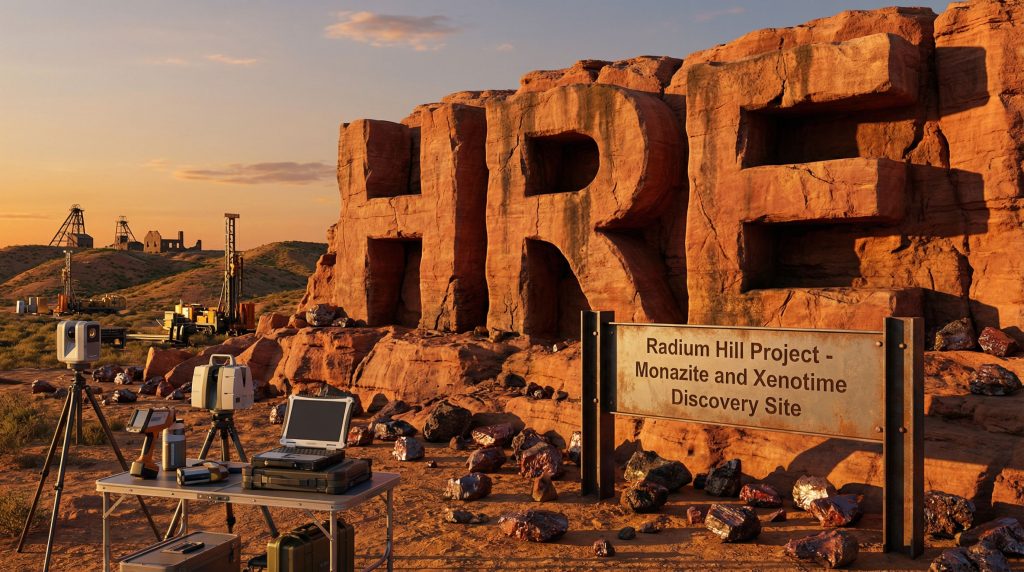
Heavy Rare Earths Limited (ASX:HRE) has announced significant mineralogical discoveries at its Radium Hill Project in South Australia, with collaborative research confirming the presence of monazite and xenotime – two highly sought-after rare earth element host minerals previously unrecognised in the area. The Heavy Rare Earths Ltd Radium Hill discovery represents a breakthrough in understanding the mineral potential of this historic mining region.
Working with Adelaide University through the Australian Research Council's Centre for Critical Resources for the Future (CCRF), the company has identified these critical minerals within the 8km Bonython Critical Mineral Corridor (BCMC), a structural zone extending from the historic Radium Hill Mine to Bonython Hill.
First Discovery of Monazite and Xenotime at Radium Hill in 60+ Years
The research represents the first significant mineralogical investigation into Radium Hill-style mineralisation in over 60 years, with previous work focused almost exclusively on uranium extraction. Using modern scanning electron microscope (SEM) analysis, researchers examined samples from two key locations.
Sample 25RH13 was collected from ore piles at the historical Radium Hill Mine, whilst Sample 25RH08 was taken from Taylor's shaft, a pre-WWII uranium mine 3.7km from the exclusion zone. The findings revealed monazite and xenotime minerals associated with the well-documented davidite-rutile-ilmenite mineralisation.
Testing confirmed the presence of rare earth elements (REEs) and yttrium within individual mineral grains. Furthermore, this breakthrough validates the company's approach of applying modern analytical techniques to historically productive areas.
Gabriel Chiappini, Chair of the Board, commented:
"We are encouraged with the results of research and studies performed thus far at Adelaide University. Our collaboration has uncovered key indicators of the existence of sought-after Heavy Rare Earths elements and Yttrium, with the presence of Monazite and Xenotime in mineral systems congruent with that of the Radium Hill Mine."
When big ASX news breaks, our subscribers know first
Understanding Monazite and Xenotime: Critical Mineral Powerhouses
For investors new to rare earth mineralogy, monazite and xenotime represent some of the most valuable mineral hosts for critical elements used in clean energy and technology applications. Consequently, the Heavy Rare Earths Ltd Radium Hill discovery positions the company strategically in these markets.
Monazite is a phosphate mineral that typically concentrates light rare earth elements (LREEs) such as lanthanum and cerium. These elements are essential for permanent magnets, catalysts, and glass polishing compounds. The SEM analysis confirmed high concentrations of these elements in the Radium Hill samples.
Xenotime is a yttrium phosphate mineral that preferentially hosts heavy rare earth elements (HREEs) – the most valuable subset of rare earths including dysprosium, terbium, and yttrium. These elements are critical for wind turbines, electric vehicle motors, and advanced electronics.
What makes these minerals particularly attractive to investors is their proven flowsheet for commercial production. Unlike many rare earth deposits where extraction methods remain experimental, monazite and xenotime have established processing techniques developed over decades of industrial application.
Both minerals can be processed using conventional mineral separation techniques, potentially reducing technical risk for future development scenarios. In addition, the presence of these well-understood mineral hosts suggests the potential for more straightforward metallurgical processing compared to complex rare earth deposits hosted in other mineral types.
Strategic Positioning Within the Bonython Critical Mineral Corridor
The discoveries occur within HRE's 57km² Radium Hill Project, specifically along the BCMC where previous surface sampling has already returned positive assays for multiple critical elements. The Heavy Rare Earths Ltd Radium Hill discovery encompasses several critical elements with high commercial value.
| Critical Element | Symbol | Strategic Applications |
|---|---|---|
| Yttrium | Y | LED phosphors, lasers, superconductors |
| Scandium | Sc | Aerospace alloys, fuel cells |
| Rare Earth Elements | REEs | Permanent magnets, defence systems |
| Vanadium | V | Battery storage, steel strengthening |
The corridor features small-scale pits and shafts scattered along prospects including Railways, Bristowe's, Radium Hill North, and Bonython Hill. These historical workings suggest previous recognition of mineralisation that modern analysis has now proven to contain high-value critical minerals.
The structural continuity of the 8km corridor provides substantial exploration potential beyond the two initial sample locations. However, the company noted that additional samples have been collected between Radium Hill Mine and Taylor's shaft for ongoing processing.
Research Collaboration Delivers Modern Analytical Power
The partnership with Adelaide University's CCRF represents a strategic approach to understanding mineralisation using cutting-edge techniques that were unavailable during previous exploration programs. For instance, the Heavy Rare Earths Ltd Radium Hill discovery utilised several advanced analytical methods.
- Electron Probe Microanalysis (EPMA) – Provides precise chemical analysis of individual mineral grains
- Energy Dispersive X-ray Spectroscopy (EDS) – Identifies elemental composition at microscopic scale
- Scanning Electron Microscopy (SEM) – Delivers high-resolution imaging of mineral textures and relationships
These modern analytical methods have revealed mineral relationships that were invisible to historical exploration programs, potentially opening multi-commodity critical mineral opportunities across the project area.
The company noted that the genetic association between the newly identified monazite and xenotime with the known davidite mineralisation remains under investigation. This ongoing research could reveal additional discovery potential along the 8km corridor and help develop targeting criteria for future exploration.
Near-Term Catalysts and Exploration Timeline
HRE has outlined clear next steps to capitalise on these mineralogical discoveries. Furthermore, the company's systematic approach ensures comprehensive evaluation of the Heavy Rare Earths Ltd Radium Hill discovery potential.
Immediate Activities
- Additional sample processing from locations between Radium Hill Mine and Taylor's shaft through the CCRF collaboration
- Continued petrological analysis at Adelaide University Microscopy Centre to understand mineral genesis
- Compilation of over 60 years of historical geological and geochemical data
Short-Term Exploration
- On-ground geological mapping with scintillometer and handheld XRF analysis
- Target generation based on new geological model development incorporating modern mineralogical understanding
- Near-term drilling program targeting critical mineral resource discoveries along the BCMC
Strategic Development
- Integration of existing magnetic and radiometric survey interpretations with new geological models
- Development of comprehensive geological model for Radium Hill-type uranium-scandium-REE mineralisation
Investment Thesis: First-Mover Advantage in Proven System
Heavy Rare Earths presents a compelling investment proposition based on several converging factors that differentiate it within the critical minerals exploration sector. The Heavy Rare Earths Ltd Radium Hill discovery demonstrates several key advantages.
Proven Historical Production
The Radium Hill Mine operated from 1908-1961, demonstrating substantial mineral endowment in the area. However, the exclusive focus on uranium extraction during this period meant that critical minerals were largely overlooked, despite their presence being documented in early geological reports.
Modern Technology Advantage
The application of 21st-century analytical techniques to a historically productive mineral system provides HRE with significant discovery potential that previous operators could not access. Advanced SEM analysis and microprobe techniques can identify mineral phases that were invisible to historical exploration methods.
Strategic Location Benefits
South Australia's Curnamona Province is recognised as an emerging critical minerals hub. The state government has indicated support for diversifying the mining economy beyond traditional iron ore and copper operations.
Multi-Commodity Revenue Potential
The confirmed presence of uranium, rare earths, scandium, yttrium, and vanadium in the same mineralised system provides potential for multiple revenue streams, reducing single-commodity price risk.
The discovery of monazite and xenotime specifically enhances the project's attractiveness as these minerals are well-understood by processing facilities globally, potentially reducing technical risk in any future development scenarios.
Market Context and Timing
The confirmation of high-value rare earth minerals comes at a time of increased global focus on critical mineral security. Supply chain diversification away from Chinese rare earth dominance has created investment interest in alternative sources, particularly those in stable jurisdictions like Australia.
Heavy rare earth elements, which xenotime preferentially hosts, trade at significantly higher prices than light rare earths. Dysprosium and terbium, key components in permanent magnets for wind turbines and electric vehicles, have seen sustained price premiums due to limited global supply sources.
The 8km Bonython Critical Mineral Corridor provides substantial exploration upside beyond the initial two sample locations. Historical drilling data indicates approximately 190 drillholes were completed within the project area outside the exclusion zone, providing a foundation for targeting future exploration.
The next major ASX story will hit our subscribers first
Why Investors Should Monitor Heavy Rare Earths
The confirmation of monazite and xenotime at Radium Hill represents more than a mineralogical discovery – it validates HRE's strategy of applying modern analytical techniques to historically productive areas with untested critical mineral potential. Consequently, the Heavy Rare Earths Ltd Radium Hill discovery could reshape understanding of the region's mineral potential.
With near-term drilling planned and ongoing research collaboration with Adelaide University, the company is positioned to potentially define critical mineral resources in a proven geological system. The partnership with Havilah Resources ensures access to established mineral tenure with existing Native Title agreements and regulatory frameworks.
The combination of proven historical mineralisation, modern analytical capabilities, and strategic timing within the global critical minerals supply chain creates a compelling early-stage investment opportunity in Australia's emerging critical minerals sector.
Key Investment Considerations:
Heavy Rare Earths has positioned itself within a historically productive mineral system using modern techniques unavailable to previous operators. The confirmation of high-value monazite and xenotime minerals, combined with planned drilling programmes and university research collaboration, suggests significant exploration upside in the expanding critical minerals market.
Is Heavy Rare Earths Your Next Critical Minerals Investment?
With monazite and xenotime confirmed at the historic Radium Hill Project and near-term drilling programmes planned across the 8km Bonython Critical Mineral Corridor, Heavy Rare Earths Limited (ASX:HRE) is positioned to capitalise on the global critical minerals opportunity. The company's strategic partnership with Adelaide University and systematic approach to exploring this historically productive system using modern analytical techniques presents a compelling proposition for investors seeking exposure to Australia's emerging rare earth sector. To explore how HRE's multi-commodity potential and first-mover advantage in proven mineralisation could fit within your investment portfolio, visit the company's investor section for detailed project information, financial reports, and upcoming milestones.