June 4, 2026
Stacked Pay, Restricted Chokes, and a Six-Well Bet on Colombia's Gas Future
When exploration geologists talk about de-risking a campaign, they rarely mean it in the absolute sense. Risk in onshore gas exploration is never fully eliminated; it is redistributed, compressed, and reframed through successive data points. The Sinú Basin in northern Colombia has spent decades accumulating those data points quietly, with each well adding a new layer to a geological narrative that is now attracting serious mid-tier international capital. Understanding why the Maurel & Prom Hechicero-1X gas discovery in Colombia matters requires stepping back from the headline flow rate and examining what the subsurface actually confirmed, how the well was engineered, and what the result means for the five wells still to come in 2026.
When big ASX news breaks, our subscribers know first
Colombia's Gas Market and the Economics Driving Sinú-9 Exploration
Colombia's domestic natural gas pricing environment sits at approximately US$8 per MMBtu, a level that makes onshore gas exploration commercially compelling for operators willing to commit to multi-well appraisal programs. Monitoring natural gas price trends reveals how volatile market conditions can be, yet unlike offshore deepwater development — where capital intensity is enormous and breakeven prices are correspondingly high — onshore Colombian gas can be monetised rapidly through existing pipeline infrastructure at unit economics that reward early movers.
The Sinú Basin occupies a particular position within this landscape. Its geological architecture, characterised by stacked carbonate and clastic reservoir sequences deposited across different geological periods, creates the conditions for multi-zone discoveries within a single wellbore. This stacking is not a theoretical geological concept on Sinú-9; it is precisely what Hechicero-1X confirmed in practice.
Colombia's growing supply-demand gap for domestic gas has intensified pressure on operators to convert exploration acreage into production assets quickly. Industrial consumers and residential distribution networks alike depend on a steady domestic supply base, and the country's capacity to substitute imports with locally produced gas remains a central concern for energy planners. Furthermore, understanding the broader LNG supply outlook helps contextualise why blocks like Sinú-9, positioned within an already-productive basin with established transportation links, offer the fastest pathway from drill bit to grid.
The Sinú-9 Block: Ownership Structure and Exploration History
The Sinú-9 block is operated by Maurel & Prom SA, which assumed operatorship with a 61% working interest effective January 2026. NG Energy International Corp. holds the remaining 39% non-operating interest. This ownership transition was consequential. Maurel & Prom's entry as operator brought with it a more accelerated drilling cadence, replacing a pace of development that had previously been measured rather than aggressive.
Two earlier wells on Sinú-9, Magico-1X and Brujo-1X, served as geological reference points for the Hechicero-1X design. These analogues informed both the stratigraphic targeting decisions and the completion architecture of the new well. When NG Energy announced the Sinú-9 discovery, confirming that Hechicero-1X results are consistent with those prior wells, the statement carried meaningful technical weight: it suggested reservoir continuity across the block rather than isolated pockets of gas accumulation.
Reservoir continuity across multiple wells within the same block is one of the most important de-risking signals in appraisal drilling. It implies that the geological model holding for one well location is likely representative of the broader structural fairway, which directly reduces volumetric uncertainty for subsequent targets.
In addition, the exploration de-risking process is a critical consideration for investors assessing whether successive campaign wells are likely to replicate initial results or face increasing geological uncertainty.
Hechicero-1X: Well Architecture and Drilling Timeline
The Hechicero-1X well was spudded on February 24, 2026, and reached a total measured depth of 8,500 ft MD on March 28, 2026. The drilling duration of approximately 32 days to total depth reflects an efficient operation for an onshore well of this depth profile.
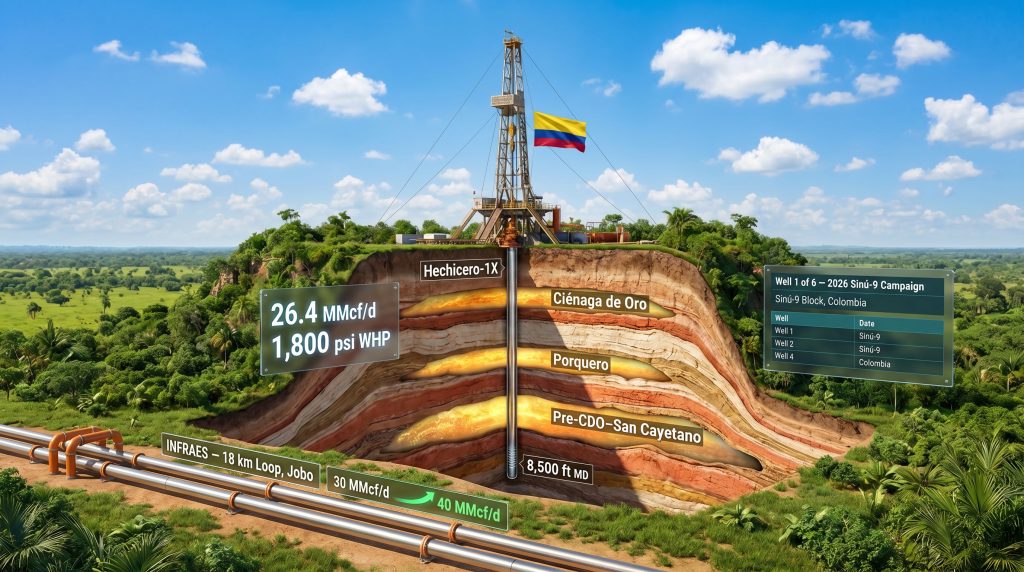
The completion design is worth examining closely. Rather than completing the well as a single producing interval, the team configured Hechicero-1X to allow selective production across multiple stratigraphic zones. Specifically, the well was completed across five intervals within the Ciénaga de Oro formation and the deeper Pre-CDO–San Cayetano zone. This architecture preserves operational flexibility: different intervals can be opened or shut in independently, allowing the operator to optimise production profiles as infrastructure capacity evolves.
The choice of a 43/128-inch restricted choke during initial testing is a deliberate engineering decision that is frequently misunderstood outside technical circles. Operators use restricted choke sizes during early flow tests to protect reservoir integrity, control drawdown rates, and gather stabilised pressure data. A smaller choke constrains surface flow rates but provides far more reliable reservoir characterisation data than an unrestricted or fully open test would. Consequently, published initial flow rates under restricted choke conditions represent a conservative lower bound on deliverability, not the well's maximum productive capacity.
Three Gas-Bearing Formations Confirmed: What the Electric Log Data Showed
Electric log analysis across Hechicero-1X confirmed gas saturation in three distinct stratigraphic units. The data points below summarise the confirmed net pay figures across each formation:
| Formation | Stratigraphic Position | Confirmed Net Pay | Completion Status |
|---|---|---|---|
| Ciénaga de Oro (CDO) | Primary target | 288 ft | 5 intervals completed for selective production |
| Porquero | Shallower secondary | 149 ft | Additional upside above primary target |
| Pre-CDO–San Cayetano | Deeper interval | 103 ft | Initial production interval; new play type |
The aggregate confirmed net pay across all three formations totals 540 ft within a single wellbore. This is a notable volumetric result, but the significance extends beyond the raw number.
Each formation represents a different depositional environment and age. The Ciénaga de Oro is a well-characterised carbonate-rich sequence that has been the dominant exploration target across the Sinú Basin for years. The Porquero, sitting stratigraphically above the CDO, adds shallower clastic reservoir exposure. The Pre-CDO–San Cayetano is, however, the most consequential discovery of the three in terms of future exploration implications.
The Pre-CDO–San Cayetano: A New Play Type Opens Up
Prior exploration on Sinú-9 concentrated almost exclusively on the Ciénaga de Oro as the primary objective. The Pre-CDO–San Cayetano interval, sitting deeper in the stratigraphic column, had not been established as a primary target. Its confirmation as a gas-bearing zone at Hechicero-1X introduces what geologists describe as a new play type for the block: a distinct reservoir system with its own pressure regime, fluid contacts, and productive characteristics.
The importance of this cannot be overstated for the remaining five wells in the 2026 program. If the Pre-CDO–San Cayetano is mappable across the block and correlates with the same geological controls that made it productive at Hechicero-1X, every subsequent well in the campaign carries an additional upside interval that was not part of the original resource thesis. This type of play extension, where a deeper zone opens up beneath an already-proven shallower reservoir system, is one of the mechanisms through which exploration programs generate step-change revisions to resource estimates.
NG Energy's characterisation of the Hechicero-1X result as consistent with Magico-1X and Brujo-1X outcomes at the CDO level implies lateral continuity in the primary formation. Whether the deeper Pre-CDO–San Cayetano zone demonstrates the same lateral extent across the block will be one of the key geological questions answered by the remaining campaign wells.
Initial Flow Test Results: Reading the 26.4 MMcf/d Figure Correctly
Initial tests conducted on April 22 to 24, 2026 on the Pre-CDO–San Cayetano interval recorded an instantaneous rate of 26.4 MMcf/d at 1,800 psi wellhead pressure through the restricted 43/128-inch choke. Maurel & Prom indicated the well was expected to be brought into production within days of the April 28, 2026 announcement. Maurel & Prom's update on the Sinú-9 drilling campaign provides further detail on the operational timeline and infrastructure planning surrounding these results.
The figure demands contextual interpretation. Several factors shape how this flow rate should be read:
- The test was conducted on a single interval, the Pre-CDO–San Cayetano zone, which contains 103 ft of net pay, the smallest of the three confirmed formations.
- The five CDO intervals, representing 288 ft of net pay, have not yet been tested for flow rate. Their contribution to total well deliverability remains unquantified but is expected to be substantial given the larger net pay volume.
- The choke restriction means the reservoir was deliberately prevented from producing at its full potential during the test period.
- At 1,800 psi wellhead pressure, the well demonstrated strong reservoir pressure support, a critical indicator of reservoir quality and the likelihood of sustained production rates over time.
The 26.4 MMcf/d result from the deepest and smallest pay zone suggests that when CDO production is layered on top through the five completed intervals, aggregate well deliverability could substantially exceed the figures already published. This is speculative at this stage, but the well architecture was specifically designed to enable this multi-zone production scenario.
The next major ASX story will hit our subscribers first
Infrastructure: The 30 MMcf/d Bottleneck and the INFRAES Solution
Even the most productive wellbore is ultimately constrained by the infrastructure available to move gas from the wellhead to market. At Sinú-9, this constraint is real, immediate, and already being addressed in parallel with the drilling campaign.
Current transportation capacity connected to Colombia's national gas network at Sinú-9 sits at 30 MMcf/d. With existing producers already utilising a portion of that capacity, the addition of Hechicero-1X production is expected to fill the available headroom within a short time frame. The production pathway for the well follows a logical sequence:
- Initial production from the Pre-CDO–San Cayetano interval via existing tie-in infrastructure connected to Colombia's national transportation system.
- Incremental contribution from CDO intervals as production optimisation proceeds.
- Capacity expansion to 40 MMcf/d upon completion of the INFRAES twin pipeline loop project.
- Full deployment of well deliverability potential as pipeline headroom grows alongside subsequent campaign wells.
The INFRAES project involves constructing a twin pipeline along the existing right-of-way, with an initial 18-kilometre loop from Jobo targeted for completion by the end of May 2026. Upon completion, this loop adds approximately 10 MMcf/d of incremental transportation capacity, lifting the system ceiling to 40 MMcf/d.
The parallel timing of drilling activity and infrastructure construction is operationally significant. It reflects an operator conviction that the wells will produce, not merely that they might. Furthermore, building pipeline capacity ahead of confirmed production volumes is a capital commitment that signals long-term development intent rather than cautious, one-step-at-a-time appraisal.
The Six-Well Campaign: What Comes After Hechicero-1X
Hechicero-1X is the first of six wells planned for the Sinú-9 block in 2026 under Maurel & Prom's exploration program. The drilling rig moved directly to Magico-2X following completion of Hechicero-1X operations, targeting appraisal of the earlier Magico discovery and a potential step-up in resource volumes at that location. Running multi-well drilling programs of this scale requires both geological confidence and sufficient balance sheet depth to maintain momentum across successive wells without interruption.
The risk profile of the remaining campaign has shifted measurably following Hechicero-1X's result. Several factors now work in favour of subsequent wells:
- Multi-formation gas confirmation across three stratigraphic levels validates the geological model applied to the broader Sinú-9 acreage position.
- Consistency with Magico-1X and Brujo-1X results demonstrates that the CDO reservoir is laterally continuous and not isolated to a single structural closure.
- The Pre-CDO–San Cayetano discovery introduces an additional reservoir interval that was not in the original campaign design, giving each subsequent well an opportunity to test this new play type at a fresh location.
An illustrative scenario, based on published well results and not intended as a production forecast, gives a sense of the aggregate potential: if each of the six campaign wells delivers net pay and flow characteristics broadly comparable to Hechicero-1X, combined CDO net pay across the program could exceed 1,700 ft in aggregate, with combined initial flow capacity approaching or exceeding 150 MMcf/d, subject to infrastructure scaling that would need to run well ahead of such volumes.
This scenario is strictly illustrative. Actual results will vary based on reservoir heterogeneity, structural position, and individual well characteristics at each location. It should not be interpreted as a production forecast or resource estimate.
Key Metrics: Hechicero-1X at a Glance
| Parameter | Detail |
|---|---|
| Well Name | Hechicero-1X |
| Block | Sinú-9, Colombia |
| Operator | Maurel & Prom SA (61% WI) |
| Non-Operating Partner | NG Energy International Corp. (39% WI) |
| Spud Date | February 24, 2026 |
| Total Measured Depth | 8,500 ft MD |
| Total Depth Reached | March 28, 2026 |
| Primary Formation (CDO) Net Pay | 288 ft |
| Secondary Formation (Porquero) Net Pay | 149 ft |
| Tertiary Formation (Pre-CDO–San Cayetano) Net Pay | 103 ft |
| Total Confirmed Net Pay | 540 ft |
| Initial Test Rate | 26.4 MMcf/d at 1,800 psi WHP |
| Choke Size | 43/128-inch (restricted) |
| Test Dates | April 22 to 24, 2026 |
| Current Infrastructure Capacity | 30 MMcf/d |
| Post-Expansion Capacity (INFRAES loop) | 40 MMcf/d |
| Pipeline Expansion Completion Target | End of May 2026 |
| Campaign Well Position | Well 1 of 6 (2026 program) |
| Next Well | Magico-2X |
Source: Oil & Gas Journal, April 28, 2026 (ogj.com)
What the Hechicero-1X Result Signals for Colombia's Onshore Gas Development Trajectory
The Sinú Basin is not a frontier exploration province in the conventional sense. Its carbonate and clastic reservoir sequences have been known to geologists for decades. What has changed is the combination of domestic gas price incentives, improved subsurface characterisation tools, and the entry of operators with the balance sheet and technical appetite to run multi-well campaigns rather than one-off appraisal wells.
The Maurel & Prom Hechicero-1X gas discovery in Colombia adds a meaningful data point to the evolving picture of Colombia's onshore gas potential. Three formations confirmed as gas-bearing, 540 ft of total net pay, a flow test result of 26.4 MMcf/d from the smallest of the three confirmed intervals under restricted conditions, and infrastructure investment running concurrently with drilling activity: taken together, these elements present a coherent picture of a block moving from exploration into early-stage development.
The Pre-CDO–San Cayetano discovery is the element of the result that deserves the most attention going forward. By opening a new play type that sits below the historically dominant CDO target, Hechicero-1X has expanded the prospective footprint of Sinú-9 in both a vertical and areal sense. How this zone performs across the remaining five campaign wells will shape the longer-term resource thesis for the block and, by extension, its contribution to Colombia's domestic gas supply base.
Moreover, following the project development pathway from discovery through to sustained production requires not just geological success but disciplined capital allocation and infrastructure development in parallel — both of which appear to be firmly in place at Sinú-9.
For investors and industry observers tracking Colombia's onshore gas sector, the six-well program on Sinú-9 now represents one of the most active exploration sequences in the country's current drilling calendar. The pace of results through the remainder of 2026 will determine whether the block transitions from a promising appraisal story into a confirmed cornerstone of Colombia's domestic gas production landscape.
This article contains forward-looking statements and illustrative production scenarios based on publicly available information. These should not be interpreted as investment advice or production forecasts. Readers should conduct their own due diligence before making any financial decisions related to companies or assets discussed herein.
Want to Track the Next Major Energy Discovery Before the Market Moves?
Discovery Alert's proprietary Discovery IQ model delivers real-time alerts on significant ASX mineral and energy discoveries, transforming complex geological data into actionable investment insights the moment they hit the market — explore historic discovery returns to understand the scale of opportunity, then begin your 14-day free trial to position yourself ahead of the broader market.