August 24, 2026
When Legacy Manufacturers Reinvent Themselves: The Industrial Logic Behind Sodium-Ion's European Moment
Battery chemistry has never been purely a science problem. It has always been a geopolitics problem dressed in electrochemical language. Across the past decade, the global energy transition accelerated demand for lithium-ion technology at a scale that exposed a fundamental structural flaw: the raw materials underpinning the world's dominant battery chemistry were overwhelmingly concentrated in the hands of a small number of nations. That concentration, tolerable during periods of geopolitical stability, has become an acute strategic liability as trade tensions, export restrictions, and resource nationalism reshape global supply chains.
It is against this backdrop that the Heidelberg and Phenogy sodium-ion battery partnership acquires its full significance. This is not simply a manufacturing agreement between two companies. It represents a calculated industrial response to a systemic vulnerability that European policymakers, energy developers, and defence procurement agencies are only beginning to fully price into their decision-making.
When big ASX news breaks, our subscribers know first
The Concentration Problem That Sodium-Ion Was Built to Solve
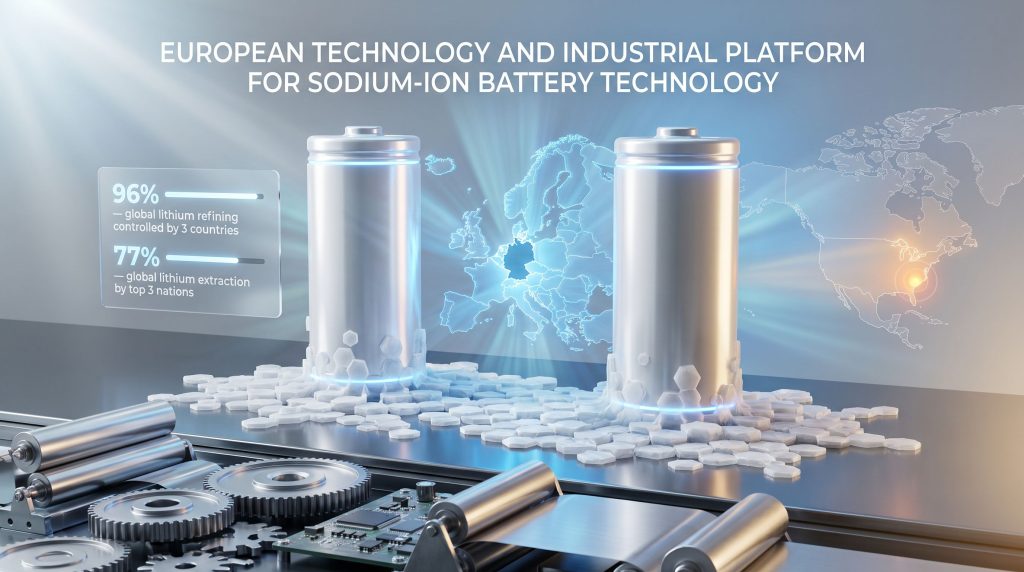
The raw material dependencies embedded in lithium-ion technology are more severe than most public commentary acknowledges. According to the International Energy Agency's 2024 data, just three countries collectively account for 96% of global lithium refining capacity. Separately, those same three largest producing nations are responsible for 77% of global lithium extraction output. This double concentration, at both the mining and refining stages, means that any disruption along that supply chain propagates through the entire global battery manufacturing ecosystem.
Cobalt presents an analogous risk profile. Production is heavily concentrated in politically volatile regions, and procurement uncertainty has already forced several European manufacturers to redesign product roadmaps around cobalt-reduced or cobalt-free chemistries. Recent export restriction measures implemented by major producing countries have furthermore sharpened institutional awareness of just how exposed European battery manufacturers remain.
Sodium-ion technology addresses this vulnerability at the chemistry level rather than through sourcing workarounds. Because sodium-ion cells are formulated entirely without lithium or cobalt, the dependency is eliminated structurally, not merely managed through diversified procurement. Sodium is one of the most abundant elements in the Earth's crust, geographically distributed across every major region, and available through well-established industrial supply chains at costs that bear no resemblance to the price volatility that has characterised lithium markets over the past five years.
This distinction matters enormously for European manufacturers operating within the EU's Critical Raw Materials Act framework, which establishes binding 2030 targets for domestic extraction, processing, and recycling of strategic materials. The critical raw materials facility agenda underpinning this legislation means battery technologies that structurally remove listed critical raw materials from the equation represent a fundamentally different regulatory risk profile compared to lithium-ion systems still dependent on geographically concentrated inputs.
Inside the Heidelberg and Phenogy Sodium-Ion Battery Partnership
The collaboration between Heidelberger Druckmaschinen AG and Phenogy AG is structured across two distinct but complementary layers, each targeting a different point in the battery value chain. Furthermore, understanding both layers is essential to appreciating the full scope of what is being attempted.
Layer One: Contract Manufacturing at Industrial Scale
The first and immediately operational component is a long-term framework supply agreement under which HD Advanced Technologies GmbH (HDAT), a wholly owned subsidiary of Heidelberg, assumes full manufacturing responsibility for Phenogy's battery energy storage systems. HDAT's existing competencies span defence, security, and energy applications, making it a structurally appropriate manufacturing partner for a technology targeting critical infrastructure and sovereign energy storage markets.
The scope of HDAT's manufacturing mandate is deliberately comprehensive:
- Procurement of components and raw materials
- Production of cabinet and container-format storage systems
- System integration across Phenogy's product portfolio
- Rollout coordination and installation
- Ongoing service and maintenance
Production is anchored initially in Germany for the European market, with a medium-term objective of establishing North American manufacturing capacity to serve US demand. Phenogy's collaboration with Heidelberg through HDAT also draws on Phenogy's existing operational presence in South Carolina, which provides a geographic foundation for this expansion, reducing the capital and logistical complexity of entering the North American market from zero.
Phenogy itself, founded in 2019 and headquartered in Root near Lucerne, Switzerland, currently operates across four locations: Root (Switzerland), Bremen (Germany), South Carolina (USA), and Singapore. This international footprint gives the partnership a genuinely global operational base from which to execute its phased manufacturing strategy.
Layer Two: The Planned Joint Venture for Cell-Level Manufacturing
The more technically ambitious element of the Heidelberg and Phenogy sodium-ion battery partnership is the planned joint venture targeting cell-level development and production. This is a categorically different undertaking from system assembly, requiring mastery of the most technically complex and strategically valuable layer of the entire battery supply chain.
What makes this joint venture architecturally unusual is the technology crossover it proposes. Heidelberg intends to contribute specialised printing process technology drawn from its legacy industrial base. While this might appear to be a non-obvious input into battery manufacturing, printing process technology is genuinely relevant to electrode fabrication — a step in cell manufacturing where precision deposition of active materials at microscale tolerances directly determines cell performance and consistency. Phenogy contributes proprietary cell chemistry and cell design architecture, creating a partnership where complementary technical capabilities converge at the manufacturing process level.
| Partner | Core Contribution to Joint Venture |
|---|---|
| Phenogy AG | Sodium-ion cell chemistry, cell design architecture |
| Heidelberg (HDAT) | Specialised printing process technology adapted from core industrial base |
| Combined | End-to-end R&D through industrial-scale sodium-ion cell production |
The joint venture's target application segments reflect a deliberate prioritisation of high-reliability, sovereignty-sensitive markets:
- Critical infrastructure (KRITIS): Grid-essential systems where supply chain independence is a procurement prerequisite
- Defence: Military and security energy storage requiring sovereign sourcing credentials
- Mobility: Transport applications where lithium-free chemistry offers logistical or regulatory advantages
Important caveat: As of the partnership announcement, the joint venture remains in a preparatory stage. Its formalisation is not guaranteed. Both parties have acknowledged that the conditions for establishing the venture are still being developed, and investors and observers should not treat its eventual realisation as a certainty.
How Sodium-Ion Stacks Up Against Lithium-Ion for Stationary Storage
Understanding where sodium-ion technology is genuinely competitive — and where trade-offs remain — is essential context for evaluating the partnership's commercial logic. In addition, the broader battery metals landscape provides important context for understanding why chemistry-level differentiation matters so significantly at this moment.
| Attribute | Sodium-Ion | Lithium-Ion |
|---|---|---|
| Key raw materials | Sodium (abundant, widely distributed) | Lithium, cobalt (geographically concentrated) |
| Supply chain risk | Structurally lower | High, concentrated in 2-3 countries |
| Energy density | Generally lower at current development stage | Higher |
| Cycle life | Competitive at commercial scale | Mature and well-characterised |
| Cost trajectory | Declining as manufacturing scale increases | Mature cost curve with limited further reduction |
| Critical material dependency | None for lithium or cobalt | High |
| Regulatory alignment with EU CRMA | Strong | Moderate, subject to supply risk scrutiny |
The performance trade-offs are real but contextually manageable. Lower energy density is a meaningful constraint in mobility applications where volumetric efficiency is critical, but in stationary grid storage, the relevant performance variables are cost, cycle life, safety, and supply chain resilience. Sodium-ion is genuinely competitive on all four of these dimensions for the stationary market, which explains why the Heidelberg-Phenogy partnership is anchoring its initial commercial strategy on grid storage and critical infrastructure before addressing mobility use cases.
A less commonly appreciated characteristic of sodium-ion cells is their superior performance at low temperatures and their inherently safer thermal behaviour compared to some lithium-ion chemistries. For defence and critical infrastructure applications where operational reliability under adverse environmental conditions is non-negotiable, these properties carry significant procurement weighting.
The Industrial Pivot: What Heidelberg's Entry Signals
Heidelberger Druckmaschinen's decision to enter battery manufacturing through HDAT is a strategic pivot of considerable industrial significance. The company's core legacy — high-precision printing machinery — has faced structural demand contraction as digital media has displaced print. The application of precision manufacturing expertise to battery production represents a textbook adjacent-market expansion strategy, leveraging existing process knowledge in a sector with structurally growing demand.
The partnership with Phenogy also illustrates an emerging pattern in European industrial strategy: established precision manufacturers seeking to transfer their core manufacturing competencies into the energy transition sector without the capital-intensive burden of building new technology from scratch. By pairing with a specialist chemistry developer, Heidelberg accelerates its market entry while Phenogy gains access to manufacturing scale and industrial credibility that a company founded in 2019 could not independently achieve within a comparable timeframe.
This model — combining mature manufacturing capability with novel chemistry expertise — may represent a replicable template for European battery industrial development more broadly. It sidesteps the decades-long investment required to build semiconductor-style gigafactories from the ground up, instead leveraging existing precision manufacturing infrastructure in new applications. Consequently, Europe's critical minerals supply chain stands to benefit meaningfully from this kind of industrial repurposing.
Three Scenarios for How This Partnership Develops
Strategic scenario analysis reveals three plausible pathways:
Scenario 1: Full realisation and European market leadership. Both the manufacturing agreement and the joint venture reach commercial scale. HDAT becomes a recognised contract manufacturer for sodium-ion storage systems across European utility and infrastructure markets, while the joint venture establishes European-sovereign cell manufacturing capacity independent of Asian supply chains. This outcome requires sustained demand growth, successful regulatory alignment with CRMA targets, and successful joint venture formalisation.
Scenario 2: Manufacturing scales, joint venture stalls. The contract manufacturing arrangement delivers commercial volume, but the joint venture fails to formalise due to the capital intensity and technical complexity of cell manufacturing at industrial scale. The partnership creates value at the system integration level but does not achieve cell-level sovereignty. This is arguably the baseline probability-weighted outcome given the acknowledged preparatory status of the joint venture.
Scenario 3: North American demand accelerates the timeline. US market conditions, shaped by domestic manufacturing incentives for battery storage, pull forward the planned North American production expansion. Phenogy's South Carolina presence becomes the foundation of a transatlantic manufacturing platform, and the partnership's geographic scope expands faster than the European sequencing would otherwise suggest.
The race sodium-ion must win is not simply a cost competition against lithium-ion. It is a race against the restructuring of lithium supply chains through alternative sourcing, enhanced recycling mandates, and new mining capacity development. If lithium supply chains are meaningfully diversified before sodium-ion achieves gigawatt-scale production economics, the commercial window for sodium-ion in some market segments may narrow. Regulatory timelines and geopolitical dynamics will heavily influence which technology wins that race.
The next major ASX story will hit our subscribers first
What Both CEOs Communicated About Strategic Intent
The strategic framing articulated by both companies' leadership reflects a shared conviction that European battery sovereignty requires more than incremental supply chain adjustments. Phenogy's CEO Peter E. Braun conveyed that Europe's path to genuine energy independence depends on closing the gap between technology development and the industrial capacity to deploy that technology at meaningful scale.
HDAT CEO Michael Wellenzohn emphasised that the partnership's ambition extends beyond contract manufacturing to the creation of a distinctly European technology and industrial platform for sodium-ion battery technology. Both organisations announced their joint platform with statements pointing to a partnership conceived with long-duration strategic intent rather than as an opportunistic short-term commercial arrangement.
The Bigger Picture: European Battery Sovereignty as Industrial Policy
The Heidelberg and Phenogy sodium-ion battery partnership is one data point in a larger and accelerating European effort to build battery manufacturing capacity that is not structurally dependent on supply chains concentrated outside the continent. The EU's Critical Raw Materials Act, with its binding 2030 benchmarks for domestic processing and recycling of strategic materials, has fundamentally altered the regulatory calculus for battery technology selection across utility, infrastructure, and defence procurement contexts.
Furthermore, the broader question of critical minerals and energy security sits at the heart of why this partnership has attracted attention well beyond the battery industry itself. Partnerships that place production in Germany, target defence and KRITIS applications, and use chemistry that eliminates lithium and cobalt dependency are structurally aligned with the direction of EU industrial policy.
However, the shifts occurring at the European level are also reshaping the global lithium market as producers and refiners adjust to the possibility that sodium-ion adoption may meaningfully alter long-term demand trajectories. Whether this specific collaboration realises its full ambitions remains to be seen. But as a model for how European industrial players might build sovereign battery capability by combining legacy precision manufacturing with specialist chemistry development, it deserves close attention from anyone tracking the long-term reshaping of European energy storage infrastructure.
This article is intended for informational purposes only and does not constitute financial advice. Forward-looking statements, scenario analyses, and assessments of commercial outcomes involve inherent uncertainty. Readers should conduct independent research before making any investment or procurement decisions related to companies or technologies discussed herein.
Want to Track the Next Major Battery Minerals Discovery Before the Market Does?
Discovery Alert's proprietary Discovery IQ model delivers real-time alerts on significant ASX mineral discoveries across battery commodities and critical materials, turning complex geological data into actionable insights for investors at every experience level — start your 14-day free trial today, or explore historic discovery returns to understand why getting in early on major mineral finds can be so consequential.