August 24, 2026
The Quiet Race Reshaping West Africa's Most Contested Mineral Corridor
When geologists first mapped the pegmatite belts threading through southern Mali, few outside specialist circles recognised what those coarse-grained rock formations implied. Lithium-bearing spodumene, the mineral at the heart of modern battery chemistry, was already sitting beneath one of West Africa's least-explored corridors. Today, that geological reality has become a geopolitical flashpoint, drawing capital from three continents and forcing a fundamental rethink of how frontier mineral jurisdictions manage foreign interest in their most sensitive resources.
Understanding Mali's current position in the global critical minerals race requires more than tracking permit approvals. It demands an appreciation of the layered regulatory architecture that now governs Mali lithium exploration permits, the capital competition intensifying across its southern belt, and the demand mathematics that make the entire exercise commercially compelling despite significant political uncertainty.
When big ASX news breaks, our subscribers know first
Why Lithium's Reclassification Changes Everything for Foreign Explorers
Mali's revised mining code did not simply update administrative procedures. It fundamentally reordered the relationship between the state and foreign capital by elevating lithium to strategic mineral status, placing it alongside uranium, thorium, tungsten, tantalum, cobalt, and rare earths in a protected category that carries distinct legal consequences.
Under this framework, the process for granting or renewing exploration permits for strategic minerals shifts from a ministerial order to a decree of the Council of Ministers, proposed by the Mines Minister. This distinction matters enormously in practice. What was once a relatively contained administrative process now requires cabinet-level approval, meaning individual permit decisions are exposed to the full weight of political deliberation at the highest levels of government.
The framework also establishes a state priority right in permit allocation, exercisable through state-owned entities or companies with majority state participation. For foreign junior explorers accustomed to operating in jurisdictions where permit issuance is largely technocratic, this introduces a structurally new variable: the possibility that the state itself may claim preferential access to ground that private operators have spent years delineating.
"Lithium's elevation to strategic mineral status in Mali is not merely a regulatory classification. It is a signal about how the state intends to capture value from the energy transition, and foreign operators must price that intention into every exploration decision they make."
A further structural constraint shapes portfolio strategy across the country's lithium-rich southern belt: no single company may hold more than three exploration permits within the same geological district. This cap prevents the land-banking behaviour common in earlier West African mineral rushes and forces companies to make concentrated, high-conviction bets rather than accumulating optionality across broad ground positions.
The 2022 Moratorium: What a Two-Year Freeze Costs an Exploration Company
In December 2022, Mali's military government suspended the renewal of exploration permits across the country. The suspension, which remained in place until March 2025, was connected to a broader review of the mining sector and negotiations over revenue-sharing arrangements with foreign operators. For companies holding active permits that came up for renewal during this window, the consequences were severe.
Exploration timelines in the mining industry are unforgiving. A two-year administrative freeze does not simply delay work by two years. It disrupts the sequential logic of resource estimation, breaks momentum with technical consultants, and creates uncertainty that makes institutional capital reluctant to commit follow-on funding. Junior companies, which typically operate on thin capital reserves and depend on milestone delivery to maintain investor support, were disproportionately affected.
The partial lifting of the moratorium in March 2025 reopened the permit renewal queue, but the word partial carries meaningful weight. New applicants face a different and more constrained pathway than existing permit holders seeking renewal, reflecting the state's interest in managing the pace of foreign access to strategic mineral ground rather than simply restoring the pre-2022 status quo. Furthermore, this moratorium period has parallels to the broader lithium market downturn that has weighed on exploration budgets globally.
Step-by-Step: How Mali's Exploration Permit Lifecycle Works in 2025
Understanding the mechanics of Mali lithium exploration permits is essential for assessing the risk profile of any asset operating under this framework. The process follows a structured sequence:
- Application submission to the Ministry of Mines, subject to review under the strategic mineral classification framework
- Council of Ministers decree required for formal grant or renewal, placing approval at cabinet level
- Initial permit term established under the revised mining code, with conditions attached to the strategic mineral designation
- First renewal window requiring updated technical documentation and compliance with exploration commitments made in the original application
- Second renewal pathway, which transitions the permit toward a potential exploitation licence, triggering more intensive state participation review
- State participation trigger, at which point the government exercises its priority rights over any transition from exploration to production-stage development
This sequence creates multiple decision nodes at which political dynamics can introduce delay or conditions that were not anticipated at the time of the original application.
The Competitive Landscape: Three Capital Sources, One Mineral Corridor
What makes Mali's lithium sector analytically distinctive is the simultaneous presence of three structurally different categories of capital: Chinese industrial groups with producing assets, Russian state-owned entities entering at the exploration stage, and Western junior exploration companies trying to maintain their positions through a challenging administrative environment.
Chinese Capital: First Mover Advantage in a Producing Sector
Chinese capital moved into Mali's lithium corridor before the regulatory framework became as complex as it is today. The results are visible in the production figures: Goulamina entered production in late 2024 with China's Ganfeng holding a central ownership stake, and Bougouni followed in early 2025, establishing Mali as a dual-mine lithium producer in a remarkably compressed timeframe.
Ganfeng's position extends beyond its producing assets. Through a joint venture with Lithium Africa, which is listed on the Toronto and Frankfurt stock exchanges, Ganfeng is involved in three exploration-stage projects in Mali: Torakoura, N'Gonzana, and Kologo. The permits for all three expired in 2025, and their renewals remained pending as of the latest available information. This unresolved overhang illustrates that even well-capitalised Chinese operators are not immune to the administrative bottlenecks created by the Council of Ministers approval process.
Russian State Capital: A New Variable in the Geopolitical Equation
In May 2025, Rosatom, the Russian state-owned nuclear and energy conglomerate, confirmed that preliminary results had identified lithium potential at a site under its operational control in Mali. For a state-owned entity whose primary mandate is the nuclear fuel cycle, this signals a deliberate strategy of diversifying into battery-critical minerals through its existing footprint in West Africa.
Mali's military government has progressively deepened its diplomatic and security alignment with Moscow since the 2021 coup, and that alignment has downstream effects on how resource sector access is structured. Russian state capital does not operate under the same return-on-capital imperatives as private investors, which means it can absorb longer timelines and greater uncertainty while maintaining a strategic land position.
Western Junior Explorers: Navigating Administrative and Geopolitical Headwinds
Perth-based First Lithium presents the clearest case study of a Western junior operating in this environment. Its subsidiary, Intermin Lithium SARL, holds two lithium exploration permits covering the Gouna prospect in the Kolondiéba district and Faraba in the Bougouni district, both in southern Mali. Originally granted in 2018 and renewed for the first time in 2022, these permits were caught in the subsequent moratorium freeze.
First Lithium took control of the assets in 2023 and launched a new exploration campaign, focusing particularly on the Blakala prospect within the Gouna permit and on Faraba. On 21 August 2026, Mali's Council of Ministers approved the renewal of 10 exploration permits, including both of First Lithium's lithium permits. This renewal was not merely administrative. In a quarterly report published on 31 July 2026, First Lithium confirmed that completing this step was a prerequisite for publishing its first mineral resource estimate, with consultants indicating the estimate could be released during the quarter ending September 2026.
The Bougoula permit, held separately, was renewed in July 2024 and subsequently became subject to a transfer agreement involving Uranium One Group, a company with ties to Russian state interests. This transfer mechanism, whereby a permit moves between owners rather than being newly applied for, illustrates a pathway that Russian-aligned capital can use to acquire lithium exploration positions in Mali without navigating the full front-end application process under the new strategic mineral framework.
Jurisdiction Comparison: Mali in Regional Context
Positioning Mali against peer West African and broader African lithium jurisdictions helps calibrate the regulatory risk premium that investors must apply to assets in the country.
| Jurisdiction | Permit Cap | Strategic Mineral Designation | State Priority Right | Moratorium History |
|---|---|---|---|---|
| Mali | 3 per district | Yes (lithium included) | Yes | 2022–2025 (partial) |
| Zimbabwe | No formal cap | Yes | Partial | No |
| DRC | Varies by zone | Yes | Yes | No |
| Ghana | No formal cap | No | No | No |
Mali's framework is among the most state-centric in the region. The combination of strategic mineral designation, a per-district permit cap, and a Council of Ministers approval requirement creates a regulatory overlay that has no direct equivalent among the four comparator jurisdictions above. This does not make Mali uninvestable, but it does mean that the risk-adjusted return calculation for early-stage exploration assets must account for administrative variables that do not exist to the same degree elsewhere. In addition, the broader question of critical minerals demand growth gives context to why these regulatory distinctions matter so acutely right now.
Two Producing Mines: What Mali's Production Status Means for the Investment Thesis
| Metric | Goulamina | Bougouni |
|---|---|---|
| Production Start | Late 2024 | Early 2025 |
| Primary Ownership | Ganfeng (China), joint venture structure | Kodal Minerals |
| Location | Southern Mali | Southern Mali |
| Current Stage | Producing | Producing |
| Permit Basis | Exploitation permit / mining licence | Mining licence |
The transition from an exploration-only jurisdiction to one with two operating mines is significant for several reasons that extend beyond headline production volumes. First, it validates the geological thesis for the southern Malian pegmatite belt at commercial scale, which reduces the discovery risk premium for nearby exploration assets. Second, it establishes logistics precedents, including concentrate transport routes and port access arrangements, that subsequent projects can reference in feasibility planning. Third, it generates royalty and tax flows to the Malian state, creating a fiscal incentive for the government to maintain conditions under which further development remains possible.
Spodumene extraction basics from hard-rock deposits, which is the primary lithium mineralogy present in southern Mali's pegmatite systems, make this resource well-suited to the processing supply chain for battery-grade lithium chemicals. This mineralogical compatibility with the dominant conversion pathway in China, where most global spodumene is processed, partially explains why Chinese industrial groups were willing to commit capital to these assets at a stage when the regulatory environment was already becoming more complex.
The next major ASX story will hit our subscribers first
The Demand Imperative: IEA Forecasts and What They Mean for Frontier Exploration
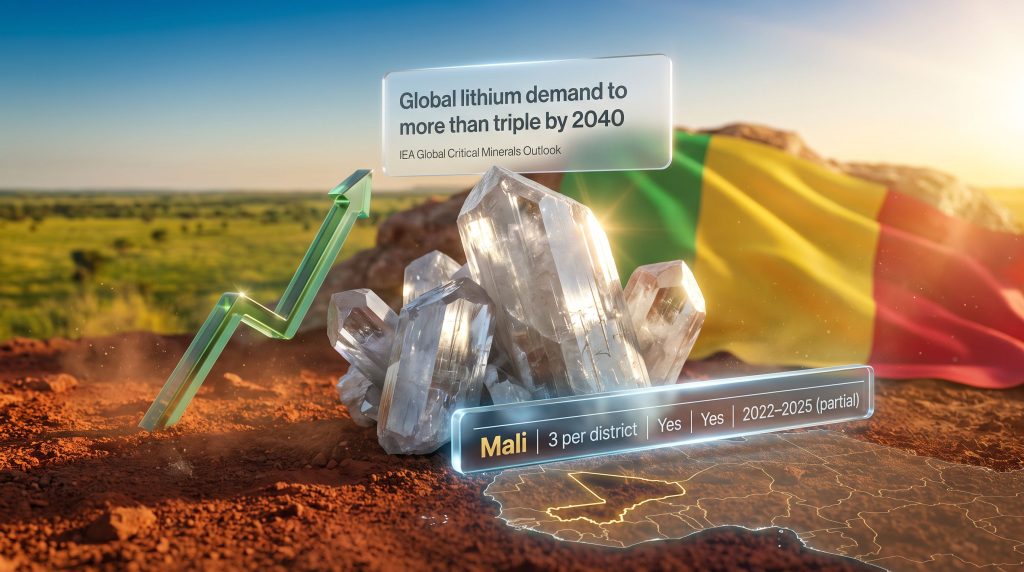
The International Energy Agency's Global Critical Minerals Outlook 2026, published in July of that year, projects that global lithium demand will more than triple by 2040 under its Announced Policies Scenario. Among all the major critical minerals the IEA tracks, lithium recorded the strongest projected demand growth trajectory. This is a figure that reframes the risk calculation for frontier jurisdictions that would previously have been considered too administratively complex to justify early-stage capital deployment.
The twin demand engines driving this trajectory are electric vehicle batteries and grid-scale stationary energy storage. Both applications require lithium in forms that trace back to either hard-rock spodumene concentrate or brine-sourced lithium carbonate. Understanding how lithium mining works across both deposit types is increasingly relevant for investors trying to assess which supply sources are best positioned to meet future demand. Hard-rock deposits, of the type found in southern Mali, tend to produce a concentrate product that feeds refining operations producing lithium hydroxide, the preferred feedstock for high-nickel cathode chemistries used in automotive batteries.
It is worth noting, however, that lithium spot prices have experienced significant cyclical volatility over the past three years. The distance between the IEA's long-run demand projections and near-term price signals creates a timing problem for exploration-stage companies seeking to attract institutional financing. Project economics that appear compelling under 2040 demand assumptions may be difficult to defend in a 2026 financing environment where lithium carbonate prices have retreated substantially from their 2022 peaks.
Disclaimer: Demand forecasts, price projections, and scenario analyses referenced in this article reflect the views of the cited institutions and do not constitute financial advice. Mineral exploration investments carry substantial risks, including commodity price volatility, regulatory uncertainty, and financing constraints.
From Permit Renewal to Mineral Resource Estimate: The Value Inflection Point
For exploration-stage lithium assets in Mali, the publication of a first mineral resource estimate (MRE) represents the critical technical and commercial gateway. An MRE, prepared in accordance with internationally recognised reporting codes, transforms a collection of drill hole data into a classified statement of tonnes and grade that institutional investors, potential joint venture partners, and offtake counterparties can evaluate.
Without an MRE, an exploration asset is essentially a hypothesis supported by rock chip samples and drill intercepts. With an MRE, it becomes a project with a defined resource base from which economic studies can be constructed. This distinction directly affects access to capital: most resource-sector institutional investors will not engage seriously with an asset until a compliant resource estimate exists.
For First Lithium, the August 2026 permit renewal clears the final administrative precondition for MRE publication. The September 2026 quarter represents the target window for that publication, which will determine whether the exploration work conducted since 2023 justifies progression to prefeasibility-level studies. Technologies such as direct lithium extraction may also increasingly influence how downstream processing of any eventual production is structured.
Three Scenarios for Mali's Lithium Sector Over the Next 24 Months
| Scenario | Trigger Conditions | Likely Outcome |
|---|---|---|
| Accelerated Development | Permit renewals resolved promptly; MREs published; lithium prices recover | New feasibility studies launched; additional foreign capital enters southern belt |
| Managed Stagnation | Permit delays persist; MREs deferred; prices remain subdued | Exploration continues at reduced pace; no new mines sanctioned in the near term |
| Geopolitical Consolidation | Western permits lapse through non-renewal; Russian and Chinese capital fills resulting gap | Structural shift toward state-aligned capital dominance across the lithium corridor |
The unresolved status of the Torakoura, N'Gonzana, and Kologo permits held through the Ganfeng–Lithium Africa joint venture represents a specific near-term test of how Mali's Council of Ministers processes renewal applications from established operators with producing assets already in the country. Consequently, the outcome of those applications will be closely watched by every other foreign explorer with exposure to Malian lithium ground. Notably, Mali has revoked over 90 mining exploration permits in recent months, underscoring just how unpredictable the regulatory environment remains for all participants.
Frequently Asked Questions: Mali Lithium Exploration Permits
Can foreign companies currently apply for new lithium exploration permits in Mali?
Yes, but with material constraints. The partial lifting of the moratorium in March 2025 reopened the application pathway, but lithium's strategic mineral status means state priority rights apply, and Council of Ministers approval is required. New applicants face a more complex process than existing permit holders seeking straightforward renewals.
How many exploration permits can one company hold in a single geological district?
A maximum of three exploration permits per geological district under Mali's current mining framework. This structural cap is among the most restrictive in West Africa and directly constrains land accumulation strategies.
What caused Mali's 2022 exploration permit moratorium?
The suspension was introduced in December 2022 as part of the military government's broader review of mining sector terms and revenue-sharing arrangements with foreign operators. It created a multi-year administrative backlog that disproportionately affected junior companies with limited capacity to absorb open-ended delays.
What is the significance of permit transfers involving Uranium One Group?
The transfer of the Bougoula permit to Uranium One Group illustrates how Russian state-linked capital is acquiring Mali lithium exploration permits through transfer mechanisms rather than new applications. This approach bypasses some of the front-end complexity of the current application framework while achieving equivalent ground access.
Where can investors and sector analysts follow ongoing developments in Mali's mining sector?
Readers seeking detailed, ongoing coverage of Mali's regulatory environment and the wider West African critical minerals landscape may find value in reviewing reporting from Mali's mining sector developments at Stockhead, which provides sector-focused analysis of jurisdiction risk and emerging opportunities across African mining.
Ready to Catch the Next Major Critical Minerals Discovery Before the Market Does?
Discovery Alert's proprietary Discovery IQ model scans ASX announcements in real time, instantly alerting subscribers to significant mineral discoveries — including critical minerals like lithium — so they can act on high-conviction opportunities ahead of the broader market. Explore how historic discoveries have generated substantial returns and begin a 14-day free trial today to secure a genuine market-leading edge.