August 24, 2026
Lithium's Capacity Paradox: Why the Producers Who Stayed In Are Now Pulling Ahead
The lithium market has a habit of punishing patience and rewarding it in equal measure. During the prolonged price correction that stretched across 2023 and 2024, producers faced a stark choice: exit capacity entirely or maintain optionality through disciplined care-and-maintenance protocols. Those who chose the latter now find themselves with a structural advantage that cannot be easily replicated by peers who shut down and walked away. The mechanics of reactivating a preserved processing facility are fundamentally different from building one from scratch, and that distinction is now shaping how the next production cycle unfolds across Australia's spodumene sector.
Pilbara Minerals' Pilgangoora operation sits at the centre of this dynamic. With the PLS Ngungaju restart now underway and Pilgangoora production guidance for FY27 set at 1.03 to 1.10 million tonnes of spodumene concentrate, the company has crossed a threshold that few lithium operations globally have reached. Understanding what that milestone actually means, how it was funded, and what risks still surround the ramp-up is essential for anyone tracking Australian critical minerals supply.
When big ASX news breaks, our subscribers know first
What the One-Million-Tonne Threshold Actually Represents in Spodumene Markets
Crossing one million tonnes of annual spodumene concentrate production is not simply a round-number milestone. It carries genuine operational and market significance. At that scale, a single operation begins to function as a structural price setter rather than a price taker, with sufficient volume to influence spot and contract pricing dynamics in the seaborne market.
For downstream lithium chemical converters, particularly those operating in China and increasingly in South Korea and Japan, a supplier capable of consistently delivering above one million tonnes annually represents a categorically different counterparty than a mid-tier producer. Understanding spodumene extraction basics helps contextualise why achieving this scale carries such strategic weight.
Spodumene concentrate, typically graded at 5.0% to 6.0% lithium oxide (Li₂O) for export quality, must pass through conversion facilities before becoming battery-grade lithium hydroxide or carbonate. The reliability of upstream supply at scale therefore carries a premium value that spot pricing alone does not capture. Producers who can guarantee large, consistent volumes attract offtake interest on more favourable terms, a factor that becomes increasingly material as battery manufacturers seek to de-risk their supply chains.
How Lithium Price Recovery Created the Conditions for Reactivation
The decision to bring idled capacity back into production is never made on the basis of current spot prices alone. It requires a view on price sustainability across the horizon needed to recover restart capital and achieve acceptable operating margins at the reactivated facility. Spodumene prices collapsed from historic highs above US$8,000 per tonne in late 2022 to levels that rendered high-cost operations economically unviable through much of 2024. The lithium market downturn of that period made these decisions particularly consequential for producers across the board.
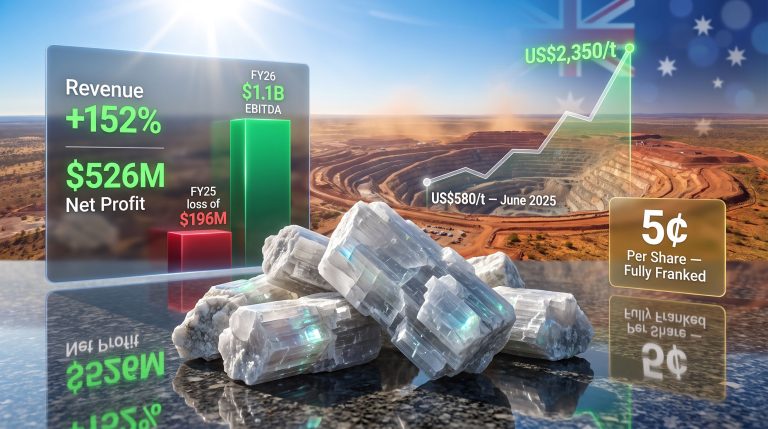
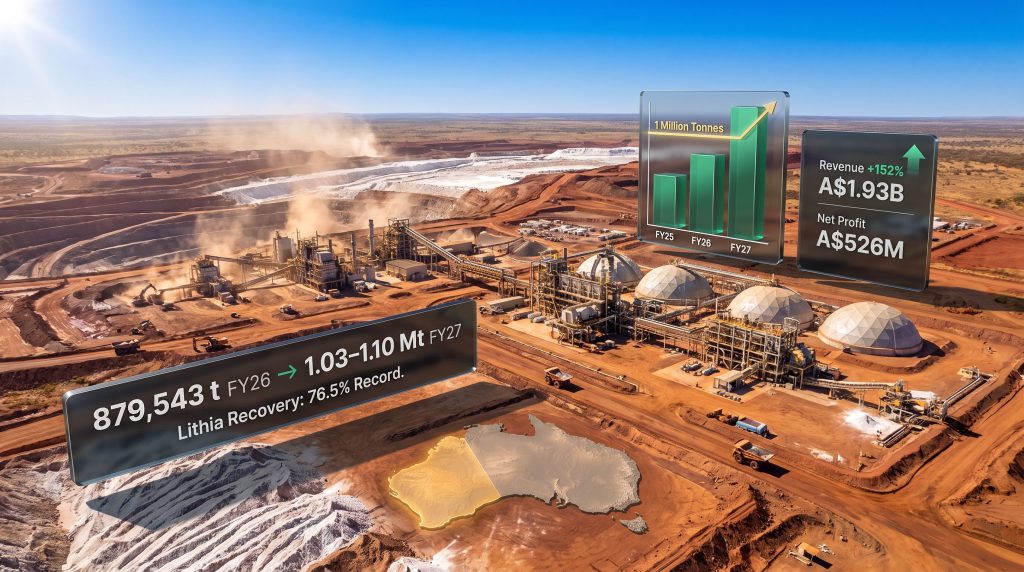
The recovery that followed was sufficient to justify reactivation at Pilgangoora, with PLS reporting an average realised spodumene price of US$1,488 per tonne in FY26, representing a 121% increase year-on-year. That price environment, combined with the operational leverage generated by higher volumes, transformed the company's financial profile from a A$196 million net loss in FY25 to a A$526 million net profit in FY26. Revenue climbed 152% to A$1.93 billion, and underlying EBITDA reached A$1.14 billion, providing the capital base from which the Ngungaju restart and the broader P2000 pre-investment program are being funded.
FY26 Operating Performance: The Foundation Beneath the Growth Story
Before examining what the Ngungaju restart adds, it is worth understanding the operational platform from which PLS is scaling. FY26 was not simply a financially stronger year; it was a year of measurable technical progress across multiple dimensions of the Pilgangoora operation.
| Operational Metric | FY25 | FY26 | Change |
|---|---|---|---|
| Spodumene Concentrate Production | ~752,000 t (est.) | 879,543 t | +17% |
| Lithia Recovery Rate | 71.9% | 76.5% | +4.6 percentage points |
| Ore Processed | – | 4.1 Mt | – |
| Total Material Moved | – | 35.9 Mt | – |
| FOB Unit Operating Cost | Higher | A$569/t | -9% |
The 4.6 percentage point improvement in lithia recovery from 71.9% to a record 76.5% deserves particular attention. Recovery rate is one of the most technically meaningful metrics in spodumene processing because it reflects how efficiently the plant is extracting lithium-bearing mineral from ore that has already been mined and moved.
Improvements at this level do not happen by accident. They result from sustained investment in plant optimisation, reagent chemistry adjustments, and operational discipline across the flotation and dense media separation circuits that are central to spodumene concentration. Furthermore, understanding how lithium mining works at this technical level helps explain why such incremental gains compound so significantly over a full production year.
The Owner-Operator Fleet Transition and Its Cost Implications
One of the less-discussed drivers behind the 9% reduction in FOB unit operating costs to A$569 per tonne was PLS's transition to an owner-operator mining fleet. In contract mining arrangements, the contractor captures a margin that the mine owner pays as part of the mining unit cost. Internalising that function eliminates the contractor's margin but requires upfront capital investment in equipment and the operational infrastructure to manage a larger direct workforce.
The cost savings demonstrated in FY26 suggest the transition has been executed effectively. However, investors should note that owner-operator models introduce a different risk profile: equipment downtime, maintenance scheduling, and workforce management become the operator's direct responsibility rather than the contractor's. The net benefit is typically positive at scale, but the transition period carries execution risk.
The Ngungaju Plant: Technical Profile and the Logic of Care and Maintenance
The Ngungaju processing facility at Pilgangoora is a separate concentrator from the main Pilgangoora plant, with its own crushing, screening, dense media separation, and flotation circuits. It was originally developed as part of a staged expansion strategy and brings meaningfully different unit economics to the combined operation due to its smaller scale relative to the primary plant.
When PLS placed Ngungaju on care and maintenance in 2024, the decision reflected the reality that operating two plants at subdued spodumene prices would compress margins across both facilities. Care and maintenance is a defined operational state in which a facility is kept in a condition suitable for restart within a specified timeframe. It is not decommissioning.
Electrical systems remain energised, mechanical equipment is preserved against corrosion and deterioration, and key personnel maintain familiarity with the circuit. The Ngungaju restart approval by PLS's board marked a decisive turning point in the company's capacity strategy, signalling sufficient confidence in the price outlook to commit restart capital.
The distinction between care and maintenance and full decommissioning is commercially critical. A decommissioned plant requires years and hundreds of millions of dollars to recommission. A care-and-maintenance facility can be reactivated in months, provided the underlying market conditions justify the restart capital.
Prior to restarting Ngungaju on 1 July 2026, PLS completed a crusher upgrade and undertook systematic plant readiness work to ensure the facility could reach nameplate throughput within the expected ramp-up window.
FY27 Pilgangoora Production Guidance: Reading the Numbers Carefully
The PLS Ngungaju restart and Pilgangoora production guidance for FY27 centres on a range of 1.03 to 1.10 million tonnes of spodumene concentrate. Several nuances within that guidance deserve careful interpretation.
First, the September Quarter of FY27 will reflect below-steady-state output from Ngungaju. Processing plant commissioning and ramp-up rarely achieve nameplate throughput immediately, particularly following a period of care and maintenance. Investors modelling FY27 production should apply a weighted ramp-up curve across the four quarters rather than assuming the full Ngungaju contribution from day one.
Second, the guidance range width of 70,000 tonnes implicitly reflects the uncertainty around commissioning timelines and processing performance during the ramp-up period. A tighter range would suggest greater confidence in the ramp-up trajectory; the current width is consistent with prudent guidance practice for a plant returning from idle.
Third, the P1000 operating model, meaning both the Pilgangoora and Ngungaju plants running simultaneously, has never been sustained at full capacity before. This is genuinely new operational territory for the combined site.
FY27 Cost Guidance and the Ngungaju Premium
| Cost Metric | FY26 Actual | FY27 Guidance |
|---|---|---|
| FOB Unit Operating Cost | A$569/t | A$575 to A$625/t |
| Guidance Range Width | – | A$50/t |
| Primary Cost Driver | Owner-operator fleet savings | Ngungaju restart integration |
The step-up in unit cost guidance from A$569/t to a range of A$575 to A$625/t reflects Ngungaju's inherently higher cost structure. Smaller processing plants carry higher fixed cost per tonne of output, and a facility returning from care and maintenance will initially operate with less efficiency than a plant running at steady state.
The cost premium is real and should not be dismissed, but it must be evaluated against the volume uplift that Ngungaju delivers. At one million tonnes of production, even a higher per-unit cost can generate substantially more absolute cash flow than a lower-cost operation running at 879,000 tonnes.
The Balance Sheet That Makes the Growth Program Credible
PLS entered FY27 with A$2.29 billion in cash, a figure that transforms the risk profile of the company's concurrent capital programs. The financial rebound from FY25 to FY26 was not incremental; it was a structural reversal driven by the combination of higher realised prices and improved operational leverage.
Entering a major capacity expansion cycle with more than A$2 billion in cash significantly reduces the probability of equity dilution, even if capital expenditure runs toward the upper end of guidance. It also provides a meaningful buffer against renewed spodumene price weakness during the ramp-up period.
FY27 capital expenditure is guided at A$620 to A$685 million, allocated across the following priorities:
| Capex Category | FY27 Allocation Focus |
|---|---|
| Mine Development | Largest weighted component |
| P2000 Pre-FID Program | Included within total guidance |
| Colina Project, Brazil | A$45 to A$55 million |
| Ngungaju Restart Capex | Embedded in mine development spend |
The scale of the mine development allocation reflects the underground mining pre-feasibility study currently underway alongside surface operations. Underground lithium mining potential at Pilgangoora has long been considered as a pathway to accessing higher-grade ore zones at depth, which could improve head grade and therefore recovery economics at the processing plants over the longer term.
The next major ASX story will hit our subscribers first
P2000: The Next Production Horizon and What Investors Do Not Yet Know
Beyond the immediate FY27 production ramp-up, P2000 represents the most consequential long-term decision PLS faces. The concept involves constructing a new concentrator adjacent to the existing Pilgangoora infrastructure that would approximately double the site's annual production capacity to around two million tonnes of spodumene concentrate per annum.
PLS has approved approximately A$175 million in pre-final investment decision spending to advance the feasibility study, with results expected in the December quarter of 2026. The feasibility study outcome will be a pivotal data point for the market because it will define the capital cost, operating cost, and production profile assumptions on which a final investment decision would be based.
Several factors that are less commonly discussed in mainstream coverage will influence the P2000 economics. In addition, emerging technologies such as direct lithium extraction may reshape long-term processing economics across the sector, adding another variable to multi-year feasibility assumptions.
- Ore reserve grade trajectory: As mining at Pilgangoora progresses deeper, the grade profile of ore delivered to the processing plants changes. Higher-grade feed improves recoveries and reduces processing cost per tonne of concentrate produced.
- Shared infrastructure benefits: A second concentrator built beside existing facilities can leverage shared power supply, water management systems, tailings infrastructure, and port logistics, reducing the effective greenfield capital intensity.
- Underground mining integration: If the underground pre-feasibility study demonstrates economic viability, the combination of underground high-grade ore and surface material through P2000 circuits could meaningfully improve the blended head grade, strengthening the project economics.
- Feasibility study risk: Pre-feasibility and feasibility studies regularly revise capital cost estimates upward from earlier scoping figures. The market should treat the December 2026 results as genuinely new information rather than confirmation of prior assumptions.
Colina: International Diversification at an Early Stage
The Colina lithium project in Brazil represents PLS's only wholly owned international asset and its primary mechanism for reducing single-asset concentration risk. PLS has allocated A$45 to A$55 million to studies at Colina during FY27, a meaningful spending commitment that reflects the project's strategic importance to the company's longer-term resource base.
Brazil's lithium geology, centred on pegmatite-hosted spodumene and lepidolite deposits in the state of Minas Gerais, shares lithological characteristics with Western Australia's Pilbara region. However, the Brazilian regulatory and permitting environment introduces variables that are materially different from the established frameworks governing Australian operations. Study-stage spending at this level does not imply an imminent development decision, but it does signal that PLS is actively building the technical basis for a future development option outside Australia.
Three-Year Production Arc: Guidance Delivery as a Track Record Signal
| Financial Year | Production Guidance | Actual or Guided Outcome | FOB Cost Guidance |
|---|---|---|---|
| FY26 (Original) | 820,000 to 870,000 t | 879,543 t (beat) | A$560 to A$600/t |
| FY27 (Current) | 1,030,000 to 1,100,000 t | Guidance only | A$575 to A$625/t |
The 879,543 tonne FY26 outcome exceeded the top end of original guidance by approximately 9,500 tonnes. In mining, outperformance against production guidance is not trivial. It reflects the combined effect of better-than-expected plant performance, ore body consistency, and operational management.
For investors assessing the credibility of FY27 guidance, the track record of FY26 delivery provides one relevant reference point. However, it is important to recognise that adding Ngungaju to the production mix introduces new commissioning variables that did not affect the FY26 result. The Ngungaju plant restart and growth studies update published by PLS provides further technical detail on those commissioning considerations.
Key Risks Surrounding the FY27 Guidance Range
No production guidance should be accepted without examining the conditions under which it could be missed. For FY27, the primary risk categories include:
- Ngungaju commissioning performance: Processing plant ramp-ups following care-and-maintenance periods can encounter mechanical, electrical, or reagent-related issues that extend the timeline to steady-state throughput. Each week of below-target Ngungaju output reduces the full-year production contribution from that plant.
- Spodumene price volatility: The restart economics assume that current or improving price conditions persist. A renewed deterioration in spodumene prices could pressure the operational logic of running both plants simultaneously, though PLS's cash position provides substantial protection against a short-cycle reversal.
- Concurrent capital execution risk: Managing A$620 to A$685 million in annual capital expenditure across mine development, P2000 pre-FID work, and the Colina studies simultaneously introduces project management and supply chain complexity.
- P2000 feasibility study outcomes: If the December quarter results indicate materially higher capital costs or lower project returns than the market has priced in, it could affect sentiment around the company's growth trajectory into FY28 and beyond.
Frequently Asked Questions: PLS Ngungaju Restart and Pilgangoora Production Guidance
When Did the Ngungaju Restart Begin?
The Ngungaju plant restart commenced on 1 July 2026, following a preparation phase that included a crusher upgrade and comprehensive plant readiness assessment. Output during the September Quarter 2026 is expected to remain below the steady-state run rate, with full target capacity anticipated within the first four months of FY27.
What Is PLS's Official FY27 Production Guidance for Pilgangoora?
PLS has guided FY27 spodumene concentrate production of 1.03 to 1.10 million tonnes, incorporating contributions from both the Pilgangoora plant and the reactivated Ngungaju facility under the P1000 operating model.
What Are the FY27 Unit Cost Expectations?
FOB unit operating costs are guided at A$575 to A$625 per tonne for FY27, above the FY26 actual of A$569 per tonne, primarily reflecting Ngungaju's higher per-unit operating cost structure relative to the primary Pilgangoora plant.
What Is the P1000 Operating Model?
P1000 refers to the simultaneous operation of both the Pilgangoora and Ngungaju processing facilities, enabling the combined site to target production above one million tonnes of spodumene concentrate per annum for the first time in its history.
How Much Cash Does PLS Hold Entering FY27?
PLS entered FY27 with A$2.29 billion in cash, providing substantial capacity to fund expansion programs without requiring near-term equity issuance even if capital expenditure runs toward the top of guidance.
What Is P2000 and When Will a Decision Be Made?
P2000 is a proposed second concentrator at Pilgangoora targeting approximately two million tonnes of annual spodumene production capacity. A feasibility study is expected to deliver results in the December quarter of 2026, after which a formal final investment decision process would commence based on those findings.
Strategic Implications for Australia's Lithium Supply Chain
Pilgangoora's evolution toward one million tonnes of annual spodumene output reinforces its position as one of a small number of globally significant hard-rock lithium operations. The scale, ore body quality, and established infrastructure at the site create a competitive moat that is difficult for newer entrants to replicate across a typical project development timeline of five to ten years.
What is less commonly appreciated is the through-cycle dimension of this competitive advantage. Peers who curtailed or sold production assets during the 2024 downturn now face the capital and time costs of re-entry into a market where prices have partially recovered. PLS, by contrast, maintained operational continuity and preserved its restart optionality, emerging from the downturn with a stronger balance sheet, better unit economics, and a clearer path to two million tonnes of annual capacity.
For the broader Australian supply chain, a domestic spodumene producer operating at and beyond one million tonnes annually provides a more credible anchor for downstream investment discussions. Lithium conversion, battery precursor manufacturing, and cell manufacturing facilities require long-term, high-volume supply commitments before capital can be deployed. Consequently, the production scale now being established at Pilgangoora is a necessary, though not sufficient, condition for those discussions to advance.
Disclaimer: This article contains forward-looking statements and financial projections drawn from publicly available company guidance and announcements. Production outcomes, cost performance, and feasibility study results may differ materially from guidance. This content is informational in nature and does not constitute financial or investment advice. Readers should conduct their own due diligence before making investment decisions.
For ongoing coverage of Pilgangoora's operational developments and Australian critical minerals production trends, visit australianmining.com.au.
Want to Be First to Identify the Next Major Lithium Discovery on the ASX?
Discovery Alert's proprietary Discovery IQ model scans ASX announcements in real time, instantly identifying significant mineral discoveries across lithium and more than 30 other commodities — turning complex data into clear, actionable opportunities for investors at every experience level. Explore how major mineral discoveries have historically generated substantial returns on Discovery Alert's dedicated discoveries page, and begin your 14-day free trial today to position yourself ahead of the broader market.