August 21, 2026
When Commodity Cycles Turn, the Leverage Is Rarely Linear
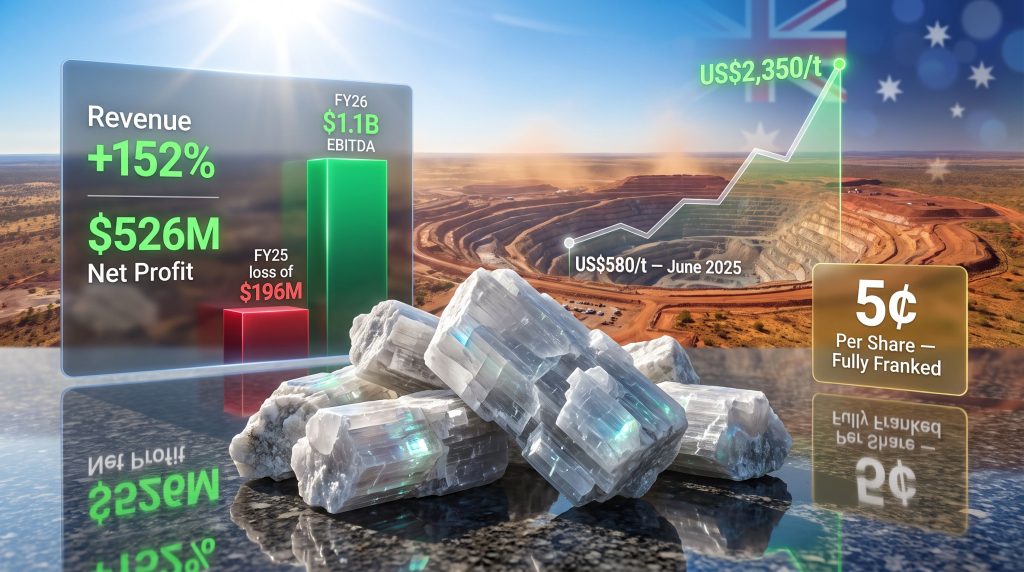
Hard rock lithium mining is one of the most operationally leveraged commodity businesses on the planet. When prices collapse, margins evaporate faster than revenue. When prices recover, profits can multiply at a rate that feels almost disconnected from the underlying commodity move. Understanding this asymmetry is the starting point for making sense of what Pilbara Minerals (ASX: PLS) reported for FY26, and why the Pilbara Minerals dividend lithium recovery carries more weight than a simple five-cent-per-share announcement might suggest.
The lithium cycle that punished producers between 2023 and mid-2025 was one of the most severe commodity corrections in recent memory. To understand the spodumene extraction basics involved, spodumene concentrate prices fell from levels above US$6,000 per tonne during the 2022 peak to approximately US$580 per tonne by June 2025, a decline of roughly 90%. That kind of price destruction does not just compress margins; it erases them entirely and forces producers into capital preservation mode.
The fact that PLS navigated that trough with its balance sheet intact, and emerged with the operational capacity to capitalise on the recovery, is as important to the investment thesis as the FY26 headline numbers themselves.
When big ASX news breaks, our subscribers know first
From Survival to Surplus: The Financial Mechanics of PLS's Earnings Recovery
The FY26 result is best understood not as a single data point but as the outcome of two simultaneous forces amplifying each other. Volume grew by 17% to 879,500 tonnes of spodumene produced. Price recovered from a cyclical floor to an average realised level of $2,164 per tonne for 5.2% spodumene concentrate.
Neither of those improvements alone would have produced the magnitude of the swing from a $196 million net loss in FY25 to a $526 million net profit in FY26. Together, they created what commodity analysts call operating leverage in full effect.
| Financial Metric | FY25 Result | FY26 Result | Change |
|---|---|---|---|
| Revenue | Baseline | $1.93 billion | +152% |
| Underlying EBITDA | $97 million | $1.1 billion | >1,000% increase |
| Net Profit / (Loss) | ($196 million) | $526 million | $722M swing |
| Spodumene Production | ~751,000t (est.) | 879,500 tonnes | +17% |
| Average Realised Price | Depressed | $2,164/t (5.2% SC) | Recovery phase |
| Final Dividend | Nil | 5 cents (fully franked) | First since FY23 |
| Total Distribution | Nil | ~$161 million | Return of capital |
The underlying EBITDA expansion from $97 million to $1.1 billion on a 152% revenue increase illustrates precisely why fixed-cost mining operations behave differently from other businesses. Once fixed costs are covered, incremental revenue falls through to earnings at a dramatically higher rate. During the downturn, those fixed costs represented a heavy burden on thin or negative margins. During the recovery, they become almost irrelevant relative to the revenue being generated.
The Dividend History That Makes the FY26 Announcement Meaningful
Investors with a longer memory will recall that PLS distributed 25 cents per share across FY23, comprising an 11-cent interim and a 14-cent final dividend, before suspending distributions entirely. The combined FY23 payout reflected a moment when spodumene prices were still elevated and the business was generating strong cash flows.
The subsequent suspension was not a sign of structural weakness but rather a deliberate capital preservation decision in the face of a deteriorating price environment. The broader lithium market downturn during this period created widespread pressure across the sector.
The FY26 five-cent final dividend is, therefore, not just a financial event. It is a signal from management that the current lithium price recovery is considered durable enough to warrant sharing surplus cash with shareholders rather than hoarding it defensively. That shift in posture is itself informative for investors trying to assess where PLS management believes the cycle sits.
The reinstatement of the Pilbara Minerals dividend lithium recovery narrative after two full financial years of suspension marks a fundamental repositioning of the company's risk profile, from capital preservation to capital allocation.
The Spodumene Price Recovery: What the Numbers Actually Mean
The lithium price recovery that underpins the FY26 result is striking in its velocity. From the June 2025 trough of approximately US$580 per tonne for 6% spodumene concentrate to the current level of around US$2,350 per tonne, the recovery represents more than a fourfold increase within roughly twelve months.
| Period | 6% Spodumene Concentrate Price | Market Condition |
|---|---|---|
| June 2025 | ~US$580/t | Cyclical trough |
| FY26 Average (5.2% SC equivalent) | ~US$2,164/t | Recovery phase |
| Current (6% SC) | ~US$2,350/t | Sustained rebound |
One aspect of spodumene pricing that is frequently overlooked by investors is the grade adjustment calculation. Spodumene is priced on a lithium oxide (Li2O) content basis, and concentrate grades typically range from 5.0% to 6.0% Li2O. A producer selling 5.2% grade product at $2,164 per tonne is receiving a lower price per unit of contained lithium than a 6.0% benchmark would suggest.
When PLS reports its average realised price against 5.2% concentrate, comparing that directly to 6% benchmark prices requires a proportional grade adjustment, a nuance that can cause investors to misread actual revenue capture relative to reported spot prices. Furthermore, understanding lithium carbonate dynamics adds additional context for how upstream spodumene pricing connects to downstream battery chemical markets.
What Is Driving Lithium Demand in 2026?
The demand dynamics supporting the Pilbara Minerals dividend lithium recovery story are not reliant on a single source:
- Electric vehicle penetration continues to expand globally, with battery-grade lithium demand growing in line with EV production volumes across China, Europe, and North America
- Grid-scale stationary storage is increasingly a standalone demand driver, separate from transport, as utilities invest in battery energy storage systems at scale
- Supply-side inertia has proven more persistent than markets expected. Producers that curtailed or mothballed capacity during the 2023–2025 downturn face meaningful lead times before restarting at full output, keeping the market tighter than simple price signals would suggest
- Chemical conversion bottlenecks at the lithium hydroxide and lithium carbonate processing stage mean that raw spodumene supply does not instantly translate into battery-grade lithium, creating additional price support mechanisms upstream
The Structural vs. Cyclical Debate: Risk Factors Worth Monitoring
Not all market observers agree that the current recovery is structurally durable. Several risk factors warrant attention:
- Chinese domestic lithium production capacity has been expanding, and any resumption of aggressive output could pressure seaborne spodumene prices
- Battery chemistry evolution, particularly the shift toward lithium iron phosphate (LFP) cathodes in some vehicle segments, affects the relative demand for different lithium compounds
- Inventory restocking cycles in the battery supply chain can create temporary demand spikes that are subsequently followed by drawdowns, making short-term price strength difficult to interpret as lasting
- New hard rock projects in Africa and Latin America represent potential future supply additions that could change the market balance beyond the near term
Lithium Recovery Rates: The Operational Improvement That Investors Often Miss
Among the most underappreciated elements of the FY26 result is the improvement in PLS's spodumene recovery rate, a processing metric that directly determines how much saleable product is extracted from each tonne of ore fed through the concentrator.
In simple terms, a higher recovery rate means more lithium captured per tonne of rock processed, without needing to mine additional material. It is a pure efficiency gain that flows directly into production volumes and, by extension, revenue. In addition, advances in direct lithium extraction technology across the broader industry are setting new benchmarks for what processing efficiency can look like.
| Period | Reported Recovery Rate | Context |
|---|---|---|
| Prior Comparative Quarter | 71.6% | Pre-optimisation baseline |
| Recent Quarter | 78.2% | Post-P1000 optimisation |
| FY26 Operational Average | ~75% | Full-year management commentary |
The improvement from 71.6% to 78.2% represents a 6.6 percentage point gain in the share of contained lithium being captured as saleable concentrate. Applied to the 879,500 tonnes of spodumene produced in FY26, this kind of efficiency improvement could theoretically add tens of thousands of tonnes of incremental output on the same ore feed volume.
At the FY26 average realised price of $2,164 per tonne, a recovery improvement of this magnitude could represent more than $125 million in incremental annual revenue potential, without mining a single additional tonne of ore.
How the P1000 Expansion Contributed to Processing Efficiency
The P1000 expansion, which took processing nameplate capacity toward 1,000,000 tonnes per annum, also introduced plant design improvements that contributed to the recovery rate gains. Specifically, more efficient dense media separation circuits and optimised flotation cell configurations have been cited as contributors to the improved lithium capture performance.
This matters because processing plant design choices made during expansion phases can lock in efficiency profiles for years. The fact that P1000 appears to have delivered a structurally higher recovery rate, rather than just more throughput, is a meaningful operational development.
Growth Capital Deployment: Where the Recovered Cash Flow Is Going
The Pilbara Minerals dividend lithium recovery is the visible shareholder return from the FY26 result, but the more consequential capital allocation decisions involve the company's growth pipeline. For a deeper breakdown, the Pilbara Minerals analysis available elsewhere covers the investment case in further detail.
P2000: The Next Scale Step
PLS approved $175 million in pre-investment funding for the P2000 expansion in June 2026. The project targets processing capacity of approximately 2,000,000 tonnes per annum, doubling the nameplate output from the P1000 configuration. Key considerations for investors include:
- Capital commitment was made at a point when internal cash generation had strengthened materially, reducing reliance on external financing
- The timing aligns the expansion ramp with a lithium market that is currently in recovery, rather than requiring the company to fund growth through a trough
- Execution risk remains, as large processing plant expansions in the Pilbara face well-documented labour and materials cost pressures
Ngungaju Plant Restart and the Colina Project
The Ngungaju processing plant, which had been placed on care and maintenance during the downturn, was restarted during FY26. This added near-term production volume without the capital intensity of a greenfield build. The Colina project represents early-stage pipeline development, focused on expanding the resource base that will underpin longer-term production capacity beyond the current development horizon.
Is the Pilbara Minerals Dividend Sustainable? A Framework for Assessment
The central question for income-focused investors is not whether the FY26 dividend was justified — it clearly was — but whether distributions can be maintained and potentially grown from here. The answer depends on a set of interlocking conditions:
- Spodumene prices holding above the level required to generate positive free cash flow after funding growth capex commitments
- Production volumes continuing to grow as Ngungaju operates at capacity and P2000 progresses through its development phases
- Recovery rates sustaining at or above the recently achieved 78.2% level, preventing efficiency regression
- Operating cost discipline in a Pilbara region where labour, energy, and logistics costs have been structurally elevated
| Lithium Price Scenario | 6% SC Price Range | Likely Dividend Outlook |
|---|---|---|
| Bear Case | Below US$1,200/t | Distributions likely suspended; capital preservation mode |
| Base Case | US$1,800 to US$2,500/t | Modest sustainable distributions with growth capex funded |
| Bull Case | Above US$2,500/t | Higher payout ratios; accelerated expansion investment |
The Pilgangoora deposit itself provides a structural advantage that underpins the long-term investment case. It is one of the largest and highest-quality hard rock lithium deposits globally, with a resource scale that supports decades of production at expanded rates. The fully owned and operated structure eliminates joint venture complications, and established offtake relationships with Asian battery supply chain participants provide revenue visibility during price negotiations.
The next major ASX story will hit our subscribers first
What PLS's $16.3 Billion Market Capitalisation Reflects
At a $16.3 billion market capitalisation with PLS shares reaching $5.07 following more than a doubling over the prior year, the market is clearly pricing in sustained earnings power rather than simply the spot FY26 result. That pricing implies investors expect spodumene prices to remain above levels that support meaningful free cash flow generation, while also ascribing value to the P2000 expansion optionality and the quality of the Pilgangoora resource.
The risk embedded in that valuation is symmetrical. If lithium prices retrace materially, the earnings leverage that amplified the FY26 profit will work in reverse with equal force, and the dividend will likely be the first casualty of any sustained deterioration in the spodumene price environment. However, independent analyst views suggest the company's cost structure and balance sheet strength position it relatively well to weather further volatility compared to higher-cost peers.
Frequently Asked Questions: Pilbara Minerals Dividend and Lithium Recovery
When Did PLS Last Pay a Dividend Before FY26?
The last distribution before the FY26 final dividend was paid in FY23, when the company distributed a combined 25 cents per share across the full year. Payments were suspended during FY24 and FY25 as lithium prices declined sharply and the business moved to protect its balance sheet.
How Much Is the FY26 Pilbara Minerals Dividend?
PLS declared a fully franked final dividend of 5 cents per share for FY26, representing a total distribution of approximately $161 million to shareholders.
What Is the Current Spodumene Recovery Rate at Pilgangoora?
The most recent quarterly data reported a recovery rate of 78.2%, up from 71.6% in the prior comparative period. The FY26 full-year average was approximately 75%, reflecting the ramp-up period for the optimised processing configuration.
What Is P2000 and Why Does It Matter?
P2000 is PLS's expansion programme targeting 2,000,000 tonnes per annum of processing capacity at Pilgangoora. Pre-investment funding of $175 million was approved in June 2026, and the project represents the primary medium-term production growth driver for the company.
What Caused the Pilbara Minerals Dividend Suspension?
The dividend suspension during FY24 and FY25 was a deliberate response to severely depressed spodumene prices. The company reported a $196 million net loss in FY25, making capital distribution inappropriate. Consequently, the suspension preserved cash and protected the balance sheet through the trough.
The material in this article is for informational purposes only and does not constitute investment advice. Investors should conduct their own research and consult a qualified financial adviser before making any investment decisions. Lithium price forecasts and production projections involve inherent uncertainty. Past financial performance is not a reliable indicator of future results. For further context on ASX lithium sector developments and Pilbara Minerals operational updates, additional coverage is available at The Market Online.
Want to Catch the Next Major ASX Mineral Discovery Before the Market Does?
Discovery Alert's proprietary Discovery IQ model delivers real-time alerts on significant ASX mineral discoveries — turning complex commodity data across more than 30 sectors into clear, actionable insights for both short-term traders and long-term investors. Explore how historic discoveries have generated extraordinary returns on Discovery Alert's dedicated discoveries page, and begin your 14-day free trial today to position yourself ahead of the broader market.