August 22, 2026
Advanced helium exploration techniques have evolved far beyond conventional natural gas methodologies, driven by the unique physical and chemical properties of this noble gas. While traditional hydrocarbon exploration focuses on organic source rocks and petroleum system dynamics, helium discovery requires understanding radioactive decay processes within crystalline basement formations and specialized migration pathways through fractured rock systems. Furthermore, developing a comprehensive mineral exploration methods approach becomes essential when targeting these unconventional resources.
What Makes Helium Exploration Different from Traditional Gas Exploration?
Unique Geological Requirements for Helium Accumulation
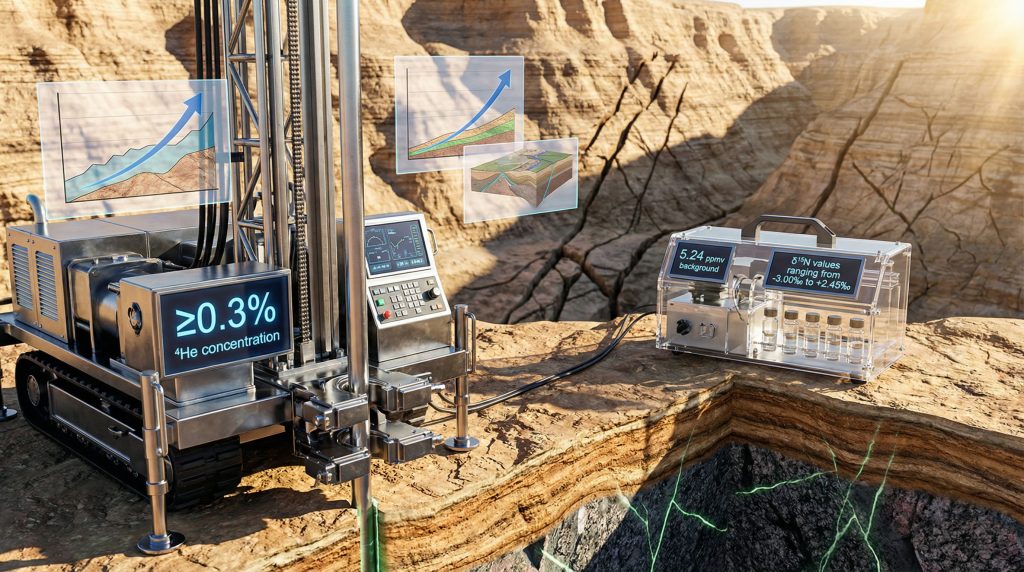
Helium exploration program development demands fundamentally different geological frameworks compared to conventional hydrocarbon systems. The U.S. Geological Survey establishes that helium requires minimum concentration thresholds of approximately 0.3% to achieve commercial viability in extraction operations, representing significantly higher purity requirements than most conventional natural gas reservoirs.
Radioactive decay processes generate helium-4 within uranium and thorium-bearing crystalline basement rocks over geological timescales. Optimal conditions require:
- Uranium and thorium content exceeding 10 parts per million (ppm) combined
- Basement rock ages exceeding 1 billion years for sufficient helium generation
- Active fault systems providing migration conduits
- Specialized trapping mechanisms in overlying sedimentary formations
| Factor | Optimal Conditions | Measurement Methods |
|---|---|---|
| Uranium/Thorium Content | >10 ppm combined | Gamma-ray spectrometry |
| Basement Rock Age | >1 billion years | Radiometric dating |
| Structural Complexity | Active fault systems | Seismic interpretation |
| Seal Rock Integrity | Clay-rich formations | Core analysis |
Why Standard Natural Gas Methods Need Adaptation
Helium's extreme buoyancy and noble gas characteristics create unique subsurface behavior patterns requiring specialized analytical protocols. Unlike methane and other hydrocarbons that respond predictably to conventional pressure regimes, helium exhibits distinctive migration dynamics through fractured basement rocks into sedimentary sequences where specific structural geometries enable concentration and trapping.
The extreme diffusivity of helium means conventional hydrocarbon sealing mechanisms prove inadequate. Helium accumulation requires enhanced seal rock integrity and specialized stratigraphic configurations that differ substantially from petroleum trapping systems. This necessitates modified risk assessment frameworks and interpretation methodologies specifically developed for noble gas systems.
When big ASX news breaks, our subscribers know first
What Are the Core Phases of a Modern Helium Exploration Program?
Phase 1 – Regional Geological Assessment
Contemporary helium exploration program implementation follows systematic progression through increasingly capital-intensive phases designed to manage financial risk while establishing geological confidence. Regional assessment establishes foundational understanding of helium source rock distribution and structural geometries enabling migration and accumulation.
Critical evaluation criteria include:
- Radiometric dating confirming basement rock ages exceeding 1 billion years
- Gamma-ray spectrometry measuring uranium and thorium source potential
- Seismic interpretation identifying structural complexity and fault systems
- Stratigraphic analysis determining seal rock distribution and integrity
Phase 2 – Geochemical Soil Gas Surveys
Shallow probe sampling at approximately 1-meter depths provides direct measurement of helium migration to surface environments. Mass spectrometry analysis quantifies helium concentrations against established baseline levels, typically 5.24 parts per million by volume (ppmv) in uncontaminated geological settings.
Anomaly identification focuses on concentrations exceeding background levels by 50 to 500 parts per billion (ppb), indicating potential subsurface helium sources requiring further investigation through drilling programs. These surveys enable spatial targeting for subsequent expensive drilling operations while minimizing exploration risk.
Phase 3 – Drill Stem Testing Operations
Direct reservoir characterization through controlled testing in exploratory boreholes provides definitive confirmation of helium presence and commercial viability. Open-hole interval isolation enables measurement of gas flow rates under controlled conditions while pressure buildup analysis determines reservoir properties essential for resource estimation.
Recent technical developments demonstrate the sophistication of modern drill stem testing protocols. Moreover, comprehensive drilling results interpretation becomes crucial for accurate assessment of helium concentrations and commercial potential. Analysis of gas samples from exploratory drilling programs requires specialized noble gas laboratories capable of parts-per-billion detection sensitivity.
Independent verification from multiple laboratories has become standard practice for establishing analytical credibility essential for investor confidence and regulatory approval.
Which Analytical Techniques Drive Successful Helium Discovery?
Noble Gas Isotopic Analysis Methods
Advanced analytical capabilities represent the cornerstone technology distinguishing helium exploration from conventional natural gas discovery programs. Helium-4 concentration measurements establish absolute helium abundance while helium-3 detection provides critical information about helium age, source rock characteristics, and migration history.
Independent laboratory analysis demonstrates contemporary detection capabilities reaching parts-per-billion sensitivity levels. Recent confirmations from the U.S. Geological Survey's Noble Gas Laboratory in Denver and Lawrence Livermore National Laboratory in California validated helium-3 concentrations of 11.2 to 11.9 parts per billion (ppb) in exploration samples.
This analytical consistency across major federal research facilities demonstrates the reliability required for commercial development. Furthermore, these advanced techniques are aligned with broader mining industry innovation trends that emphasise precision and technological advancement in resource exploration.
Modern helium exploration program success requires integrating helium-4 concentrations alongside nitrogen isotope signatures (δ¹⁵N values ranging from -3.00‰ to +2.45‰) to distinguish crustal versus atmospheric sources and optimize drilling target selection for maximum commercial potential.
Advanced Reservoir Characterization Tools
Multi-laboratory verification protocols have become essential for establishing analytical credibility required for resource estimation acceptance by regulatory authorities and investment communities. Nitrogen isotope ratios measured via continuous-flow isotope ratio mass spectrometry enable differentiation between crustal helium sources produced through radioactive decay versus atmospheric contamination.
Critical analysis parameters include:
- Helium-4 absolute abundance measurements
- Helium-3/Helium-4 isotopic ratio analysis
- Nitrogen isotope signatures (δ¹⁵N) for source discrimination
- Pressure profile characterization during drill stem testing
- Thermal maturity assessment of associated formations
How Do Different Geological Settings Affect Exploration Strategy?
Methane-Rich Reservoir Systems
The Mid-Continent United States model demonstrates how associated hydrocarbon systems create synergistic exploration opportunities. Dual-commodity extraction potential enhances economic viability through shared infrastructure development and processing facilities, reducing overall project risk profiles while expanding revenue potential.
These systems typically occur in sedimentary basins where conventional petroleum exploration has identified hydrocarbon accumulations. Helium concentration within existing natural gas fields provides opportunities for co-production, though separation technology requirements differ significantly from conventional gas processing.
Nitrogen-Rich Systems
Utah, Montana, and Saskatchewan geological environments exemplify independent helium accumulation mechanisms where nitrogen comprises the primary associated gas rather than hydrocarbons. These systems require specialized separation technology capable of processing nitrogen-helium mixtures while maintaining economic extraction thresholds.
Nitrogen-rich system characteristics:
- Independent helium generation from basement source rocks
- Nitrogen concentrations often exceeding 80% of total gas content
- Specialized membrane or pressure swing adsorption separation requirements
- Different risk-reward profiles compared to hydrocarbon-associated systems
Thermal Spring Systems
East African Rift environments demonstrate exceptional helium concentrations reaching up to 10.5% helium-4 content in natural thermal spring systems. These geological settings represent unique helium exploration opportunities requiring alternative methodologies focused on geothermal gradients and deep crustal processes rather than conventional sedimentary basin analysis.
Tanzania's Rukwa Basin exemplifies how thermal spring systems produce commercially significant helium concentrations through entirely different geological mechanisms than sedimentary basin accumulations. Consequently, this expands global exploration potential into previously unconsidered geological environments.
What Technologies Enable Efficient Helium Extraction Post-Discovery?
Pressure Swing Adsorption Systems
Selective gas separation through pressure swing adsorption represents the most commonly deployed technology for helium extraction from nitrogen-rich reservoir systems. These systems operate through cyclical pressure variations that preferentially adsorb nitrogen while allowing helium passage, achieving separation efficiency levels suitable for commercial production.
Key operational parameters:
- Separation efficiency typically exceeding 85% for helium recovery
- Energy requirements approximately 2-4 kWh per cubic meter of helium produced
- Capital costs ranging from $2-5 million for commercial-scale installations
- Operational flexibility accommodating variable feed gas compositions
Membrane Separation Technologies
Advanced polymer membrane applications enable continuous processing of helium-bearing gas streams through selective permeation characteristics. These technologies demonstrate particular effectiveness for helium exploration program applications where continuous operation and scalability represent critical economic factors.
Membrane separation achieves helium purity levels sufficient for most industrial applications while maintaining lower capital requirements compared to cryogenic distillation systems. This makes the technology particularly suitable for early-stage production from newly discovered helium accumulations.
Cryogenic Distillation Methods
Ultra-high purity helium production for specialized applications requires cryogenic distillation processing capable of achieving 99.999% purity levels. These energy-intensive systems represent premium market applications where helium purity commands significant price premiums over standard industrial-grade helium.
Where Are the Most Promising Global Helium Exploration Frontiers?
North American Opportunities
| Region | Key Geological Features | Exploration Status |
|---|---|---|
| Four Corners (US) | Mississippian formations | Active drilling programs |
| Saskatchewan Basin | Cratonic basement systems | Early-stage geochemical surveys |
| Tohache Wash, Arizona | Leadville Formation targets | Detailed geological mapping |
| Minnesota Iron Range | Precambrian basement rocks | Advanced drilling operations |
Recent developments in Minnesota demonstrate the potential for significant helium discoveries within Precambrian basement terranes. Exploration programs targeting helium accumulations in formations previously evaluated for conventional resources have identified commercially viable concentrations through systematic drilling campaigns reaching depths exceeding 1,000 meters.
International Emerging Markets
Tanzania's Rukwa Basin represents exceptional helium exploration potential through thermal spring systems producing concentrations far exceeding conventional sedimentary accumulations. These systems demonstrate helium-4 content levels reaching 10.5%, establishing new benchmarks for global helium exploration targeting.
Algeria's established infrastructure provides strategic advantages for helium exploration program development within North African geological settings. Existing natural gas processing facilities and export infrastructure reduce capital requirements for helium commercialization while established regulatory frameworks facilitate project development.
Canadian prairie opportunities within sedimentary basins demonstrate significant helium potential associated with conventional hydrocarbon systems. Saskatchewan and Alberta geological environments provide multiple target horizons where helium accumulation occurs independently or in association with natural gas reservoirs.
In addition, companies such as Blue Star Helium are actively advancing helium exploration projects across North America, demonstrating commercial interest in these emerging opportunities.
The next major ASX story will hit our subscribers first
What Risk Factors Should Investors Consider in Helium Exploration?
Technical Risk Assessment
Reservoir continuity uncertainties represent primary technical risks in helium exploration program evaluation. Unlike conventional hydrocarbon reservoirs where seismic interpretation provides reliable continuity assessment, helium accumulations often occur in structurally complex basement-sediment interface zones where geological continuity proves difficult to predict between drilling locations.
Concentration variability challenges create significant economic risk factors where helium concentrations may vary dramatically across relatively short distances. This variability requires extensive drilling programs to establish resource confidence levels suitable for commercial development decisions.
Key technical risk factors:
- Reservoir pressure maintenance over production lifecycles
- Extraction technology performance at varying concentrations
- Infrastructure development in remote exploration areas
- Regulatory approval timelines for novel helium projects
Market Risk Considerations
Global helium supply-demand dynamics create complex market risk scenarios requiring careful evaluation. Traditional helium production from natural gas processing facilities faces declining output as conventional reserves deplete, while growing demand from semiconductor manufacturing, medical applications, and aerospace industries creates supply deficit projections.
Price volatility factors include geopolitical considerations affecting major helium-producing regions, technological changes in end-use applications, and competition from recycling technologies reducing primary helium demand. These market dynamics create both opportunity and risk for new helium exploration program development.
However, the strategic importance of helium has led to focused critical minerals strategy initiatives globally, potentially providing more stable market conditions for new projects.
How Do Successful Programs Integrate Multidisciplinary Expertise?
Essential Team Composition
Successful helium exploration program implementation requires integrating specialized expertise across multiple technical disciplines. Petroleum geologists with noble gas experience provide essential geological interpretation capabilities while geochemists specialising in isotopic analysis enable sophisticated source rock evaluation and migration pathway analysis.
Reservoir engineers familiar with noble gas behavior contribute critical expertise for production forecasting and extraction system design. Process engineers specialising in gas separation technology ensure commercial viability through optimal extraction methodology selection and system integration.
Technology Integration Requirements
Contemporary helium exploration program success depends on seamlessly integrating geological mapping, geochemical soil gas surveys, drill stem testing, and noble gas analysis to identify commercially viable helium concentrations exceeding 0.3% in subsurface reservoirs formed through radioactive decay processes within basement rock systems.
Integration success factors:
- Systematic geological assessment protocols ensuring comprehensive source rock evaluation
- Advanced analytical technology deployment with multi-laboratory verification
- Risk-balanced investment strategies managing technical and market uncertainties
- Long-term market positioning considering evolving helium supply-demand dynamics
What Does the Future Hold for Helium Exploration Technology?
Emerging Detection Technologies
Enhanced mass spectrometry sensitivity continues advancing detection capabilities toward single parts-per-billion levels, enabling identification of helium anomalies previously below detection thresholds. Real-time downhole gas analysis systems under development promise immediate reservoir characterisation during drilling operations, reducing analytical delays and improving drilling decision-making.
Satellite-based geological mapping applications demonstrate potential for regional helium exploration targeting through identification of structural features and basement rock distributions over extensive areas. Artificial intelligence pattern recognition systems increasingly support geological interpretation by identifying complex relationships between geological parameters and successful helium discoveries.
Research institutions like the CSIRO are advancing understanding of hydrogen and helium occurrence mechanisms, supporting more effective exploration strategies.
Sustainability and Environmental Considerations
Minimal surface footprint exploration methods represent increasing priorities for helium exploration program development in environmentally sensitive areas. Advanced drilling techniques reduce surface disturbance while enhanced analytical capabilities minimise the number of exploration boreholes required for resource definition.
Water resource protection protocols become increasingly important as helium exploration expands into arid regions where groundwater resources require careful protection. Carbon footprint reduction strategies through renewable energy integration for drilling and processing operations align helium exploration with broader sustainability objectives.
Furthermore, the volatility seen in related commodity markets, such as uranium market volatility, highlights the importance of developing stable, sustainable exploration and production practices.
Building Successful Helium Exploration Programs Through Strategic Integration
Critical Success Elements
Systematic geological assessment protocols form the foundation for successful helium exploration program development. These protocols must integrate basement rock source evaluation, structural geology interpretation, and stratigraphic analysis to identify optimal drilling targets while managing exploration risk through phased capital deployment.
Advanced analytical technology deployment with multi-laboratory verification establishes the credibility essential for securing investment funding and regulatory approval for commercial development. Independent confirmation from established federal laboratories provides third-party validation exceeding industry standards for analytical quality assurance.
Strategic implementation priorities:
- Comprehensive geological database development before drilling initiation
- Multi-phase exploration budgeting managing technical risk progression
- Strategic partnership development with established analytical laboratories
- Regulatory compliance planning for novel helium project development
- Market analysis integration ensuring commercial viability assessment
Risk-balanced investment strategies acknowledge both technical uncertainties inherent in helium exploration and market dynamics affecting long-term commercial viability. Successful programs balance aggressive exploration targeting with prudent capital management while maintaining flexibility to adapt to evolving technical understanding and market conditions.
Long-term market positioning considerations recognise that helium exploration program development occurs within rapidly evolving supply-demand dynamics where new discovery success creates competitive advantages in securing premium helium supply contracts with end-use industries requiring reliable, high-quality helium supplies for critical applications.
Investment in helium exploration programs involves significant technical and market risks. This analysis provides educational information only and should not be considered investment advice. Potential investors should conduct thorough due diligence and consult qualified professionals before making investment decisions.
Ready to Capitalise on the Next Major Helium Discovery?
Discovery Alert's proprietary Discovery IQ model delivers real-time alerts on significant helium and mineral discoveries across the ASX, instantly empowering subscribers to identify actionable opportunities ahead of the broader market. Begin your 14-day free trial today at Discovery Alert and secure your market-leading advantage in this rapidly evolving sector.