
July 15, 2026
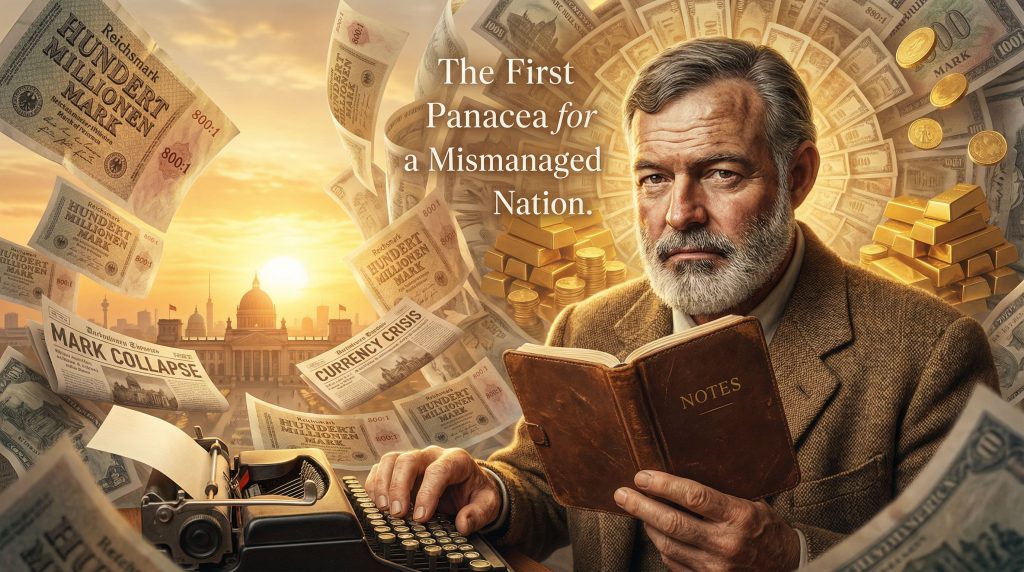
The intersection of war, monetary policy, and currency stability has fascinated observers for centuries, yet few literary figures possessed the unique vantage point to witness these forces firsthand like Ernest Hemingway. His experiences across Europe during the tumultuous post-World War I period provided him with insights into how hemingway exposed inflation and the collapse of currency that modern economists often miss in their theoretical frameworks. Furthermore, his firsthand observations of the historic gold surge explained during periods of monetary instability offer valuable lessons for contemporary investors.
What Did Ernest Hemingway Understand About Currency Debasement That Modern Economists Miss?
The Writer as Economic Observer – Beyond Fiction's Boundaries
Hemingway's perspective on monetary instability emerged from his dual role as both acclaimed novelist and working journalist. His position with The Toronto Star and other publications during the early 1920s placed him directly in the path of Europe's economic reconstruction following World War I. Unlike academic economists who studied currency movements from university offices, Hemingway observed the human reality of monetary collapse while reporting from the streets of post-war Europe.
This firsthand experience shaped his understanding of how currency debasement affects ordinary citizens. Where economists might focus on exchange rate mechanisms and monetary theory, Hemingway witnessed the social fabric tearing apart as families lost their savings overnight and workers found their wages worthless by the time they reached the marketplace.
Key advantages of Hemingway's observational approach:
• Direct documentation of daily price changes and their impact on human behaviour
• Real-time observation of social stratification during monetary crisis
• Understanding of psychological responses to purchasing power destruction
• Insight into how currency collapse affects different social classes
Hyperinflation as Human Drama – The Weimar Republic Through Literary Eyes
The German hyperinflation period between 1921 and 1923 provided Hemingway with a case study in monetary destruction that would influence his economic thinking for decades. During this period, the German mark deteriorated from approximately 4 marks per US dollar in 1920 to an astronomical 4.2 trillion marks per dollar by November 1923.
Hemingway's journalistic training enabled him to document not just the statistical reality of this collapse, but its human consequences. He observed how hyperinflation created distinct classes of winners and losers, with those holding hard currencies or tangible assets gaining tremendous advantage over wage earners and savers. Consequently, his observations of gold as an inflation hedge during this period would prove remarkably prescient for modern investors.
The social transformation during Weimar hyperinflation included:
• Factory workers requiring wheelbarrows to transport their daily wages
• Middle-class families losing generational wealth within months
• Currency denomination changes from thousands to millions to billions of marks
• Emergence of barter systems as people abandoned worthless paper money
The velocity of monetary circulation increased dramatically as citizens rushed to convert their marks into goods before further devaluation occurred. This behavioural response to currency instability would later inform Hemingway's broader understanding of how hemingway exposed inflation and the collapse of currency as a government policy tool.
When big ASX news breaks, our subscribers know first
How Did Hemingway's 1922 German Reporting Predict Modern Currency Crises?
Eyewitness Accounts of Monetary Collapse
Hemingway's reporting during the early stages of German hyperinflation revealed patterns that would repeat in currency crises throughout the 20th and 21st centuries. His observations of exchange rate deterioration, from manageable devaluation to complete monetary breakdown, demonstrated how currency crises accelerate once public confidence erodes. Moreover, his insights into how tariffs impact markets during periods of economic nationalism provide relevant context for understanding modern monetary pressures.
During 1922, when the dollar-to-mark ratio reached approximately 400:1, Hemingway documented the practical challenges facing German businesses and individuals. The Reichsbank's continuous issuance of higher denomination notes reflected the government's inability to halt the inflationary spiral through conventional monetary policy.
Timeline of observable currency deterioration:
- January 1922: 1 USD = approximately 190 marks
- July 1922: 1 USD = approximately 400 marks
- December 1922: 1 USD = approximately 8,000 marks
- August 1923: 1 USD = approximately 4.6 million marks
These dramatic shifts occurred within months, demonstrating how quickly confidence in fiat currency can evaporate once the inflationary process accelerates beyond government control.
The Profiteer Class During Currency Debasement
Hemingway's observations revealed how currency collapse creates opportunities for those positioned to exploit exchange rate disparities. Cross-border arbitrage became highly profitable for individuals with access to stable foreign currencies, particularly the US dollar. However, these opportunities came at the expense of ordinary citizens who bore the brunt of the monetary destruction.
Arbitrage opportunities during hyperinflation:
• Black market currency trading at rates divergent from official exchanges
• International commodity purchases using hard currency for domestic resale
• Real estate acquisitions by foreign currency holders at deeply discounted prices
• Industrial equipment purchases by international investors
These patterns would later manifest in numerous currency crises, from post-war Hungary and Greece to more recent examples in Venezuela and Zimbabwe. Hemingway's early documentation of these phenomena provided insights into how monetary instability redistributes wealth in society.
The writer understood that hyperinflation functions as a wealth transfer mechanism, moving resources from savers and wage earners to asset holders and those with access to stable currencies. This understanding would inform his later commentary on government monetary policy as a deliberate tool rather than an accidental consequence.
What Was Hemingway's Famous 1935 Warning About Inflation as Government Policy?
Historical Pattern Recognition in Economic Policy
By 1935, Hemingway had observed enough monetary crises to recognise recurring patterns in government behaviour during fiscal stress. His writing during this period reflected an understanding that inflation often serves as what he termed "a refuge for mismanaged nations" facing internal or external pressures.
The mid-1930s context provided the perfect backdrop for such observations. The United States remained mired in the Great Depression, with unemployment exceeding 20% and deflationary pressures threatening economic recovery. Roosevelt's New Deal policies had significantly expanded government spending, while the Federal Reserve had begun experimenting with monetary expansion to combat deflation.
Government incentives for monetary expansion during crises:
• Financing increased spending without explicit tax increases
• Reducing the real burden of existing government debt
• Creating artificial economic stimulus through lower real interest rates
• Transferring wealth from creditors to debtors (including the government)
Hemingway recognised that these incentives created a predictable pattern: governments facing fiscal constraints would eventually turn to monetary expansion as their least politically painful option. This insight proved remarkably prescient, as similar patterns would emerge during every major conflict and economic crisis of the subsequent decades.
War and Inflation as Twin Refuges for Failed Leadership
The connection between military conflict and monetary expansion became a central theme in Hemingway's economic observations. His experience covering the Spanish Civil War (1936-1939) and later World War II reinforced his understanding of how governments finance military operations through currency debasement. Furthermore, his analysis of US economic inflation trends during wartime provides valuable historical context for modern policy decisions.
Historical correlation between war and monetary expansion:
| Period | Conflict | Money Supply Growth | Inflation Rate |
|---|---|---|---|
| 1914-1918 | World War I | >100% (US) | >15% annually |
| 1939-1945 | World War II | >140% (US) | >5% annually |
| 1965-1975 | Vietnam War | >80% (US) | >7% annually |
| 2001-2021 | War on Terror | >300% (US) | Variable |
Hemingway understood that war provides political cover for monetary policies that would face resistance during peacetime. The urgency of national defence justifies economic measures that would otherwise appear reckless or irresponsible to the voting public.
"The temporary prosperity created by monetary expansion during wartime often masks the long-term consequences of currency debasement, creating a dangerous cycle where governments repeatedly resort to the same policies during subsequent crises."
Why Do Hemingway's Currency Observations Remain Relevant in 2026?
Modern Parallels to 1920s Monetary Destruction
The monetary landscape of 2026 bears striking similarities to the conditions Hemingway observed during the interwar period. Central banks across major economies have engaged in unprecedented monetary expansion since the 2008 financial crisis, with money supply growth rates far exceeding historical peacetime norms. Additionally, understanding how hemingway exposed inflation and the collapse of currency provides crucial context for evaluating modern monetary policies.
Current monetary policy context (as of March 2026):
• US M2 money supply increased approximately 40% between 2008-2019
• Additional expansion of roughly 25% occurred during 2020-2021 COVID response
• European Central Bank asset purchases exceeded €3 trillion since 2015
• Bank of Japan balance sheet expansion reached 130% of GDP by 2025
These expansion rates mirror the early stages of the currency crises Hemingway documented, though the mechanisms have evolved. Modern central banking allows for more sophisticated intervention, but the fundamental dynamics remain unchanged: governments facing fiscal stress turn to monetary expansion as their primary tool.
Asset Price Inflation Versus Consumer Price Metrics
Hemingway's observations about wealth redistribution during currency debasement prove particularly relevant in understanding modern inflation patterns. While consumer price indices may show moderate increases, asset prices have experienced dramatic appreciation in stocks, real estate, and commodities.
Asset price performance during monetary expansion (2008-2026):
- S&P 500: +400% nominal gain
- Real Estate: +300% in major metropolitan areas
- Gold: +200% over the period
- Collectibles/Art: +500% in premium segments
This divergence between consumer prices and asset prices reflects the same wealth transfer mechanisms Hemingway observed during Weimar hyperinflation. Those holding financial assets benefit dramatically, while wage earners and savers experience purchasing power erosion despite relatively modest consumer price inflation.
Social Inequality During Currency Debasement Periods
The social stratification patterns Hemingway documented in 1920s Germany have manifested in contemporary economies through similar mechanisms. Monetary expansion disproportionately benefits asset holders while disadvantaging those dependent on wage income or fixed-income investments.
Modern wealth concentration statistics:
• Top 1% of US households own approximately 40% of total wealth (2026)
• Real wage growth has lagged asset price appreciation by 3-4% annually
• Home ownership rates have declined among younger demographics
• Educational and healthcare costs have outpaced general inflation by 2-3x
These trends reflect the same underlying dynamics Hemingway observed: currency debasement functions as a wealth redistribution mechanism that favours those with access to hard assets and international diversification.
How Can Investors Apply Hemingway's Currency Collapse Insights Today?
Hard Asset Protection Strategies
Hemingway's observations about winners and losers during currency crises provide valuable guidance for modern investors seeking to protect wealth during periods of monetary instability. His documentation of how gold, real estate, and foreign currencies maintained purchasing power during hyperinflation offers timeless lessons. In addition, understanding the key investment strategy components remains crucial for implementing these protective measures effectively.
Core hard asset allocation principles:
• Physical gold: 10-20% of portfolio as currency hedge
• International real estate: Geographic diversification outside home currency
• Commodity exposure: Energy, agriculture, and base metals
• Foreign currency deposits: Exposure to stronger monetary jurisdictions
These allocations mirror the strategies employed by successful investors during historical currency crises. The key insight from Hemingway's observations is that currency instability often develops gradually before accelerating rapidly, making early positioning crucial.
Recognising Early Warning Signs of Currency Instability
Hemingway's documentation of pre-crisis conditions provides a framework for identifying when monetary systems approach instability. His observations suggest that currency collapse follows predictable patterns in government rhetoric and policy implementation. For instance, his analysis of Hemingway's insights on economic collapse provides valuable historical documentation of these warning signs.
Early warning indicators identified through historical analysis:
- Fiscal deficit expansion exceeding 5% of GDP consistently
- Debt-to-GDP ratios approaching 100% with rising trajectory
- Political rhetoric emphasising "extraordinary circumstances"
- Central bank policy described as "temporary" or "emergency" measures
- International tensions requiring increased military spending
Contemporary observers can monitor these indicators to assess the probability of currency instability in their home jurisdictions. Hemingway's insight was that governments rarely admit to deliberate currency debasement, instead framing policies as temporary responses to external threats.
Cross-Border Diversification Lessons from 1920s Germany
The international perspective Hemingway gained through his journalism highlighted the importance of geographic and currency diversification during periods of monetary instability. His observations of how Americans and other foreigners could exploit currency arbitrage opportunities provide lessons for modern investors.
Modern diversification strategies inspired by historical precedents:
• Multi-currency bank accounts in stable jurisdictions (Switzerland, Singapore)
• International brokerage accounts with foreign currency settlement
• Overseas real estate in countries with sound monetary policy
• International business operations generating foreign currency income
These strategies provide protection against home currency debasement while potentially creating profit opportunities during currency crises. Hemingway's key insight was that currency instability creates both risks and opportunities for those positioned to exploit exchange rate disparities.
What Modern Economic Lessons Emerge from Hemingway's Literary Economics?
The Human Cost of Monetary Experimentation
Hemingway's strength as an economic observer lay in his focus on individual human stories rather than abstract macroeconomic statistics. His documentation of how currency collapse affects families, businesses, and communities provides insights often missing from academic economic analysis. Moreover, understanding how hemingway exposed inflation and the collapse of currency through personal narratives makes these lessons more accessible to contemporary readers.
Individual impacts of currency debasement:
• Retirement savings destruction: Fixed-income investments lose purchasing power
• Intergenerational wealth transfer disruption: Traditional inheritance planning fails
• Social mobility reduction: Asset price inflation prevents younger generations from building wealth
• Economic planning impossibility: Long-term financial decisions become extremely difficult
These human consequences explain why currency instability often leads to political upheaval and social unrest. Hemingway understood that monetary policy creates winners and losers, with the losers often constituting the majority of the population.
Literature as Economic Documentation
Hemingway's approach to economic observation through narrative and character development offers advantages over traditional economic analysis. Literature captures the psychological and social dimensions of economic phenomena that statistical analysis often misses.
Advantages of literary economic observation:
- Psychological insight: Understanding how people actually behave during crises
- Social dynamics: Documenting how communities respond to economic stress
- Cultural memory: Preserving lessons that formal economic models may overlook
- Accessibility: Making complex economic concepts understandable to general audiences
This approach proves particularly valuable during unprecedented circumstances when historical data may provide limited guidance. Hemingway's insights into human behaviour during currency crises remain relevant because the psychological responses to monetary instability remain consistent across cultures and time periods.
The next major ASX story will hit our subscribers first
Frequently Asked Questions About Hemingway's Economic Insights
Did Hemingway Have Formal Economic Training?
Hemingway's economic insights emerged from practical observation rather than academic training. His background as a journalist provided him with skills in fact-gathering, pattern recognition, and human psychology that proved more valuable than formal economic education for understanding currency crises. However, his analysis of market dynamics during economic collapse demonstrates sophisticated understanding of financial systems despite his lack of formal training.
Hemingway's relevant qualifications:
• Foreign correspondent experience: Direct observation of post-war European reconstruction
• International travel: Exposure to multiple currencies and economic systems
• Business journalism: Coverage of financial markets and economic policy
• War correspondence: Understanding of how conflict affects monetary policy
His lack of formal economic training may have been an advantage, allowing him to observe phenomena without theoretical preconceptions that might have limited his perspective.
How Accurate Were Hemingway's Economic Predictions?
Hemingway's observations about government behaviour during fiscal crises have proven remarkably prescient. His identification of inflation as a government refuge during times of stress accurately predicted policy responses during subsequent conflicts and economic crises.
Validated predictions from Hemingway's observations:
- Korean War (1950-1953): Money supply expansion to finance conflict
- Vietnam War (1965-1975): Inflation surge following military escalation
- 2008 Financial Crisis: Massive monetary expansion as policy response
- COVID-19 Response (2020-2021): Unprecedented peacetime money creation
His understanding that governments would repeatedly resort to monetary expansion during crises has been validated by policy responses across multiple decades and different political administrations.
Key Takeaways – Hemingway's Enduring Currency Wisdom
Essential Principles for Modern Investors
Hemingway's observations provide a framework for understanding how currency instability develops and spreads through economic systems. His insights remain relevant because the fundamental incentives facing governments during fiscal stress have not changed despite technological and institutional evolution.
Core principles derived from Hemingway's observations:
• Currency instability follows predictable patterns despite varying specific circumstances
• Government rhetoric often obscures deliberate policy choices regarding monetary expansion
• Early positioning proves crucial because currency crises accelerate rapidly once confidence erodes
• International diversification provides protection against home currency debasement
• Hard assets maintain purchasing power during periods of monetary instability
The Writer's Economic Legacy
Hemingway's contribution to economic understanding lies not in theoretical innovation but in practical observation of how monetary systems function under stress. His documentation of currency collapse provides insights that remain valuable for investors, policymakers, and citizens seeking to understand modern monetary phenomena.
Enduring relevance of Hemingway's insights:
- Pattern recognition: Understanding how currency crises develop and spread
- Human psychology: Appreciating how people respond to monetary instability
- Political economy: Recognising government incentives during fiscal stress
- Investment strategy: Applying historical lessons to modern portfolio management
His work demonstrates that careful observation of human behaviour during economic stress can provide insights that formal economic models may miss, making literature a valuable complement to traditional economic analysis. Consequently, how hemingway exposed inflation and the collapse of currency continues to serve as a masterclass in recognising and preparing for monetary instability.
Disclaimer: This analysis is for educational purposes and does not constitute financial advice. Currency and investment risks should be carefully evaluated with qualified financial professionals. Historical patterns do not guarantee future outcomes, and all investments carry the risk of loss.
Are You Positioned Ahead of the Next Currency Crisis?
Discovery Alert's proprietary Discovery IQ model delivers instant notifications on significant ASX mineral discoveries, providing crucial portfolio diversification during periods of monetary uncertainty that Hemingway documented so effectively. Understanding why historic discoveries can generate substantial returns becomes essential when traditional currencies face debasement pressures, and begin your 14-day free trial today to secure your market-leading advantage.