August 14, 2026
What Makes High-Altitude Mining a Strategic Advantage in Global Copper Markets?
Extreme elevation mining operations represent one of the industry's most challenging yet potentially rewarding frontiers. When copper deposits lie buried beneath oxygen-thin air at altitudes exceeding 5,000 meters, extraction becomes a test of engineering ingenuity and operational resilience. The Zijin Julong copper mine expansion exemplifies how these harsh conditions, while demanding specialised equipment and techniques, often conceal some of the world's most substantial mineral resources.
The technical mastery required to succeed in such environments creates natural barriers to entry, potentially offering sustained competitive advantages for companies capable of navigating these operational complexities. Furthermore, the convergence of technological advancement and resource scarcity has elevated high-altitude mining from a niche specialty to a strategic necessity.
As easily accessible copper deposits become increasingly depleted, mining companies must venture into previously inaccessible territories where geological formations preserve untapped mineral wealth. This shift represents more than operational adaptation; it signals a fundamental transformation in how the industry approaches resource development in an era of intensifying demand for critical metals.
Understanding China's Largest High-Altitude Copper Operation
The Julong copper mine stands as a testament to modern mining engineering capabilities in extreme environments. Located on the Tibetan Plateau at over 5,000 meters above sea level, this facility represents the pinnacle of high-altitude mining technology. The mine's successful operation in conditions characterised by frigid temperatures, oxygen deprivation, and logistical isolation demonstrates how specialised engineering solutions can unlock previously inaccessible mineral resources.
Operating in such extreme conditions requires fundamentally different approaches to equipment selection, maintenance protocols, and workforce management. The thin atmosphere at this altitude contains approximately 50% less oxygen than at sea level, creating unique challenges for both human workers and mechanical systems.
Combustion engines operate less efficiently, hydraulic systems require modifications, and electronic equipment must withstand extreme temperature fluctuations while maintaining operational reliability. However, these challenges are being addressed through data-driven mining operations that optimise performance in extreme conditions.
Processing Capacity Transformation: From 150,000 to 350,000 Tonnes Daily
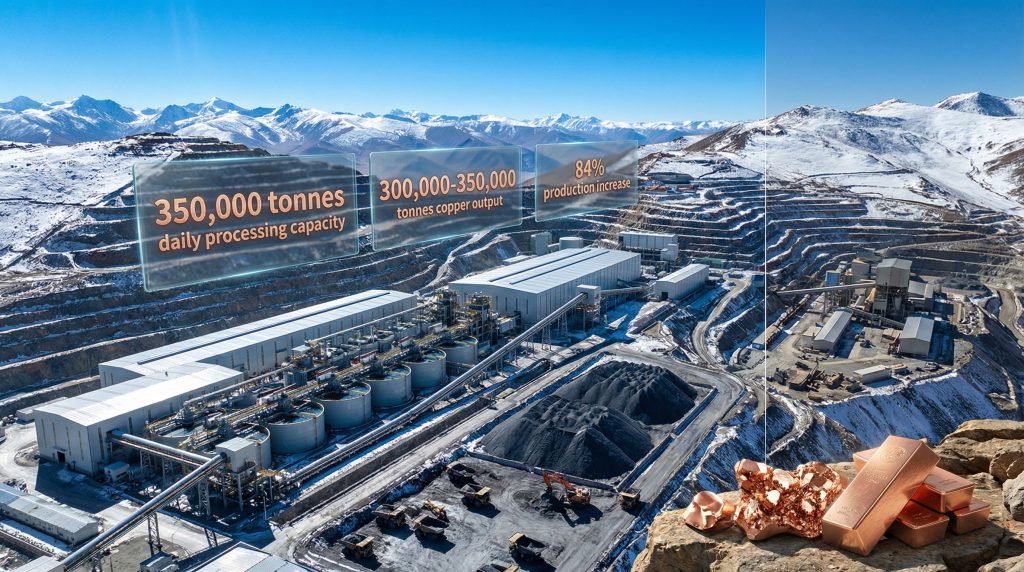
The expansion at Julong represents a massive scaling of operational capacity that transforms the mine from a significant regional producer into a globally relevant copper source. The increase in ore processing capacity from 150,000 to 350,000 tonnes per day represents a 233% capacity enhancement, achieved through sophisticated engineering adaptations designed for extreme altitude conditions.
This capacity expansion required extensive modifications to traditional mining equipment and processes. Flotation cells, crushers, and conveyor systems all needed altitude-specific calibrations to maintain efficiency in low-pressure environments. The processing infrastructure incorporates advanced automation systems to compensate for the challenges of maintaining consistent human operations at extreme altitude.
Additionally, AI in mining innovation plays a crucial role in optimising these systems for maximum efficiency despite challenging environmental conditions.
Strategic Location at 5,000+ Meters Above Sea Level
The geographic positioning of the Julong mine, while presenting operational challenges, also offers certain strategic advantages. The extreme altitude location places the operation in a region with minimal competing land uses, reducing potential conflicts with agricultural or urban development. The isolated location also provides access to geological formations that have remained largely undisturbed by previous mining activities.
The Tibetan Plateau's geological history has created unique conditions for copper mineralisation. Tectonic activities and volcanic processes that formed the plateau concentrated metal deposits in ways that can result in high-grade ore bodies. These geological advantages can offset some of the operational costs associated with extreme altitude mining, particularly when extraction technologies are specifically optimised for these conditions.
When big ASX news breaks, our subscribers know first
How Does Phase 2 Expansion Impact Global Copper Supply Dynamics?
The copper market operates within a delicate balance of supply constraints and demand pressures that make any significant capacity addition globally relevant. When major producers announce flat or declining output forecasts, the emergence of new production capacity takes on heightened importance. The Zijin Julong copper mine expansion enters production at a particularly crucial moment when the global copper industry faces the dual challenge of aging mine portfolios and accelerating demand from electrification initiatives.
Traditional copper-producing regions have experienced declining ore grades and increasing extraction costs as easily accessible deposits become exhausted. This trend has created supply bottlenecks that new capacity additions like Julong can help alleviate. However, the impact extends beyond simple tonnage additions to include considerations of production timing, cost competitiveness, and supply chain reliability.
Annual Production Surge: 190,000 to 350,000 Tonnes Copper Output
The projected increase in annual copper production represents a significant addition to global copper supply forecast. Moving from 190,000 tonnes to between 300,000-350,000 tonnes annually constitutes an 84% production increase that places Julong among the world's larger copper operations.
This output level positions the mine as a meaningful contributor to global copper markets, particularly during periods when other major producers face operational challenges or declining yields. The timing of this production increase coincides with global supply constraints that have characterised the copper market in recent years.
Many established copper mines are experiencing declining grades as they extract ore from deeper, less accessible areas. The addition of high-capacity production from a newly expanded facility provides market stability during a period of industry transition.
Multi-Metal Production Benefits Beyond Copper
Beyond copper, the Julong expansion delivers significant increases in secondary metal production that enhance the operation's overall economic value. Molybdenum production is projected to increase from 8,000 to 13,000 tonnes annually, representing a 63% increase in this critical industrial metal. Silver production shows even more dramatic growth, rising from 109 to 230 tonnes annually, more than doubling output.
| Metal | 2025 Output | 2026 Projected Output | Percentage Increase |
|---|---|---|---|
| Copper | 190,000 tonnes | 300,000-350,000 tonnes | 84% increase |
| Molybdenum | 8,000 tonnes | 13,000 tonnes | 63% increase |
| Silver | 109 tonnes | 230 tonnes | 111% increase |
This multi-metal production profile creates revenue diversification that can help buffer the operation against price volatility in any single commodity market. Molybdenum serves critical roles in steel production and chemical applications, while silver maintains importance in both industrial applications and investment demand. The combined revenue streams from these secondary metals can significantly improve the mine's overall profitability and operational sustainability.
Resource Base Expansion: 25.88 Million Tonnes Copper Content
The substantial resource base underlying the Julong operation provides long-term production visibility that extends well beyond the current expansion phase. With 25.88 million tonnes of copper content identified within the resource base, the mine possesses sufficient reserves to support decades of production at expanded capacity levels.
This resource magnitude has increased dramatically since initial development, growing by 2.5 times from original estimates. Such resource growth demonstrates the potential for continued exploration success within the broader mineralised system. The geological characteristics that created the initial copper deposit likely extend throughout the surrounding area, suggesting possibilities for further resource additions through systematic exploration programs.
What Engineering Challenges Define Ultra-High Altitude Mining Operations?
Mining at extreme altitudes presents a unique constellation of engineering challenges that require specialised solutions not encountered in traditional mining environments. The combination of reduced atmospheric pressure, temperature extremes, and oxygen deprivation creates operational conditions that push conventional mining equipment beyond its design parameters. Success in such environments demands comprehensive re-engineering of standard mining practices and equipment specifications.
The development of high-altitude mining capabilities requires significant technological investment and operational expertise that few companies possess. This technical specialisation creates competitive barriers that can protect market positions for companies capable of mastering these challenging conditions. The engineering solutions developed for extreme altitude operations often find applications in other challenging mining environments, creating additional value from the specialised knowledge base.
Oxygen-Deprived Environment Operational Considerations
Atmospheric oxygen levels at 5,000+ meters altitude present fundamental challenges for both human operations and mechanical systems. Worker productivity and safety require specialised protocols, including gradual acclimatisation periods, supplemental oxygen systems, and modified work schedules that account for reduced physical capacity in thin air. These human factors significantly impact operational planning and labour cost structures.
Mechanical equipment faces equally significant challenges in low-oxygen environments. Combustion engines experience reduced power output and efficiency, while electronic systems may require pressure compensation or sealed housings to maintain reliability. Cooling systems must operate more efficiently due to reduced air density, while hydraulic systems need pressure adjustments to compensate for altitude-related performance changes.
Equipment Performance at Extreme Elevations
Standard mining equipment requires extensive modifications to maintain operational effectiveness at extreme altitudes. Diesel engines typically lose 3-5% of their power output for every 1,000 feet of elevation gain, necessitating oversized equipment or specialised high-altitude engine variants. Hydraulic systems must be recalibrated to account for fluid behaviour changes in low-pressure environments.
Electronic control systems require specialised housing and cooling solutions to handle the extreme temperature variations common at high altitudes. Temperature swings from intense solar radiation during the day to sub-zero conditions at night can exceed 40 degrees Celsius, placing extraordinary stress on sensitive electronic components. Maintenance schedules must be accelerated to account for the harsh operating environment's impact on equipment longevity.
Logistics Infrastructure in Remote Tibetan Plateau
The remote location of high-altitude mining operations creates complex logistics challenges that significantly impact operational costs and supply chain reliability. Transportation infrastructure must handle extreme weather conditions, including seasonal road closures due to snow and ice. Supply chain planning requires extended lead times and substantial inventory buffers to account for transportation disruptions.
Communication systems at extreme altitudes require specialised equipment capable of maintaining connectivity despite challenging atmospheric conditions and remote locations. Satellite communication systems become essential for operational coordination and emergency response capabilities. The logistics of transporting heavy equipment and supplies to such remote locations requires careful planning and often involves multi-modal transportation strategies.
How Does Julong Position Within Zijin's Global Copper Portfolio?
Zijin Mining's global copper portfolio demonstrates a sophisticated strategy of geographic and operational diversification designed to optimise production stability and market positioning. The company's operations span multiple continents and geological environments, from the tropical conditions of the Democratic Republic of Congo to the mountainous terrain of Serbia and the extreme altitudes of Tibet. This diversity provides natural hedging against regional operational risks while positioning the company to capitalise on different market conditions and resource characteristics.
The integration of Julong's expanded capacity within this global portfolio creates operational synergies and strategic flexibility that enhance the overall enterprise value. Different operations within the portfolio can complement each other during periods of regional challenges or market volatility, providing stability that single-asset producers cannot achieve. This portfolio approach also facilitates knowledge transfer between operations, allowing engineering innovations and operational improvements to benefit the entire enterprise.
Integration with Serbian and DRC Operations
Zijin's operations across diverse geographic regions create opportunities for operational knowledge sharing and technical innovation transfer. The engineering solutions developed for high-altitude operations at Julong may find applications in other challenging environments within the portfolio. Similarly, techniques developed for tropical mining conditions in the DRC or European operational standards from Serbia can inform best practices at Julong.
The geographic distribution of production assets provides natural currency hedging and market access advantages. While Julong serves primarily Asian markets due to its geographic location, other operations can focus on European, African, or global markets based on their proximity and transportation advantages. This positioning flexibility allows the company to optimise sales strategies based on regional market conditions and pricing dynamics.
The broader Zijin global strategy demonstrates how diverse geographic assets can create competitive advantages through operational synergies and risk diversification.
China's Domestic Copper Security Strategy
The expansion of domestic copper production capacity aligns with China's broader strategic objectives of reducing dependence on imported commodities and enhancing supply chain security. As the world's largest copper consumer, China's domestic production capabilities directly impact its industrial competitiveness and strategic autonomy. The Zijin Julong copper mine expansion contributes meaningfully to these national objectives while providing Zijin with preferential access to domestic markets.
Domestic production offers certain advantages over imported copper, including reduced transportation costs, elimination of import duties, and greater supply chain reliability. These factors can provide domestic producers with competitive advantages in Chinese markets, particularly during periods of global supply disruption or trade tensions. The strategic value of domestic production extends beyond simple cost considerations to include national security and industrial policy objectives.
Supply Chain Resilience Through Geographic Diversification
Geographic diversification within Zijin's portfolio provides resilience against regional disruptions that can affect single-country producers. Political instability, natural disasters, labour disputes, or regulatory changes in one region can be partially offset by continued production from other portfolio assets. This diversification strategy has become increasingly valuable as global supply chains face mounting pressures from geopolitical tensions and climate-related disruptions.
The operational knowledge gained from managing diverse geographic assets also enhances the company's ability to evaluate and develop new projects in challenging environments. The expertise developed at Julong in extreme altitude operations, for example, could be applied to high-altitude deposits in other regions such as the Andes or other Asian mountain ranges.
What Are the Technical Specifications of the Expansion Project?
The technical scope of the Julong expansion represents a comprehensive transformation of processing capabilities that required extensive engineering innovation adapted to extreme altitude conditions. The project encompasses not merely capacity increases but fundamental improvements to processing efficiency, recovery rates, and operational reliability under challenging environmental conditions.
The expansion incorporates advanced flotation and concentration technologies specifically calibrated for the high-altitude environment. These systems must operate effectively despite reduced atmospheric pressure and extreme temperature variations while maintaining the metallurgical performance necessary to achieve target recovery rates. The engineering solutions developed for this project represent significant advances in high-altitude mineral processing technology.
Processing Plant Infrastructure Upgrades
The processing infrastructure upgrades encompass comprehensive improvements to crushing, grinding, flotation, and concentration systems. The expansion transforms annual processing capacity from approximately 45 million tonnes to over 105 million tonnes, representing a 133% capacity increase. This massive scaling required not only additional equipment but fundamental redesign of process flows and control systems.
Advanced automation systems play a crucial role in managing the expanded processing capacity under extreme conditions. These systems compensate for the challenges of maintaining consistent human oversight at high altitude while optimising processing parameters in real-time based on ore characteristics and environmental conditions. The automation infrastructure includes advanced sensors, control systems, and data analytics capabilities that enable remote monitoring and adjustment of processing parameters.
Ore Handling System Capacity Increases
The ore handling systems underwent comprehensive upgrading to accommodate the dramatic increase in throughput capacity. These systems must operate reliably despite extreme weather conditions, including high winds, temperature extremes, and potential ice formation. Materials handling equipment required specialised modifications to maintain operational reliability in low-pressure environments where conventional equipment performance may be compromised.
Conveyor systems, crushers, and stockpiling infrastructure all required altitude-specific engineering modifications. Belt conveyors need enhanced tensioning systems to account for material behaviour changes at low atmospheric pressure, while crusher optimisation must account for power limitations imposed by reduced engine performance at altitude. The integration of these systems requires sophisticated control algorithms that coordinate operations across the entire materials handling chain.
Environmental Management at High Altitude
Environmental management at extreme altitudes presents unique challenges related to ecosystem sensitivity, water management, and waste containment. High-altitude ecosystems often display enhanced sensitivity to disturbance due to harsh natural conditions and limited biodiversity. Environmental protection strategies must account for these factors while managing the impacts of large-scale mineral processing operations.
Water management systems require specialised design considerations for extreme temperature conditions where freeze-thaw cycles can damage conventional infrastructure. Tailings management must address challenges related to water balance in arid, high-altitude environments while preventing contamination of sensitive mountain watersheds. These environmental systems often require more robust engineering solutions than comparable systems at lower altitudes.
The expansion transforms Julong from processing 45 million tonnes annually to over 105 million tonnes, representing a 133% capacity increase through advanced flotation and concentration technologies adapted for extreme altitude conditions.
When Will Phase 3 Development Begin and What Scale Could It Achieve?
The potential for additional expansion phases at Julong depends on multiple factors including resource delineation, market conditions, and the successful integration of current expansion capacity. Phase 3 development could potentially target processing capacity of 200 million tonnes annually, which would position Julong among the world's largest copper operations by throughput volume.
The timeline for Phase 3 development likely extends several years beyond the current expansion completion, allowing for operational optimisation and resource definition. The substantial resource base of 25.88 million tonnes copper content provides adequate mineral inventory to support such expansion, but additional geological work may be required to define ore reserves suitable for the increased production rates.
Potential 200 Million Tonnes Annual Processing Capacity
A Phase 3 expansion targeting 200 million tonnes annual processing capacity would represent another doubling of current expanded capacity levels. Such massive throughput would require additional infrastructure development including power generation, water supply, waste management, and transportation systems. The engineering challenges of achieving this scale at extreme altitude would push the boundaries of current mining technology.
The economic viability of such expansion depends heavily on copper price assumptions and cost management capabilities. Higher throughput rates could provide economies of scale that reduce per-unit production costs, but the capital investment required would be substantial. The project economics would also depend on metallurgical performance at higher throughput rates and the ability to maintain recovery rates as processing intensity increases.
Path to 600,000 Tonnes Annual Copper Production
Achieving 600,000 tonnes annual copper production would position Julong among the world's top-tier copper mines by output volume. Such production levels would require not only expanded processing capacity but also optimisation of metallurgical performance to maximise copper recovery from processed ore. The combination of higher throughput and improved recovery rates would be necessary to achieve these production targets.
The global copper market impact of such production levels would be significant, potentially representing 2-3% of global annual copper production. This scale of production could influence regional pricing dynamics and supply chain logistics throughout Asia. The strategic implications for China's copper supply security would also be substantial, potentially reducing import dependence by meaningful margins.
Timeline and Investment Requirements for Next Phase
The timeline for Phase 3 development likely extends 5-7 years from initial feasibility studies through construction completion. This timeline accounts for extensive engineering design requirements, environmental permitting processes, equipment procurement with long lead times, and the complex logistics of constructing major infrastructure at extreme altitude.
Investment requirements for Phase 3 would likely exceed current expansion costs due to the scale and complexity of the infrastructure required. Capital intensity may be partially offset by economies of scale and learning curve benefits from previous expansion phases. The investment decision would depend heavily on long-term copper price forecasts and confidence in sustained demand growth from electrification trends.
The next major ASX story will hit our subscribers first
How Does This Expansion Address Global Copper Market Dynamics?
The global copper market faces a complex interplay of declining production from aging mines, increasing demand from electrification initiatives, and supply chain disruptions that have created periodic shortages and price volatility. The Zijin Julong copper mine expansion addresses these market dynamics by providing substantial new production capacity precisely when many established producers face declining output prospects.
Industry production plateaus have become increasingly common as major copper mines reach maturity and ore grades decline. The addition of high-capacity production from newly expanded facilities like Julong provides market stability during this transitional period. This new capacity enters production at optimal timing when global supply constraints have created favourable market conditions for efficient producers.
Supply Response During Industry Production Plateaus
The copper industry faces a paradox where robust demand growth coincides with production challenges at many established mines. Aging infrastructure, declining ore grades, and increasing extraction costs have limited production growth from traditional sources. New production capacity like the Julong expansion provides crucial supply additions during a period when organic growth from existing operations has become increasingly difficult to achieve.
The timing of this capacity addition is particularly significant because it coincides with broader industry trends toward production plateaus. Many of the world's largest copper mines are experiencing declining production profiles as they extract lower-grade ore from deeper sections. The Julong expansion provides fresh production capacity that can help stabilise global supply during this period of industry transition.
Impact on Copper Price Fundamentals
Substantial additions to global copper supply capacity can influence price fundamentals by reducing supply constraints that have periodically driven price spikes. However, the impact depends on demand growth rates and the timing of capacity additions relative to market needs. The Julong expansion enters a market environment where demand growth from electrification initiatives continues to accelerate.
Price impact analysis must consider not only absolute production volumes but also cost competitiveness and production reliability. High-efficiency operations like the expanded Julong mine can provide stable supply even during periods of market stress when higher-cost producers may reduce output. This reliability factor can provide price stability benefits that extend beyond simple supply volume considerations.
Strategic Timing Amid Electrification Demand Growth
The expansion timing aligns favourably with accelerating demand growth from electric vehicle adoption, renewable energy infrastructure development, and electrical grid modernisation projects. These demand drivers represent long-term structural changes rather than cyclical fluctuations, supporting sustained copper consumption growth over multi-decade timeframes.
Electrification demand differs from traditional industrial copper consumption in its growth trajectory and price sensitivity. Electric vehicle production, wind turbine manufacturing, and grid infrastructure projects typically proceed based on long-term planning cycles that are less sensitive to short-term price fluctuations. This demand characteristic provides more stable market conditions for new production capacity additions.
What Investment Implications Emerge from This Capacity Addition?
The successful expansion of production capacity at extreme altitude demonstrates technological capabilities that create competitive advantages and potential investment themes. Companies capable of developing challenging mineral deposits may command premium valuations due to their specialised expertise and access to resources that competitors cannot efficiently extract.
Investment implications extend beyond individual company performance to include broader themes around resource scarcity, technological innovation, and supply chain security. The success of extreme environment mining operations validates investment approaches focused on technological leadership and operational excellence rather than simply resource scale or geographic advantages. Understanding copper investment strategies becomes crucial in this evolving landscape.
Capital Efficiency Analysis of High-Altitude Operations
Capital efficiency metrics for high-altitude mining operations must account for specialised equipment requirements, extended construction timelines, and higher operational complexity. While initial capital investments may exceed comparable low-altitude projects, the resulting operations may achieve competitive advantages through reduced competition and access to higher-grade ore bodies.
Return on investment calculations for extreme environment operations should incorporate the strategic value of technological capabilities and competitive positioning. The engineering expertise developed through challenging projects can create sustainable competitive advantages that justify higher capital investments. These capabilities may also enable companies to develop similar challenging deposits that competitors cannot access.
Long-Term Resource Depletion Considerations
The substantial resource base at Julong provides production visibility extending decades into the future at expanded capacity levels. This long-term production profile offers investment stability that is increasingly valuable as many established mines face declining reserves and uncertain production prospects. Resource longevity becomes a crucial investment criterion in an industry where major discoveries have become increasingly rare.
Resource depletion analysis must consider not only absolute reserve quantities but also grade characteristics and extraction costs over time. High-altitude operations may maintain more stable cost profiles over time due to reduced competing land uses and potentially more consistent ore characteristics. These factors can provide investment returns that remain attractive even as production volumes eventually decline.
Competitive Positioning Against Global Copper Producers
The specialised capabilities required for extreme altitude mining create natural competitive barriers that can protect market positions and profit margins. Few companies possess the technical expertise and capital resources necessary to successfully develop high-altitude copper deposits. This specialisation creates competitive advantages that may be more sustainable than advantages based purely on resource scale or grade.
Competitive analysis must evaluate not only current production costs and capacity but also technological capabilities and development pipeline strength. Companies with proven track records in challenging environments may have superior access to future development opportunities in similar conditions. This technological leadership can provide sustained competitive advantages even as individual deposits mature.
How Do Extreme Operating Conditions Affect Production Costs?
Production costs at extreme altitudes incorporate numerous factors not encountered in conventional mining environments. These cost premiums must be evaluated against potential offsetting factors such as reduced land acquisition costs, fewer environmental conflicts, and possible higher ore grades in undisturbed geological formations.
Cost structure analysis for high-altitude operations requires detailed understanding of altitude-specific factors including equipment performance degradation, accelerated maintenance requirements, and specialised workforce considerations. However, these cost premiums may be partially offset by operational efficiencies achievable through advanced automation and process optimisation.
Energy Requirements at High Altitude
Energy systems at extreme altitudes face performance challenges related to reduced atmospheric pressure and equipment efficiency degradation. Diesel generators and other combustion-based power systems experience reduced output and efficiency, potentially requiring oversized installations or alternative energy sources. These factors directly impact operating cost structures and energy security considerations.
Power generation alternatives at high altitude may include hydroelectric systems utilising mountain water sources or wind power installations that can capitalise on high-altitude wind resources. Solar power systems may achieve enhanced efficiency due to reduced atmospheric filtering at altitude, despite challenges related to weather exposure. The selection of optimal energy solutions requires careful analysis of local resource availability and system reliability requirements.
Labour and Equipment Maintenance Premiums
Workforce management at extreme altitudes requires specialised approaches including gradual acclimatisation procedures, modified work schedules, and enhanced safety protocols. These requirements typically result in higher labour costs per unit of work accomplished. Housing and life support systems for workers at high altitude also require more robust engineering solutions than comparable facilities at lower elevations.
Equipment maintenance costs increase significantly due to harsh operating conditions and reduced equipment reliability. Preventive maintenance schedules must be accelerated to account for extreme temperature variations, UV exposure, and mechanical stress from altitude-related performance changes. Spare parts inventory requirements also increase due to longer supply chain lead times and reduced equipment reliability.
Transportation Cost Factors from Remote Location
Transportation costs for remote, high-altitude operations typically exceed those for accessible mining locations due to limited infrastructure, seasonal access restrictions, and specialised vehicle requirements. Road maintenance costs increase due to extreme weather exposure and heavy equipment traffic. Alternative transportation methods such as aerial delivery may be required for emergency supplies or time-sensitive materials.
Product transportation from remote locations to market centres involves complex logistics planning and potentially higher costs per unit. However, these costs must be evaluated against market access advantages and potential pricing premiums for products from strategically located operations. Transportation infrastructure investments may provide long-term cost benefits that justify initial capital expenditures.
What Role Does Julong Play in China's Resource Security Strategy?
China's approach to resource security emphasises diversification of supply sources, development of domestic production capabilities, and strategic stockpiling of critical materials. The Zijin Julong copper mine expansion directly supports these objectives by reducing dependence on imported copper while demonstrating technological capabilities that can be applied to other domestic mineral resources.
Domestic copper production provides strategic advantages beyond simple cost considerations, including supply chain reliability, currency hedging benefits, and reduced exposure to international trade disputes. These strategic values may justify investments in domestic production capacity even when international sources might offer lower costs under normal market conditions.
Domestic Production vs. Import Dependency Balance
China's massive copper consumption requires careful balance between domestic production capabilities and import source diversification. Domestic production provides supply security and economic benefits but cannot realistically meet total consumption requirements given current resource constraints. The optimal strategy involves maximising efficient domestic production while maintaining diverse import relationships.
The Julong expansion meaningfully contributes to domestic production goals while demonstrating advanced mining capabilities that could be applied to other domestic copper resources. This technological demonstration effect may be as valuable as the direct production contribution in supporting long-term resource security strategies. Success at Julong could encourage investment in other challenging domestic copper deposits.
Critical Metal Supply Chain Diversification
Beyond copper, the Julong operation produces molybdenum and silver that contribute to broader critical material supply security. These secondary products reduce import dependence for industrial materials that support manufacturing competitiveness. The multi-metal production profile demonstrates how single mining operations can contribute to multiple strategic material objectives.
Supply chain diversification benefits extend beyond simple geographic distribution to include technological capabilities and operational flexibility. The expertise developed in extreme environment mining can be applied to other challenging deposits containing critical materials. This capability development supports long-term resource security by expanding the range of deposits that can be economically developed.
Geopolitical Implications of Increased Domestic Capacity
Enhanced domestic production capacity provides strategic flexibility during periods of international tension or trade disruption. The ability to increase domestic production during supply emergencies offers policy alternatives that purely import-dependent strategies cannot provide. This strategic value justifies investments in domestic capacity that might not be optimal under purely economic criteria.
| Ranking Factor | Julong Position | Significance |
|---|---|---|
| Altitude | World's highest ultra-large copper mine | >5,000m elevation |
| National Scale | China's largest copper mine | 350,000 tonnes/day processing |
| Resource Base | 25.88 million tonnes copper content | Expanded 2.5x since 2020 acquisition |
The demonstration of advanced mining capabilities at Julong also supports broader geopolitical objectives related to technological leadership and resource development expertise. Success in extreme environment mining showcases technological capabilities that can be applied internationally through investment and partnership opportunities in similar challenging deposits worldwide. Zijin Mining has officially brought the Phase 2 expansion into production, marking a significant milestone in high-altitude mining technology.
The strategic implications of the Zijin Julong copper mine expansion extend beyond immediate production benefits to include technological capability demonstration, supply chain resilience enhancement, and geopolitical positioning advantages. These broader benefits support the investment rationale for challenging domestic mining projects even when international alternatives might offer purely economic advantages.
Please note: This analysis includes forward-looking projections and capacity estimates that involve inherent uncertainties. Mining operations face various operational and market risks that could affect actual production outcomes. Investment decisions should consider comprehensive risk assessments and professional financial advice.
Looking to Capitalise on High-Altitude Mining Opportunities?
Discovery Alert identifies significant ASX mineral discoveries across diverse mining environments, including challenging high-altitude operations like those showcased at Julong, powered by its proprietary Discovery IQ model. Explore historic examples of exceptional returns from major mineral discoveries and begin your 30-day free trial today to position yourself ahead of the market in Australia's dynamic resources sector.