June 28, 2026
Understanding High Pressure Grinding Roll Systems in Modern Mining
The modern mining sector stands at the intersection of operational efficiency and environmental responsibility, where technological choices increasingly determine both profitability and sustainability outcomes. Ivanhoe Mines Platreef HPGR technology represents one of the most significant advances in mineral processing technology, fundamentally altering how mining operations approach comminution while addressing the dual pressures of cost reduction and carbon footprint minimization. This transformation extends far beyond simple equipment upgrades, encompassing entire processing philosophies that reshape how companies evaluate operational performance, maintenance strategies, and long-term viability.
Understanding these technological shifts becomes crucial as mining companies navigate increasingly complex operational environments where energy costs, environmental regulations, and production efficiency demands converge. Furthermore, the adoption patterns emerging across different commodity sectors reveal strategic decision-making frameworks that prioritise integrated solutions over traditional isolated equipment selections. This evolution reflects broader mining industry innovation where proven technologies from successful operations inform strategic decisions at new projects, creating technology transfer pathways that span geographic regions and commodity types.
The Engineering Fundamentals of HPGR Crushing Technology
The fundamental mechanics of HPGR technology centre on counter-rotating cylindrical rolls that generate extreme pressures to fracture ore particles through controlled compression. Unlike conventional impact-based crushing methods, these systems operate by forcing material through a high-pressure zone between two opposing rolls, creating micro-fractures that enhance mineral liberation whilst consuming significantly less energy than traditional approaches.
Counter-rotating roll mechanics rely on precise hydraulic pressure control to maintain optimal compression forces across varying feed conditions. The pressure distribution principles governing HPGR operations typically range from 50 to 100 MPa, with hydraulic systems designed to respond dynamically to feed variations whilst maintaining consistent product specifications.
Key Engineering Parameters:
• Roll diameter specifications ranging from 700mm to 2400mm for different applications
• Operating pressure maintenance through sophisticated hydraulic control systems
• Wear-resistant roll surface materials designed for specific ore hardness profiles
• Predictive maintenance strategies utilising vibration analysis and pressure monitoring
The micro-fracture generation process distinguishes HPGR technology from conventional crushing methods by creating preferential breakage along grain boundaries. This controlled comminution approach preserves valuable mineral particles whilst achieving superior liberation characteristics compared to impact crushing alternatives.
Energy Efficiency Metrics That Drive HPGR Adoption
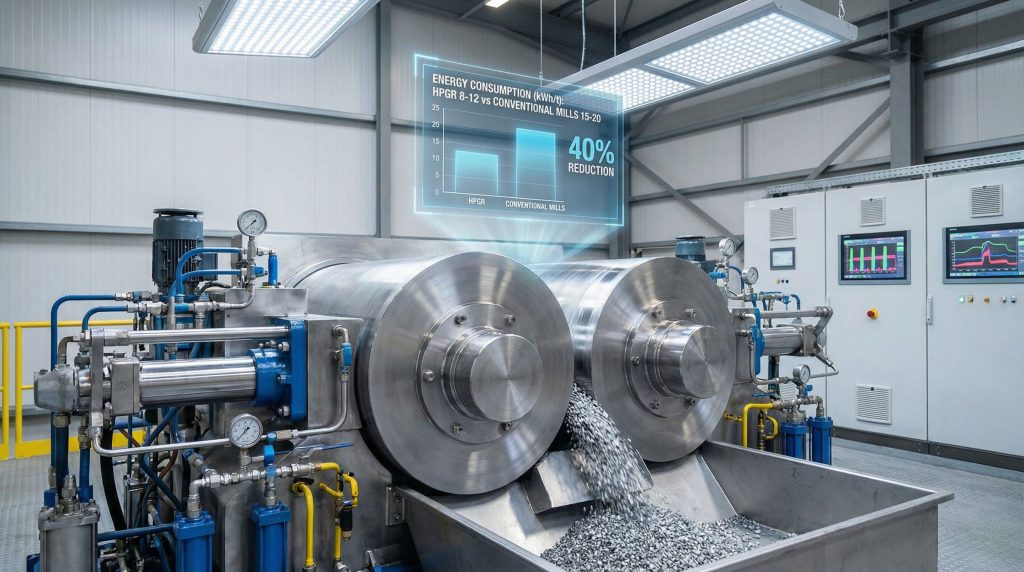
Energy consumption analysis reveals substantial advantages for HPGR systems, with documented reductions of up to 40 percent compared to traditional tumbling mills. This efficiency improvement translates directly into operational cost savings and reduced greenhouse gas emissions, supporting both economic and environmental objectives through data-driven mining operations.
Comparative Energy Performance:
| System Type | Energy Consumption (kWh/t) | Operational Efficiency |
|---|---|---|
| HPGR Systems | 8-12 | High performance baseline |
| Ball Mills | 15-20 | Traditional standard |
| Cone Crushers | 12-16 | Intermediate efficiency |
Power draw calculations for HPGR installations must account for hydraulic system requirements, roll drive mechanisms, and auxiliary equipment. The total energy profile demonstrates superior efficiency across varying operational conditions, particularly in tertiary crushing applications where particle size reduction requirements align with HPGR operational strengths.
When big ASX news breaks, our subscribers know first
What Makes HPGR Integration Critical for Large-Scale PGM Operations?
Platinum group metal processing presents unique technical challenges that align favourably with HPGR capabilities. The complex mineralogy of PGM deposits requires precise liberation strategies to maximise recovery rates whilst maintaining cost-effective processing volumes. These operational requirements have driven increased HPGR adoption across major PGM projects globally.
Mineral Liberation Enhancement in Complex Ore Bodies
The controlled comminution characteristics of HPGR systems prove particularly effective for platinum, palladium, and rhodium liberation. The micro-fracture generation process preserves valuable mineral grains whilst creating optimal particle size distributions for downstream flotation circuits.
Liberation Performance Factors:
• Grain boundary fracturing that maintains mineral integrity
• Reduced over-grinding compared to conventional milling approaches
• Enhanced flotation feed preparation through optimal particle sizing
• Improved recovery rates of 2-5 percent in downstream processes
The Platreef project, located 280 kilometres northeast of Johannesburg, represents a significant case study in Ivanhoe Mines Platreef HPGR technology implementation for PGM operations. Following successful Phase 1 completion in November 2025, the integration of Weir ENDURON HPGR technology in Phase 2 demonstrates industry confidence in the technology's capability to support large-scale production targets.
Throughput Capacity Scaling for Multi-Phase Mine Expansions
The Phase 2 expansion at Platreef illustrates how Ivanhoe Mines Platreef HPGR technology supports ambitious production scaling objectives. The project's progression toward becoming one of the world's largest and lowest-cost platinum group metal producers requires processing technologies that can deliver both volume and efficiency improvements simultaneously.
Scaling Considerations:
• Circuit integration with existing Phase 1 infrastructure
• Processing volume optimisation through tertiary crushing applications
• Maintenance scheduling coordination across multiple processing trains
• Quality control consistency throughout expanded operations
The successful implementation of HPGR technology at the Kamoa-Kakula copper complex provided crucial operational experience that informed Platreef's technology selection. This technology transfer demonstrates how proven performance in copper applications translates effectively to PGM processing environments.
Which Technical Specifications Define Successful HPGR Implementation?
Successful HPGR deployment requires careful specification of equipment parameters that align with specific ore characteristics and processing objectives. The technical requirements encompass mechanical design elements, control system capabilities, and maintenance infrastructure considerations that determine long-term operational success.
Equipment Sizing and Configuration Parameters
Roll diameter and width specifications must accommodate expected throughput volumes whilst maintaining optimal pressure distribution across the crushing zone. For tertiary crushing applications in large-scale operations, roll diameters typically range from 1000mm to 1800mm, with corresponding width specifications designed to handle projected feed rates.
Critical Specifications:
• Hydraulic system pressure ratings up to 350 bar for maximum compression
• Roll surface materials optimised for specific ore hardness profiles
• Bearing specifications designed for continuous high-load operations
• Lubrication system complexity requiring specialised maintenance protocols
Operating pressure ranges for PGM applications typically require sustained pressures between 60-90 MPa, with hydraulic systems designed to maintain consistent compression despite variations in feed characteristics. The Weir ENDURON HPGR selected for Platreef represents proven technology with demonstrated reliability in comparable large-scale mineral processing environments.
Process Control Systems and Monitoring Technologies
Modern HPGR installations incorporate sophisticated monitoring systems that track operational parameters in real-time. These control systems enable operators to optimise performance whilst preventing equipment damage through early detection of abnormal conditions.
Monitoring Capabilities:
• Real-time pressure monitoring with automatic adjustment protocols
• Roll gap control systems maintaining consistent product sizing
• Vibration analysis for predictive maintenance scheduling
• Wear detection technologies extending equipment service life
Roll gap control represents a critical technical specification, as variations can significantly impact both product quality and equipment longevity. Advanced control systems automatically adjust hydraulic pressure to maintain optimal gap settings despite normal wear patterns and feed variation.
How Do Mining Companies Evaluate HPGR Technology Performance?
Performance evaluation frameworks for HPGR technology encompass multiple metrics that reflect both operational efficiency and economic impact. Mining companies utilise comprehensive benchmarking approaches that consider energy consumption, availability, maintenance requirements, and downstream process optimisation when assessing technology performance.
Operational Performance Benchmarking
The mining industry recognises HPGR technology as fairly standard within modern operations, with established performance benchmarks that enable meaningful comparisons across different implementations. Energy efficiency improvements of 40 percent versus traditional tumbling mills represent documented industry achievements rather than theoretical projections.
| Performance Metric | HPGR Systems | Conventional Mills | Improvement Factor |
|---|---|---|---|
| Energy Consumption (kWh/t) | 8-12 | 15-20 | 40% reduction |
| System Availability (%) | 92-95 | 85-90 | 5-7% increase |
| Maintenance Frequency | Quarterly | Monthly | 75% reduction |
| Roll Lifespan (hours) | 3,000-5,000 | N/A | Extended service intervals |
Availability improvements reflect the robust design characteristics of modern HPGR systems, which demonstrate superior operational reliability compared to conventional grinding circuits. The reduction in maintenance frequency translates directly into lower operational costs and reduced production interruptions.
Economic Impact Assessment Methodologies
Capital expenditure analysis must account for the higher initial investment required for HPGR systems whilst recognising the substantial operating cost reductions achieved over mine life. The technology delivers proven cost and energy efficiency benefits that support both economic and environmental objectives simultaneously.
Economic Evaluation Framework:
• Lifecycle cost modelling incorporating energy, maintenance, and replacement costs
• Return on investment calculations based on documented performance improvements
• Risk assessment considering technology maturity and operational experience
• Sensitivity analysis evaluating performance under varying operational conditions
The selection of Ivanhoe Mines Platreef HPGR technology reflects sophisticated evaluation methodologies that considered extensive prior experience at Kamoa-Kakula and industry-wide performance data. This decision-making framework demonstrates how established technology track records inform strategic equipment selections at major mining projects.
What Are the Operational Challenges in HPGR System Integration?
HPGR integration presents distinct operational challenges that require specialised planning and execution strategies. The high-pressure nature of these systems demands enhanced safety protocols, modified maintenance procedures, and infrastructure adaptations that differ significantly from conventional crushing equipment.
Infrastructure Modification Requirements
The installation of HPGR systems often necessitates structural modifications to accommodate the substantial forces generated during operation. Foundation requirements, power supply specifications, and material handling system adaptations represent significant engineering considerations for successful integration.
Integration Challenges:
• Structural engineering modifications for high-pressure equipment support
• Power supply infrastructure upgrades to handle hydraulic system demands
• Material handling adaptations for modified particle size distributions
• Safety system integration addressing hydraulic pressure hazards
The Phase 2 expansion at Platreef, scheduled for completion by end of 2027, illustrates the complexity of integrating new HPGR technology into existing operational environments. This retrofit scenario requires careful coordination to minimise production disruptions whilst implementing advanced processing capabilities.
Workforce Training and Safety Protocol Development
HPGR operations require specialised technical knowledge for optimal performance and safe operation. The hydraulic systems operating at extreme pressures demand enhanced safety protocols and maintenance procedures that extend beyond conventional crushing equipment requirements.
Training Requirements:
• Hydraulic system operation and emergency shutdown procedures
• Predictive maintenance techniques utilising advanced monitoring systems
• Safety protocols for high-pressure equipment environments
• Process optimisation strategies maximising system performance
The development of comprehensive training programmes becomes essential for successful HPGR implementation, ensuring that operational teams possess the technical capabilities required for sustained high-performance operation.
How Does HPGR Technology Support Sustainable Mining Practices?
Environmental impact reduction represents a significant opportunity within the mining sector, with HPGR technology providing measurable improvements in energy efficiency and emissions reduction. The discernible trend toward reducing environmental impact across mining operations aligns directly with HPGR capabilities for sustainable mining transformation.
Environmental Impact Reduction Strategies
The 40 percent energy reduction achieved through HPGR implementation translates directly into lower greenhouse gas emissions through reduced power consumption. This improvement supports both operational efficiency and environmental compliance objectives that increasingly influence mining investment decisions.
Sustainability Benefits:
• Reduced Scope 2 emissions through lower electrical power consumption
• Water consumption optimisation in grinding circuit operations
• Grinding media waste reduction compared to conventional ball mill systems
• Noise reduction benefits in processing plant environments
The adoption of HPGR systems as the preferred solution for efficient, high-performance, and sustainable ore processing reflects industry recognition that environmental performance and economic efficiency represent complementary rather than competing objectives. However, the integration of renewable energy solutions remains crucial for achieving comprehensive sustainability goals.
Carbon Footprint Minimisation Through Process Efficiency
Mining operations increasingly focus on carbon footprint reduction as both a regulatory requirement and competitive advantage. HPGR technology's superior energy efficiency directly supports these objectives whilst maintaining or improving operational performance metrics.
Environmental Performance Metrics:
• Energy grid impact reduction through decreased power demand
• Carbon intensity improvements per tonne of processed material
• Long-term sustainability supporting environmental compliance
• Resource utilisation optimisation through improved mineral liberation
The integration of HPGR technology at major projects like Platreef demonstrates industry commitment to sustainable processing approaches that deliver environmental benefits without compromising economic performance.
The next major ASX story will hit our subscribers first
What Future Developments Will Shape HPGR Technology Adoption?
Technology advancement continues to enhance HPGR capabilities, with emerging developments focused on automation, predictive maintenance, and operational optimisation. These innovations support broader industry trends toward autonomous operations and data-driven decision making, particularly in the context of energy transition in mining.
Emerging Technologies in High Pressure Grinding
Advanced materials science continues to improve roll surface durability and performance characteristics. Innovative coatings and metallurgical advances extend service life whilst maintaining consistent crushing performance across diverse ore types.
Technology Development Areas:
• Advanced roll surface materials extending operational life
• Artificial intelligence integration for predictive maintenance
• Remote monitoring capabilities enabling centralised control
• Process optimisation algorithms maximising energy efficiency
The evolution toward intelligent processing systems positions HPGR technology as a key component in future autonomous mining operations, where real-time optimisation and predictive maintenance become standard operational practices.
Industry-Wide Implementation Trends
The successful technology transfer from copper operations to PGM applications demonstrates HPGR versatility across commodity types. This adaptability supports broader adoption patterns as mining companies recognise the technology's applicability to diverse geological and operational conditions.
Adoption Patterns:
• Cross-commodity technology transfer from copper to PGM operations
• Geographic expansion across major mining regions
• Retrofit applications in existing processing facilities
• Integration with renewable energy supporting sustainability objectives
Regional preferences increasingly favour technologies that deliver both operational and environmental benefits, positioning HPGR systems favourably in regulatory environments that prioritise emissions reduction and energy efficiency.
Frequently Asked Questions: HPGR Technology in Platinum Group Metal Mining
What is the typical lifespan of HPGR rolls in PGM processing applications?
HPGR rolls in PGM operations typically require replacement every 3,000 to 5,000 operating hours, depending on ore hardness characteristics and operational parameters. Advanced wear detection systems enable precise replacement scheduling that optimises both performance and cost efficiency.
How does HPGR technology affect downstream flotation performance?
The controlled micro-fracture generation achieved through HPGR processing enhances mineral liberation whilst avoiding over-grinding, typically improving flotation recovery rates by 2 to 5 percent compared to conventional crushing approaches. This improvement reflects optimal particle size distributions that favour flotation kinetics.
What are the key maintenance requirements for HPGR systems?
Critical maintenance activities include hydraulic system monitoring, roll surface inspection, bearing lubrication protocols, and pressure sensor calibration. The quarterly maintenance scheduling contrasts favourably with monthly requirements for conventional mills, reducing operational disruptions and maintenance costs.
Can existing processing plants be retrofitted with HPGR technology?
Most existing plants can accommodate HPGR retrofits through appropriate structural modifications and power supply upgrades. However, space constraints and infrastructure requirements must be carefully evaluated to ensure successful integration with existing processing circuits.
Key Takeaways for Mining Industry Professionals
Critical Success Factors for HPGR Implementation
Comprehensive ore characterisation studies provide essential baseline data for equipment selection and performance optimisation. Integrated circuit design must consider downstream process impacts to maximise system benefits. Robust maintenance planning and spare parts inventory management ensure sustained operational performance. Operator training programmes develop the specialised skills required for optimal system operation.
Investment Considerations
Higher capital costs are typically offset by reduced operating expenses over mine life, with energy cost savings becoming more significant as electricity prices increase. The technology demonstrates proven performance across multiple commodity types and diverse ore characteristics, reducing implementation risk for new applications.
The evolution of HPGR technology from specialised application to industry standard reflects broader mining sector maturation toward sustainable, efficient processing approaches. As demonstrated through successful implementations like the Kamoa-Kakula copper complex and ongoing Platreef development, these systems deliver measurable improvements in energy efficiency, operational performance, and environmental impact.
Modern mining operations increasingly recognise that technology selection represents strategic decision-making that influences both immediate operational performance and long-term competitive positioning. The documented benefits of HPGR systems, including 40 percent energy reductions and improved maintenance intervals, support investment decisions that prioritise both economic and environmental objectives.
This analysis reflects current industry practices and documented performance data. Mining companies should conduct site-specific evaluations and consult qualified engineering professionals when considering HPGR technology implementation. Performance results may vary based on ore characteristics, operational parameters, and specific equipment configurations.
Are You Ready to Capitalise on Mining Technology Breakthroughs?
While companies like Ivanhoe Mines advance processing efficiency through HPGR technology, Discovery Alert's proprietary Discovery IQ model delivers real-time alerts on significant ASX mineral discoveries, empowering subscribers to identify actionable opportunities ahead of the broader market. Explore Discovery Alert's dedicated discoveries page to understand why historic mineral discoveries have generated substantial returns, then begin your 14-day free trial to position yourself ahead of the market.