July 21, 2026
Energy consumption stands as one of the most significant operational costs in modern mineral processing operations, with traditional grinding circuits often representing the largest single power draw in mining facilities. Across the industry, operators continuously seek technologies that can deliver substantial reductions in energy requirements while maintaining or improving processing performance. This pursuit of efficiency has driven widespread adoption of innovative grinding solutions that fundamentally alter how ore preparation occurs within mineral processing flowsheets, particularly as companies explore decarbonisation benefits for sustainable operations.
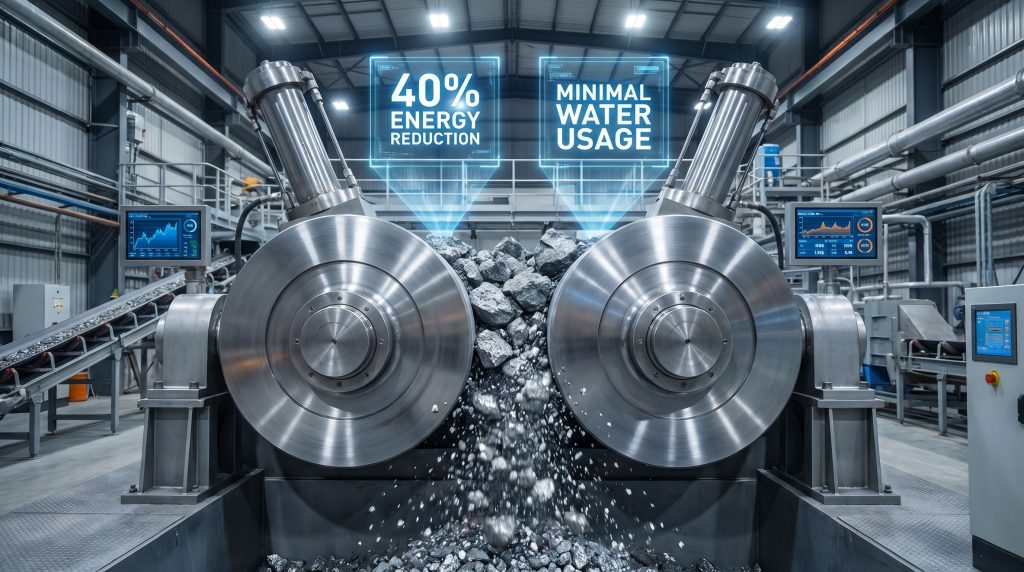
High-pressure grinding roll technology has emerged as a transformative force in this landscape, offering energy savings that can reach up to 40% compared to conventional tumbling mill systems. These systems operate on entirely different mechanical principles than traditional approaches, applying intense pressure between counter-rotating rolls to fracture ore particles through compression rather than impact. This fundamental shift in grinding methodology creates opportunities for mining operations to significantly reduce their energy footprint while achieving superior particle size control.
Understanding High-Pressure Grinding Roll Technology in Mining Operations
High-pressure grinding roll systems function through controlled application of extreme pressure between specially designed rolls, creating a confined particle bed that generates inter-particle crushing forces. Unlike conventional grinding mills that rely on impact and attrition to break ore particles, HPGR technology applies compressive stress that propagates micro-fractures throughout the ore matrix. This mechanism proves particularly effective for hard, competent ores where traditional grinding methods struggle with energy efficiency.
The pressure application ranges typically operate between 4-8 N/mm² of roll width, generating forces that can exceed 1000 tonnes per linear meter. This controlled pressure environment creates what engineers term the "compression zone," where ore particles experience multi-directional stress that weakens crystal boundaries and creates preferential fracture pathways. The resulting particle size distribution exhibits improved liberation characteristics compared to impact-based grinding methods.
The Mechanical Principles Behind HPGR Systems
Energy transfer within HPGR systems occurs through direct compression rather than the kinetic energy transfer mechanisms employed in ball mills or SAG mills. The rolls, typically measuring 1.5-3.0 meters in diameter, rotate at precise speeds to maintain consistent pressure across the entire particle bed. Surface velocities generally range from 1.0-2.5 m/s, optimized to prevent material slippage while ensuring complete compression of the ore bed.
Material throughput optimization depends heavily on maintaining consistent feed characteristics and pressure application. The gap between rolls, typically measured in millimeters, determines the final particle size and must be precisely controlled to achieve target product specifications. Advanced hydraulic systems maintain this gap within tolerances of ±0.5mm, ensuring consistent performance across varying ore hardness conditions.
Operational Advantages Over Traditional Tumbling Mills
HPGR systems eliminate several operational challenges inherent in conventional grinding circuits. The absence of grinding media requirements removes ongoing costs for steel ball or rod replacement, while also eliminating the need for complex media handling systems. Furthermore, water consumption drops dramatically since HPGR operations require minimal moisture for dust suppression, contrasting sharply with the high water demands of traditional wet grinding circuits.
Maintenance intervals extend significantly due to the simpler mechanical design and reduced wear component count. Roll surface replacement typically occurs every 6-12 months depending on ore abrasiveness, compared to daily or weekly liner replacements in tumbling mills. This maintenance advantage translates directly into improved equipment availability and reduced operational disruption, supporting data-driven mining operations that require consistent performance metrics.
| Parameter | HPGR Systems | Ball Mills | SAG Mills |
|---|---|---|---|
| Energy Consumption | 40% lower | Baseline | 15% higher |
| Water Requirements | Minimal | High | Very High |
| Grinding Media | None | Steel balls | Steel balls/rocks |
| Maintenance Frequency | Lower | Higher | Highest |
| Typical Availability | >95% | 85-90% | 80-85% |
When big ASX news breaks, our subscribers know first
How Do Mining Companies Integrate HPGR Systems Into Existing Processing Circuits?
Integration of HPGR technology into existing mineral processing circuits requires careful consideration of material flow patterns, particle size specifications, and downstream equipment compatibility. Most successful implementations position HPGR systems in tertiary crushing roles, where they can accept conventionally crushed feed material and deliver precisely sized products to subsequent concentration stages.
Circuit designers must account for the unique particle size distribution produced by HPGR systems, which typically generates more fines than conventional crushing while maintaining excellent coarse particle control. This characteristic often necessitates modifications to downstream classification systems and may require additional screening or cyclone capacity to handle the altered size distribution effectively.
Tertiary Crushing Stage Implementation
Positioning HPGR systems as tertiary crushers offers several strategic advantages for mineral processing operations. Feed material typically arrives from secondary crushing at sizes ranging from 12-25mm, ideal for HPGR processing. The controlled pressure environment can reduce this material to products with P80 values between 1.5-6mm, depending on operational requirements and ore characteristics.
Flowsheet optimization for precious metals recovery benefits significantly from the improved liberation characteristics achieved through HPGR processing. The compression-based fracturing mechanism tends to follow grain boundaries more effectively than impact crushing, potentially improving downstream flotation or leaching performance. This liberation advantage can translate into higher overall metal recoveries and improved concentrate grades.
Retrofitting Challenges and Solutions
Infrastructure modifications for HPGR installation typically focus on foundation requirements and material handling systems. The high operational forces generated by HPGR systems demand substantial concrete foundations, often requiring specialized analysis to ensure adequate support for the dynamic loads generated during operation.
Material handling considerations include feed distribution systems designed to maintain consistent material flow across the full roll width. Uneven feeding can create localised wear patterns and reduce overall system efficiency. Successful retrofits often incorporate variable speed belt feeders with cross-belt distributors to ensure uniform material presentation to the rolls.
Production continuity during equipment transitions requires detailed planning and often phased implementation approaches. Many operations choose to install HPGR systems in parallel with existing grinding circuits, allowing gradual transition and performance optimisation before complete changeover. This approach minimises production risks while providing operational data to optimise the new grinding circuit.
What Makes HPGR Technology Essential for Large-Scale Platinum Operations?
Large-scale platinum group metal operations face unique processing challenges that make HPGR technology particularly attractive. Platinum-bearing ores often exhibit complex mineralogy with fine-grained precious metal associations, requiring careful particle size control to achieve optimal liberation without over-grinding valuable minerals. The precise particle size distribution achieved through HPGR processing addresses these requirements effectively.
Capacity scaling advantages become increasingly important as platinum operations expand production to meet growing industrial demand. HPGR systems can be sized for throughput rates exceeding 6,000 tonnes per hour in single-unit configurations, with multiple units providing virtually unlimited scaling potential. This scalability supports the large tonnage requirements typical of modern platinum mining operations.
Processing Efficiency in High-Throughput Environments
Consistent product sizing proves critical for downstream beneficiation processes in platinum operations. Flotation circuits, commonly employed for platinum group metal concentration, perform optimally within narrow particle size ranges. HPGR systems deliver superior size distribution control compared to conventional crushing, with typical variability of less than ±5% in P80 values under steady-state conditions.
The reduced variability in ore preparation stages translates directly into improved flotation performance and higher overall metal recoveries. Studies indicate that improved size distribution control can increase platinum recovery rates by 2-4 percentage points, representing significant value in high-grade platinum operations where metal prices justify sophisticated processing approaches.
Economic Impact on Processing Costs
Operating expenditure reduction through energy savings represents the most quantifiable benefit of HPGR adoption in platinum operations. Energy typically accounts for 30-40% of total processing costs in platinum mills, making the documented 40% energy reduction achievable with HPGR systems a substantial economic driver. For large operations processing millions of tonnes annually, this energy savings can exceed $10 million per year.
Maintenance cost optimisation extends beyond simple component replacement savings. The improved availability associated with HPGR systems reduces production losses from unplanned downtime, while the simplified maintenance procedures reduce specialised labour requirements. In addition, these factors combine to create total cost of ownership advantages that often justify HPGR capital expenditures within 3-5 years.
Industry analysis demonstrates that HPGR systems have evolved from innovative technology to preferred standard practice for efficient, high-performance ore processing, particularly in energy-intensive precious metals operations where operational cost control directly impacts project economics.
Which Major Mining Projects Have Successfully Deployed HPGR Technology?
HPGR technology deployment has accelerated significantly across major mining projects worldwide, with particularly notable success in copper and platinum group metal operations. The technology's proven performance in demanding operational environments has established confidence among mining operators planning capital-intensive projects.
Ivanhoe's Platreef adopts Weir HPGRs represents a notable example of successful multi-project HPGR implementation, following Ivanhoe Mines' deployment of three operational units at their Kamoa-Kakula copper complex in the Democratic Republic of Congo. This cross-commodity application demonstrates the technology's versatility and the operator's confidence in its performance.
Copper Operations Leading HPGR Adoption
Democratic Republic of Congo copper processing operations have emerged as significant proving grounds for HPGR technology. The Kamoa-Kakula complex, located in the Central African Copperbelt, processes oxide and sulfide copper ores through advanced beneficiation circuits incorporating multiple HPGR units. The operational experience gained from these installations has provided valuable data on HPGR performance in challenging tropical operating conditions.
Operational performance data from established copper installations indicates typical availability rates exceeding 95% when properly maintained, significantly higher than conventional grinding systems operating in similar conditions. The improved reliability proves particularly valuable in remote locations where equipment failures can result in extended downtime due to parts availability and technical support challenges.
Precious Metals Sector Technology Migration
South African platinum group metals processing has experienced gradual migration toward HPGR technology as operators seek competitive advantages in an increasingly challenging economic environment. The Platreef project, located approximately 280 kilometres northeast of Johannesburg, represents recent adoption of the technology for platinum, palladium, and rhodium processing.
Technology transfer between different commodity operations within the same corporate portfolio has facilitated HPGR adoption. Ivanhoe's experience at Kamoa-Kakula provided operational knowledge directly applicable to the Platreef implementation, reducing technical risk and accelerating deployment timelines. This knowledge transfer approach has become increasingly common as mining companies seek to leverage proven technologies across their project portfolios.
| Project | Location | Commodity | HPGR Units | Status |
|---|---|---|---|---|
| Kamoa-Kakula | DRC | Copper | 3 units | Operational |
| Platreef Phase 2 | South Africa | PGM | Multiple | Implementation |
| Various Global | Multiple | Iron Ore | >50 units | Operational |
How Does HPGR Technology Support Sustainable Mining Practices?
Environmental benefits through energy efficiency represent the most significant sustainability advantage of HPGR technology. The documented energy consumption reduction of up to 40% compared to traditional tumbling mills translates directly into reduced greenhouse gas emissions from mining operations. For operations powered by coal-based electricity grids, this energy reduction can decrease carbon emissions by thousands of tonnes annually.
HPGR systems eliminate grinding media requirements, removing the environmental impact associated with steel ball or rod production, transportation, and disposal. Traditional grinding circuits consume substantial quantities of steel media, with large operations requiring hundreds of tonnes of replacement media annually. This elimination represents a significant reduction in embodied energy consumption and associated environmental impacts.
Environmental Benefits Through Energy Efficiency
Carbon footprint reduction in mineral processing operations becomes increasingly important as mining companies face growing environmental scrutiny and carbon pricing mechanisms. HPGR energy efficiency improvements directly support corporate sustainability goals while potentially reducing exposure to carbon tax obligations in jurisdictions implementing climate policy frameworks.
Sustainable development goals alignment occurs through multiple pathways with HPGR technology adoption. Reduced energy consumption supports SDG 7 (Affordable and Clean Energy) and SDG 13 (Climate Action), while improved operational efficiency can contribute to SDG 9 (Industry, Innovation and Infrastructure). These alignments increasingly influence project financing and stakeholder approval processes for major mining developments.
Resource Conservation Advantages
Water usage optimisation proves particularly valuable in arid mining regions where water availability constraints limit operational expansion. HPGR systems require minimal process water, typically limited to dust suppression rather than the substantial water requirements of wet grinding circuits. This advantage can prove decisive in securing operational permits in water-stressed regions, supporting energy transition strategies that prioritise resource efficiency.
Waste heat recovery potential exists within HPGR operations through the substantial mechanical energy converted to heat during the compression process. While currently underutilised, emerging technologies for waste heat capture and conversion could further improve the environmental profile of HPGR-equipped operations.
| Environmental Impact | HPGR Systems | Conventional Mills |
|---|---|---|
| Energy Consumption | 40% reduction | Baseline |
| Water Usage | Minimal | High |
| Carbon Emissions | Significantly lower | Higher |
| Steel Media Consumption | Zero | Substantial |
| Noise Levels | Reduced | Elevated |
What Are the Technical Specifications for Modern HPGR Systems?
Modern HPGR systems incorporate sophisticated engineering designed to withstand the extreme operational forces while maintaining precise control over product characteristics. Roll diameters typically range from 1.5-3.0 meters, with larger diameters providing increased throughput capacity but requiring proportionally higher installation and maintenance costs.
Pressure application systems utilise advanced hydraulic technology to maintain consistent force across the full roll width. Operating pressures typically range from 4-8 N/mm² of roll width, with some specialised applications reaching pressures up to 12 N/mm². These pressure levels generate sufficient force to fracture even the hardest ore types while maintaining precise control over product size distribution.
Equipment Design Parameters
Throughput capacity specifications vary significantly based on ore characteristics and desired product sizing. Typical single-unit capacities range from 500-6,000 tonnes per hour, with feed size limitations generally restricted to 25-30mm maximum particle size. The roll gap, typically adjustable between 5-25mm, determines final product size and must be precisely controlled to maintain consistent performance.
Material handling requirements include substantial foundation systems capable of withstanding dynamic loads exceeding 1,000 tonnes per linear meter of roll width. These foundation systems typically require specialised concrete designs with integrated vibration dampening to prevent structural damage from operational forces.
Process Control and Automation Features
Real-time monitoring systems for pressure optimisation incorporate advanced sensor technology to maintain consistent operational parameters. Hydraulic pressure sensors monitor roll separation forces continuously, while vibration monitoring systems detect potential operational anomalies before they impact production.
Automated adjustment mechanisms respond to varying ore characteristics by modifying operational parameters within predetermined ranges. These systems can adjust roll speed, hydraulic pressure, and feed rate to maintain optimal performance across different ore types without requiring manual intervention.
Integration with plant-wide control systems enables HPGR operations to respond automatically to upstream and downstream process conditions. Modern installations typically incorporate distributed control systems (DCS) that coordinate HPGR operations with feed preparation and product handling systems to optimise overall circuit performance, supporting renewable energy solutions through improved efficiency.
The next major ASX story will hit our subscribers first
How Do Mining Engineers Evaluate HPGR Performance?
Mining engineers employ sophisticated measurement and analysis techniques to optimise HPGR performance and ensure consistent operational results. Performance evaluation focuses on energy consumption metrics, product quality characteristics, and equipment reliability indicators that directly impact operational profitability.
Specific energy consumption measurements provide the fundamental metric for evaluating HPGR efficiency. Engineers typically measure energy consumption in kilowatt-hours per tonne of material processed, comparing actual performance against theoretical calculations and industry benchmarks. Advanced monitoring systems track energy consumption continuously, enabling real-time optimisation of operational parameters.
Key Performance Indicators for HPGR Operations
Product size distribution analysis utilises laser diffraction or automated screening systems to characterise particle size characteristics continuously. Engineers monitor P80 values (80th percentile particle size) as the primary control parameter, with typical targets ranging from 1.5-6.0mm depending on downstream process requirements.
Equipment availability and reliability metrics track operational continuity and maintenance effectiveness. Modern HPGR installations typically achieve availability rates exceeding 95%, significantly higher than conventional grinding systems. Reliability metrics include mean time between failures (MTBF) and mean time to repair (MTTR), which inform maintenance scheduling and spare parts inventory planning.
Performance benchmarking occurs through comparison with industry standards and manufacturer specifications. Engineers utilise normalised performance indicators that account for ore variability, enabling meaningful comparisons across different operating conditions and time periods, reflecting industry evolution trends toward data-driven optimization.
Optimisation Strategies for Maximum Efficiency
Operating parameter adjustment protocols enable engineers to respond systematically to changing ore characteristics or operational requirements. These protocols typically specify adjustment sequences for hydraulic pressure, roll speed, and feed rate modifications, ensuring optimisation efforts do not inadvertently create operational instabilities.
Preventive maintenance scheduling incorporates condition-based monitoring data to optimise maintenance intervals. Vibration analysis, oil analysis, and thermal monitoring provide early indicators of potential equipment issues, enabling maintenance scheduling that minimises production impact while ensuring equipment reliability.
What energy savings do HPGR systems provide compared to traditional mills?
HPGR systems consume up to 40% less energy than traditional tumbling mills while eliminating the need for grinding media and additional water for fine grinding, making them the preferred solution for efficient ore processing in modern mining operations.
What Future Developments Are Expected in HPGR Technology?
Technological advancement trends in HPGR systems focus on improved automation, enhanced materials science, and integration with digital mining technologies. Next-generation pressure application systems incorporate smart hydraulic controls that respond automatically to ore variability, potentially improving energy efficiency beyond current performance levels.
Smart automation and artificial intelligence integration represent significant development opportunities for HPGR technology. Machine learning algorithms could optimise operational parameters continuously based on feed characteristics, product requirements, and energy costs, potentially achieving efficiency improvements beyond current operator-dependent optimisation approaches.
Technological Advancement Trends
Next-generation pressure application systems under development incorporate variable pressure zones across roll width, enabling optimisation for non-uniform ore feeds. These systems could improve product quality while reducing energy consumption in applications where ore characteristics vary significantly across the feed stream.
Modular design improvements focus on reducing installation complexity and enabling easier capacity expansion. Manufacturers are developing standardised mounting systems and simplified foundation requirements that could reduce capital costs and installation timelines for HPGR projects.
Market Adoption Projections
Ivanhoe's Platreef adopts Weir HPGRs exemplifies industry standardisation, which appears to be advancing rapidly, with HPGR technology transitioning from innovative to conventional status across multiple mining sectors. This standardisation trend suggests continued adoption growth as operators gain confidence in the technology's proven performance record.
Regional deployment patterns indicate strongest growth in energy-constrained markets where operational cost advantages provide competitive benefits. Mining operations in regions with high electricity costs or carbon pricing mechanisms show particular interest in HPGR technology adoption.
Investment trends indicate substantial capital allocation toward grinding technology upgrades, with HPGR systems capturing increasing market share from traditional grinding approaches. Equipment manufacturers report strong order backlogs for HPGR systems, suggesting sustained growth in technology deployment.
HPGR Technology as the New Standard in Mineral Processing
HPGR technology has evolved from innovative alternative to established standard practice across modern mineral processing operations. The combination of proven energy savings, operational reliability, and environmental benefits has established HPGR systems as the preferred grinding solution for new mining projects and major plant expansions.
Strategic considerations for mining operations increasingly favour HPGR adoption due to the technology's documented performance advantages and improving economic returns. The 40% energy reduction achieved through Ivanhoe's Platreef adopts Weir HPGRs implementation, combined with eliminated grinding media costs and reduced maintenance requirements, creates compelling economic justification for technology adoption.
Strategic Considerations for Mining Operations
Technology selection criteria for new projects now routinely evaluate HPGR alternatives alongside conventional grinding systems. The proven performance record and established supplier base have reduced technology risk to levels comparable with traditional approaches, while maintaining significant operational advantages.
Long-term operational planning increasingly incorporates HPGR technology as mining companies seek to future-proof operations against rising energy costs and environmental regulations. The sustainability advantages of HPGR systems align with corporate environmental commitments while delivering quantifiable cost reductions.
Industry Transformation Through Efficient Processing
Competitive advantages from HPGR adoption extend beyond simple cost reduction to include improved product quality, operational reliability, and environmental performance. Mining companies implementing HPGR technology often achieve superior flotation or leaching performance due to improved particle liberation characteristics.
Supply chain implications of improved processing efficiency ripple throughout mining value chains, enabling higher recovery rates and improved concentrate grades. These improvements can enhance project economics sufficiently to justify development of previously marginal ore bodies, expanding resource availability and extending mine life.
The transformation of grinding technology from energy-intensive mechanical systems to efficient compression-based alternatives represents a fundamental shift in mineral processing philosophy. This evolution continues as operators recognise that processing efficiency improvements often provide greater economic impact than incremental increases in mining productivity, supporting Ivanhoe's Platreef adopts Weir HPGRs as an example of this industry-wide transformation.
This analysis reflects current industry understanding of HPGR technology based on available operational data and manufacturer specifications. Future developments may alter performance characteristics and economic assumptions. Mining operations should conduct site-specific technical and economic evaluations before implementing new grinding technologies.
Ready to Spot the Next High-Performance Mining Technology Implementation?
Discovery Alert's proprietary Discovery IQ model instantly identifies significant ASX mining technology developments and operational improvements, helping subscribers recognise companies enhancing their processing capabilities for competitive advantage. Stay ahead of market movements by exploring Discovery Alert's discoveries page to understand how major operational developments have historically generated substantial returns, then begin your 14-day free trial to access real-time alerts on emerging opportunities in mining technology and processing efficiency improvements.