May 16, 2026
The exponential growth of artificial intelligence computing capabilities faces a fundamental physical constraint: thermal management. As processors become more powerful and computational demands increase, managing heat generation emerges as the primary technical bottleneck limiting further AI advancement. This challenge has elevated high purity alumina in AI industry applications from a specialized industrial material to a critical enabler of modern AI infrastructure.
Advanced computing systems now operate at thermal densities that rival industrial applications, creating unprecedented engineering challenges. The material properties required to address these thermal constraints demand purity levels and performance characteristics that conventional materials cannot provide, positioning HPA as an indispensable component in the AI technology stack.
Understanding High Purity Alumina's Unique Properties for AI Applications
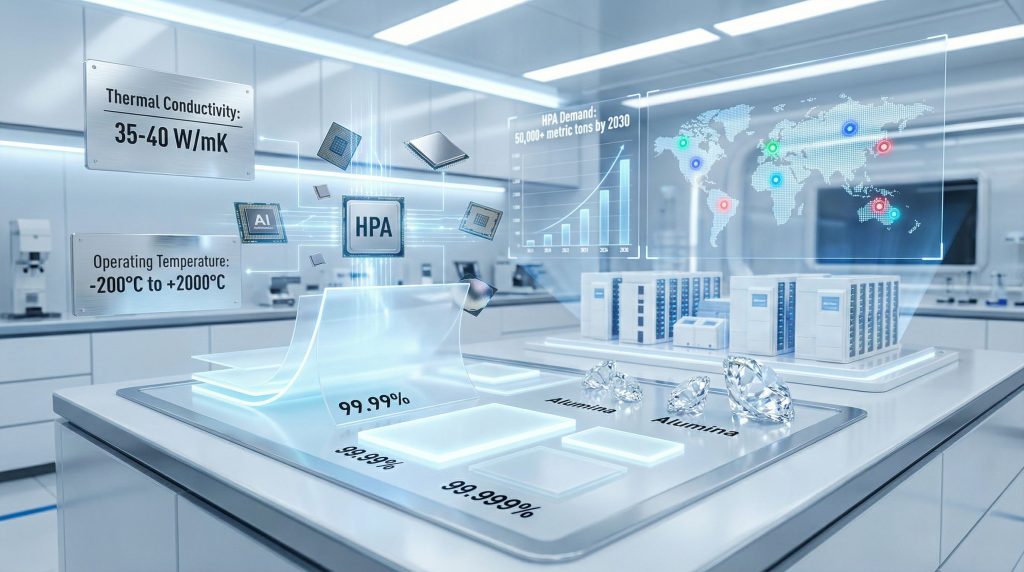
High purity alumina achieves exceptional material performance through purity levels ranging from 99.99% to 99.999% (4N-5N grades), far exceeding conventional alumina specifications. This ultra-high purity enables HPA to function effectively as both a thermal conductor and electrical insulator simultaneously, addressing the dual requirements of modern AI processors.
The material's crystalline structure provides superior thermal management capabilities while maintaining the electrical isolation necessary for high-frequency computing operations. Furthermore, unlike traditional thermal interface materials, HPA maintains performance consistency across extreme temperature ranges and operational conditions typical of AI data centers.
Thermal Performance Characteristics in Computing Applications
Modern AI processors generate heat loads that create significant engineering challenges for system designers. According to industry experts, computer chips have progressed beyond generating more heat per unit area than household appliances, with the situation continuing to deteriorate as computational demands increase exponentially.
Professor Robert Perrons from Queensland University of Technology explains that "the number of calculations performed by modern processors has reached astronomical levels, creating substantial heat generation challenges." The management of this excess heat has become critically important in chip design, with HPA providing solutions through its excellent insulating properties combined with substantially higher thermal conductivity than conventional alternatives.
Key Material Performance Metrics:
- Purity specifications: 4N to 5N grades (99.99% to 99.999%)
- Thermal stability: Maintains performance across extreme temperature ranges
- Electrical isolation: Prevents cross-talk in high-density processor designs
- Chemical inertness: Resists degradation in harsh operating environments
When big ASX news breaks, our subscribers know first
AI Data Center Infrastructure Driving Unprecedented Material Demand
The United Nations Trade and Development organization projects artificial intelligence to become a multi-trillion dollar sector by the 2030s, creating massive infrastructure requirements that directly impact materials demand. Large-scale AI data centers represent some of the most thermally intensive industrial facilities ever constructed, requiring up to 19 million liters of water daily for cooling systems alone.
This water consumption equals the daily requirements of towns with populations between 10,000 and 50,000 people, illustrating the enormous scale of thermal management challenges facing AI infrastructure developers. Consequently, traditional cooling approaches prove inadequate for the heat densities generated by modern AI processors, necessitating advanced materials solutions.
System-Level Thermal Constraints
UBS analyst Phineas Glover identifies heat generation as reaching physical limit constraints for both AI data centers and individual processors. The thermal bottleneck creates three interconnected operational challenges:
- Energy expenditure increases due to inefficient heat dissipation
- Cooling infrastructure requirements expanding beyond traditional capacity
- Operational risk escalation from thermal-related system failures
Glover emphasizes that while advanced cooling equipment investments will be necessary, these solutions alone cannot address the fundamental thermal bottleneck without complementary materials innovations like high purity alumina in AI industry applications. This has led to increasing focus on critical minerals energy security considerations.
Commercial Scale Production and Market Validation
The commercial viability of HPA for AI applications has been demonstrated through substantial supply agreements with semiconductor manufacturers across Asia and the United States. Alpha HPA, operating from Gladstone, Queensland, has secured letters of intent totaling up to 4,000 metric tonnes per annum, validating market demand for specialized thermal management materials.
The company currently employs approximately 130 people and plans to nearly double its workforce over the next 12 months while constructing what is positioned as the world's largest HPA production facility. In addition, this expansion reflects both current demand and projected growth in AI infrastructure requirements, aligning with broader mining industry innovation trends.
Advanced Computing Hardware Dependencies on HPA Technology
High-performance processors used by major technology companies including NVIDIA, Intel, and Amazon rely increasingly on advanced thermal management solutions to maintain performance levels. The optimal operating temperature requirements for these processors create narrow operational windows where thermal management materials become critical for system reliability.
Rob Williamson, managing director of Alpha HPA, explains that "computer chips function similarly to automotive engines in their thermal sensitivity." Performance degradation and component failure occur when optimal operating temperatures are exceeded, making thermal management materials essential for maintaining computational efficiency.
Material Substitution Trends in Semiconductor Manufacturing
Industry analysis suggests HPA is positioned to replace silica as the primary thermal management material in advanced semiconductor applications. This material transition represents a significant shift in manufacturing processes, potentially unlocking substantial market opportunities for specialized producers.
The transition from conventional materials to HPA involves multiple applications across the semiconductor manufacturing process:
- Substrate materials for high-density interconnect systems
- Thermal interface compounds preventing processor overheating
- Dielectric layers maintaining signal integrity in complex circuits
- Process equipment components requiring ultra-low contamination levels
Power Electronics Integration Requirements
AI data centers require sophisticated power conversion and distribution systems to manage the enormous energy requirements of modern processors. Silicon carbide power devices, which rely on HPA-based processing materials during manufacturing, enable higher efficiency power conversion essential for large-scale AI facilities.
These advanced power electronics achieve conversion efficiencies exceeding 95%, reducing cooling infrastructure requirements and enabling more compact system designs. Furthermore, the improved efficiency directly addresses the thermal management challenges created by AI computational loads, supporting AI-powered operational efficiency initiatives across the industry.
Production Scaling and Supply Chain Integration
Meeting projected demand growth requires substantial expansion of global HPA production capacity. Current manufacturing approaches face scalability challenges due to energy-intensive processing requirements and the technical complexity of achieving ultra-high purity specifications consistently.
Alpha HPA's strategic location in Gladstone demonstrates the importance of integrated supply chains for cost-effective production. The company relocated specifically to access chemical inputs from Orica and alumina feedstock from Rio Tinto, enabling operation of its proprietary processing technology.
Government Recognition and Strategic Support
The strategic importance of HPA production has attracted substantial government support, reflecting its classification as a critical material for technological competitiveness. Alpha HPA has received $400 million in financing through Federal Government programs including Export Finance Australia and the Northern Australia Infrastructure Facility.
Additionally, $30 million in funding from Queensland's Critical Minerals and Battery Technology Fund, provided through the Queensland Investment Corporation, demonstrates state-level recognition of HPA's economic importance. This combined government support totaling over $430 million indicates the material's strategic significance for national technology capabilities, representing a big pivot critical minerals strategy.
Regional Production Capacity Distribution
Global HPA production capacity is distributed across several key regions, each developing specialized capabilities:
Australia: Leveraging abundant alumina feedstock and integrated chemical supply chains
Japan: Focusing on ultra-high purity grades for advanced semiconductor applications
United States: Developing domestic supply chains for strategic technology requirements
South Korea: Concentrating on display technology and consumer electronics applications
Investment Opportunities in the HPA Value Chain
The convergence of AI growth and critical materials demand creates substantial investment strategies for the future across the HPA value chain. Phineas Glover characterizes successful HPA technology development as representing positive developments for Australia's position in global technology supply chains.
The country's existing role in supplying materials for energy transition and AI infrastructure positions HPA as a natural extension downstream into high-specification, value-added materials that directly enable advanced technologies. However, investors should carefully evaluate the technical and market risks associated with this emerging sector.
Supply Chain Security and Competitive Advantages
Companies with integrated supply chains from raw material sources through final HPA production demonstrate significant competitive advantages in both cost control and quality assurance. The strategic relocation decisions made by companies like Alpha HPA illustrate the importance of securing reliable access to key inputs including:
- Chemical processing inputs from established industrial suppliers
- Alumina feedstock from major mining operations
- Proprietary technology access enabling differentiated production capabilities
- Skilled workforce availability in established industrial regions
Technology Development and Market Positioning
Proprietary processing technologies create sustainable competitive advantages in the specialized HPA market. Companies investing in process optimization, particle engineering, and application-specific formulations position themselves to capture value from the growing AI infrastructure market.
Long-term supply agreements with semiconductor manufacturers and technology companies provide revenue stability while supporting capacity expansion planning. For instance, these strategic partnerships often include technical collaboration and joint development initiatives beyond simple supply relationships.
Emerging Technologies and Future HPA Requirements
Next-generation computing architectures will create additional demand categories for specialized materials with properties similar to or exceeding current HPA specifications. Quantum computing systems require ultra-stable operating environments with minimal electromagnetic interference, creating opportunities for HPA-based components.
Neuromorphic computing architectures, designed to simulate brain-like information processing, demand materials that can support both electrical and ionic conductivity behaviors. Consequently, HPA's chemical stability and processing flexibility position it as a foundation material for these emerging applications.
Advanced Manufacturing Integration
The integration of HPA into advanced manufacturing processes requires close coordination between material suppliers and equipment manufacturers. This collaboration ensures that material properties align with specific processing requirements while maintaining the performance characteristics essential for AI applications.
Process development includes:
- Particle size optimization for specific application requirements
- Surface treatment techniques enhancing material bonding characteristics
- Quality control systems maintaining consistency across large production volumes
- Application-specific formulations tailored to individual customer requirements
The next major ASX story will hit our subscribers first
Regulatory Environment and Sustainability Considerations
Government policies increasingly recognize HPA as a critical material for national technology competitiveness, creating regulatory frameworks that support domestic production while ensuring supply chain security. These policies include strategic stockpiling programs, domestic production incentives, and international trade considerations.
Environmental sustainability requirements are driving innovations in HPA production processes, including renewable energy integration and process waste heat recovery systems. Furthermore, these improvements address the traditionally energy-intensive nature of ultra-high purity material production.
Critical Materials Classification Impact
The competitive geopolitical environment surrounding critical minerals has elevated HPA's strategic importance, enabling companies to attract substantial government funding and financing support. This classification reflects recognition that advanced materials like HPA are essential enablers of technological leadership.
Policy implications include:
- Export control considerations balancing commercial interests with national security
- International trade agreements addressing critical materials availability
- Technology transfer regulations protecting proprietary processing innovations
- Environmental compliance requirements ensuring sustainable production practices
Market Outlook and Strategic Implications
The convergence of exponential AI growth with specialized materials requirements creates unprecedented market dynamics for high purity alumina producers. Market projections suggest demand could increase by an order of magnitude over the current decade, driven primarily by AI infrastructure expansion.
Companies successfully navigating the technical and commercial challenges of HPA production are positioned to capture significant value as the AI industry expands into new computational paradigms. The material's critical role in enabling thermal management solutions ensures sustained demand growth aligned with broader AI market development.
Long-Term Technology Roadmap Alignment
The evolution of AI computing architectures toward higher performance densities will continue driving demand for advanced thermal management materials. HPA's unique combination of properties positions it as an enabling technology for breakthrough performance levels that would otherwise be constrained by thermal limitations.
Future applications may extend beyond current AI infrastructure into quantum computing, edge computing devices, and next-generation data center architectures. However, each of these applications will require materials with the exceptional properties that high purity alumina in AI industry applications provides.
Investment strategies focusing on the critical materials enabling AI infrastructure development offer exposure to one of technology's fastest-growing sectors while providing essential components for continued innovation. According to market research, the technical barriers to entry and specialized production requirements create sustainable competitive advantages for established players in the HPA market.
The intersection of artificial intelligence advancement and critical materials production represents a fundamental shift in industrial priorities, positioning specialized materials like high purity alumina in AI industry applications at the center of global technology competition. Companies and investors recognizing this convergence early will be best positioned to benefit from the transformative changes reshaping both computing and materials industries.
Want to Capitalise on the Next AI Infrastructure Discovery?
Discovery Alert's proprietary Discovery IQ model delivers real-time alerts on significant mineral discoveries across critical materials sectors, instantly empowering subscribers to identify actionable opportunities ahead of the broader market. Begin your 30-day free trial today and secure your market-leading advantage in the rapidly expanding AI materials revolution.