
June 4, 2026
Why the Next Big Copper Supply Gap May Already Be Priced Into the Ground
The global copper market is not waiting for new mines to be built. Demand from electric vehicles, grid infrastructure, data centres, and industrial electrification is accelerating faster than the development pipeline can respond. According to the International Energy Agency, copper demand from clean energy technologies alone could more than double by 2040. The copper supply crunch is compounding the fact that the average timeline from discovery to first production now exceeds 16 years. That structural gap makes every fully permitted, near-construction copper asset in a stable jurisdiction extraordinarily valuable, not just to miners, but to the broader energy transition itself.
It is within this context that the Highland Copper Copperwood feasibility update, targeted for Q1 2027, carries significance that extends well beyond a single junior mining company's project timeline.
When big ASX news breaks, our subscribers know first
Copperwood at a Glance: A Pre-Construction Asset in a Mature Mining State
Located in Michigan's Upper Peninsula, Copperwood is an underground sediment-hosted copper deposit with a long operational history in the surrounding region. Michigan's Upper Peninsula has produced copper for over 150 years, and the local geology, regulatory environment, and skilled workforce represent genuine competitive advantages that are frequently overlooked by investors focused on newer jurisdictions.
The project's current technical baseline, established through the 2023 feasibility study, provides a solid foundation for understanding what the updated study will need to improve upon or validate.
| Parameter | 2023 Feasibility Study Baseline |
|---|---|
| Location | Michigan, Upper Peninsula, USA |
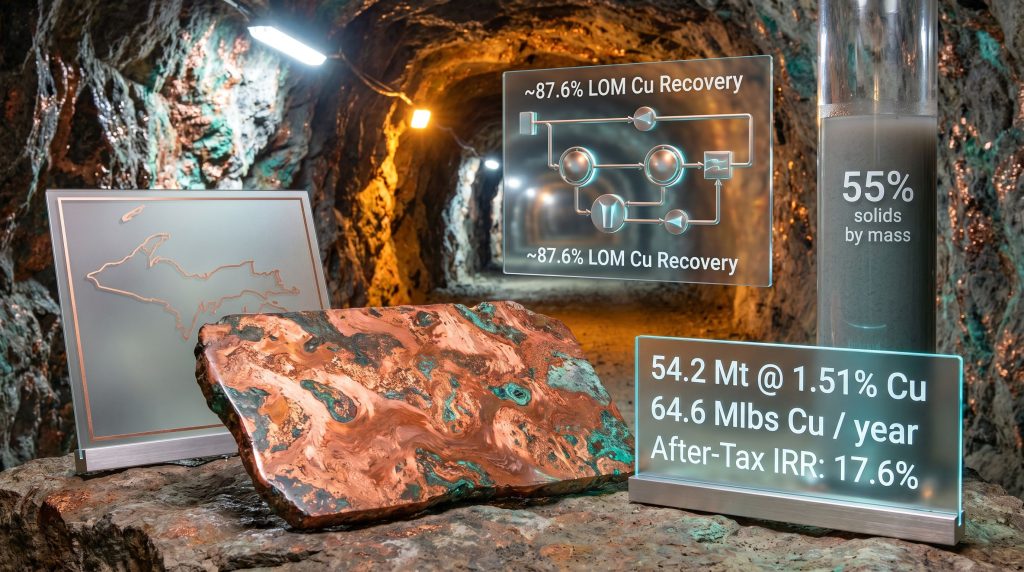
| M&I Resource (main deposit) | 54.2 million tonnes at 1.51% copper |
| UCBS Resource (excluded) | 10.2 million tonnes at 1.1% copper |
| Annual Copper Production | ~64.6 million pounds |
| Mine Life | 11 years |
| Initial Capital Cost | US$391 million (net of pre-production revenue) |
| After-Tax IRR | 17.6% |
| Permit Status | Fully permitted |
| Updated Feasibility Study Target | Q1 2027 |
A fully permitted, pre-construction asset with an existing feasibility baseline occupies a fundamentally different risk category than an exploration-stage project. The Q1 2027 update is an optimisation and capital readiness exercise, not a discovery event.
The Economics of Optimisation: Why Update an Already Completed Study?
Feasibility studies in mining are not static documents. They reflect a specific set of engineering assumptions, commodity price inputs, and metallurgical data available at the time of publication. When any of these inputs shift materially, the economics of the project can change significantly, sometimes in both directions.
In the case of the Highland Copper Copperwood feasibility update, three factors are driving the revision:
-
Commodity price realignment. The company is now modelling against a long-term consensus copper price of approximately $4.8 per pound, a figure that represents a meaningful shift from the assumptions embedded in the 2023 study. Higher price assumptions expand the economic boundary of the ore body by lowering the cut-off grade at which material becomes profitable to mine.
-
Engineering refinements. Continued geotechnical investigation, metallurgical test work, and detailed engineering completed since 2023 have produced new data that warrant full incorporation into a revised mine plan.
-
Technology evaluation. The potential application of bulk ore sorting to lower-grade material in the Upper Copper Bearing Sequence (UCBS) introduces an entirely new variable that was not part of the original study's scope.
Understanding Cut-Off Grade Economics in Underground Copper Mining
Cut-off grade economics represent one of the most consequential and least understood variables in mining. It defines the minimum copper concentration that must be present in rock for it to be economically viable to mine, haul, and process. When the assumed long-term copper price rises, the break-even concentration required for profitable extraction falls, which expands the volume of material that can be economically included in the mine plan.
At Copperwood, the UCBS contains 10.2 million tonnes grading 1.1% copper in the measured and indicated category. This material is currently excluded from reserves because, under previous price assumptions and processing configurations, it sat below the economic threshold. If the revised cut-off grade, underpinned by the $4.8/lb planning price, brings this material inside the economic boundary, the implications for mine life or annual throughput could be substantial.
| Scenario | Main Deposit | UCBS Added | Total Resource Base |
|---|---|---|---|
| 2023 Baseline | 54.2 Mt at 1.51% Cu | Excluded | 54.2 Mt |
| Potential Revised | 54.2 Mt at 1.51% Cu | 10.2 Mt at 1.1% Cu | 64.4 Mt |
Adding lower-grade material dilutes the average feed grade but increases total contained copper. The updated feasibility study will need to quantify whether the revenue gain from additional contained metal outweighs the increased processing costs associated with lower average grades.
Bulk Ore Sorting: A Technology Bridging the Grade Gap
Bulk ore sorting is not a new concept, but its practical application in underground copper mines is still maturing. XRT ore sorting and other sensor-based detection systems, including electromagnetic induction or prompt gamma neutron activation analysis, distinguish between ore and waste rock at or near the mining face, before material reaches the processing plant.
The key economic appeal of sorting in the context of the UCBS material is its ability to upgrade low-grade feed. By rejecting barren or near-barren rock early in the material handling chain, sorting effectively increases the average grade of material delivered to the mill, which can:
- Reduce energy consumption per tonne of copper produced
- Lower reagent and water usage in flotation circuits
- Decrease wear and maintenance costs in grinding equipment
- Shrink the effective tailings volume requiring disposal
It is worth noting that bulk ore sorting viability for the UCBS material at 1.1% copper remains under evaluation. No construction commitment has been made, and the economics of sorting at this grade will depend heavily on the sensor technology selected and the mineralogical characteristics of the ore.
The mineral liberation characteristics of Copperwood's ore are particularly relevant here. Sediment-hosted copper deposits like Copperwood tend to exhibit relatively fine-grained copper mineralisation, which can influence the effectiveness of sensor-based sorting. If the copper is too finely disseminated within the rock matrix, bulk sorting may struggle to reliably separate ore from waste — a technical risk that must be resolved through ongoing test work before any investment decision can be made.
Metallurgical Innovation: The Mill-Float-Mill-Float Advantage
The processing flowsheet used to extract copper concentrate from crushed ore is a critical determinant of both operating costs and metal recovery rates. Furthermore, advances in copper processing technologies demonstrate how flowsheet improvements can meaningfully shift project economics. Conventional flotation circuits grind ore to a target particle size and then use chemical reagents and air bubbles to separate copper-bearing minerals from gangue.
The limitation of a single grinding and flotation stage is that some copper minerals remain locked within coarser rock particles, reporting to the tailings stream as unrecovered metal.
The mill-float-mill-float (MF2) configuration addresses this by introducing a secondary grinding and flotation stage after the primary concentrate has been removed. This allows finer liberation of copper minerals that were not fully exposed in the first pass, improving overall copper recovery from the ore body.
Metallurgical test work completed in September 2025 at Copperwood projected the following improvements under the MF2 flowsheet:
| Metric | 2023 Feasibility Study | MF2 Projection |
|---|---|---|
| Life-of-Mine Copper Recovery | 86.0% | ~87.6% |
| Secondary Milling Requirements | Baseline | Reduced |
| Energy Consumption | Baseline | Lower (projected) |
| Reagent Use | Baseline | Lower (projected) |
A 1.6 percentage point improvement in copper recovery may appear modest, but at a production rate of approximately 64.6 million pounds per year, it translates to meaningfully more copper sold over an 11-year mine life. At $4.8/lb, even a 1% improvement in life-of-mine recovery represents tens of millions of dollars in additional revenue.
Important caveat: These projections derive from bench-scale test work and engineering modelling. Plant-scale performance involves additional variables, including ore variability, temperature, water chemistry, and equipment performance, that bench tests cannot fully replicate. The updated feasibility study will incorporate these results with appropriate engineering confidence intervals.
Thickened Tailings: Rethinking Waste Management as a Capital Efficiency Tool
Tailings management is increasingly recognised as both a cost centre and an environmental liability in underground mining. Conventional tailings disposal involves pumping a water-heavy slurry to large storage facilities, which require significant land footprint, ongoing water management, and long-term closure liabilities.
Thickened tailings technology alters this equation by mechanically dewatering the tailings stream before deposition, increasing the solids content to approximately 55% by mass in Copperwood's case. Test work conducted at Responsible Mining Solutions in Sudbury, Ontario confirmed that this target solids concentration is technically achievable for Copperwood's ore.
The operational benefits of thickened tailings at Copperwood are projected to include:
- Reduced storage facility footprint, potentially lowering initial construction costs
- Improved process water recovery, reducing freshwater demand and environmental impact
- Lower long-term pumping costs, as thickened tailings require less hydraulic pressure to transport
- Simplified closure planning, as denser tailings are more geotechnically stable and require less post-closure management
From a project finance perspective, lower tailings facility construction costs directly reduce the initial capital requirement, which in turn improves the after-tax IRR and strengthens the project's debt serviceability profile. This is not a trivial consideration for a project targeting US$391 million in initial capital expenditure.
The next major ASX story will hit our subscribers first
Geotechnical Refinement: What Underground Mine Design Actually Means for Economics
Geotechnical engineering in underground mining involves far more than structural safety. The dimensions of stopes (the excavated cavities from which ore is extracted), pillar geometries, and the sources of unplanned dilution collectively determine how efficiently the ore body can be extracted relative to the designed mine plan.
At Copperwood, current geotechnical investigations are examining three variables with direct economic consequences:
- Mining height selection — taller stopes extract more ore per development metre but require more robust ground support.
- Pillar dimension optimisation — smaller pillars recover more ore but may increase the risk of ground movement events.
- Dilution source identification — understanding whether waste rock enters the ore stream from the hanging wall or footwall allows engineers to design stope geometries that minimise it.
A particularly noteworthy finding from current investigations is that dilution at Copperwood is more likely to originate from the mineralised hanging wall rather than the footwall. This distinction matters because hanging wall dilution at Copperwood is itself copper-bearing material. Unlike barren waste dilution, which increases mill throughput without adding recoverable metal, mineralised dilution still contributes copper to the process stream, albeit at a lower grade than the primary ore.
The FEED Threshold: What 40% Completion Signals to Project Financiers
Front-End Engineering and Design (FEED) represents the critical bridge between feasibility-level design and detailed construction engineering. Within the project finance community, FEED completion milestones are closely watched as indicators of project maturity and financing readiness.
The significance of the 40% FEED completion target by end of 2026 cannot be overstated for investors tracking the Copperwood development timeline:
- Most project finance lenders require a completed definitive feasibility study combined with advanced FEED documentation before committing to debt facilities
- 40% FEED provides sufficient engineering definition for independent technical advisers to assess project risk on behalf of lenders
- This milestone effectively unlocks access to formal project financing processes, which typically take 12 to 24 months to complete
The deliberate sequencing of the 40% FEED target (end of 2026) ahead of the updated feasibility study publication (Q1 2027) suggests a carefully structured path toward a construction decision, with financing conversations potentially commencing in parallel with the final stages of the feasibility update.
The milestone sequence matters as much as the milestones themselves. 40% FEED by end-2026, followed by an updated feasibility study in Q1 2027, creates a logical pathway for project finance due diligence to begin before the study is finalised, compressing the overall timeline to a potential construction decision.
Key Risks Facing the Copperwood Development Path
No pre-construction mining project is without risk, and the Copperwood update process introduces several specific uncertainties that prospective investors and analysts should weigh carefully.
Technical Risks
- Metallurgical projections from bench-scale test work may not translate directly to plant performance
- Bulk ore sorting viability for UCBS material at 1.1% copper remains unconfirmed
- Geotechnical assumptions around dilution sources require further validation
Financial and Market Risks
- Project economics are sensitive to copper price assumptions; the $4.8/lb planning price sits above long-run historical averages and introduces downside commodity risk
- Initial capital of US$391 million (2023 baseline) may be revised upward in the updated study due to construction cost inflation experienced across the mining sector since 2023
- Public financing support cannot be assumed; a reported US$50 million Michigan state funding request was not approved in 2025
Timeline Risks
- The Q1 2027 feasibility target is contingent on the timely completion of ongoing engineering, metallurgical, and geotechnical work streams
- Any delays in FEED completion or feasibility publication push back the potential financing and construction decision timeline
This article contains forward-looking statements and projections based on publicly available information. Readers should conduct independent due diligence and consult qualified financial advisers before making investment decisions. Mineral resource estimates, projected recovery rates, and capital cost figures are subject to change and may not reflect actual outcomes.
FAQ: Highland Copper Copperwood Feasibility Update
What is the total mineral resource at Copperwood?
The main deposit holds 54.2 million tonnes of measured and indicated mineral resources grading 1.51% copper. An additional 10.2 million tonnes at 1.1% copper sits within the Upper Copper Bearing Sequence, currently excluded from the mine plan and reserve base.
When will the updated feasibility study be released?
Highland Copper is targeting publication of the updated feasibility study in Q1 2027, alongside 40% FEED completion by end of 2026. For the latest project developments, the Highland Copper progress update provides further detail on current milestones.
What were the key economics from the 2023 feasibility study?
The 2023 study projected annual production of approximately 64.6 million pounds of copper over an 11-year mine life, with initial capital of US$391 million net of pre-production revenue, and an after-tax IRR of 17.6%. Consequently, the Highland Copper Copperwood feasibility update aims to build meaningfully on these foundations.
What is the mill-float-mill-float (MF2) flowsheet?
MF2 is a processing configuration that adds a secondary grinding and flotation stage to improve copper mineral liberation. Test work projects life-of-mine recovery of approximately 87.6%, compared to 86% in the 2023 study, while also projecting lower energy and reagent consumption.
Is Copperwood currently under construction?
No. The project remains in pre-construction development, with detailed engineering and FEED work advancing toward a construction decision. No construction start date has been formally announced. However, detailed engineering at Copperwood continues to identify key optimisation opportunities that may strengthen the case for a future construction commitment.
What are thickened tailings and why does Copperwood use them?
Thickened tailings involve increasing the solids content of processed mine waste to approximately 55% by mass before deposition. This approach can reduce the tailings storage facility footprint, lower initial construction costs, improve water recovery, and reduce ongoing pumping expenses.
Ready to Identify the Next Major Copper Discovery Before the Market Does?
Discovery Alert's proprietary Discovery IQ model delivers real-time alerts on significant ASX mineral discoveries — translating complex mineral data into actionable insights the moment they hit the exchange. Explore historic discovery returns that demonstrate what early positioning in transformative mineral finds can mean for a portfolio, and begin your 14-day free trial today to secure a market-leading advantage.