May 11, 2026
The construction materials industry stands at an inflection point where traditional extraction-heavy business models face mounting pressure from climate commitments, circular economy mandates, and evolving investor expectations. This transformation demands more than incremental adjustments; it requires fundamental restructuring of operations, product portfolios, and strategic frameworks that have defined the sector for decades.
Understanding Holcim's Strategic Framework for Construction's Sustainability Revolution
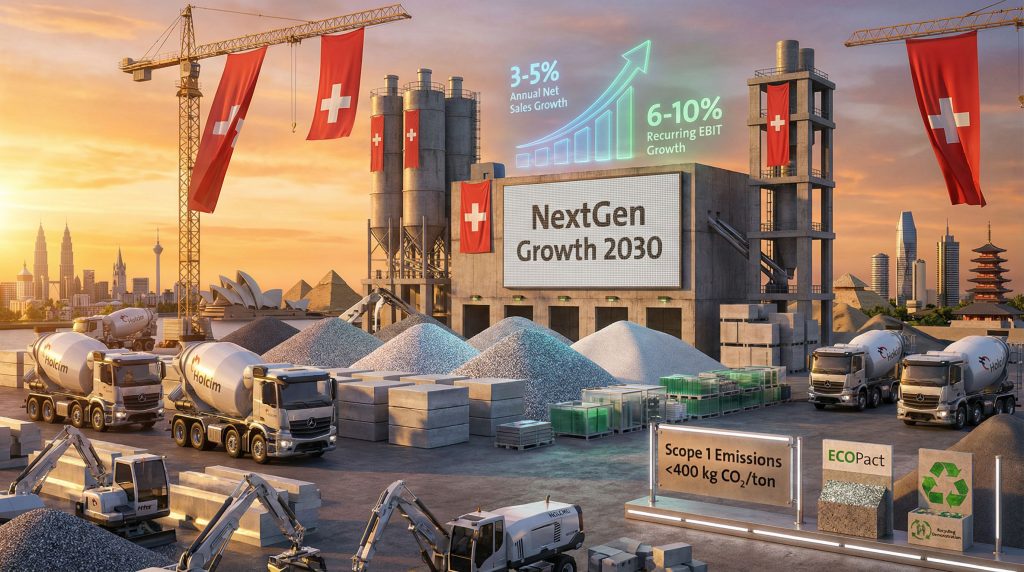
The Holcim NextGen Growth 2030 strategy represents a comprehensive reimagining of how global construction materials companies can navigate the transition from volume-based commodity production to value-driven sustainable solutions. This strategic framework, launched during 2025, positions the Swiss multinational as a leader in sustainable construction partnerships across 43 global markets.
Kim Fausing, Chairman of the Board at Holcim, emphasised the transformational nature of this strategic pivot, noting that 2025 was a transformative year for Holcim as the company began delivering on its NextGen Growth 2030 strategy to become the leading partner for sustainable construction. This statement underscores the fundamental shift from traditional materials supplier to comprehensive sustainability partner.
The strategy operates through integrated sustainable product platforms that address different aspects of construction's environmental footprint. These platforms include ECOPact for low-carbon ready-mix concrete, ECOPlanet for reduced-emission cement production, and ECOCycle technology for construction demolition material recovery and reintegration.
Strategic Architecture Components:
- Product Innovation Focus: Development of sustainable alternatives to conventional construction materials
- Operational Excellence: Integration of environmental stewardship with extraction activities
- Market Expansion: Geographic diversification while maintaining sustainability commitments
- Technology Integration: Advanced recycling and carbon reduction technologies
Furthermore, this transformation aligns with broader industry innovation trends that prioritise sustainable development across extractive industries.
When big ASX news breaks, our subscribers know first
How NextGen Growth 2030 Transforms Global Construction Materials Markets
The strategic transformation extends beyond product development to encompass fundamental changes in how construction materials are conceived, produced, and delivered to market. This shift addresses growing demand for sustainable building solutions while maintaining operational efficiency across extensive quarrying networks.
Portfolio Evolution Through Sustainable Innovation
Market penetration of sustainable products demonstrates the strategy's practical implementation. ECOPact achieved 31% of ready-mix concrete net sales in 2025, while ECOPlanet represented 36% of cement net sales during the same period. These figures reflect significant market acceptance of sustainable alternatives in traditionally conservative construction markets.
The company targets exceeding 50% market share for both products within their respective categories by 2030, indicating confidence in continued market adoption. This growth trajectory suggests construction industry stakeholders increasingly prioritise environmental performance alongside traditional metrics of cost and durability.
Sustainable Product Performance Metrics:
| Product Category | 2025 Market Share | 2030 Target | Application Focus |
|---|---|---|---|
| ECOPact (Ready-Mix) | 31% | >50% | Low-carbon concrete solutions |
| ECOPlanet (Cement) | 36% | >50% | Reduced-emission cement production |
| ECOCycle (Recycling) | Pilot phase | >20M tons CDM | Construction demolition materials |
Circular Economy Integration Strategy
The ECOCycle technology platform represents a paradigm shift from linear extraction-production-disposal models toward circular material flows. This technology guarantees between 10% and 100% recycled construction demolition material content, potentially reducing primary resource demands across the company's 408 quarry operations.
Miljan Gutovic, CEO of Holcim, highlighted the strategic importance of this circular approach, stating that the company accelerated initiatives for decarbonisation and circular construction through ECOCycle while building a nature-positive future. This emphasis on circularity addresses both resource scarcity concerns and waste management solutions inherent in construction activities.
Circular Economy Targets:
- Construction Demolition Materials Recovery: >20 million tons by 2030
- Recycled Content Range: 10-100% in construction applications
- Primary Material Demand Reduction: Proportional to recycled content integration
In addition, this approach demonstrates the mining decarbonisation benefits that can be realised through innovative technology adoption.
Financial Framework Driving Strategic Transformation
While specific financial projections for the Holcim NextGen Growth 2030 strategy require verification through official company disclosures, the operational metrics provide insight into the economic foundation supporting this transformation. The integration of sustainable products across global markets suggests substantial capital allocation toward research and development, production capacity expansion, and market development initiatives.
Investment Prioritisation Areas:
- Technology Development: Advanced recycling systems and carbon reduction technologies
- Production Infrastructure: Sustainable product manufacturing capabilities
- Market Development: Geographic expansion of sustainable product offerings
- Operational Efficiency: Integration of environmental management with extraction activities
The strategy's financial viability depends on successful market adoption of premium-priced sustainable products. Early penetration rates suggest market receptivity to these offerings, potentially supporting sustained investment in capacity expansion and technology advancement.
Revenue Diversification Strategy:
- Traditional Products: Continued optimisation of conventional cement and aggregates
- Sustainable Alternatives: Premium pricing for ECOPact and ECOPlanet offerings
- Circular Solutions: Value capture from waste material processing and reintegration
- Service Integration: Comprehensive sustainability consulting and technical support
Geographic Market Prioritisation and Expansion Strategy
Operating across 43 global markets with 408 quarries, Holcim's geographic footprint provides substantial platform for sustainable product deployment. This extensive operational presence enables localised market development while leveraging economies of scale in technology development and production optimisation.
Carmen Díaz Canabal, Chief People and Sustainability Officer at Holcim, emphasised the global scope of sustainable product scaling, noting that the company is accelerating the scale-up of its sustainable offering across all markets. This comprehensive geographic approach suggests confidence in universal demand for sustainable construction materials.
Regional Market Dynamics
The company's approach to geographic expansion reflects varying market maturity levels and regulatory environments across regions. Established markets may prioritise premium sustainable products, while emerging markets focus on foundational infrastructure development with integrated environmental considerations.
Market Penetration Factors:
- Regulatory Environment: Local environmental standards and carbon pricing mechanisms
- Market Maturity: Construction industry sophistication and sustainability awareness
- Competitive Landscape: Local player capabilities and market structure
- Infrastructure Demand: Regional development requirements and project pipelines
The diversity of operational markets provides natural hedging against regional economic cycles while enabling knowledge transfer and best practice implementation across different regulatory and competitive environments. Moreover, this geographic reach supports comprehensive sustainability transformation in mining operations worldwide.
Sustainability Integration Across Mining and Quarrying Operations
The environmental stewardship component of the Holcim NextGen Growth 2030 strategy addresses the fundamental tension between resource extraction and environmental protection. Managing 408 quarries while advancing sustainability commitments requires sophisticated operational frameworks that balance production requirements with ecological restoration.
Land Management and Biodiversity Conservation
During 2025, Holcim's quarrying operations disturbed 19,673 hectares of land across its global footprint, while simultaneously rehabilitating 7,658 hectares by year-end. This rehabilitation activity demonstrates active environmental stewardship alongside ongoing extraction activities.
Biodiversity Management Metrics:
| Metric | 2025 Performance | Management Approach |
|---|---|---|
| High-Biodiversity Quarries | 252 sites identified | Specialised management plans |
| BMP Implementation | 98% compliance rate | Site-specific conservation strategies |
| Biodiversity Offset Investment | $1.1 million | Financial commitment to conservation |
| Rehabilitation Planning | 100% coverage | Universal restoration requirements |
The identification of 252 quarries with high biodiversity importance reflects comprehensive environmental assessment capabilities. The 98% implementation rate for Biodiversity Management Plans indicates systematic approach to conservation across diverse geographic and ecological contexts.
Water Resource Management Innovation
Water management represents a critical operational challenge for extraction-intensive industries. Holcim achieved its 2030 freshwater reduction target ahead of schedule, reaching 102 litres per tonne in aggregates production, representing more than 50% reduction compared to 2020 baseline levels.
Water Efficiency Achievements:
- Freshwater Withdrawal Reduction: >50% versus 2020 baseline (target achieved in 2025)
- Water Recycling Infrastructure: 76% of water-risk sites equipped with recycling systems
- Resource Optimisation: Integration of water management with production efficiency
This early achievement of water efficiency targets demonstrates successful integration of resource conservation with operational requirements. The deployment of water recycling systems at 76% of water-risk sites indicates proactive management of scarce resources in challenging environments.
Technology Integration and Product Innovation Framework
The Holcim NextGen Growth 2030 strategy relies heavily on technological innovation to achieve sustainability objectives while maintaining operational efficiency. This technology integration spans product development, production processes, and resource management systems that enable data-driven operations across the company's global footprint.
Advanced Recycling Technologies
ECOCycle technology represents the most significant technological innovation within the strategy, enabling systematic recovery and reintegration of construction demolition materials. This technology platform addresses both waste management challenges and primary resource demands through sophisticated material processing capabilities.
Technology Platform Capabilities:
- Material Sorting: Advanced separation and classification of demolition waste
- Quality Control: Standardisation of recycled material properties and performance
- Integration Systems: Seamless incorporation into production processes
- Scalability Framework: Expansion across diverse market conditions and material types
The technology's flexibility in delivering 10-100% recycled content enables customisation for specific project requirements while maintaining performance standards. This adaptability supports market acceptance across diverse construction applications.
Production Process Innovation
ECOPact and ECOPlanet platforms require sophisticated production technologies that reduce carbon intensity without compromising material performance. These innovations integrate alternative materials, optimised chemical formulations, and advanced production techniques.
Innovation Focus Areas:
- Alternative Raw Materials: Reduced reliance on high-carbon traditional inputs
- Process Optimisation: Energy efficiency improvements in production
- Quality Assurance: Maintaining performance standards with sustainable formulations
- Scalability Planning: Capacity expansion for sustainable product lines
The next major ASX story will hit our subscribers first
Risk Management and Operational Excellence
The comprehensive scope of the NextGen Growth 2030 strategy introduces various operational and market risks that require sophisticated management approaches. These risks span technology adoption, market acceptance, regulatory compliance, and operational integration challenges.
Operational Risk Mitigation
Managing 408 quarries across 43 markets while implementing sustainability transformation requires robust risk management frameworks. The company's approach emphasises systematic compliance with environmental standards while maintaining production efficiency.
Risk Categories and Management:
- Environmental Compliance: Universal rehabilitation planning and biodiversity management
- Technology Adoption: Staged rollout of sustainable technologies across operations
- Market Acceptance: Gradual market penetration with proven sustainable products
- Resource Management: Efficient utilisation of water, energy, and raw materials
The company's zero-tolerance policy for conflict minerals and commitment to free, prior, and informed consent for Indigenous peoples demonstrates comprehensive approach to social and environmental risk management.
Supply Chain Sustainability
The Responsible Mining Programme addresses environmental and social risks inherent in third-party extraction activities. This programme includes on-site assessments and development initiatives with key extractive material suppliers.
Supply Chain Management Elements:
- Supplier Assessment: Systematic evaluation of environmental and social practices
- Development Programs: Capacity building for sustainable extraction practices
- Compliance Monitoring: Regular verification of responsible sourcing standards
- Risk Mitigation: Diversification of supplier base and geographic sourcing
Strategic Outlook and Industry Transformation
The Holcim NextGen Growth 2030 strategy reflects broader industry transformation toward sustainable construction practices. This transformation responds to climate commitments, regulatory requirements, and evolving market demands for environmental performance alongside traditional construction material qualities.
The strategy's emphasis on circular economy principles, advanced recycling technologies, and comprehensive environmental stewardship positions the company to capitalise on increasing demand for sustainable construction solutions. Early market penetration rates and operational achievements suggest successful initial implementation of strategic objectives.
According to Holcim's NextGen Growth 2030 fact sheet, the comprehensive transformation encompasses operational excellence, innovation leadership, and sustainable value creation across global markets. Furthermore, industry analysis from MatrixBCG highlights the strategic importance of this transformation in establishing competitive differentiation within global construction materials markets.
Long-term Value Creation Drivers:
- Market Leadership: Establishing competitive advantages in sustainable construction materials
- Operational Excellence: Integration of environmental stewardship with extraction activities
- Technology Innovation: Advanced capabilities in recycling and carbon reduction
- Geographic Diversification: Risk mitigation through diverse market exposure
The strategy's success depends on continued market acceptance of sustainable products, successful technology scaling, and effective integration of environmental management with operational requirements. Early indicators suggest positive momentum across these critical success factors.
Investors should note that strategic transformations of this scope involve inherent uncertainties regarding technology adoption, market development, and regulatory evolution. Performance projections and strategic objectives represent management expectations that may be subject to revision based on market conditions and operational experience.
Ready to Capitalise on Resource Innovation Opportunities?
Discovery Alert's proprietary Discovery IQ model delivers real-time alerts on significant ASX mineral discoveries, enabling subscribers to identify actionable opportunities in companies driving industry transformation through sustainable technologies and innovative practices. Stay ahead of market movements by exploring Discovery Alert's discoveries page, showcasing historic examples of exceptional returns, and begin your 14-day free trial today to position yourself ahead of the market.