August 14, 2026
What does a Hormuz disruption reveal about global oil trade rerouting?
A severe interruption in the Strait of Hormuz does not produce a clean substitute route elsewhere. Instead, it forces a partial reshuffle across the global shipping network, raises freight and access costs, pushes some Asian buyers towards U.S. crude, and temporarily makes routes such as the Panama Canal more valuable without turning them into true replacements.
For readers searching why Hormuz blockage boosts Panama Canal oil tanker traffic, the answer lies in network substitution rather than route replacement. The canal becomes more important because it shortens eligible U.S. Gulf Coast to Asia voyages for smaller tankers, not because it can absorb Gulf export volumes on a one-for-one basis.
This matters for oil markets because logistics shocks often show up first in shipping behaviour, booking fees, insurance costs, and refinery procurement patterns. Benchmark crude prices like Brent and WTI capture only part of the story. Delivered cost, vessel availability, and transit timing can move even faster, especially amid wider oil price movements.
When big ASX news breaks, our subscribers know first
How do maritime chokepoints reshape oil flows when one route fails?
In energy logistics, a chokepoint is not simply a narrow passage on a map. It is a segment of infrastructure where physical capacity, vessel compatibility, and scheduling discipline determine whether crude reaches refiners on time.
The Strait of Hormuz functions as one of the world’s highest-volume export arteries for Gulf crude and petroleum liquids. By contrast, the Panama Canal serves as an inter-ocean shortcut for selected vessel classes, including smaller tankers moving U.S. energy cargoes towards Asia.
When one chokepoint is disrupted, oil trade adapts through several mechanisms:
- buyers seek alternative origin barrels
- traders rework arbitrage calculations
- shipowners redirect eligible tonnage
- insurers and charterers reprice route risk
- refiners rebalance crude slates around new delivery windows
What matters in the first phase is often throughput and compatibility, not only the headline oil price. A route that looks available on paper may be unusable for the dominant vessel class or too congested to scale quickly.
| Route | Primary function | Vessel limitations | Typical cargo relevance | Approximate historical throughput | Substitution potential during disruption |
|---|---|---|---|---|---|
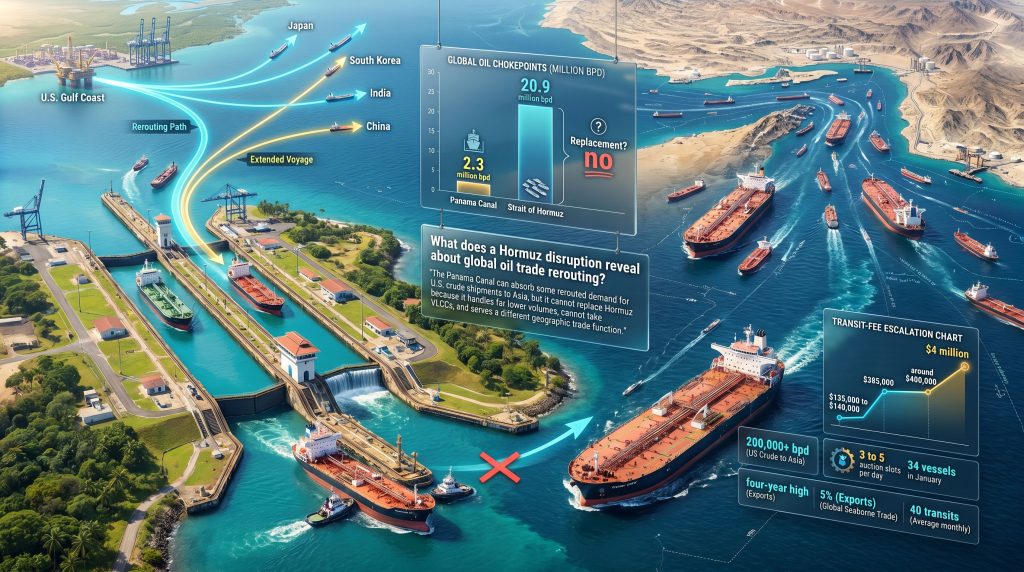
| Strait of Hormuz | Main export corridor for Gulf crude and liquids | Exposed to geopolitical disruption, but accommodates very large tankers | Core route for Middle East exports | 20.9 million bpd in January to June 2025 | Low replaceability due to scale and source location |
| Panama Canal | Inter-ocean shortcut linking Atlantic and Pacific basins | Cannot handle VLCCs | Useful for some U.S. crude, products, LPG, and container cargo | 2.3 million bpd of crude and petroleum liquids in January to June 2025 | Partial relief only for eligible cargoes |
According to U.S. Energy Information Administration chokepoint data, Hormuz moved roughly nine to ten times the oil volumes that crossed the Panama Canal in the same half-year period. That gap alone explains why a full substitution thesis does not hold.
Why is the Panama Canal seeing more oil tanker traffic now?
The recent increase is fundamentally a demand response from Asia. When Middle Eastern availability becomes less reliable, refiners look for barrels from other export regions. The U.S. Gulf Coast becomes more attractive because it offers large export capacity, pricing transparency, and the option to ship eastward through the Panama Canal on eligible vessels.
Current trade reshuffling has involved buyers in Japan, South Korea, India, and China, all of which are significant crude importers with the scale to redirect procurement quickly when disruption hits a core supply corridor.
This is best understood as tactical diversification, not a permanent replacement of Gulf supply. Asian refiners still optimise around crude quality, refinery configuration, freight economics, and term-contract commitments. However, in a disruption window, flexibility becomes more valuable than perfection.
Third-party flow estimates cited by Bloomberg from vessel-tracking firm Kpler indicate that U.S. oil exports via the Panama Canal recently exceeded 200,000 barrels per day, approaching the highest level since July 2022 and marking a four-year high for this lane.
That increase reflects several advantages of U.S. exports in a crisis-driven market:
- Atlantic Basin cargoes can be redirected with relative speed
- U.S. Gulf Coast supply can serve several destination markets
- pricing linked to WTI and related grades can become competitive against disrupted alternatives
- canal transit can shorten the route to Asia for eligible ships versus sailing around South America
In short, Hormuz blockage boosts Panama Canal oil tanker traffic because Asian refiners are not replacing geography. They are paying for time, optionality, and reliability. Recent reports on Panama Canal traffic increases show how quickly that demand can intensify.
Can the Panama Canal replace the Strait of Hormuz?
The short answer is no.
The most obvious reason is scale. EIA data show the Panama Canal handled about 2.3 million bpd of crude oil and petroleum liquids in January to June 2025. Over the same period, the Strait of Hormuz handled about 20.9 million bpd. Even allowing for rounding differences, Hormuz carried around nine to ten times more volume.
The second reason is vessel size. The canal’s lock dimensions exclude very large crude carriers, or VLCCs, which can carry up to 2 million barrels per voyage. These supertankers are central to long-haul crude transport economics, especially for major export systems in the Gulf.
The third reason is geography. Hormuz is located at the source of Gulf exports. Panama is a routing shortcut for certain Atlantic-to-Pacific cargoes. One is an export gateway. The other is a transit optimiser, and its role sits within broader oil geopolitics and logistics.
“The Panama Canal can take some rerouted demand from U.S. crude shipments to Asia, but it cannot replace Hormuz because it handles much smaller volumes, cannot pass VLCCs, and serves a completely different trade function.”
This distinction is crucial for investors and market watchers. Increased canal usage can soften a shock at the margin, but it does not restore the lost carrying capacity of a major Gulf outlet.
What are soaring Panama Canal slot prices signalling?
Canal slot prices are not just a congestion story. They are a market signal that delivery optionality has become expensive.
The Panama Canal Authority reported that average auction pricing for a transit slot was roughly $135,000 to $140,000 before the Middle East conflict window referenced in the reporting. After that, the average surged to about $385,000 between March and April. Last-minute slot prices climbed to nearly $400,000.
An even more dramatic anecdote came via Associated Press reporting, with the canal administrator describing a case in which one tanker paid $4 million for a transit slot after redirecting fuel cargoes towards Singapore, where prompt delivery had become exceptionally valuable.
That does not mean $4 million is normal. Instead, it means there are moments when product scarcity, missed delivery windows, or destination pricing can justify extraordinary logistics spending. In addition, industry coverage of canal slot costs surging reinforces how route access itself can become a tradable premium.
The canal’s allocation mechanics help explain these spikes:
- Many vessels secure reservations well in advance.
- Ships without a booking may depend on last-minute reservations or auctions.
- The canal typically releases about 3 to 5 auction slots per day.
- When redirection pressure rises, those scarce slots become tradable time advantages.
“High slot prices are an early warning sign that logistics scarcity is entering the oil price stack alongside crude fundamentals and geopolitical risk.”
How much additional traffic can the Panama Canal realistically absorb?
Recent operating data show room for some additional traffic, but not limitless expansion. The Panama Canal Authority said total traffic increased 5% between October 2025 and March 2026, with daily averages rising from 34 vessels in January to 37 in March, while peak days moved above 40 transits.
These numbers indicate recovery and flexibility, but they do not imply a frictionless capacity reserve for oil. Furthermore, they must be viewed against competing demand from containers, LPG carriers, and refined product tankers.
The canal has to balance multiple cargo categories at the same time:
- container ships
- LPG carriers
- crude tankers
- refined product tankers
- booked priority movements across different commercial segments
Panama Canal officials have also highlighted that container traffic remains strong, LPG demand has been robust, and energy products are becoming increasingly important in the canal’s cargo mix. That matters because oil cargos are competing with other profitable users for scarce transit windows.
| Metric | Pre-disruption level | Recent level | What it signals for oil markets |
|---|---|---|---|
| Average auction slot price | $135,000 to $140,000 | About $385,000 in March to April | Access scarcity is being priced aggressively |
| Last-minute slot pricing | Lower historical norm | Near $400,000 | Urgent cargoes are paying for timing |
| Total canal traffic | Baseline before late-2025 recovery | 5% higher from October 2025 to March 2026 | More system utilisation, less spare flexibility |
| Daily average transits | 34 in January | 37 in March | Rising throughput but not unlimited capacity |
| Peak daily transits | Lower than current spikes | Above 40 | Stress periods can be managed, but at cost |
The next major ASX story will hit our subscribers first
Which parts of the energy chain are most affected by rerouting?
The effects are uneven across the value chain.
Crude exporters
U.S. Gulf Coast exporters gain strategic relevance during a Gulf chokepoint disruption because they can serve both Atlantic and Pacific buyers. Middle Eastern suppliers, by contrast, face route-access interruptions and greater difficulty defending market share in Asia if cargo movement becomes unreliable.
Asian refiners
Refiners in import-dependent economies may need to adjust crude slates quickly. That can mean:
- paying higher delivered feedstock costs
- extending procurement lead times
- accepting less optimal grade mixes
- increasing spot market exposure
For sophisticated refiners, crude quality still matters. Light-sweet U.S. grades may not perfectly replace every Middle Eastern barrel, especially where plants are optimised for heavier or sourer feedstocks. So the substitution is commercial, not technical perfection.
Tanker owners and charterers
Shipping dislocation tends to support earnings for owners of eligible vessels when route demand rises and scheduling urgency intensifies. The benefit can differ by fleet composition. Owners with exposure to smaller tankers able to transit Panama may capture rerouting demand more directly than operators focused mainly on VLCCs.
Fuel importers in tight end markets
The Singapore redirection example shows how downstream shortages can ripple back into shipping economics. If product inventories are tight, the value of arriving sooner may overwhelm ordinary transit cost logic.
How do shipping constraints alter oil pricing beyond the crude benchmark?
In a routing shock, oil pricing becomes a layered cost stack rather than a simple benchmark number.
Key components include:
- crude benchmark price
- freight rates
- canal fees and slot auction costs
- insurance and war-risk premiums
- demurrage and queue delays
- refinery margin adjustments
A simple framework helps explain this process:
- A Middle East supply corridor becomes restricted.
- Asian buyers seek replacement barrels, including U.S. crude.
- More cargoes compete for eligible ships and canal access.
- Freight costs and slot prices rise.
- Delivered crude costs increase even if benchmark prices move less dramatically.
- Refining margins and product pricing adjust to reflect new logistics costs.
This is why delivered cost often matters more than headline Brent or WTI during a system shock. Benchmarks may show stress, but physical buyers feel the shock through all-in replacement cost. For context, the trade war impact on oil also shows how non-supply factors can rapidly distort energy pricing.
“Financial markets often notice crude first. Physical markets often feel logistics first.”
Key data points worth watching
The following figures are central to understanding why Hormuz blockage boosts Panama Canal oil tanker traffic while still leaving a major capacity gap:
- 2.3 million bpd through the Panama Canal in the first half of 2025
- 20.9 million bpd through the Strait of Hormuz in the same period
- 200,000+ bpd of U.S. oil exports via Panama Canal recently
- a four-year high for this U.S.-to-Asia route
- slot costs near $400,000
- prior average auction prices of $135,000 to $140,000
- post-conflict average auction pricing near $385,000 between March and April
- an extreme single-transit case of $4 million
- overall canal traffic up 5% from October 2025 to March 2026
- daily averages of 34 vessels in January and 37 vessels in March
- peak days above 40 transits
- only 3 to 5 auction slots typically released per day
- VLCC carrying capacity of up to 2 million barrels
Scenario analysis if disruption persists
Three broad pathways matter.
Scenario 1: Short disruption
Panama traffic stays elevated temporarily, slot premiums remain high, and opportunistic U.S. crude flows to Asia increase. Once Gulf routes normalise, some of the pressure fades.
Scenario 2: Medium-duration disruption
Asian buyers deepen non-Middle East procurement, tanker scheduling becomes structurally tighter, and freight plays a larger role in refinery economics. In this scenario, the canal acts as a sustained pressure valve rather than a brief detour.
Scenario 3: Prolonged disruption
System-wide bottlenecks become more visible. Panama helps, but cannot solve the problem. Storage, refinery flexibility, and product trade imbalances start to matter more, and oil market fragmentation increases. Under that outcome, Hormuz blockage boosts Panama Canal oil tanker traffic for longer, yet the relief remains partial.
A practical example illustrates the issue. An Asian refiner replacing Gulf barrels with U.S. crude may face:
- longer procurement planning cycles
- different vessel-class availability
- canal booking risk
- a higher delivered-cost profile despite attractive headline crude pricing
That scenario can support trading gains for some shipping and marketing participants, but it can also squeeze refiners that lack flexibility in feedstock or freight procurement. Meanwhile, tracking current crude oil prices helps only partly, because logistics costs can move faster than the benchmark itself.
Important disclaimer: scenario analysis is inherently uncertain. Trade flows, tanker earnings, and crude pricing can change rapidly with geopolitical developments, canal operating conditions, and refining demand. Nothing here should be treated as investment, legal, or trading advice.
FAQs on rerouted oil flows and canal demand
Why does a Hormuz blockage increase Panama Canal oil tanker traffic?
Because Asian buyers seek more U.S. crude when Middle Eastern supply is disrupted, and the canal offers the fastest route to Asia for smaller eligible vessels leaving the U.S. Gulf Coast.
Can the Panama Canal handle supertankers?
No. It cannot accommodate VLCCs, which is one of the main reasons it cannot replace Hormuz for large-scale Gulf crude exports.
Why are canal transit fees rising so sharply?
Because last-minute access becomes more valuable when diverted cargoes need fast delivery and only a limited number of auction slots are available.
Which countries are most likely to switch towards U.S. crude in this environment?
Recent trade reshuffling has involved Japan, South Korea, India, and China, all of which have the scale and flexibility to widen sourcing when disruptions hit.
Is this bullish for oil prices or mainly for freight markets?
It can support both, but the first impact often appears in freight, access fees, and delivered-cost premiums before fully showing up in benchmark crude prices.
The bigger lesson for global energy logistics
The central takeaway is not that Panama can replace Hormuz. It cannot. The real lesson is that stress at one major chokepoint rapidly changes the economics of every other route that still has spare functionality. That is also consistent with the broader OPEC influence on oil, where logistics and supply power often interact.
Rising tanker traffic through the Panama Canal shows adaptation, but not restored resilience. The global oil system remains vulnerable to route concentration, vessel mismatch, and expensive logistical improvisation.
If Hormuz disruption persists, the canal will stay relevant as a partial relief valve for U.S.-to-Asia crude movements. Yet the hard limits remain visible in the data: smaller throughput, vessel restrictions, and fierce competition for transit slots. That is why the current shift should be read as a sign of system strain, not as evidence that the market has found a full workaround.
Sources referenced in this analysis include the U.S. Energy Information Administration, Panama Canal Authority operating updates, vessel-tracking data cited by Bloomberg, and Associated Press reporting on canal slot pricing and cargo redirection.
Could The Next Market-Moving Discovery Be Detected First?
Discovery Alert’s proprietary Discovery IQ model delivers real-time alerts on significant ASX mineral discoveries, helping investors cut through market noise and spot actionable opportunities early. See how major discoveries have historically driven exceptional returns on the Discovery Alert discoveries page and start a 14-day free trial to stay ahead of the market.