June 8, 2026
When Mine Supply Rebounds But Refined Metal Doesn't Follow
The zinc industry offers a masterclass in why commodity markets routinely confuse participants who focus on a single variable. When mine production recovers after years of contraction, the instinct is to call a surplus. Concentrate flows improve, ore grades stabilise, and the pipeline appears to be filling. Yet what happens between the mine gate and the finished metal warehouse is where the real story unfolds, and in zinc's case, that middle layer has become the defining constraint of 2025 and 2026.
The zinc supply deficit and smelter disruptions dominating market conversation today are not simply the product of two unfortunate industrial accidents. They are the culmination of a multi-year structural deterioration in Western processing capacity, amplified by an energy cost environment that has made smelting economics deeply unfavourable outside of China. Understanding how these forces converged, and why even the most sophisticated forecasters missed the scale of the problem, requires working through each layer of the supply chain in sequence.
When big ASX news breaks, our subscribers know first
The Three-Stage Supply Chain and Where It Breaks Down
Zinc reaches end markets through three distinct transformation stages, each with its own economics, time lags, and vulnerability to disruption:
- Mining extracts zinc-bearing ore from the ground, typically sulphide deposits containing sphalerite (zinc sulphide) as the primary mineral.
- Concentration crushes and floats the ore to produce zinc concentrate, a powder typically containing 50 to 60 percent zinc by weight, which is the tradeable intermediate product sold to smelters.
- Smelting and refining converts concentrate into refined zinc metal through either the electrolytic or Imperial Smelting Furnace (ISF) process, producing the Special High Grade (SHG) zinc that trades on the LME.
Each stage requires separate capital, separate energy inputs, and separate economic incentives to operate. A surge in stage one output does not automatically accelerate stages two and three. This is the pipeline gap that has caught markets off guard.
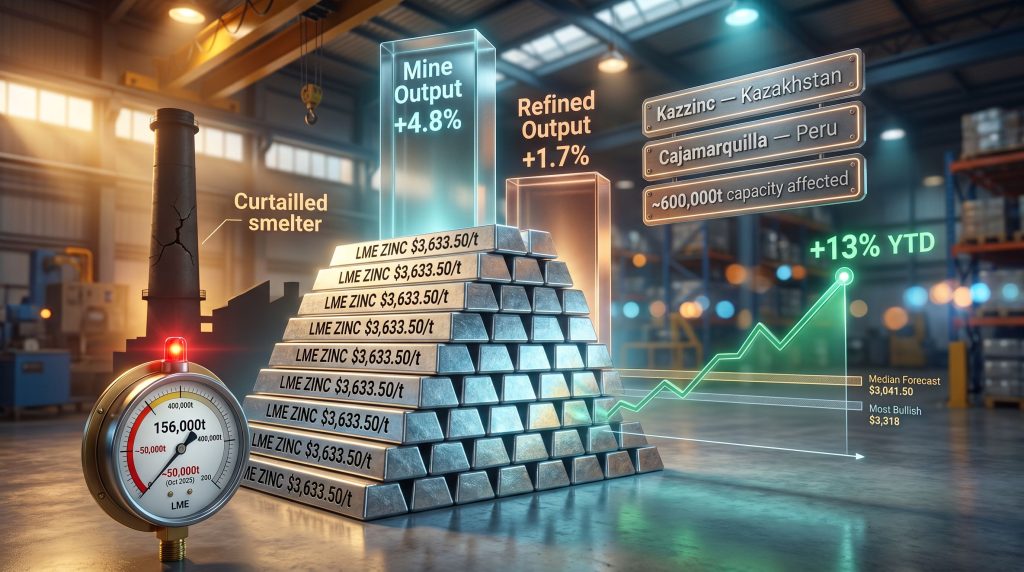
Furthermore, global zinc production trends show that global mined zinc production surged 4.8% year-on-year in 2025, the first meaningful rebound after three consecutive years of output contraction, according to the International Lead and Zinc Study Group (ILZSG). Yet refined zinc production grew by only 1.7% over the same period. That divergence tells you everything about where the bottleneck sits.
The processing layer, not the mining layer, is where the 2025 to 2026 deficit is actually forming. A recovering mine supply cannot compensate for a smelting sector operating below capacity.
Treatment Charges: The Canary in the Smelter
One of the least understood dynamics in the zinc market is the role of treatment charges (TCs) as a real-time indicator of supply chain health. When mining companies deliver concentrate to smelters for processing, smelters earn a fee known as a treatment charge. The level of that fee reflects the balance of power between miners and processors:
- High TCs signal abundant concentrate supply, giving smelters strong negotiating leverage and healthy processing margins.
- Low TCs signal concentrate scarcity, meaning miners have the upper hand and smelter margins compress, sometimes to the point where continued operation becomes uneconomic.
Through 2024 and into 2025, TC levels collapsed. This collapse was a leading indicator of concentrate tightness that the broader market largely underweighted. When smelters face compressed TC revenue while simultaneously paying elevated energy costs, voluntary output curtailment becomes the rational economic response, even when the zinc price itself is rising. This counterintuitive dynamic, where high prices fail to stimulate smelter output because input economics remain prohibitive, is central to understanding the current deficit. Indeed, tight mine supply is putting increased pressure on smelters according to analysts at Bank of America.
How the Surplus Forecast Unravelled
A Forecast Revision of Historic Proportions
The scale of the forecast error in zinc for 2025 and 2026 is genuinely remarkable. When the ILZSG met in October 2024, its projections pointed firmly toward a well-supplied market:
| Forecast Period | ILZSG October 2024 Projection | Revised Assessment |
|---|---|---|
| 2025 | +85,000 tonne surplus | Small deficit recorded |
| 2026 | +271,000 tonne surplus | -19,000 tonne deficit projected |
| 2026 (post-May incidents) | Under review | Likely materially wider |
By April 2026, the group's revised assessment confirmed that the expected surplus had not only failed to materialise but had flipped into deficit territory. The market moved from an anticipated 356,000-tonne combined surplus across two years to an actual and projected deficit position. This is one of the largest directional revisions in recent zinc market history.
Why Demand Weakness Created a False Sense of Comfort
Construction and galvanised steel account for more than half of global zinc consumption. The China steel demand outlook shows that China's prolonged property sector downturn suppressed demand expectations throughout 2024 and into 2025, and that demand weakness created a misleading picture of overall market health. When consumption is soft, analysts reasonably reduce deficit risk estimates. The problem was that this demand-side logic masked a far more serious supply-side deterioration that was accumulating independently.
The Reuters poll of 25 analysts conducted in January 2026 generated a mean price forecast of $3,041.50 per metric ton for the second quarter. The single most bullish participant projected an average of $3,318 per ton. By mid-May 2026, LME three-month zinc had reached $3,633.50 per metric ton, a near four-year high that exceeded even the most optimistic forecast in the survey. A year-to-date gain of 13% in a commodity that was expected to be in surplus is not a speculative anomaly. It is a market speaking clearly about physical reality.
The Western Smelter Bottleneck: Energy, Economics, and Structural Decline
Why European Smelters Are Particularly Exposed
Zinc smelting through the conventional electrolytic process is extraordinarily electricity-intensive. Producing one tonne of refined zinc via electrolysis typically requires between 3,400 and 4,000 kilowatt-hours of electrical energy, making power costs the single largest operating expense at most Western facilities. When European electricity and gas prices elevated sharply following the 2022 energy crisis and remained structurally higher than pre-crisis levels, the margin economics for European zinc smelters deteriorated dramatically.
The compounding effect of elevated power costs and compressed TC revenue created a squeeze from both ends of the income statement:
- Revenue from concentrate processing (TC income) fell as concentrate tightened.
- Operating costs rose as power prices remained elevated.
- The combination made voluntary curtailment economically superior to continued loss-making production.
This is not a short-cycle problem that resolves when zinc prices spike. If power costs remain structurally elevated, restarting idled capacity requires both a higher zinc price and either lower energy costs or higher TCs to justify the capital expenditure and operational risk of restart. Consequently, commodity price impacts on smelter viability have become a critical factor shaping Western production decisions.
Regional Smelter Performance Divergence
| Region | 2025 Refined Output Trend | Primary Drivers |
|---|---|---|
| China | +6.7% year-on-year | New smelter capacity commissioned |
| Western markets | Contraction | Energy costs, TC compression, closures |
| Europe | Significant curtailment | Power prices, uneconomic margins |
| Global aggregate | +1.7% year-on-year | Chinese growth masking Western decline |
The data confirms that global refined zinc output growth in 2025 was entirely a Chinese phenomenon. Western production not only failed to grow but actively contracted, leaving the global aggregate figure propped up by Chinese expansion alone.
The May 2026 Supply Shock: Kazzinc and Cajamarquilla
Two Major Facilities, One Critical Month
Against this already taut backdrop, two major smelting incidents struck within weeks of each other in May 2026:
- Kazzinc facility, Kazakhstan (Glencore): A fatal explosion on May 5, 2026 forced reduced-capacity operations at what is one of the largest integrated zinc operations in the world. Kazzinc's Ust-Kamenogorsk metallurgical complex is a vertically integrated facility covering mining, concentration, and smelting, making any disruption there particularly difficult to substitute at short notice.
- Cajamarquilla plant, Peru (Nexa Resources): Approximately two weeks after the Kazzinc incident, a fire forced a full operational suspension at the Cajamarquilla refinery near Lima, one of the largest zinc smelters in the Americas.
Together, these two facilities represent approximately 600,000 tonnes of annual refined zinc production capacity.
Contextualising the Scale of the Disruption
With global refined zinc production running at roughly 13 to 14 million tonnes annually, the combined capacity at risk represents approximately 4 to 5% of total global output. In a market carrying a comfortable inventory buffer, this scale of disruption would be manageable. However, in a market already running a pre-incident deficit with LME stocks well below historical norms, the impact is disproportionately severe. The zinc supply deficit and smelter disruptions have been rattling buyers across the supply chain as a result.
If both facilities operate at reduced or suspended capacity for three to six months, the effective volume of lost refined metal could range from 150,000 to 300,000 tonnes, potentially expanding the 2026 deficit by a factor of eight to fifteen times the ILZSG's pre-incident projection of 19,000 tonnes.
The LME price response to these events is itself informative. In well-buffered commodity markets, individual plant outages rarely produce sustained multi-percentage-point price moves. The magnitude and persistence of zinc's price rally signal that the market was already operating with minimal slack before either incident occurred.
LME Inventory: Reading What the Warehouse Data Actually Says
The Failed Inventory Rebuild
| Inventory Milestone | Level (tonnes) | Market Significance |
|---|---|---|
| October 2025 low | ~50,000 | Near-critical tightness |
| End of 2025 | ~144,000 | Partial recovery |
| Mid-May 2026 | ~156,000 | Stalled rebuild |
| 2024 peak | ~400,000 | Comfortable buffer benchmark |
The failure of LME zinc stocks to rebuild meaningfully through the first five months of 2026 is arguably the most important data point in the entire zinc story. The inventory recovery from the October 2025 low of approximately 50,000 tonnes partially reversed through year-end, but the rebound lost momentum almost immediately in January 2026. From January 1 to mid-May 2026, combined registered and off-warrant LME stocks grew by only 21,125 tonnes to approximately 156,000 tonnes.
That 156,000-tonne level, while meaningfully above the crisis lows of late 2025, provides limited protection against further supply disruption. The contrast with the 2024 peak of nearly 400,000 tonnes illustrates how rapidly the inventory cushion has been consumed by the Western smelter bottleneck.
Off-Warrant Stocks and Market Opacity
One nuance worth understanding is the distinction between LME registered stocks (physically located in LME-approved warehouses and immediately deliverable) and off-warrant stocks (metal stored in LME warehouses but not formally warranted for delivery). Both categories are tracked as part of the broader inventory picture, and their combined behaviour provides a more complete view of Western physical availability than registered stocks alone. The flat trajectory of both categories through early 2026 reinforces the supply constraint narrative.
The next major ASX story will hit our subscribers first
China's Self-Sufficiency Trajectory and Its Global Consequences
A Structural Inflection Point Approaching
China's zinc market is evolving in a direction that has profound implications for how Western markets manage future supply disruptions. Furthermore, the broader China industrial demand outlook suggests that analysts at Citi have identified 2026 as a potential inflection point at which China could reach refined zinc self-sufficiency, meaning domestic production meets or exceeds domestic consumption without requiring net imports.
The data supporting this view is compelling:
- Chinese smelters expanded refined output by 6.7% in 2025, driven by newly commissioned capacity.
- The ILZSG projects a further 3.0% increase in Chinese refined output for 2026.
- Against a global growth rate of only 1.4%, China is absorbing all incremental production growth.
- Chinese refined zinc import volumes contracted by approximately one-third to 300,000 tonnes in 2025.
- In the first quarter of 2026, Chinese import volumes fell a further 57% year-on-year.
China even briefly became a net exporter of refined zinc in the fourth quarter of 2025, exploiting a profitable LME arbitrage window during a period of intense Western market tightness. While outbound shipments reverted to modest levels in Q1 2026 (approximately 10,600 tonnes), the brief export burst demonstrated that Chinese domestic inventory is sufficient to support opportunistic export activity.
Shanghai Futures Exchange (SHFE) registered zinc stocks had nearly doubled to approximately 146,766 tonnes by mid-2026, confirming that the Chinese market is not experiencing physical shortage. The bifurcation between a comfortable Chinese market and a tight Western market is the defining structural feature of the current zinc landscape.
The Weakening Safety Valve
Historically, Chinese refined zinc exports provided a pressure release mechanism during periods of Western tightness. When LME prices rose sufficiently above Shanghai prices to create a profitable arbitrage after accounting for export duties and freight, Chinese metal could flow West and help bridge supply gaps. As China moves toward self-sufficiency and its domestic market absorbs an increasing share of local production, however, this mechanism weakens. Future Western supply disruptions will have fewer external sources of relief available.
Scenario Analysis: Three Pathways for the Zinc Deficit
| Scenario | Estimated 2026 Deficit | Price Outlook |
|---|---|---|
| Rapid smelter restoration (60-90 days) | 50,000-80,000 tonnes | Moderate support, consolidation likely |
| Prolonged curtailments through H2 2026 | 150,000-250,000 tonnes | Elevated, potential for further LME squeezes |
| Additional European disruptions materialise | 300,000+ tonnes | New multi-year highs, potential squeeze events |
The key variables determining which scenario unfolds include the timeline for restart at Kazzinc and Cajamarquilla, the trajectory of European electricity costs, TC recovery, and whether China's arbitrage window reopens to provide any Western relief. In addition, the broader commodity market volatility environment may amplify price swings beyond what fundamentals alone would suggest. None of these factors is expected to resolve in the near term.
Frequently Asked Questions: Zinc Supply Deficit and Smelter Disruptions
What is actually causing the zinc supply deficit in 2026?
The deficit is fundamentally a smelting problem, not a mining problem. Global mine output recovered strongly in 2025, but that recovered ore flow has not translated into proportionate refined metal production because Western smelters have been operating below capacity due to energy cost pressures, compressed treatment charges, facility closures, and now acute operational incidents in Kazakhstan and Peru.
Why did treatment charges collapse and why does it matter?
TC compression reflects an underlying tightness in zinc concentrate availability caused by mine disruptions across multiple producing countries including Australia, Peru, Mexico, and South Africa. When concentrate is scarce, smelters lose bargaining power, their processing margins fall, and voluntary curtailment becomes economically rational. This mechanism transforms what appears to be a concentrate problem into a refined metal shortage, with a lag of several weeks to months.
What does China's approach to zinc self-sufficiency mean for investors?
As China's domestic production increasingly covers its own consumption needs, the country's role as a marginal buyer of Western refined zinc diminishes. This removes a traditional demand balancing mechanism and makes Western markets more reliant on their own smelting capacity. Any further deterioration in Western smelter output becomes harder to offset through import substitution.
Could the deficit reverse quickly if smelters restart?
A rapid reversal would require simultaneous restoration of disrupted capacity, stabilisation of European energy economics, TC recovery to levels that incentivise full Western smelter utilisation, and either a demand pickup or a plateauing of Chinese output growth. These conditions are unlikely to align quickly, suggesting the zinc supply deficit and smelter disruptions environment persists through at least the first half of 2026.
This article contains forward-looking statements, scenario projections, and market analysis that involve inherent uncertainty. Commodity price forecasts and deficit projections are subject to material revision as market conditions evolve. Nothing in this article constitutes financial or investment advice. Readers should conduct their own due diligence and consult qualified advisers before making investment decisions.
Want to Capitalise on the Next Major Commodity Discovery Before the Broader Market?
Discovery Alert's proprietary Discovery IQ model delivers real-time alerts on significant ASX mineral discoveries — cutting through complex supply chain dynamics across zinc, copper, gold, and 30+ other commodities to surface actionable opportunities the moment they are announced. Explore historic examples of exceptional discovery returns or start your 14-day free trial today to position yourself ahead of the market.