
August 6, 2026
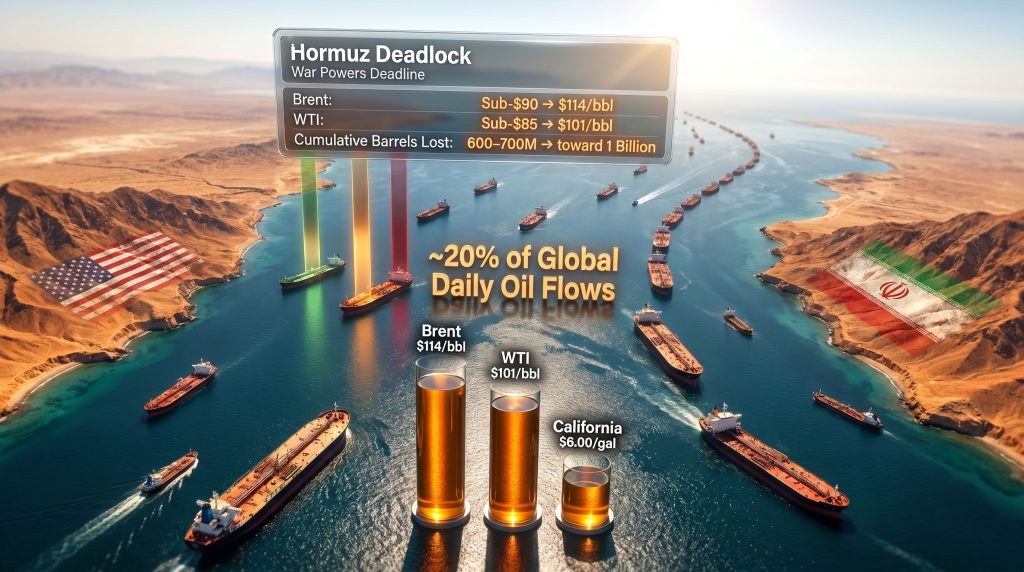
When Geography Becomes Destiny: The Strait That Holds the World to Ransom
Every energy crisis carries a geographic fingerprint. The 1973 oil embargo traced back to pipeline politics and tanker routes. The 2022 price surge mapped directly onto Russian pipeline dependency across Central Europe. Today's crisis has its own chokepoint: a 33-kilometre-wide passage between Iran and Oman through which, until recently, roughly one-fifth of the planet's daily oil and liquefied natural gas supply flowed without interruption. The Hormuz deadlock and Trump war powers deadline have now fused into a single, compounding uncertainty that energy markets are still struggling to fully price.
Understanding why this moment is structurally different from previous supply disruptions requires examining three interlocking systems simultaneously: the geography that makes Hormuz irreplaceable, the legal architecture that constrains U.S. military options, and the accumulated barrel losses that mean any resolution now comes with a built-in recovery lag measured in months, not weeks. Furthermore, the crude oil price trends emerging from this standoff are unlike anything seen in recent cycles.
When big ASX news breaks, our subscribers know first
The 1973 War Powers Resolution and What It Actually Demands
Most commentary on the War Powers Resolution treats it as a procedural formality. In practice, it represents one of the most consequential constraints on presidential military authority in U.S. constitutional history, enacted specifically because Congress believed the executive branch had overreached its powers during the Vietnam War.
The Resolution's core mechanism operates in three phases:
- Notification obligation: The President must inform Congress within 48 hours of deploying armed forces into hostilities.
- Mandatory 60-day termination clock: Unless Congress formally authorises continued military action, the President must terminate operations within 60 days of that notification.
- 30-day safe withdrawal extension: A single 30-day extension is available if the President certifies that additional time is required for the safe removal of U.S. forces.
The 60-day deadline arrived on May 2, 2026, with Congress yet to authorise the ongoing U.S. military posture in the conflict. Defense Secretary Pete Hegseth advanced the argument that an existing U.S.-Iran ceasefire arrangement effectively suspends the clock by pausing active hostilities, a legal interpretation that independent constitutional scholars have received with considerable scepticism. The statutory text of the Resolution does not explicitly address ceasefire scenarios, creating an interpretive ambiguity that the administration appears to be exploiting.
House Speaker Mike Johnson offered a parallel but distinct political argument, stating that from his perspective the United States is not formally at war with Iran. That framing carries political weight but no legal standing under the Resolution's own language, which activates upon the introduction of forces into situations of hostilities, not upon a formal declaration of war.
Three Scenarios and Their Market Implications
| Congressional Pathway | Legal Mechanism | Market Impact |
|---|---|---|
| Full authorisation granted | Congress votes to approve continued operations | Prices remain elevated; Hormuz disruption prolonged |
| 30-day extension invoked | President certifies safe-withdrawal need | Uncertainty premium sustained; markets price in delay |
| Forced de-escalation | Withdrawal requirement triggered | Short-term relief rally; structural supply damage persists |
The critical market insight here is that all three scenarios leave the global supply gap intact. Even a forced military withdrawal would not immediately reopen Hormuz to full commercial traffic. Iran's control over internal vessel movements within the Strait means political resolution and logistical restoration operate on entirely separate timelines.
Why Hormuz Cannot Be Substituted at Scale
Before the conflict began, the Strait of Hormuz facilitated the transit of approximately 20% of global daily oil and LNG flows, according to reporting by Tsvetana Paraskova for OilPrice.com. No other maritime corridor or overland pipeline network comes close to replicating that capacity on equivalent timescales. Alternative routing options, including around the Cape of Good Hope or through the limited pipeline infrastructure across Saudi Arabia and the UAE, add weeks to transit times and face immediate capacity saturation at crisis volumes.
The geopolitical architecture of the Strait creates an asymmetry that is often underappreciated: while the U.S. Navy maintains a blockade outside the Strait to constrain Iranian exports, Iran retains operational jurisdiction over the waterway itself. This distinction is not merely semantic. It means that any vessel attempting to transit the Strait must navigate Iranian-controlled waters, giving Tehran both a practical and a legal instrument to manage access in ways that external naval power cannot fully override. These geopolitical trade tensions have consequently accelerated a broader realignment of global energy relationships.
The pre-conflict baseline metrics illustrate the scale of the repricing that has followed:
| Benchmark | Pre-Conflict Level | Current Level |
|---|---|---|
| Brent Crude | Below $90/bbl | Peaked above $114/bbl |
| WTI Crude | Below $85/bbl | Exceeded $101/bbl |
| California Retail Gasoline | Below $5.00/gallon | Surpassed $6.00/gallon |
| Net Daily Crude Supply Loss | Baseline | Approximately 9 million bpd (Vortexa) |
The California gasoline figure is particularly significant. It represents the highest domestic retail fuel price since July 2022, directly paralleling the price environment that followed Russia's invasion of Ukraine. That prior episode resolved over 12 to 18 months as European buyers restructured supply chains and alternative LNG sources came online. The Hormuz scenario involves a narrower physical chokepoint with no equivalent workaround at comparable scale.
What the Blockade Has and Has Not Achieved
The U.S. naval blockade positioned outside the Strait has achieved partial effectiveness in constraining Iran's export throughput, but intelligence monitoring reveals a more nuanced picture than headline traffic data suggests.
Marine intelligence firm Windward reported on May 1, 2026, that while traffic at the Strait of Hormuz had become more active over the preceding week, the broader system had simultaneously grown more opaque. The firm described Iranian export activity as constrained but adaptive, noting that Kharg Island, Iran's primary crude loading terminal, continues operating with queue pressure accumulating and what the firm characterised as dark tanker drift expanding in parallel with any surface-level transit increases.
Understanding the Dark Tanker Phenomenon
The term dark tanker drift refers to vessels operating with disabled or manipulated Automatic Identification System (AIS) transponders, effectively rendering them invisible to standard commercial maritime tracking platforms. This methodology was first widely documented during the Russian oil sanctions regime following the 2022 invasion of Ukraine, where a so-called shadow fleet of untracked or obscurely flagged vessels allowed sanctioned crude to reach buyers without appearing in conventional trade data.
Iran has adapted this playbook at scale. The practical consequences for market intelligence are significant:
- Satellite imagery and AIS-based tracking undercount actual export volumes
- The visible increase in Strait traffic does not correspond to genuine supply restoration
- Kharg Island queue pressure suggests production is outpacing export capability, driving onshore storage toward capacity limits
- A separate OilPrice.com headline from the same period noted that Iran had reactivated a 30-year-old derelict tanker as Kharg Island approached storage limits, a detail that underscores the desperation and adaptability of Iranian logistics under blockade conditions
A critical distinction that markets are only beginning to fully appreciate: an increase in observable vessel movements through the Strait does not translate into restored global supply volumes. Concealed activity, enforcement ambiguity, and elevated regional risk premiums continue suppressing effective throughput even as surface-level metrics appear to improve marginally.
A Billion Barrels Already Lost: The Arithmetic of Irreversibility
The most important insight from the FT Commodities Global Summit in Lausanne came from Russell Hardy, Chief Executive of Vitol Group, the world's largest independent oil trading house. Hardy assessed that cumulative supply losses had already reached between 600 and 700 million barrels at the time of his remarks, with the total trajectory heading toward one billion barrels once restart lag is incorporated into the calculation.
His reasoning centres on a point that markets were slow to absorb: the loss is effectively locked in regardless of when the Strait reopens. Even an unconditional reopening today would not produce immediate supply restoration. Three distinct barriers extend the recovery timeline:
- Production facility restart: Wells and processing infrastructure that have been idled or constrained require technical assessment, maintenance clearance, and gradual ramp-up before reaching pre-conflict output rates.
- Tanker fleet repositioning: Vessels that were redeployed to alternative trade routes, or that have been anchored or idled due to risk and enforcement uncertainty, must be recalled, inspected, and repositioned to Persian Gulf loading facilities.
- Commercial contract restoration: Many buyers operating under force majeure clauses or who have secured alternative supply arrangements will require renegotiation before returning to normal purchasing volumes from the Gulf.
At the daily net crude supply loss figure of approximately 9 million barrels per day cited by analytics firm Vortexa, the mathematics confirm Hardy's assessment. The conflict has simultaneously destroyed an estimated 1.6 million barrels per day in oil demand through price-driven consumption suppression, meaning the remaining gap of approximately 7.4 million bpd is being bridged only through reserve drawdowns and inventory depletion, both of which are finite resources.
System Buffers Are Now Structurally Exhausted
The question of whether strategic reserves and OPEC spare capacity can absorb the Hormuz shock has been answered definitively, and the answer is no.
Bassam Fattouh, Director at the Oxford Institute for Energy Studies (OIES), and Andreas Economou, Head of Oil Research at OIES, published their assessment in a paper released during the week of May 2, 2026. Their analysis concluded that the scale of the production loss, combined with the effective unavailability of spare capacity sufficient to replace lost volumes, has rendered existing system buffers structurally inadequate for the current shock. Their conclusion was that price mechanisms would need to perform the primary market-clearing function, simultaneously suppressing consumption among price-sensitive buyers and incentivising new production elsewhere.
This finding has profound implications for how policymakers and market participants should interpret current price levels. Brent crude touching $113 to $114 per barrel is not a speculative premium awaiting resolution. It is the price signal that the global system requires to rebalance supply and demand in the absence of adequate physical buffers. In addition, OPEC market influence has proven structurally insufficient to offset the volumes removed from circulation by the Hormuz standoff.
The UAE's decision to exit OPEC+ has added a further dimension. Barclays has identified UAE oil supply growth as likely to accelerate following the departure, and JP Morgan has noted the potential for increased U.S. investment into UAE upstream assets. However, incremental UAE production growth operates on timelines measured in quarters, not weeks, and cannot meaningfully offset the immediate Hormuz supply deficit.
Demand Destruction: Where the Numbers Are Already Visible
Price-driven demand destruction is not a theoretical risk at current levels. It is already measurable across multiple import-dependent economies:
- Pakistan: Oil import expenditure has risen approximately 167% since the onset of the conflict, according to the country's Prime Minister, with the country only recently receiving its first LNG cargo in weeks after a prolonged supply interruption.
- China: LNG imports have declined to a six-year low as price levels have suppressed purchasing activity, with Beijing also authorising higher domestic fuel exports to partially offset regional shortfalls.
- Japan: The government is weighing approximately $3 billion in power subsidies to cushion the impact of surging LNG procurement costs on domestic consumers and industry.
- European Union: Institutional warnings have emerged that the energy crisis stemming from the conflict could persist for multiple years, a timeframe that goes well beyond the resolution of the immediate military standoff.
- Iran: Tehran has publicly warned that sustained disruption could push oil prices to $140 per barrel, a figure that functions simultaneously as a threat signal and a negotiating instrument.
The next major ASX story will hit our subscribers first
How Global Supply Chains Are Adapting Under Pressure
The secondary restructuring effects of the Hormuz deadlock and Trump war powers deadline are reshaping energy infrastructure relationships across multiple regions simultaneously.
Southeast Asia is moving toward formalising a regional petroleum security pact, a development that reflects how severely the crisis has exposed individual countries' vulnerability to a single-chokepoint supply dependency. The regional cooperation framework represents a structural shift in how Asian governments approach energy sovereignty, one that will likely persist regardless of how the current conflict resolves.
China has activated two parallel responses: allowing higher fuel exports in May to ease regional shortages, and through CNPC, publicly committing to securing the country's oil and gas supply amid the crisis. These actions reflect Beijing's dual concern with internal energy security and its regional influence, particularly given that its own LNG imports are simultaneously at a six-year low.
Germany faces a compounding supply shock, seeking alternative oil routing through Poland after Russia halted flows through the Druzhba pipeline, the latest in a series of European energy disruptions that have accumulated since 2022.
Tanker market mechanics have shifted in ways that reveal how the industry is internalising a prolonged disruption scenario. Operators are actively moving fleet capacity from fuel trade to crude trade as war-driven flow disruptions alter the commercial calculus. This reallocation is not a temporary tactical adjustment. It reflects the industry's expectation that the pattern of trade flows established during the conflict will persist well into the future.
Venezuela's oil exports have reached a seven-year high as buyers scramble for Atlantic Basin supply alternatives, while Syria continues to depend on Russian crude, and Ukraine has attacked Russian Black Sea oil port infrastructure four times in a single week, layering additional fragility onto a global system already operating near its tolerance limits. The oil market impacts of these simultaneous disruptions are compounding in ways that no single hedging strategy can adequately address.
The Convergence Point: Legal Deadlines, Market Deadlines, and What Comes Next
The Hormuz deadlock and Trump war powers deadline are not parallel stories. They are converging pressures on a single energy system with diminishing shock-absorbing capacity. The War Powers clock introduces a compressed political timeline that could either escalate the conflict through Congressional authorisation or create space for negotiated de-escalation. Neither outcome restores the barrels already lost, and neither eliminates the structural recovery lag that Vitol Group's Hardy has quantified so precisely. Consequently, the recession risk analysis now circulating among institutional investors has taken on renewed urgency.
The central insight for anyone analysing this situation across investment, policy, or operational dimensions is that supply restoration and conflict resolution are not the same event. A ceasefire or a military withdrawal ends the political conflict. Restoring one billion barrels of cumulative supply loss to an already-stressed global system requires months of coordinated logistical, commercial, and production restart activity, all of which unfolds independently of whatever agreement gets reached at a diplomatic table.
What the OIES analysis confirms is that the price mechanism is now doing the work that physical buffers have exhausted themselves trying to do. That means current Brent and WTI levels are not a crisis premium waiting to collapse. They are the clearing price for a structurally depleted supply system, and they will remain elevated until either new supply materialises at sufficient volume, or demand destruction broadens to the point of visible economic contraction across major consuming economies.
The Russell Hardy framing captures the asymmetry best: the billion barrels is, in his assessment, already baked in. The question global markets are now pricing is not whether that loss occurs, but how long it takes the system to absorb its consequences. Furthermore, reports of a Pakistan-brokered backchannel between the U.S. and Iran suggest diplomatic activity is intensifying — though whether that translates into a durable resolution remains deeply uncertain. Whether another three months of Hormuz restriction pushes the global economy across the recession threshold that analysts are increasingly warning about remains the defining question for energy markets in the months ahead.
This article contains forward-looking analysis and references to market conditions as reported by independent sources including OilPrice.com, the Financial Times, the Oxford Institute for Energy Studies, and marine intelligence firm Windward. Energy market conditions are subject to rapid change. Nothing in this article constitutes investment advice. Readers should conduct independent due diligence before making any financial decisions based on the information presented here.
Want to Capitalise on the Next Major Resource Discovery Before the Broader Market Reacts?
While the Hormuz crisis reshapes global energy supply chains and drives commodity prices to multi-year highs, Discovery Alert's proprietary Discovery IQ model delivers real-time alerts on significant ASX mineral discoveries — instantly translating complex resource data into actionable investment insights for both short-term traders and long-term investors. Explore how historic discoveries have generated substantial returns and begin your 14-day free trial today to position yourself ahead of the market.