August 6, 2026
Global supply chains have operated for decades on the assumption that critical maritime passages remain open to commercial traffic. This fundamental expectation underlies everything from manufacturing schedules to energy security planning across developed economies. Yet beneath this stability lies a complex web of geopolitical tensions that could rapidly transform global commerce through strategic maritime control.
The interconnected nature of modern energy markets means that disruptions in one region can cascade through entire economic systems within days. When strategic waterways become contested zones, the ripple effects extend far beyond immediate shipping routes, affecting everything from agricultural fertilizer costs to manufacturing supply chains across continents.
Understanding the Strategic Importance of Hormuz in Global Energy Security
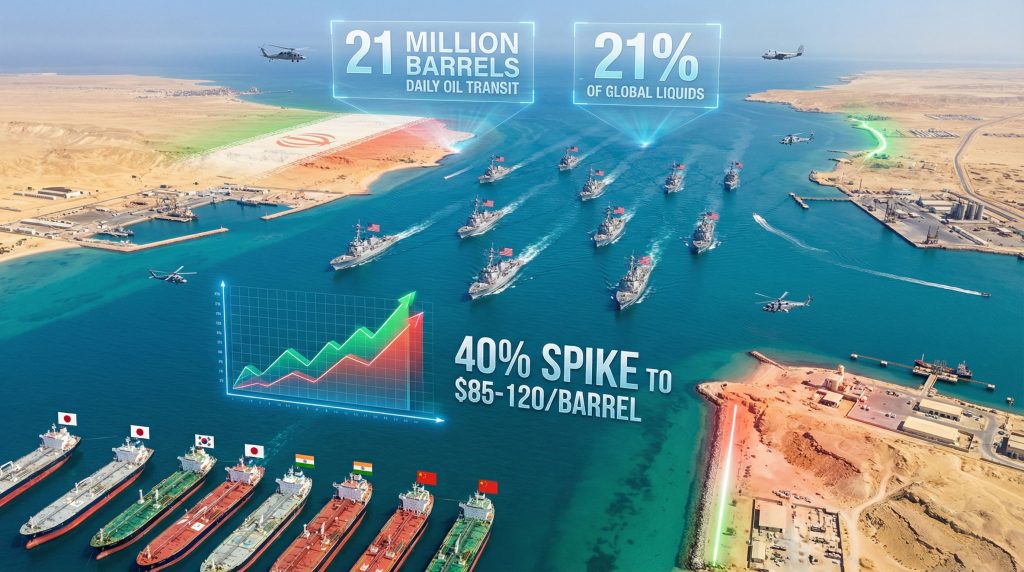
The Strait of Hormuz represents one of the world's most critical energy transit corridors, positioned between Iran and Oman as a 21-mile wide passage controlling access to Persian Gulf oil terminals. This narrow waterway handles approximately 21 million barrels of oil daily, representing roughly 21% of global liquid petroleum movements.
Strategic depth limitations create unique operational challenges for naval forces. The confined geography restricts maneuvering space for large vessels while providing natural advantages to asymmetric warfare tactics. Revolutionary Guard speedboats and coastal missile batteries can exploit these geographic constraints to complicate conventional naval operations.
Current Energy Flow Dependencies
Table: Major Energy Transit Volumes Through Hormuz (2026 Data)
| Energy Type | Daily Volume | Global Share |
|---|---|---|
| Crude Oil | 21 million barrels | 21% of global liquids |
| Natural Gas (LNG) | 25% of world shipments | Critical for Asian markets |
| Refined Products | 3.2 million barrels | 15% of global trade |
| Petrochemicals | Various volumes | 30% of regional exports |
Regional producer dependencies create cascading vulnerabilities. Saudi Arabia's eastern provinces, Kuwait's export terminals, and UAE loading facilities all depend on Hormuz transit for market access. Iraq's southern oil exports face similar constraints, with limited pipeline alternatives to bypass maritime routes.
Historical Maritime Conflict Precedents
The Tanker War period (1980-1988) demonstrated how sustained attacks on commercial shipping could disrupt global energy markets without completely closing strategic passages. During this conflict, over 540 vessels suffered attacks, yet maritime traffic continued flowing at reduced volumes with enhanced protection measures.
Operation Praying Mantis in 1988 showcased US naval capabilities to respond rapidly to threats against commercial shipping. The operation destroyed Iranian naval assets within hours, establishing precedents for proportional responses to maritime aggression. However, modern Iranian capabilities have evolved significantly since these historical encounters.
International maritime law frameworks governing strait closures remain complex and contested. The UN Convention on the Law of the Sea provides transit passage rights for international straits, but enforcement mechanisms depend on political will and military capability rather than legal authority alone.
When big ASX news breaks, our subscribers know first
How Would a US Naval Blockade Actually Function?
Implementation of a US blockade of Strait of Hormuz would require unprecedented coordination between multiple military commands and allied nations. Based on the April 2026 announcement, US Central Command planned enforcement beginning at 10:00 AM Eastern Time (14:00 GMT) targeting all maritime traffic entering and exiting Iranian ports.
Military Resource Requirements
A sustainable blockade operation demands significant naval assets positioned strategically throughout the region. Minimum deployment typically includes:
- 12-ship destroyer squadron for interception and escort duties
- Air cover coordination from regional bases in UAE, Bahrain, and Qatar
- Intelligence, surveillance, reconnaissance (ISR) systems for vessel tracking
- Logistics support infrastructure for extended operations
The enforcement framework distinguished between Iranian port access restrictions and general freedom of navigation. US Central Command stated forces would enforce the blockade impartially against vessels of all nations entering or departing Iranian ports and coastal areas, while explicitly maintaining that US forces would not impede freedom of navigation for vessels transiting to and from non-Iranian ports.
Operational Complexity and Neutral Shipping
Distinguishing between Iranian-bound cargo and neutral commercial traffic presents significant verification challenges. Modern container shipping often involves multiple cargo owners and destinations, making definitive origin and destination determination complex.
Key Operational Challenge: Neutral shipping protection requires sophisticated identification systems to prevent interference with legitimate commercial traffic while maintaining effective enforcement against targeted vessels.
Vessel inspection protocols must balance thoroughness with commercial efficiency. Extended inspections could create traffic bottlenecks affecting neutral commerce, potentially undermining international support for blockade operations.
International Maritime Law Complications
Legal justifications for maritime blockades face several critical challenges:
- Freedom of navigation vs. blockade rights – International law provides limited circumstances for lawful blockades
- Third-party shipping immunity – Neutral vessels typically enjoy protection from interference
- UN Security Council authorization – Multilateral approval strengthens legal foundation
- Regional ally consent obligations – Host nation agreements affect operational scope
The Revolutionary Guards characterized potential blockade enforcement as ceasefire violations, stating that any military vessels approaching the Strait of Hormuz would be dealt with harshly and decisively. This position frames Iranian resistance as defensive rather than aggressive action.
What Economic Shockwaves Would Ripple Through Global Markets?
Market reactions to blockade announcements demonstrate the immediate financial impact of supply disruption fears. Oil prices jumped 7% to above $100 per barrel ahead of the announced US enforcement, while Kuwait crude reached $102.44 per barrel, reflecting an increase of $1.81. Furthermore, this oil price rally analysis reveals deeper market dynamics at play.
Immediate Price Volatility Scenarios
Table: Projected Oil Price Impact Timeline
| Period | Price Range | Market Driver |
|---|---|---|
| Week 1-2 | $85-120/barrel | Initial supply fear premium |
| Month 1-3 | $100-150/barrel | Actual supply constraints |
| Month 3-6 | Variable | Strategic reserve effectiveness |
These projections assume varying degrees of enforcement success and alternative supply activation. Strategic petroleum reserve releases could moderate price spikes, but sustained blockade operations would likely overwhelm reserve capacity within months.
Commodity Market Cascade Effects
Energy market disruptions trigger broader commodity volatility through interconnected supply chains. Wheat prices rose nearly 2% in response to blockade preparations, demonstrating agricultural sector sensitivity to energy cost increases.
Petrochemical feedstock availability constraints affect manufacturing inputs across multiple industries. Plastic production, synthetic materials, and pharmaceutical precursors all depend on steady petroleum derivative supplies from Gulf region producers. Additionally, commodities market volatility creates broader hedging challenges for international traders.
Natural gas pricing mechanisms could disconnect from traditional oil benchmark relationships under supply stress. LNG shipments through Hormuz represent 25% of global trade volumes, making alternative sourcing difficult during extended disruptions.
Regional Economic Vulnerability Assessment
GCC state revenue structures create immediate fiscal pressures under blockade scenarios. Saudi Arabia, UAE, and Kuwait derive substantial government revenues from energy exports, making prolonged transit disruptions fiscally unsustainable.
Asian manufacturing hubs face acute supply security challenges. Japan's energy vulnerability prompted strategic reserve drawdown consideration, while South Korea and India evaluate alternative sourcing arrangements to maintain industrial operations.
European energy security calculations must balance sanction coordination with supply availability. The potential reactivation of alternative payment mechanisms like INSTEX could provide bypass options for essential energy imports. Moreover, trade war oil impacts demonstrate how economic conflict escalates energy market tensions.
Which Countries Would Face the Greatest Strategic Vulnerabilities?
Table: National Energy Import Dependencies on Gulf Region
| Country | Gulf Dependency | Strategic Vulnerability |
|---|---|---|
| Japan | 85% Middle East oil | Extremely High |
| South Korea | 70% Persian Gulf crude | Very High |
| India | 60% regional sourcing | High |
| China | 45% Gulf state supplies | Moderate |
Alternative Supply Route Analysis
Pipeline infrastructure limitations restrict rapid supply diversification options. Key constraints include:
- Trans-Arabian Pipeline – Limited capacity relative to maritime volumes
- East-West Pipeline (Saudi) – Recent capacity restoration supports alternative routing
- Suez Canal alternatives – Higher transportation costs and extended transit times
- Red Sea security environment – Additional risk factors for alternate routes
Saudi Arabia's restoration of East-West Pipeline capacity provides some alternative export capability, though maximum throughput remains significantly below normal Gulf loading terminal volumes. This infrastructure recovery offers partial supply security for global markets but cannot fully substitute for Hormuz transit capacity.
Strategic Reserve Utilisation Frameworks
International Energy Agency (IEA) coordinated release protocols provide 180-day emergency supply coverage through member nation strategic stockpiles. However, sustained blockade operations exceeding six months would exhaust these buffer mechanisms.
Emergency Reserve Capacity Overview:
- US Strategic Petroleum Reserve: 650 million barrel capacity
- IEA member combined reserves: 1.5 billion barrels
- Release coordination timeline: 30-day activation period
- Maximum sustainable drawdown: 4 million barrels daily
National stockpile adequacy varies significantly among vulnerable importers. Japan maintains approximately 90-day import coverage, while other Asian economies operate with shorter buffer periods, creating differential exposure to extended supply disruptions.
How Would Iran Likely Respond to Blockade Enforcement?
Iranian strategic response calculations balance escalation risks against perceived defensive necessities. The Revolutionary Guards' explicit warning that military vessels approaching Hormuz would be considered ceasefire violations indicates Iran views resistance as legitimate under existing agreements.
Asymmetric Warfare Capability Assessment
Iran's maritime strategy relies heavily on asymmetric tactics designed to exploit geographic advantages and conventional force limitations. Revolutionary Guard Corps naval units operate small, fast vessels capable of swarming tactics against larger military ships.
Missile and drone capabilities provide standoff attack options without direct naval confrontation. Iran's coastal missile batteries can target vessels throughout Hormuz approaches, while drone swarms offer cost-effective attack vectors against expensive naval assets.
Regional Proxy Network Activation
Iranian influence extends through proxy relationships across multiple regional theaters. Potential activation scenarios include:
- Hezbollah operational integration – Lebanese-based forces could open additional fronts
- Houthi Red Sea operations – Alternative supply route interdiction capabilities
- Iraqi militia coordination – Attacks on regional energy infrastructure
- Syrian territory utilisation – Launch platforms for extended-range operations
Nuclear Programme Acceleration Concerns
Critical Security Consideration: Intelligence assessments suggest Iran currently operates uranium enrichment at 60% levels, with potential acceleration to 90% weapons-grade material under sustained military pressure within 2-4 weeks.
IAEA monitoring system effectiveness becomes crucial during crisis periods. Iran's potential circumvention of international oversight could significantly alter regional security calculations and alliance response requirements.
The timeline between current enrichment levels and weapons capability represents a critical threshold for international intervention decisions. Military pressure could paradoxically accelerate nuclear programme advancement rather than constraining Iranian strategic options.
What Alternative Energy Routes Could Emerge?
Overland pipeline development would accelerate under sustained maritime disruption scenarios. Long-delayed projects like the Iran-Pakistan-India pipeline could gain renewed political support despite historical financing and security challenges. In addition, the recent Venezuela policy shift could reshape Western Hemisphere energy supply patterns.
Central Asian Energy Corridor Expansion
Turkey's position as an energy transit hub becomes increasingly valuable during Gulf supply disruptions. Expanded pipeline capacity through Turkish territory could partially offset maritime route constraints, though development timelines extend over multiple years.
Russian Arctic LNG production offers alternative supply sources, though transportation infrastructure and seasonal accessibility limit immediate substitution capability. European import terminals would require modification to handle increased Arctic supply volumes.
Strategic Petroleum Reserve Coordination Mechanisms
Table: Global Emergency Oil Stock Deployment
| Reserve System | Capacity (Million Barrels) | Daily Release Rate | Duration |
|---|---|---|---|
| US SPR | 650 | 4.4 | 150 days |
| IEA Combined | 1,500 | 10-15 | 100-150 days |
| China SPR | 500 (estimated) | 2-3 | 160-250 days |
| Other National | 300 | 1-2 | Variable |
Release coordination requires unprecedented international cooperation to prevent market manipulation while maintaining strategic deterrence value. Timing decisions balance immediate price moderation against reserve depletion for extended crisis scenarios.
Renewable Energy Transition Acceleration
Energy security crises historically accelerate alternative energy investment patterns. Solar and wind deployment could receive enhanced political and financial support as strategic independence considerations outweigh cost concerns.
Battery storage technology development gains urgency for grid stability management. Large-scale storage deployment becomes essential for renewable energy integration during conventional supply disruptions. Consequently, global energy security considerations drive increased investment in diversified energy portfolios.
Green hydrogen production scaling offers long-term energy security benefits, though current production capacity remains insufficient for immediate substitution requirements. Investment acceleration could compress development timelines from decades to years.
The next major ASX story will hit our subscribers first
Which Global Powers Would Intervene or Stay Neutral?
Chinese Strategic Response Calculations
China's Belt and Road Initiative energy security investments create strong incentives for diplomatic intervention rather than military escalation. Chinese energy import dependencies make extended supply disruptions economically devastating despite alternative sourcing capabilities.
Naval presence escalation in the Indian Ocean represents China's most likely military response. Increased Chinese naval activity could complicate US enforcement operations while demonstrating strategic commitment to energy security partners.
Economic leverage through alternative financing mechanisms offers China non-military influence options. Currency swap arrangements and bilateral trade agreements could provide sanctions bypass opportunities for partner nations.
European Union Diplomatic Positioning
EU energy security priorities create tension between alliance solidarity and economic necessity. European dependence on Middle East energy imports requires careful balance between US coordination and independent supply security.
Alternative payment mechanism development accelerated during previous sanction periods. INSTEX or similar systems could provide European energy import continuity while maintaining diplomatic cooperation frameworks.
Mediterranean supply negotiations become critical for European energy security. North African production capacity and Russian pipeline alternatives gain strategic importance during Gulf supply disruptions.
Russian Opportunistic Strategy
Arctic route development acceleration benefits from Gulf supply constraints. Russian energy exports become more valuable during Middle East disruptions, providing economic and political leverage opportunities.
European energy dependency exploitation offers significant geopolitical advantages. Sustained Gulf disruptions could strengthen Russian negotiating positions regarding Ukraine and broader European security issues.
Middle East influence expansion through Iranian cooperation provides strategic benefits. Russian-Iranian energy coordination could circumvent blockade effectiveness while advancing regional influence objectives.
How Long Could a Blockade Realistically Be Sustained?
US Military Resource Sustainability
Naval deployment sustainability requires systematic rotation schedules to maintain operational effectiveness. Standard deployment cycles involve:
- Six-month deployment rotations for major surface combatants
- Regional base logistics capacity supporting extended operations
- Allied burden-sharing agreements reducing US resource requirements
- Domestic political support durability affecting long-term commitment
Coalition partner participation becomes essential for extended operations. Regional allies provide basing, logistics, and political legitimacy, while European and Asian partners contribute naval assets and financial support.
Economic Pressure Timeline Analysis
Global economic impact accelerates through interconnected supply chains and financial markets. Critical timeline considerations include:
- 3-6 month window before global recession probability increases significantly
- Inflation transmission to consumer prices affecting domestic political support
- Allied economic coordination stress testing international partnership durability
- Strategic reserve depletion timelines limiting crisis management options
Table: Blockade Sustainability Factors
| Timeline | US Capability | Economic Impact | Political Pressure |
|---|---|---|---|
| 1-3 months | High | Moderate | Low |
| 3-6 months | Moderate | High | Moderate |
| 6-12 months | Declining | Severe | High |
| 12+ months | Limited | Critical | Very High |
Diplomatic Resolution Pathways
Negotiation framework development requires third-party mediation to provide face-saving options for all parties. Potential mechanisms include:
- Direct bilateral talks resumption under neutral auspices
- European Union mediation leveraging economic relationships
- UN Security Council involvement despite veto power complications
- Phased de-escalation confidence-building measures
Regional security architecture institutionalisation could provide long-term conflict prevention mechanisms. Gulf Cooperation Council expansion or new multilateral frameworks might address underlying tensions beyond immediate crisis resolution.
What Would Be the Long-Term Geopolitical Consequences?
Middle East Power Balance Transformation
Saudi-Iranian proxy competition intensification affects regional stability across multiple theaters. Extended conflict could reshape alliance patterns and influence distribution throughout the Middle East.
Israeli security calculations require adjustment for prolonged regional instability. Energy supply security and Iranian nuclear programme advancement create complex strategic planning requirements for Israeli policymakers.
Turkish regional influence expansion opportunities emerge from Gulf instability. Turkey's geographic position and energy transit role provide enhanced leverage in regional political arrangements.
Global Energy Architecture Evolution
Permanent supply chain diversification acceleration reduces future Gulf dependency regardless of crisis resolution. Energy security planning incorporates blockade scenarios as routine considerations rather than exceptional circumstances.
Strategic alliance restructuring around energy security creates new partnership frameworks. Traditional military alliances expand to include explicit energy security cooperation and mutual assistance obligations.
Technology transfer patterns shift toward energy independence capabilities. International cooperation in renewable energy, storage technology, and alternative fuel development receives unprecedented priority and resource allocation.
International Maritime Law Development
Strait passage rights precedent establishment affects global maritime security planning. Future chokepoint disputes will reference Hormuz blockade precedents for legal and operational guidance.
Naval blockade legitimacy thresholds require clarification through international legal processes. The balance between sovereign rights and freedom of navigation needs updated frameworks for modern conflict scenarios.
Regional security architecture institutionalisation becomes essential for preventing future crises. Multilateral frameworks must address underlying tensions while providing crisis management mechanisms.
Critical Questions About Strategic Maritime Control
Could Iran Initiate Strait Closure First?
Iranian capabilities for strait mining or closure remain limited by international legal constraints and military vulnerabilities. Complete closure would eliminate Iranian oil export revenues while providing clear justification for international intervention.
Military assessments suggest Iran possesses sufficient coastal missile and naval assets to threaten shipping without complete closure. Selective targeting creates greater strategic ambiguity while maintaining plausible deniability for escalation control.
Economic self-damage calculations make Iranian strait closure unlikely except under extreme circumstances. Oil export revenues provide essential government funding that complete closure would eliminate entirely.
How Would Insurance Markets Respond?
Maritime war risk premiums would increase dramatically for Gulf region transit. Lloyd's of London and other major insurers might suspend coverage entirely during active conflict periods.
Insurance Market Impact Scenarios:
- Premium increases: 300-500% for Gulf transit routes
- Coverage suspension triggers: Active military engagement
- Alternative risk mechanisms: Government insurance programmes
- Rate duration: 6-18 months post-conflict normalisation
Alternative risk transfer mechanisms require government backing during extended crisis periods. State-sponsored insurance programmes become necessary to maintain essential commerce flows.
What Role Would International Institutions Play?
UN Security Council authorisation provides legitimacy but faces veto power constraints from permanent members. Russia and China could block resolutions supporting blockade operations while demanding immediate de-escalation.
International Court of Justice jurisdiction questions complicate legal resolution pathways. Maritime law interpretation requires international legal consensus that may prove elusive during active conflicts. However, US naval forces face unprecedented coordination challenges when implementing such extensive enforcement operations.
Regional organisation mediation offers alternative diplomatic channels. Gulf Cooperation Council, Arab League, or Organisation of Islamic Cooperation involvement could provide face-saving negotiation frameworks.
Disclaimer: This analysis presents hypothetical scenarios based on publicly available information and historical precedents. Actual outcomes would depend on numerous variables including political decisions, military capabilities, and international responses that cannot be precisely predicted. Investment and policy decisions should not be based solely on speculative scenario planning.
Looking for Strategic Investment Opportunities in Energy Markets?
Discovery Alert's proprietary Discovery IQ model delivers real-time alerts on significant ASX mineral discoveries, instantly empowering subscribers to identify actionable opportunities ahead of the broader market. Visit Discovery Alert's discoveries page to understand how historic mineral discoveries have generated substantial returns during periods of global uncertainty and supply chain disruption.