July 7, 2026
The Geography of Catastrophic Risk: How a Single Waterway Became the Pivot Point of Global Energy Security
Every energy market model carries within it a set of assumptions about supply chain continuity. Most of the time, those assumptions hold. But when a single maritime chokepoint sits beneath the convergence of geopolitical conflict, fragmented diplomatic frameworks, and competing military interests, the entire architecture of global LNG pricing becomes vulnerable to a single drone or missile strike on a vessel transiting a 21-nautical-mile-wide passage.
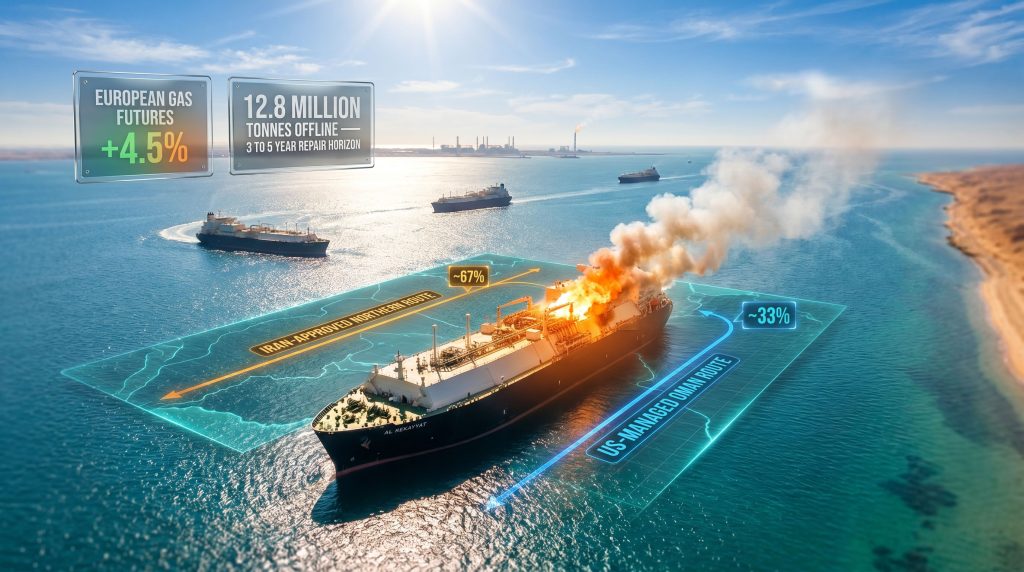
That is the reality confronting energy markets following the strike on the Al Rekayyat, a laden Qatari LNG carrier struck approximately 8 nautical miles east of Limah, Oman, as it exited the Strait of Hormuz in the early hours of Tuesday, July 7, 2026. Security consultancy EOS Risk Group confirmed the attack and a subsequent fire aboard the vessel, classifying the incident as either a drone or missile strike.
The strike did not merely represent another incident in an already volatile maritime environment. It exposed the fragility of the interim diplomatic architecture that had been constructed to manage the Strait of Hormuz since US and Israeli strikes on Iran began in late February 2026, and it sent European gas prices climbing as much as 4.5% in early Asian trading.
When big ASX news breaks, our subscribers know first
Why the Strait of Hormuz Cannot Be Replaced
The Physical Chokepoint No Engineer Can Redesign
The Strait of Hormuz connects the Persian Gulf to the Gulf of Oman and the broader Arabian Sea. Its navigable channel is narrow enough that all outbound and inbound maritime traffic must pass through corridors of just a few nautical miles in width, making it structurally impossible to reroute at commercial scale.
For Persian Gulf LNG exporters, there is no economically viable alternative. Qatar's Ras Laffan terminal, the operational hub of the world's largest LNG export facility, sits behind the strait. There is no pipeline network capable of carrying those volumes to alternative loading terminals. There is no canal. There is no overland bypass. Every cargo destined for Europe, Japan, South Korea, or China must pass through Hormuz.
This geographic reality transforms any disruption to Hormuz transit into an immediate global supply event. Unlike crude oil, which has more diversified origin points, LNG is concentrated. Furthermore, global LNG supply depends substantially on Qatar, and its entire export infrastructure sits behind a single maritime gateway.
The Conflict That Fractured the Chokepoint
The conflict that began in late February 2026 fundamentally altered transit dynamics through the strait. The death of Supreme Leader Ali Khamenei on the opening day of hostilities destabilised Iranian command structures and removed a singular decision-making authority, creating tactical unpredictability in how Iranian forces have subsequently engaged with commercial shipping.
An interim peace agreement was reached, but rather than restoring a unified transit framework, it produced something arguably more complex: two competing corridors operating simultaneously within the same waterway.
- The Iran-approved northern corridor along the northern side of the strait, which accounts for approximately two-thirds of all recent transits according to data from intelligence firm Kpler
- The US-managed Oman route along the southern side, which handles the remaining one-third of transits, predominantly by vessels maintaining active transponders
This bifurcation has no direct historical precedent in modern maritime law or logistics. A single international waterway is now effectively operating under two competing jurisdictions, with different risk profiles, compliance requirements, and attack histories attached to each.
Decoding the Al Rekayyat Strike
Vessel Profile, Route History, and the Transponder Question
The Al Rekayyat is owned by Nakilat, Qatar's state-owned shipping company and one of the operators of the world's largest LNG tanker fleets. The vessel had loaded its LNG cargo from Ras Laffan earlier in the month before beginning its transit outbound through the strait.
At the time of the strike, ship-tracking data showed the vessel was operating without active AIS transponders, meaning it had deliberately suppressed its automatic identification system signal before entering the most dangerous stretch of the transit corridor.
This detail matters enormously. The decision to go dark reflects not compliance failure but a calculated risk trade-off: vessel crews and operators in active conflict zones increasingly believe that broadcasting their position makes them more vulnerable to targeting, not less. Yet international maritime regulations under SOLAS require transponder operation in most circumstances, creating a direct collision between crew safety instinct and regulatory obligation.
Out of 25 ships that transited Hormuz on the Monday preceding the strike, only three did so on the Oman route with their transponders active, despite regional naval forces having issued a reminder that the US-managed corridor remained available. This data point reveals how comprehensively the official framework has failed to build confidence among commercial operators.
The Divergent Behavior of the Fleet
On that same Monday, a group of Japan-linked vessels transited the strait by following the Iran-approved northern corridor. The Al Kharaitiyat, carrying LNG to Pakistan, and the Al Sahla, bound for Tianjin, China, both completed transits via the Iranian-approved route. Meanwhile, the Singapore-flagged Mihzem attempted to exit the strait but turned back at the chokepoint entrance, an event entirely separate from the Qatari LNG carrier struck that nonetheless illustrates the psychological paralysis taking hold across the Qatari fleet.
Muyu Xu, senior crude oil analyst at Kpler, described the situation by noting that continued use of divergent shipping lanes confirms that traffic through the strait remains operational but fragmented, with shipowners making routing decisions based on individual risk tolerances rather than any unified security framework.
The absence of a single enforceable transit protocol means every vessel master and every shipping operator is effectively conducting their own conflict-zone risk assessment in real time, with incomplete intelligence and asymmetric information about where the next attack will originate.
The Cascading Market Consequences
Immediate Price Signals Following the Strike
Energy markets registered the attack with speed and clarity. European natural gas futures climbed up to 4.5% in early Asian trading following news of the strike, while Brent crude oil futures also moved higher. The oil price movements were particularly revealing because crude had been falling in the preceding days, with traders pricing in the assumption that improved Hormuz transit rates would relieve supply pressure and push the market toward oversupply. The strike reversed that assumption within hours.
This dynamic illustrates one of the more underappreciated structural features of LNG and energy commodity markets: a single incident involving one vessel can reprice global benchmarks, not because of the volumetric impact of that single cargo, but because of what it signals about the durability of the entire transit framework.
Qatar's Damaged Export Architecture: The 17% Problem
The Al Rekayyat incident did not occur in isolation. Iranian strikes earlier in the conflict had already disabled approximately 17% of Qatar's LNG export capacity, sidelining an estimated 12.8 million tonnes of annual production. Repair timelines for the damaged infrastructure are projected to extend three to five years, meaning the supply gap runs through 2029 to 2031 at minimum.
Qatar had been pursuing an aggressive expansion of its North Field LNG operations, with a stated ambition to grow total export capacity to 142 million tonnes per annum (MTPA) by the late 2020s. The combination of physical infrastructure damage, maritime insecurity, and reputational risk as a reliable supplier creates a compounding challenge that the expansion programme alone cannot resolve.
Immediately following the strike, the Al Areesh, another LNG tanker that had loaded at Qatar's facilities and was outbound through the Persian Gulf with Pakistan's Port Qasim as its stated destination, appeared to reverse course in shipping data. This near-real-time behavioural response illustrates how quickly fleet-wide risk recalibration occurs following a confirmed attack.
European and Asian Supply Exposure: Scenario Modelling
The structural exposure of major importing regions varies by scenario:
| Scenario | Corridor Status | LNG Flow Impact | Market Consequence |
|---|---|---|---|
| Diplomatic De-escalation | Dual corridor stabilises post-funeral talks | Near-normal volumes resume gradually | TTF prices ease; shipping normalises |
| Frozen Conflict Status Quo | Sporadic attacks continue; talks stall | 30-40% volume reduction persists | Elevated, range-bound energy prices |
| Escalatory Breakdown | Further strikes trigger insurance collapse | Near-total Persian Gulf LNG halt | Extreme price spike; global emergency reallocation |
The Insurance Market: The Hidden Mechanism Closing Shipping Lanes
How War Risk Premiums Function as a De Facto Lane Closure Tool
Beyond the physical risk of vessel strikes, there is a financial mechanism that can effectively shut a maritime corridor without a single additional shot being fired: war risk insurance pricing. Protection and indemnity (P&I) clubs and London market underwriters set premiums based on assessed attack probability within specific geographic zones.
When premiums rise high enough, the economics of a transit become negative regardless of whether the physical risk is judged manageable by the vessel's crew. During peak Houthi attack periods in the Red Sea between 2023 and 2025, war risk premiums for certain Red Sea transits rose so sharply that virtually all major commercial operators rerouted via the Cape of Good Hope, adding approximately 10 to 14 days to voyage times but avoiding the insurance cost burden entirely.
Hormuz does not offer a comparable rerouting alternative. Persian Gulf exporters cannot simply take a longer route. This means that if war risk premiums for Hormuz transits reach the threshold at which insurance clubs withdraw cover entirely, the practical consequence is not a longer voyage but no voyage at all.
The AIS Dark Fleet and Regulatory Tension
The growing number of vessels operating without active transponders in the strait creates a secondary risk layer that extends beyond the immediate conflict. Under the International Maritime Organization's SOLAS framework, AIS operation is mandatory for vessels above certain tonnage thresholds. Vessels going dark to reduce targeting risk are technically operating outside regulatory compliance, creating potential legal exposure for operators, flag states, and insurers alike.
Maritime security advisory firms have been navigating this tension directly with clients, weighing the practical crew safety argument for transponder suppression against the regulatory and insurance liability consequences. There is no clean answer, and the divergence in fleet behaviour evident in the Hormuz transit data suggests no consensus has been reached.
The Geopolitical Framework: What Happens in the Next 90 Days
The Interim Agreement Under Strain
The US-Iran interim peace agreement that preceded the strike on the Qatari LNG carrier contained specific provisions relating to Hormuz transit, but Iran has continued to periodically assert corridor control by blocking non-approved transits and, as the latest incident demonstrates, by attacking vessels operating outside its sanctioned route. The agreement appears to function as a partial constraint rather than a comprehensive security guarantee.
US-Iran talks were suspended during the mass funeral proceedings for Supreme Leader Khamenei, whose burial was scheduled for July 9 in Mashhad, his hometown. Qatar, which has served as a diplomatic intermediary between the parties, indicated that the next round of negotiations would be arranged as soon as the funeral ceremonies concluded. These broader geopolitical tensions continue to reshape both energy markets and international diplomatic postures simultaneously.
The NATO Ankara Summit and Allied Burden-Sharing
President Trump was travelling to the NATO leaders' summit in Ankara as the Al Rekayyat strike unfolded. The US conflict with Iran was expected to dominate discussions, with Trump having expressed significant frustration at what he characterised as insufficient support from NATO allies. The practical challenge for NATO as an institution is that its collective defence architecture, designed for territorial defence of member states, does not map neatly onto the operational requirements of protecting commercial shipping lanes in the Persian Gulf.
This structural gap between alliance posture and operational need means that even a unified NATO position on the conflict does not automatically translate into an effective maritime security framework for Hormuz. Consequently, questions of trade and geopolitics are becoming inseparable from the operational calculus of energy supply chain management.
The next major ASX story will hit our subscribers first
Long-Term Structural Shifts: The Diversification Imperative
Asian Buyers Reconsidering Qatar Dependency
Japan, South Korea, and China collectively represent the dominant share of global LNG imports, and all three have significant long-term contractual exposure to Qatari supply. Emergency procurement strategies have been activated, with US Henry Hub-linked LNG cargoes functioning as a swing supply source and Australian LNG exports providing additional structural backstop capacity for Asian buyers during Persian Gulf disruptions.
The longer the transit uncertainty persists, the stronger the commercial incentive becomes for Asian national energy companies to accelerate contract diversification toward non-Hormuz-dependent supply origins. East African LNG developments, North American export expansion, and additional Australian capacity all benefit from a sustained deterioration in Qatari supply reliability.
Qatar's Unresolvable Geographic Constraint
Qatar faces a paradox that no amount of infrastructure investment or diplomatic effort can fully resolve. It holds some of the largest natural gas reserves on the planet, operates world-class liquefaction infrastructure, and commands a modern tanker fleet through Nakilat. Yet every tonne of LNG it exports must pass through a 21-nautical-mile passage that is currently contested, bifurcated, and subject to attack.
Potential partial mitigations, including floating storage solutions and offshore cargo transfer arrangements that could decouple loading operations from strait transit timing, are under active consideration in industry circles. However, none of these represent a structural solution to the underlying geographic vulnerability.
The fundamental challenge for Qatar is not operational or financial. It is cartographic. The strait is where it is, the reserves are where they are, and no amount of geopolitical negotiation changes that underlying physical reality.
Key Facts: Hormuz LNG Disruption at a Glance
- The Al Rekayyat was struck approximately 8 nautical miles east of Limah, Oman, classified by EOS Risk Group as a drone or missile attack with subsequent fire
- Only 3 of 25 vessels transiting Hormuz on the preceding Monday used the Oman route with transponders active
- ~67% of recent Hormuz transits have used the Iran-approved northern corridor, per Kpler intelligence data
- Iranian strikes have disabled approximately 17% of Qatar's LNG export capacity, representing an estimated 12.8 million tonnes annually
- Repair timelines for damaged Qatari LNG infrastructure are projected at three to five years, extending through 2029-2031
- European natural gas futures rose up to 4.5% in early Asian trading following the strike
- Qatar is targeting 142 MTPA of LNG export capacity through its North Field expansion, a programme whose commercial logic is undermined by sustained Hormuz insecurity
Disclaimer: This article contains forward-looking analysis, scenario modelling, and market projections based on available information as of the date of publication. Energy market dynamics are subject to rapid change. Nothing in this article constitutes financial or investment advice. Readers should conduct independent research before making any investment or commercial decisions.
Want to Stay Ahead of the Next Major Resource Discovery Triggered by Global Supply Shocks?
When geopolitical disruptions reshape energy and commodity markets this rapidly, the investors who move first on significant ASX mineral discoveries stand to gain the most — Discovery Alert's proprietary Discovery IQ model delivers real-time alerts the moment a major discovery hits the ASX, turning complex market signals into actionable opportunities for both short-term traders and long-term investors. Start your 14-day free trial at Discovery Alert and position yourself ahead of the market before the next supply shock reshapes the resource landscape.