July 7, 2026
When Buyers Hold the Cards: How the Asian Crude Market Flipped Against Saudi Arabia
Global crude oil markets rarely reverse course gradually. They tend to lurch from one extreme to another, driven by conflict, diplomacy, and the cold logic of delivered cost economics. The current episode unfolding across Asian refinery procurement desks is a textbook example of how quickly a seller's paradise can become a buyer's market, and how even the world's most powerful crude exporter can find its pricing tools outpaced by events on the ground.
Understanding why the Saudi oil price cut to Asia buyers is failing to generate the purchasing response Aramco anticipated requires looking beyond the headline numbers and into the structural mechanics of how crude actually gets priced, transported, and compared at an Asian refinery gate. Furthermore, crude oil volatility in recent years has conditioned Asian buyers to act swiftly when market conditions shift in their favour.
When big ASX news breaks, our subscribers know first
From Scarcity to Surplus: The 2026 Pricing Reversal
The speed of the reversal in Middle Eastern crude pricing dynamics through 2026 has been remarkable by any historical measure. In May 2026, Saudi Arab Light crude was commanding record-high premiums as shipping through the Strait of Hormuz was severely disrupted during the U.S.-Iran conflict. At its peak, Arab Light differentials reached approximately +$20 per barrel above the Oman/Dubai benchmark, as buyers scrambled for any available barrels outside the affected corridor.
That pricing environment evaporated with the conclusion of the U.S.-Iran interim deal in June 2026. The agreement unlocked a 60-day sanctions waiver on Iranian crude exports and restored shipping traffic through the Strait of Hormuz, the waterway through which roughly one-fifth of global seaborne oil supply had historically flowed. Within weeks, a market defined by desperate buying transformed into one characterised by competing sellers chasing reluctant buyers.
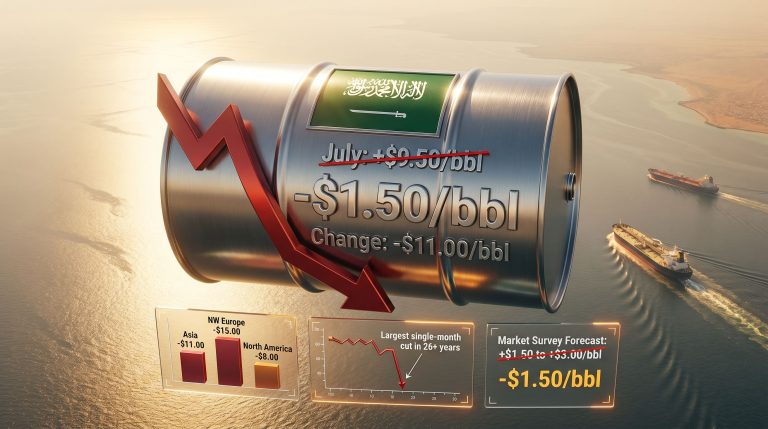
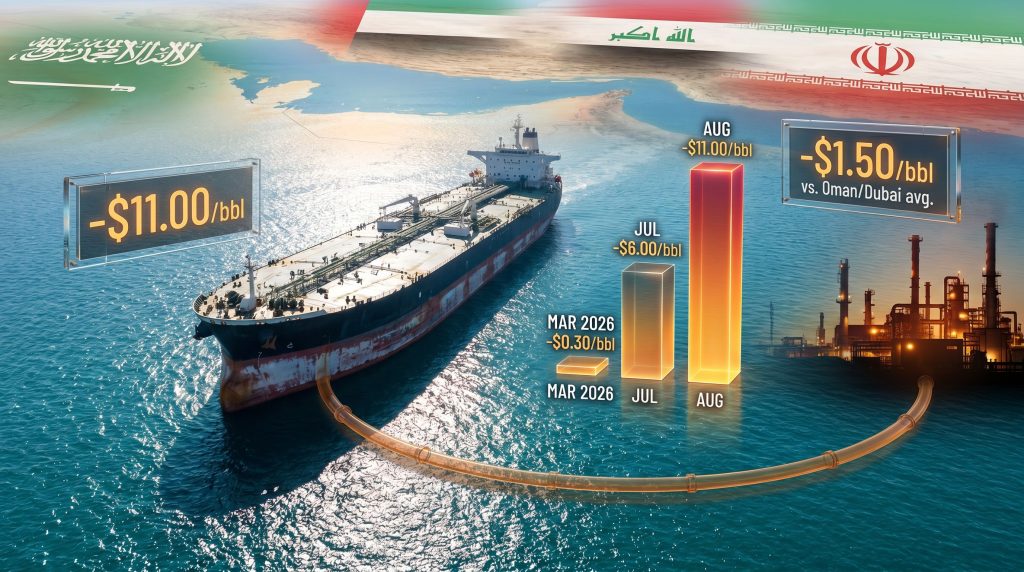
The result was Saudi Aramco's August 2026 Official Selling Price announcement: a reduction of $11.00 per barrel across all five crude grades for Asian buyers, setting Arab Light at $1.50 per barrel below the Oman/Dubai benchmark average. According to Bloomberg, by absolute magnitude, this was the largest single-month OSP reduction in more than two decades. By market impact, it has so far failed to move the needle.
Understanding the OSP Mechanism and Why It Matters
The Official Selling Price is the monthly pricing differential that Saudi Aramco sets relative to a regional benchmark. For Asian customers, that benchmark is the average of Oman and Dubai crude quotes. The OSP differential determines how expensive or cheap Saudi crude is relative to alternatives available to refiners in China, India, South Korea, Japan, and other major import markets.
Because Aramco sets OSPs once per month for all five grades simultaneously, the system is inherently backward-looking. It reflects conditions that prevailed during the prior pricing cycle rather than the real-time spot market. In stable markets, this creates manageable pricing lags. In rapidly shifting markets like the current one, the monthly cycle can leave Saudi crude materially mispriced relative to spot alternatives that adjust daily.
The table below illustrates how Saudi Arab Light's August 2026 pricing compares with competing grades available to Asian buyers:
| Crude Grade | Seller | Pricing Basis | Approximate Differential (Aug 2026) |
|---|---|---|---|
| Arab Light | Saudi Aramco | Oman/Dubai avg. | -$1.50/bbl |
| Upper Zakum | ADNOC | Dubai quotes | -$6.00 to -$8.00/bbl (STS Sohar) |
| Basrah Medium | Iraq SOMO | Oman/Dubai avg. | Deep discount (undisclosed) |
| Das Blend | ADNOC | Dubai quotes | Approx. -$7.00/bbl |
| Iranian grades | NIOC | Negotiated | Sanctioned-era discount pricing |
Even with the historic Saudi oil price cut, Arab Light remains several dollars per barrel more expensive on a delivered basis than the competing grades shown above.
The Freight Cost Problem Saudi Arabia Cannot Easily Fix
The OSP differential is only part of the landed-cost calculation. Tanker freight economics play a decisive role in determining which crude a refinery actually purchases, and here Saudi Arabia faces a structural disadvantage that no pricing adjustment alone can fully resolve.
Saudi Arabia's primary export terminal at Ras Tanura sits inside the Strait of Hormuz. A Very Large Crude Carrier loading at Ras Tanura must navigate through the strait, a route that currently carries a residual geopolitical risk premium even under the interim U.S.-Iran truce. By contrast, ADNOC conducts ship-to-ship transfer operations at Sohar port in Oman, which sits outside the strait entirely.
The financial implications are significant:
- VLCC freight from inside the Gulf is estimated at $4 to $5 per barrel higher than equivalent tonnage loading outside the strait
- Industry participants estimate the total incremental cost of lifting crude from inside the Gulf versus outside at approximately $15 per barrel under current conditions
- ADNOC's Upper Zakum is available at $6 to $8 per barrel below Dubai quotes via ship-to-ship transfer at Sohar, making the effective delivered cost advantage over Saudi crude several multiples of what the OSP differential alone suggests
Even after the largest Saudi oil price cut in over 20 years, the combination of a still-elevated OSP differential and a $4 to $5 per barrel freight surcharge for inside-the-strait loading means Arab Light lands at Asian refineries materially more expensive than competing grades. The OSP reduction addressed the pricing optics without resolving the underlying cost structure.
Why Asian Buyers Are Looking Elsewhere
China's Dramatic Demand Withdrawal
China's reduction in Saudi crude nominations between April and June 2026 captures the scale of the demand shift underway. Chinese purchases of Saudi crude fell to approximately 600,000 barrels per day in June 2026, down from roughly double that volume just two months earlier. The roughly 50% decline within a single quarter reflects a convergence of structural pressures rather than a simple pricing dispute.
Chinese independent refiners, commonly referred to as teapots, have historically operated on the thinnest margins in the refining sector and consistently prioritise the cheapest available barrel. With refinery margins compressed, crude inventories elevated, and Iranian barrels re-entering the market at steep discounts during the sanctions waiver window, these buyers have limited commercial incentive to maintain Saudi term contract volumes at current pricing levels.
The National Iranian Oil Company is simultaneously working to re-engage former Asian customers beyond the Chinese independent segment, seeking to broaden its buyer base during the 60-day window of sanctions relief. Consequently, OPEC market influence over Asian procurement decisions is being tested in ways that are deeply uncomfortable for Riyadh.
India, South Korea, and Japan Pull Back
The demand reduction is not limited to China. Across Asia's major refining economies, the pattern is consistent:
- India received approximately 30% less Saudi crude in May 2026 compared with prior months, as state refiners redirected purchases toward discounted Gulf spot grades available outside the strait
- South Korea saw loadings fall approximately 35% versus April 2026 levels, reflecting both weaker domestic refining demand and competitive pricing from alternative Gulf suppliers
- Japan has maintained a cautious procurement posture, with ongoing uncertainty around the fragility of the U.S.-Iran truce complicating any commitment to Gulf-loading cargoes, including Saudi barrels
The collective withdrawal across these four major economies represents a coordinated demand signal that goes beyond opportunistic spot buying. It suggests Asian refiners are actively restructuring their medium-term procurement strategies in response to the changed supply environment.
The Competitive Landscape: Who Is Filling the Gap?
Saudi Arabia is not competing against a single alternative. It faces a multi-front pricing challenge from producers who have moved aggressively to capture Asian market share:
- ADNOC is offering Upper Zakum and Das Blend at wide discounts via ship-to-ship transfers at Sohar, with the outside-the-strait loading location eliminating the freight risk premium that burdens Saudi cargoes
- Iraq's SOMO has cut Basrah crude prices to stimulate nominations following Kuwait's production surge in June 2026
- Kuwait Petroleum Corporation sharply increased crude output following the U.S.-Iran interim deal, adding further volume to an already well-supplied regional market
- Iran's NIOC is attempting to revive term relationships with Asian buyers during the sanctions waiver window, offering deeply discounted barrels to buyers who can transact within the permitted timeframe
The simultaneous price-cutting by multiple Gulf producers has created a structurally oversupplied spot market in Asia, fundamentally shifting bargaining power toward buyers. Indeed, the effects of trade war oil markets tensions earlier in 2025 had already begun softening Asian demand growth, leaving refiners with less urgency to secure volumes at any cost.
The next major ASX story will hit our subscribers first
Aramco's Strategic Dilemma: Price Defence or Volume Recovery?
There is a coherent strategic logic behind Aramco's decision not to match spot market pricing fully. Despite the scale of the August Saudi oil price cut, the OSP was set above the prevailing Dubai benchmark, which was trading approximately $3.70 below Dubai swaps at the time of the announcement. This means Saudi crude was priced above where the benchmark itself was clearing in the derivatives market.
Market participants broadly interpret this as a deliberate choice to defend a price floor rather than pursue aggressive volume recovery. The strategic calculus appears to involve several considerations:
Scenario A: Hold Current OSP Strategy
Saudi crude remains uncompetitive versus spot Gulf grades on a landed-cost basis. Asian buyers reduce term nominations further. Saudi export volumes drift lower. Aramco retains pricing credibility but cedes volume to ADNOC, Iraqi, Kuwaiti, and Iranian supply.
Scenario B: Deepen Discounts to Achieve Spot Parity
A further OSP reduction brings Arab Light to parity with competing grades on a delivered basis. Indian and South Korean term contract holders re-engage. However, the risk is a retaliatory pricing response from ADNOC and Iraq, potentially triggering a broader Gulf price war and creating internal OPEC+ friction.
Scenario C: Geopolitical Re-escalation in the Strait
A breakdown in the U.S.-Iran truce re-restricts Strait of Hormuz traffic. Outside-the-strait alternatives become unavailable or impractical. Asian buyers return to Saudi term contracts regardless of cost, driven by supply security requirements. OSP premiums recover rapidly.
Saudi Arabia appears to be placing a strategic wager that Scenario C is more likely than market pricing currently implies, and that tolerating near-term market share losses is preferable to triggering a price war that could destabilise OPEC+ cohesion and set a permanently lower price floor for Gulf crude.
The Fiscal Dimension: Revenue Pressure Compounds the Pricing Dilemma
The market share question is not purely commercial for Saudi Arabia. The kingdom's budget breakeven oil price is broadly estimated in the range of $70 to $90 per barrel, depending on expenditure assumptions tied to Vision 2030 commitments. When volume losses compound price compression simultaneously, the revenue impact accelerates beyond what either variable alone would suggest.
This dynamic is reflected in broader Gulf energy sector behaviour. Gulf oil companies are reportedly positioning to raise debt to fund expansion programmes, a development consistent with an environment where lower oil revenues require external financing to sustain capital investment plans. For Saudi Arabia specifically, any sustained erosion of Asian market share creates a compounding fiscal challenge with limited short-term offsets. Monitoring current crude prices alongside volume trends will be essential for gauging how quickly this fiscal pressure intensifies.
What the OSP Methodology Reveals About Saudi Arabia's Structural Vulnerability
A less-discussed dimension of the current episode is what it reveals about the inherent limitations of the OSP pricing system. The monthly pricing cycle was designed for a world of relatively stable term contract relationships, where buyers and sellers agreed on volumes in advance and the OSP provided a predictable pricing anchor.
The growth of spot trading platforms and price reporting agency benchmarks over the past decade has fundamentally changed the competitive dynamics. Asian refiners can now source alternative barrels quickly, compare landed costs in real time, and redirect nominations with a speed that the monthly OSP cycle cannot match. The current episode has exposed this structural mismatch more clearly than any previous pricing cycle.
For Saudi Arabia to reclaim Asian market share in a more competitive environment, several strategic levers are available:
- Accelerate OSP reductions to bring delivered costs to genuine parity with competing grades, including freight cost equivalence
- Explore ship-to-ship transfer arrangements at locations outside the Strait of Hormuz that reduce the freight cost disadvantage relative to ADNOC's Sohar operations
- Engage directly with Asian refinery procurement teams to offer volume incentives, flexible contract terms, or cargo financing arrangements
- Leverage Aramco's existing downstream investments in Asian refining capacity to maintain captive demand that is less sensitive to spot pricing competition
A Buyer's Market With a Geopolitical Expiry Date
The leverage currently held by Asian crude buyers is real but time-limited. The 60-day U.S. sanctions waiver on Iranian crude has a defined endpoint, after which Iranian barrels may again become difficult for many buyers to access without sanctions risk. Reuters has reported that even industry traders remain sceptical the Saudi oil price cut will be sufficient to convince already well-supplied Asian buyers to return to previous purchasing levels.
The U.S.-Iran truce remains fragile, and a breakdown in negotiations could restore Strait of Hormuz disruption risk overnight, eliminating the outside-the-strait supply advantages that ADNOC and others currently enjoy. Furthermore, a renewed oil price rally driven by geopolitical escalation could rapidly reshape the procurement calculus that currently favours buyers.
The 2026 pricing episode has nonetheless demonstrated something structurally important: Asian refiners proved capable of rapidly diversifying away from Saudi supply when competitively priced alternatives were available. That procurement flexibility, once demonstrated, is unlikely to be forgotten. Even if geopolitical conditions shift to favour Saudi crude again in the near term, the medium-term implication is that Asian buyers will be more willing and more capable of diversifying their crude import baskets whenever Saudi pricing becomes uncompetitive.
That structural shift in buyer behaviour may prove to be the most lasting consequence of the current episode, regardless of how the geopolitical situation ultimately resolves.
This article contains forward-looking analysis and scenario modelling based on publicly available market data and industry commentary. Oil market conditions, geopolitical developments, and pricing dynamics can change rapidly. Nothing in this article constitutes investment advice. Readers should conduct independent research before making any investment or procurement decisions.
Want to Stay Ahead of the Next Major Commodity Market Shift?
Discovery Alert's proprietary Discovery IQ model delivers real-time alerts on significant ASX mineral discoveries, instantly turning complex market data into actionable investment insights — explore historic discovery returns to understand the scale of opportunity, then begin your 14-day free trial at Discovery Alert to position yourself ahead of the broader market.