July 7, 2026
The OSP Mechanism Most Traders Overlook Until It Moves Against Them
When global crude markets function smoothly, the pricing architecture underpinning every barrel sold by Saudi Aramco operates almost invisibly. Monthly OSP cycles attract little attention when adjustments are minor, incremental, and close to consensus. But when the mechanism produces a swing of $11.00 per barrel in a single pricing cycle, the formula-based architecture at the heart of the world's largest crude export system becomes impossible to ignore.
Understanding what actually happened when Saudi Arabia cuts August Arab Light Asia OSP to its lowest level since June 2020 requires moving well beyond the headline number. The mechanics, the market forces, and the strategic intent behind this decision reveal a great deal about where Asian crude pricing is headed and why the gap between analyst forecasts and actual outcomes was so historically wide.
When big ASX news breaks, our subscribers know first
How Saudi Aramco's OSP System Actually Works
Saudi Aramco does not sell crude into Asia at a spot price. Instead, it publishes a monthly OSP differential, which is applied on top of a benchmark reference price. For Asian customers, that benchmark is the Oman/Dubai average, a composite reflecting medium-sour crude pricing in the Gulf region. Furthermore, understanding LPG pricing benchmarks alongside crude OSP mechanics helps paint a fuller picture of how Gulf energy pricing operates across different product categories.
The OSP differential can be either positive or negative:
- A positive OSP means the buyer pays above the Oman/Dubai average benchmark, reflecting tight supply or strong demand conditions.
- A negative OSP means the buyer pays below the benchmark, functioning as an effective incentive for refiners to take additional volumes in a softer market.
- The monthly announcement timing matters significantly: OSPs are typically released in the first week of each month for the following month's liftings, giving term contract buyers a narrow procurement planning window.
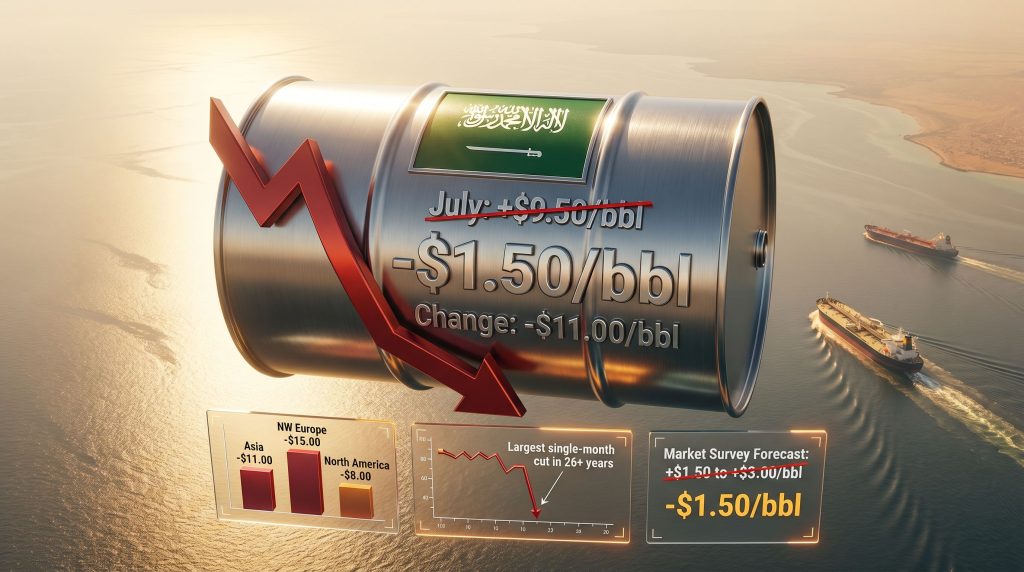
An OSP differential is not a standalone price. It is a formula-based adjustment layered on top of a floating benchmark. A shift from +$9.50/bbl to -$1.50/bbl does not mean crude became $1.50 cheaper in absolute terms; it means the pricing relationship to the benchmark shifted by $11.00 within one monthly cycle.
This distinction matters for market interpretation. OSP movements are strategic signals as much as they are commercial adjustments. When Aramco sets a negative differential, it is effectively communicating that competitive pressure, supply availability, or demand weakness requires a structural incentive to maintain market share in Asia.
Breaking Down the Record-Setting August 2026 Adjustment
The numbers behind Saudi Arabia's August Arab Light Asia OSP cut are historically exceptional by any standard measure available.
| Metric | Value |
|---|---|
| August 2026 Arab Light Asia OSP | -$1.50/bbl vs. Oman/Dubai average |
| July 2026 Arab Light Asia OSP | +$9.50/bbl vs. Oman/Dubai average |
| Month-on-Month Change | -$11.00/bbl |
| Historical Significance | Largest single-month reduction in over 26 years |
| Last Time OSP Was at This Level | June 2020 |
| Pre-Cut Market Survey Expectation | Premium of $1.50-$3.00/bbl |
| Actual Outcome vs. Survey Forecast | Exceeded by approximately $3.00-$4.50/bbl |
Reuters data extending back to 2003 confirm this as the largest recorded single-month OSP reduction on file. The previous equivalent was rooted in the pandemic-era demand collapse of 2020, when COVID-19 drove global refinery runs to historic lows. The 2026 version, however, is driven by a fundamentally different dynamic: a supply-side surplus rather than a demand-side void.
The gap between the Reuters survey consensus of $1.50 to $3.00 per barrel premium and the actual outcome of -$1.50 per barrel is particularly instructive. That survey was conducted in late June 2026. In the weeks between survey completion and OSP announcement, spot crude differentials deteriorated faster than participants had modelled, reflecting how rapidly the two concurrent supply catalysts reshaped market conditions.
The Two Supply-Side Forces That Overwhelmed Market Expectations
OPEC+ Quota Expansion Into a Softening Market
OPEC+ confirmed a further increase in collective output targets from August 2026, announced in a group statement released the day before the Aramco OSP was published. The timing was not coincidental. The decision to add barrels at precisely the point when spot market differentials were already softening reflected the group's broader strategy of prioritising production volumes over near-term price support. For context, OPEC market influence on pricing cycles has historically been most pronounced when output decisions coincide with existing benchmark weakness.
The compounding effect on Asian crude benchmarks was significant. Gulf producers increasing supply simultaneously pushes down Oman and Dubai spot prices, which in turn compresses the differential framework within which the OSP is calculated. When multiple major exporters expand output in parallel, the pressure on spot benchmarks is multiplicative rather than additive.
The Oman/Dubai spot differential reaching six-year lows prior to the OSP announcement confirmed that the formula-based pricing mechanism was already reflecting structural oversupply before the official cut was released.
The Strait of Hormuz Reopening as a Supply Catalyst
The gradual reopening of the Strait of Hormuz for crude exports introduced a second, equally significant supply catalyst. The Strait carries approximately 20% of the world's oil supply, making any material change in transit status a major variable in Asian crude balances.
Tanker flow data visible in the period preceding the OSP announcement showed Japan-owned supertankers and Saudi-flagged vessels resuming Hormuz transit routes, functioning as a real-time leading indicator of supply normalisation. As previously constrained crude volumes returned to market, Asian buyers faced a sudden widening in available supply options.
When a geopolitical supply constraint resolves faster than demand can absorb the additional volume, the pricing adjustment required to clear the market is larger than standard models anticipate. This is precisely what occurred in the July 2026 pricing cycle.
The convergence of OPEC+ output expansion and Hormuz-related supply normalisation created an environment where Aramco faced a straightforward strategic choice: price aggressively to defend market share, or hold pricing and accept volume loss to competitors offering Russian, West African, or domestic alternatives. Indeed, oil market geopolitics have consistently demonstrated that supply disruptions and their resolution can move benchmarks far more violently than demand-side shifts alone.
A Multi-Region Pricing Adjustment With Different Competitive Logic in Each Market
The August 2026 OSP revision was not limited to Asia. All three of Aramco's primary pricing regions received significant reductions, though the scale and competitive rationale differed in each case.
| Region | August 2026 OSP | Benchmark | Month-on-Month Change |
|---|---|---|---|
| Asia | -$1.50/bbl | Oman/Dubai average | -$11.00/bbl |
| Northwest Europe | +$0.85/bbl | ICE Brent | -$15.00/bbl |
| North America | +$4.60/bbl | ASCI | -$8.00/bbl |
Why Europe Required the Deepest Absolute Cut
The $15.00/bbl reduction for Northwest European buyers, moving the differential to just +$0.85/bbl against ICE Brent, reflects the fundamentally different competitive landscape of the Atlantic Basin. European refiners have access to a much wider array of crude alternatives than their Asian counterparts, including North Sea grades, West African light sweet crudes, and US export volumes. This optionality requires Aramco to price more aggressively to remain competitive against alternatives that can reach European ports at lower freight costs and without the quality discount that applies to medium-sour Saudi grades versus ICE Brent.
North America: Strategic Precision Over Competitive Desperation
The $8.00/bbl reduction for North American buyers, arriving at +$4.60/bbl against the Argus Sour Crude Index, reflects a more targeted competitive calculation. US Gulf Coast refiners operate some of the most complex upgrading units in the world, purpose-built to process heavy and medium-sour crude grades. This structural demand for Saudi-quality crude limits the degree of discounting required to maintain volume. Domestic US production dynamics and strategic petroleum reserve considerations also influence how price-sensitive the North American market is to Saudi OSP changes.
Reading the Strategic Intent Behind the Pricing Decision
Saudi Arabia's pricing philosophy across OSP cycles has historically oscillated between two poles: volume defence and price preservation. The August 2026 decision falls unambiguously into the volume defence category, and the scale of the cut signals that this is a proactive rather than reactive posture. A broader crude price overview confirms that this shift is occurring within a wider context of softening benchmark values across multiple crude grades.
Several strategic dimensions are worth examining:
- Market share retention in Asia is the primary objective. China, India, South Korea, and Japan collectively represent the dominant share of Saudi crude exports. Losing ground in any of these markets to Russian ESPO, Iranian barrels, or domestic alternatives would be difficult to recover without prolonged discounting.
- The decision to price well below survey expectations suggests Aramco had intelligence on spot market deterioration before the survey was conducted. Pricing aggressively ahead of the market rather than in response to it is a more efficient volume-retention strategy.
- The Hormuz reopening creates a temporary window of elevated supply that Aramco may be pricing through, rather than around. Once Hormuz transit volumes normalise into baseline supply expectations, the urgency of deep OSP discounting may recede.
The next major ASX story will hit our subscribers first
What the Cut Means for Asian Refiners and Crude Procurement
For Asian refinery operators, the August 2026 OSP environment creates measurably improved feedstock economics. A negative differential reduces the effective crude acquisition cost, which flows directly into crack spread margins for refiners processing Arab Light into middle distillates and gasoline.
The procurement calculus is particularly significant in the context of competing supply sources:
- Russian ESPO has historically traded at a discount to Oman/Dubai, but that discount narrows or disappears when Arab Light moves into negative OSP territory, since the sanctions-risk premium embedded in Russian purchases must be weighed against the narrowing price gap.
- Iranian crude, available to some buyers despite sanctions exposure, faces a similar competitive recalibration when Arab Light is priced below the Oman/Dubai benchmark.
- Chinese and Indian refiners, who have been the most active buyers of discounted Russian and Iranian barrels over the past several years, now face a genuine commercial comparison between sanctioned supply and competitively priced Saudi volumes.
Forward Scenarios: Where Does the August Pricing Cycle Lead?
The following scenarios involve forward-looking assessments and should not be interpreted as financial advice. Crude markets are subject to rapid and unpredictable change.
| Scenario | Assessment | Market Implication |
|---|---|---|
| OPEC+ continues quota expansion into Q4 2026 | Elevated probability | Further downward OSP pressure in September cycle |
| Asian refinery margins recover on petrochemical demand | Moderate probability | Partial OSP recovery possible in Q4 2026 |
| Hormuz disruption re-emerges | Lower probability | Rapid OSP reversal toward premium territory |
| Non-OPEC supply from US, Brazil, and Guyana accelerates | Moderate-to-high probability | Structural suppression of OSP premiums extending into 2027 |
Consequently, the oil market trade war dynamic adds a further layer of uncertainty to these projections, as tariff-driven shifts in refinery feedstock preferences could alter Asian demand patterns in ways that standard supply-demand models do not fully capture.
The return of Arab Light to negative OSP territory for the first time since the pandemic-era lows of June 2020 represents a genuine inflection point in the Saudi Arabia-Asia crude pricing relationship. Whether August 2026 marks a floor or a midpoint in a deeper downward correction depends heavily on how quickly OPEC+ supply additions are absorbed by Asian refinery demand, and whether the Hormuz reopening becomes a permanent rather than transitional feature of regional supply flows.
What is clear is that the pricing signal embedded in Saudi Arabia cuts August Arab Light Asia OSP is the most consequential single-month adjustment in over two decades. As reported by Zawya, this move brought the OSP to a six-year low, and its implications will reverberate through Asian crude markets well beyond the August lifting cycle.
Want to Stay Ahead of the Next Major Market-Moving Discovery?
While crude pricing cycles reveal how quickly energy markets can shift by billions in a single month, mineral discovery announcements on the ASX can move share prices with equal speed — and Discovery Alert's proprietary Discovery IQ model ensures subscribers receive real-time alerts the moment a significant discovery is announced, turning complex data across 30+ commodities into clear, actionable intelligence. Explore how historic ASX mineral discoveries have generated exceptional returns on Discovery Alert's dedicated discoveries page, and begin your 14-day free trial today to position yourself ahead of the broader market.