
July 5, 2026
Why India's Gas Market Has No Safety Net
Energy security frameworks around the world typically rest on two pillars: supply diversity and reserve buffers. Major oil-consuming nations developed strategic petroleum reserves over decades precisely because single-point disruptions, whether from political conflict, infrastructure failure, or weather events, can cascade rapidly through industrial economies. Yet for natural gas and liquefied natural gas, the equivalent protective layer remains conspicuously absent across much of Asia, and nowhere is this gap more consequential right now than in India.
The India LNG buffer mandate currently under deliberation by Indian policymakers represents a fundamental rethinking of how the country approaches gas supply security. Rather than treating LNG import terminals purely as commercial throughput assets, the proposal would reposition them as dual-purpose national infrastructure, simultaneously serving market participants and functioning as strategic energy reserve points accessible by the central government during supply emergencies.
Understanding why this policy has resurfaced, how it would work mechanically, and what its real-world limitations are requires stepping back from the headline and examining the structural vulnerabilities that made India's gas supply chain fragile in the first place.
When big ASX news breaks, our subscribers know first
India's LNG Supply Chain: A System Built Without Shock Absorbers
The Strait of Hormuz Dependency
Roughly one-third of the world's LNG trade transits through the Strait of Hormuz, a narrow maritime corridor flanked by Iran and Oman. For India, which sources a significant share of its LNG from Persian Gulf producers, this chokepoint is not an abstract geopolitical concern. It is the physical gateway through which energy security either holds or fractures.
The conflict involving Iran that disrupted shipping lanes in this corridor exposed something Indian energy planners had long understood but deferred addressing: the country's regasification infrastructure, while substantial in nameplate capacity, has no meaningful buffer mechanism. Once cargo flows slow or stop, there is no domestic reserve to draw upon. The global LNG supply outlook makes this vulnerability even more pressing as competition for cargoes intensifies globally.
Unlike crude oil, for which India has invested in underground strategic petroleum reserves at sites including Visakhapatnam, Mangaluru, and Padur, no analogous emergency gas storage infrastructure exists. The asymmetry is striking. India has built a physical backstop for oil supply disruptions but left its gas supply chain operating without equivalent protection. Furthermore, oil's role in energy security illustrates just how deeply embedded reserve thinking has become for liquid fuels, making the absence of an equivalent gas framework all the more conspicuous.
The Underutilisation Paradox
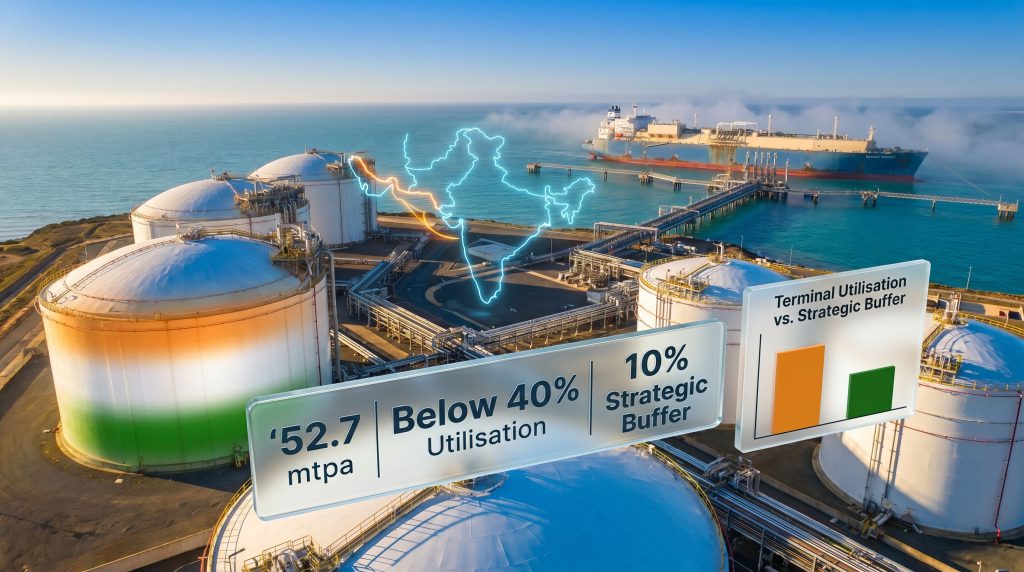
India currently operates eight LNG import terminals with a combined regasification capacity of approximately 52.7 million tonnes per annum (mtpa). The apparent paradox is that despite this substantial installed base, the majority of these terminals function at below 40% utilisation. This is not primarily a physical capacity problem. It reflects the price sensitivity of India's gas market, where imported LNG frequently cannot compete against subsidised coal or domestically produced gas at prevailing spot prices.
| Infrastructure Metric | Current Status |
|---|---|
| Operational LNG terminals | 8 |
| Combined regasification capacity | 52.7 mtpa |
| Average terminal utilisation | Below 40% |
| Dedicated strategic gas storage | None |
| Current regasification toll range | ₹65-80 per mmBtu |
This underutilisation dynamic is central to evaluating the buffer mandate's feasibility. Any policy that adds cost to the regasification chain risks compounding a utilisation problem that already constrains India's gas market development.
What the India LNG Buffer Mandate Actually Proposes
The Core Mechanism
At its structural heart, the India LNG buffer mandate is a capacity reservation policy, not an inventory mandate. The distinction matters enormously and is frequently misunderstood.
The proposal does not require terminal operators to physically fill additional tanks with LNG at all times. It requires them to build and maintain storage capacity equivalent to 10% above their standard operational requirements, with that additional capacity reserved exclusively for government activation during qualifying emergencies.
This is a meaningful operational distinction. The capital obligation falls on operators immediately, but the inventory cost burden is deferred until the government exercises access rights. In theory, this makes the financial model more manageable for commercial operators than a mandatory stockholding requirement. According to reporting on India's 10% storage buffer policy, terminal operators are still assessing the infrastructure implications of this additional capacity requirement.
How the Policy Would Function Step by Step
-
Regulatory mandate issued: The Petroleum and Natural Gas Regulatory Board (PNGRB) amends terminal registration rules to require 10% additional storage capacity as a baseline compliance condition.
-
Operators develop storage expansion plans: Terminal operators submit credible capital expenditure proposals for expanded tank infrastructure as part of their PNGRB registration or renewal process.
-
Storage capacity ring-fenced: The additional 10% capacity is contractually reserved for central government access and cannot be used for commercial throughput.
-
Government activation triggered: During a declared supply disruption or energy emergency, the government draws on the buffer to stabilise pipeline supply.
-
Cost recovery through tolls: Operators recover capital expenditure through a regulated increase in the regasification fee charged to LNG importers, who pass costs downstream through the value chain.
Why Geological Storage Was Ruled Out
Several European nations, most notably Germany and the Netherlands, maintain strategic gas reserves in depleted subsurface formations, former gas fields repurposed as seasonal storage assets. India evaluated this option but determined that the capital requirements for developing new geological storage from scratch were financially prohibitive given current fiscal constraints.
The buffer mandate's elegance, from a government financing perspective, lies in leveraging infrastructure that already exists or can be expanded incrementally, rather than commissioning entirely new geological engineering projects. It converts existing commercial assets into a strategic reserve layer without direct government capital expenditure.
Financing the Buffer: Who Pays and How Much
The Toll Recovery Model Explained
The proposed financing structure routes cost recovery through India's regulated gas infrastructure framework rather than the government budget. The mechanism works as follows:
- Terminal operators fund storage expansion using project finance or internal capital
- PNGRB approves a higher regasification toll to allow cost recovery over the asset's useful life
- LNG importers absorb the toll increase as a component of their landed gas cost
- Industrial users, city gas distribution companies, fertiliser producers, and power generators ultimately carry the marginal cost increase
The current regasification toll of ₹65-80 per mmBtu already represents a meaningful cost layer in the LNG import chain. The precise quantum of any toll increase to fund buffer storage has not been finalised, but even modest increments could affect the price competitiveness of imported LNG in segments where buyers have fuel-switching options. In addition, the import tax structure for LNG adds another layer of cost complexity that policymakers must account for when modelling the full landed price impact.
| Cost Impact Dimension | Key Consideration |
|---|---|
| Current regasification toll | ₹65-80 per mmBtu |
| Proposed toll adjustment | Quantum under evaluation, not finalised |
| Primary cost bearer | Importers, then distributors, then end users |
| Risk to terminal utilisation | Elevated, given existing sub-40% utilisation |
| Risk to domestic gas demand | Moderate, particularly in price-sensitive segments |
A Parallel With Strategic Crude Oil Reserve Financing
India has previously used a public-private partnership model for strategic petroleum reserves, where private operators build and manage storage facilities while the government retains strategic access rights. This arrangement transferred construction and operational risk to the commercial sector while reducing direct fiscal burden. The LNG buffer mandate follows a conceptually similar logic, though the mechanism differs given that it operates through a regulated toll rather than a formal concession agreement.
India's oil minister Hardeep Singh Puri articulated the rationale for limiting purely government-funded reserve approaches in a recent commentary on strategic petroleum reserves, making the case that energy held in underground storage generates no return and carries ongoing holding costs, a perspective that reinforces the commercial operator model being applied to LNG.
Regulatory Architecture: What Needs to Change
PNGRB as the Implementation Vehicle
The buffer mandate cannot be implemented through ministerial directive alone. It requires formal amendments to the PNGRB's terminal registration framework. The regulatory changes under consideration span several dimensions:
- Mandatory storage plan submission as a condition of new terminal registration and existing terminal licence renewal
- Minimum buffer capacity thresholds expressed as a defined percentage of total terminal storage capacity
- Government access protocols specifying trigger conditions for drawdown, procedural requirements, and replenishment timelines following emergency use
- Cost-recovery calculation guidelines establishing how approved toll adjustments are determined, reviewed, and potentially revised as capital costs change
Implementation Timeline
As of mid-2026, no final decision on the India LNG buffer mandate has been announced. The policy remains under active deliberation, with several unresolved questions outstanding:
- The precise storage expansion percentage requirement (10% is the figure under discussion, but not confirmed)
- The toll adjustment quantum and the regulatory methodology for calculating it
- Whether the mandate applies to all eight operational terminals or a subset
- Phased implementation timelines that reflect different terminals' capital expenditure constraints
The Policy's Critical Tensions
Adding Costs to an Already Stressed Market
The most substantive challenge facing the buffer mandate is the circularity it creates. India's LNG terminals are underutilised partly because imported gas is expensive relative to alternatives. Adding another cost layer through higher regasification tolls could further erode LNG's price competitiveness, reduce import volumes, lower terminal revenues, and paradoxically make the commercial case for terminal investment weaker.
Critical Tension: The policy simultaneously aims to strengthen gas supply security while potentially weakening the commercial ecosystem that makes gas imports viable at sufficient scale. Consequently, analysts tracking natural gas price trends have noted that any additional cost burden on the import chain could accelerate fuel-switching in price-sensitive demand segments.
Some voices within the industry have specifically cautioned that imposing additional costs on a market where terminals are already running well below design utilisation risks compounding structural underperformance rather than resolving supply vulnerability. An opinion piece in Moneycontrol argues compellingly that despite these tensions, the cost of inaction during the next supply shock would far outweigh the cost of establishing a buffer now.
Is 10% Actually Enough?
The adequacy of a 10% buffer depends entirely on the scale and duration of supply disruptions it is designed to absorb. Several analytical questions remain unresolved:
- How many days of national gas consumption does a 10% terminal buffer actually represent, given current demand levels?
- Can buffer volumes be deployed rapidly across India's gas transmission network during an emergency, or do pipeline constraints limit effective distribution?
- Does the geographic spread of India's eight terminals provide adequate coverage for all major industrial and urban demand centres?
For context, European mandatory minimum storage levels following the 2021-2022 gas supply crisis were set at 80-90% of total storage capacity ahead of peak demand periods. India's proposed 10% figure is considerably more modest, though the two situations are not directly comparable given Europe's acute seasonal heating demand exposure and India's different demand profile. However, the broader lesson from Europe's experience is that reserve adequacy thresholds must be grounded in realistic disruption scenario modelling rather than administrative convenience.
The next major ASX story will hit our subscribers first
Global Benchmarks: How Other Import-Dependent Economies Manage LNG Reserves
Japan and South Korea: Purpose-Built Reserve Infrastructure
Both Japan and South Korea, the world's largest and second-largest LNG importers respectively for much of the past two decades, maintain strategic LNG reserves through a combination of government-held inventories and mandatory operator stockpiles. Critically, both nations have invested in purpose-built LNG reserve facilities rather than relying on expanded import terminal storage.
Japan's approach involves nationally coordinated reserve management with clear trigger mechanisms tied to supply disruption events. South Korea maintains strategic LNG reserves under its national energy security framework, with defined minimum inventory levels.
India's proposed model draws conceptual parallels to these approaches but diverges in its reliance on existing commercial terminal infrastructure rather than dedicated reserve assets. This creates a more cost-effective entry point but may limit the depth and responsiveness of the reserve buffer. Furthermore, trade war impacts on energy markets have demonstrated how quickly geopolitical shifts can reshape cargo availability, reinforcing the case for purpose-built strategic reserves over commercial capacity sharing.
| Reserve Model | Storage Approach | Financing | Status |
|---|---|---|---|
| India Strategic Crude | Underground caverns (PPP) | Government + private | Operational |
| India LNG Buffer (proposed) | Expanded terminal tanks | Regasification toll recovery | Under deliberation |
| India Geological Gas Storage | Depleted field injection | Government capex | Assessed, deferred (cost) |
| European Seasonal Storage | Depleted fields + salt caverns | Commercial + regulated | Mandatory minimums active |
| Japan LNG Reserve | Purpose-built reserve facilities | Government + industry | Operational |
Frequently Asked Questions: India LNG Buffer Mandate
What triggered the revival of this policy proposal?
The Iran conflict and subsequent disruption to LNG cargo movements through the Strait of Hormuz exposed India's absence of any emergency gas reserve mechanism, prompting policymakers to revisit strategic gas storage proposals that had previously been shelved due to cost concerns.
What exactly is the 10% buffer requirement?
Terminal operators would be required to maintain storage capacity 10% above their standard operational requirements, with that additional capacity ring-fenced exclusively for government access during declared supply emergencies. The mandate focuses on capacity availability, not pre-filled inventory levels.
Who bears the cost of expanded storage infrastructure?
Terminal operators fund the capital expansion, recovering costs through a regulated increase in the regasification toll charged to LNG importers. Importers then pass costs downstream to industrial users, city gas distributors, fertiliser manufacturers, and other end customers.
Has a final decision been made?
No. As of July 2026, the policy remains under deliberation. Key parameters including the precise toll adjustment, implementation timeline, and whether all terminals are captured by the mandate have not been finalised.
How does this compare to India's strategic petroleum reserve model?
India's petroleum reserves use underground geological storage developed through a public-private partnership model. The India LNG buffer mandate avoids the higher capital costs of geological storage by leveraging existing import terminal infrastructure, financed through a regulated toll mechanism rather than direct government expenditure.
This article is based on publicly available information as of July 2026. The India LNG buffer mandate remains under government deliberation and no final regulatory decisions have been announced. Nothing in this article should be construed as investment advice. Readers should conduct independent research before making any investment or commercial decisions based on policy proposals that have not yet been formally adopted.
Want to Stay Ahead of Energy Security Shifts Shaping ASX Commodity Markets?
Discovery Alert's proprietary Discovery IQ model scans ASX announcements in real time, instantly identifying significant mineral discoveries tied to commodities like natural gas and LNG that are being reshaped by evolving energy security policies — explore historic discovery returns on the Discovery Alert discoveries page to see the market-moving potential, and begin your 14-day free trial to position yourself ahead of the next major ASX opportunity.