July 18, 2026
When a 33-Kilometre Passage Controls the World's Energy Pulse
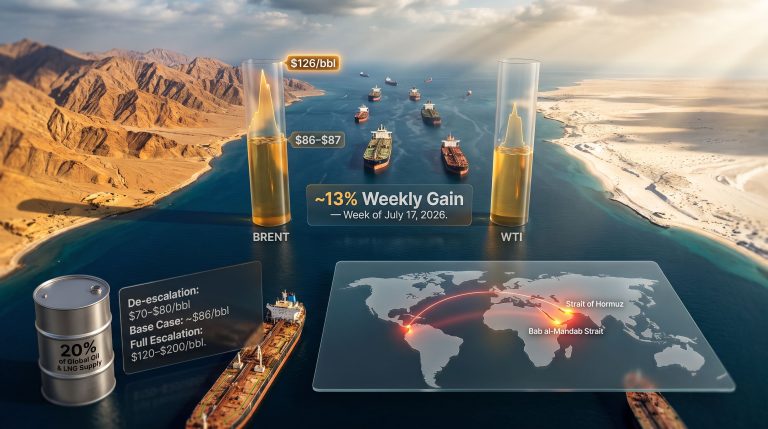
Energy systems are often described as networks, but networks have redundancies built in. What the Strait of Hormuz represents is something fundamentally different: a single corridor through which roughly one-fifth of the planet's entire oil and liquefied natural gas supply must pass before it can reach the refineries, power plants, and fuel terminals that keep modern economies functioning. Hormuz oil shipping to China and Pakistan sits at the centre of this vulnerability, and no amount of infrastructure investment elsewhere has created a genuine substitute for this passage. The strait is, in the truest engineering sense, a single point of failure embedded at the heart of global energy architecture.
Understanding what happens when that corridor becomes contested is not an academic exercise. It is the central question for energy security planners, shipping executives, commodity traders, and policymakers across Asia in 2026. Furthermore, the oil price shock implications extend well beyond the immediate region.
When big ASX news breaks, our subscribers know first
The Mechanics of Disruption: How the Hormuz Corridor Fractured
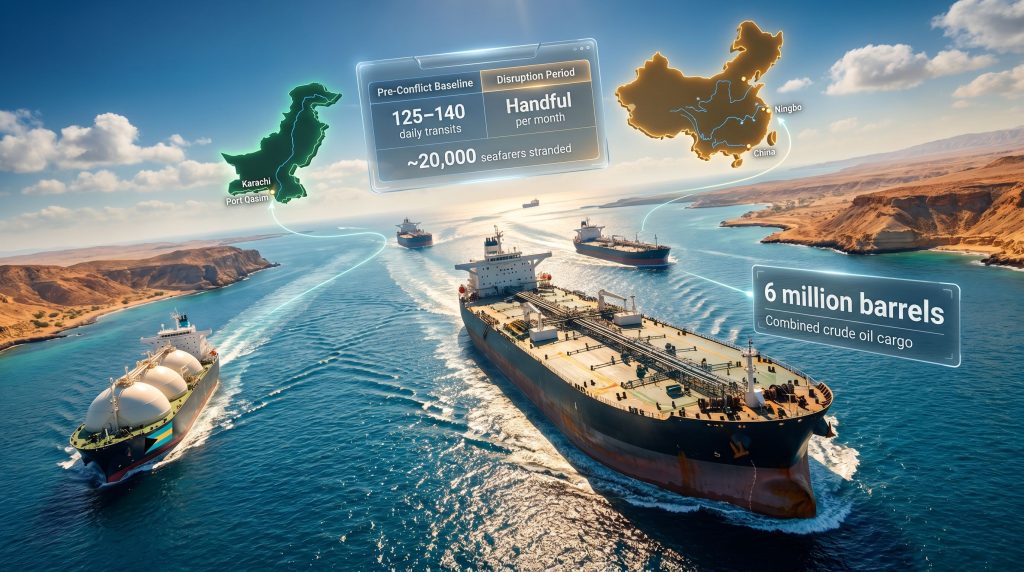
Prior to the outbreak of the U.S.-Israeli military conflict with Iran on February 28, 2026, the Strait of Hormuz functioned as a high-throughput commercial artery. Between 125 and 140 vessel transits occurred daily through its roughly 33-kilometre navigable width, carrying crude oil, refined products, and LNG cargoes destined for markets across Asia, Europe, and beyond.
The conflict's onset triggered an immediate and severe disruption to this rhythm. Iranian authorities imposed designated routing protocols for commercial vessels seeking to transit the strait, transforming what had been a straightforward commercial passage into a permission-dependent, compliance-heavy operation. Consequently, an estimated 20,000 seafarers found themselves stranded aboard hundreds of vessels inside the Gulf, unable to exit through normal procedures. As shipping disruption reports confirm, the impact on global supply chains has been severe.
What makes this disruption architecturally significant is the asymmetry between cause and effect. Iran does not need to physically block the strait to generate enormous economic damage. The mere imposition of routing requirements, approval delays, and compliance uncertainty is sufficient to paralyse commercial scheduling, spike insurance premiums, and fragment supply chains across multiple continents simultaneously.
The Hidden Cost Architecture of a Stranded Supertanker
The financial exposure embedded in a stranded Very Large Crude Carrier (VLCC) is rarely appreciated outside specialist shipping and commodity finance circles. Consider the following cost layers that accumulate during extended immobilisation:
- Daily charter hire: VLCC spot rates during periods of market stress can exceed $50,000 to $80,000 per day, meaning a three-month stranding event generates charter costs in the range of $4.5 to $7 million per vessel before any cargo or insurance adjustment
- War risk insurance surcharges: Vessels operating in or near conflict-designated zones face automatic premium escalation, with some war risk surcharges adding the equivalent of $2 to $5 per barrel to the landed cost of crude
- Cargo deterioration risk: While crude oil is relatively stable in storage, extended vessel immobilisation creates scheduling disruptions that cascade through refinery planning cycles
- Port congestion downstream: When multiple VLCCs are delayed simultaneously, downstream receiving terminals face scheduling compression and berth conflicts upon eventual arrival
No single party absorbs all of this exposure. Charterers, shipowners, cargo buyers, and insurers each carry distinct contractual obligations that govern loss allocation, making stranding events a multi-party legal and financial event as much as a logistical one.
Hormuz Oil Shipping to China: The VLCC Resumption Signal
China's structural position as Asia's largest refining nation makes it the most volumetrically significant party affected by any restriction on Hormuz oil shipping to China and Pakistan. Chinese refineries process enormous quantities of Gulf crude, particularly Iraqi Basrah grades and Saudi Arabian blends, and the country's state-linked trading and shipping infrastructure is calibrated for high-frequency, high-volume Gulf procurement.
The Eagle Verona serves as the most analytically instructive case study from the May 2026 period. This Singaporean-flagged VLCC, operating under charter to Unipec (the trading arm of Sinopec, Asia's largest refiner), loaded approximately 2 million barrels of Basrah crude in late February 2026. It then remained stationary inside the Gulf for nearly three months before receiving clearance to transit via Iran's designated routing corridor, with the vessel expected to arrive at Ningbo port around June 12. In light of the LNG supply outlook for the broader region, this delay compounds an already stressed supply picture.
That timeline — from loading in late February to discharge in mid-June — represents a supply chain elongation of roughly three and a half months for a voyage that would ordinarily take a fraction of that time.
More broadly, shipping data confirmed that three VLCCs transited the strait in the week prior, carrying a combined 6 million barrels of crude destined for China and South Korea. This small cohort of transits represented the first meaningful resumption of large-scale VLCC exit activity and was interpreted by market participants as a tentative indicator of limited normalisation.
The Unipec-Sinopec Supply Chain Under Stress
The multi-jurisdictional ownership structure of the Eagle Verona is itself revealing. A Singaporean-flagged vessel, owned by Malaysian state shipping company MISC, chartered by Unipec, carrying Iraqi crude for Chinese refinery delivery: this layered architecture is characteristic of how major Asian energy importers construct operational distance between their state-linked buyers and politically sensitive supply chains. During periods of geopolitical stress, however, this structure also complicates diplomatic engagement, since no single government can be easily identified as the counterparty in any given voyage.
Pakistan's Distinct Energy Vulnerability Profile
While China possesses the financial depth, diplomatic resources, and strategic petroleum reserve capacity to absorb extended supply disruptions with manageable consequences, Pakistan's risk exposure is categorically different. As a fuel-import-dependent economy with limited strategic reserve buffers, Pakistan faces acute near-term vulnerability whenever Hormuz access is restricted. Consideration of the global crude market trends makes clear why developing importers face disproportionate exposure.
The partial relief afforded by Iranian transit permissions for Pakistan-bound vessels has been critical. Shipping data confirmed that multiple tankers carrying crude oil and refined products arrived at Pakistani ports in the weeks following conflict escalation. Pakistan's negotiated access to the strait for 20 ships illustrates the diplomatic lengths required to maintain even limited supply continuity:
| Vessel | Cargo Type | Volume | Destination Port |
|---|---|---|---|
| MT Shalimar | Crude Oil | Undisclosed | Karachi Port |
| MT Viana Wood | Diesel | ~57,000 metric tons | Port Qasim |
| MT Khairpur | Petrol | ~55,000 metric tons | Port Qasim |
The arrival of these cargoes provided a short-term stabilisation signal for domestic fuel supply. However, the permission-dependent nature of these transits introduces a structural fragility that distinguishes Pakistan's situation from that of more diplomatically insulated importers. Access contingent on Iranian discretion is access that can be withdrawn without notice.
The LNG Dimension: A Compounding Vulnerability
The disruption to Hormuz oil shipping to China and Pakistan extends beyond crude oil into the LNG supply chain, where the consequences are structurally more severe.
LNG cargo delays do not merely create scheduling inconvenience. Unlike crude oil, LNG cannot be economically held aboard a vessel for extended periods without infrastructure-specific regasification support, and it cannot be easily redirected to alternative terminals without compatibility constraints. Each delayed LNG cargo has a compounding downstream effect on power generation capacity.
The LNG tanker Fuwairit provides the clearest illustrative case. The vessel loaded a cargo at Qatar's Ras Laffan port around March 28, 2026, then required close to two months before clearing the strait and heading toward Pakistan for discharge. For Pakistan, LNG is not a discretionary fuel — it feeds directly into the country's gas-to-power generation infrastructure, meaning delays translate with near-mechanical precision into reduced electricity generation and industrial disruption.
Three Scenarios: Where Hormuz Oil Shipping Goes From Here
The trajectory of Hormuz oil shipping to China and Pakistan over the coming months will be determined by forces largely outside the control of commercial shipping operators or energy importers. Furthermore, OPEC's market influence on pricing and production decisions will shape how these scenarios ultimately unfold. Three distinct scenarios frame the range of plausible outcomes:
Scenario 1: Gradual Normalisation (Base Case)
Diplomatic progress between the U.S. and Iran produces a phased reduction in transit restrictions. VLCC passage frequency recovers toward pre-conflict baseline levels over a three-to-six-month horizon. Insurance premiums normalise, stranded seafarers are repatriated, and the oil price geopolitical risk premium dissipates.
Scenario 2: Prolonged Restricted Access (Stress Case)
The conflict continues without resolution. China accelerates diversification toward Russian ESPO blend, West African grades, and U.S. crude. Pakistan faces acute fuel shortages requiring emergency spot market procurement at significant premium. War risk insurance surcharges remain elevated, adding an estimated $2 to $5 per barrel to effective landed costs for Gulf crude.
Scenario 3: Escalation and Full Closure (Tail Risk)
Military escalation results in near-complete closure of the strait to commercial traffic. Global oil prices spike sharply; LNG spot markets experience extreme volatility. Long-term, this scenario accelerates investment in pipeline alternatives through CPEC energy corridors and expanded LNG terminal capacity. Broader oil market disruptions of this magnitude would reshape global energy trade for years to come.
The next major ASX story will hit our subscribers first
The Diplomatic Architecture: China, Iran, and the Limits of Leverage
China's engagement with Iranian authorities over Hormuz transit conditions is driven entirely by energy security imperatives. Beijing is Iran's largest crude customer and has a direct economic interest in maintaining access to Gulf supply chains. This commercial dependency gives China meaningful, but not unlimited, influence over Iranian transit policy.
The critical distinction is that China operates as a non-military actor in a militarised corridor. Diplomatic engagement can facilitate coordination and potentially accelerate transit approvals, but it cannot substitute for physical access when the controlling authority is Iran and the contested element is military rather than commercial. The U.S. military's temporary escort operations through the strait functioned as a signal of intent rather than a permanent infrastructure solution.
Rethinking Single-Corridor Dependency: Long-Term Strategic Adjustments
The 2026 disruption has accelerated strategic conversations that energy security planners had previously treated as long-term considerations rather than urgent operational priorities.
Strategic Petroleum Reserve Adequacy
The International Energy Agency's guidance on maintaining 90-day import cover as a minimum buffer takes on heightened relevance when Hormuz access is restricted. Developing importers like Pakistan frequently fall short of this benchmark, leaving them exposed to supply disruptions within weeks rather than months.
Infrastructure Diversification
Pakistan's CPEC energy pipeline projects represent a potential long-term hedge against maritime route vulnerability, but construction timelines are measured in years, not months. Expanding regasification capacity at multiple ports to reduce single-terminal exposure is a more near-term achievable objective.
Procurement Strategy Recalibration
Major Asian importers are reassessing Gulf crude dependency ratios in response to the 2026 disruption. The role of long-term supply contracts versus spot market procurement in managing disruption risk has moved to the centre of procurement strategy discussions. Emerging supplier diversification toward U.S. LNG, East African crude, and Russian pipeline gas offers partial but not complete substitution for Gulf supply volumes.
Frequently Asked Questions: Hormuz Oil Shipping to China and Pakistan
What percentage of the world's oil supply passes through the Strait of Hormuz?
Approximately one-fifth of global oil and LNG supply transits the Strait of Hormuz under normal operating conditions, making it the single most consequential maritime energy chokepoint on the planet.
How has the 2026 conflict affected oil shipments to China?
The conflict that began on February 28, 2026 severely restricted commercial vessel transits. Chinese state-linked charterers including Unipec experienced major cargo delays, with some vessels carrying Iraqi crude stranded inside the Gulf for close to three months before receiving clearance to proceed to Chinese ports.
Is Pakistan receiving energy shipments despite the disruption?
Yes, on a limited and permission-dependent basis. Iranian authorities have granted transit access to certain Pakistan-bound vessels, enabling crude oil and refined product deliveries to Karachi Port and Port Qasim in the weeks following conflict escalation.
What is a VLCC and why does it matter for Gulf oil exports?
A Very Large Crude Carrier is a supertanker capable of transporting approximately 2 million barrels of crude oil per voyage. VLCCs are the primary vehicle for long-haul Gulf crude exports to Asia, and their ability to transit Hormuz freely is a fundamental determinant of supply availability for major importers.
What alternative shipping routes exist if Hormuz is fully closed?
Primary alternatives include the East-West Pipeline across Saudi Arabia to the Red Sea port of Yanbu, and the Suez Canal for westward-bound cargoes. However, none of these alternatives can absorb the full volume of traffic that normally transits Hormuz, and all involve longer voyage times and meaningfully higher costs.
Disclaimer: This article contains forward-looking analysis, scenario projections, and market assessments that involve uncertainty and assumptions. Nothing in this article constitutes financial or investment advice. Readers should conduct independent research and consult qualified advisers before making decisions based on the information presented.
Want to Stay Ahead of the Next Major Commodity Market Shift?
Discovery Alert's proprietary Discovery IQ model delivers real-time alerts on significant ASX mineral discoveries, instantly translating complex data across 30+ commodities into clear, actionable investment insights — ensuring subscribers are positioned ahead of the broader market. Explore Discovery Alert's dedicated discoveries page to understand how historic mineral discoveries have generated substantial returns, and begin your 14-day free trial today to secure your market-leading edge.