
August 11, 2026
Understanding the Multi-Layered Recovery Challenge
Global energy markets face unprecedented complexities following the closure of the Strait of Hormuz, with industry analysts warning that recovery scenarios extend far beyond simple chokepoint reopening. The intersection of infrastructure damage, maritime security concerns, and supply chain disruption creates a multifaceted crisis requiring strategic scenario modelling across multiple recovery timelines. The current situation demonstrates that no clear path to pre-war Hormuz return exists without addressing multiple constraint layers simultaneously.
Understanding these recovery pathways becomes critical as markets grapple with the reality that restoring pre-war energy flows involves far more than clearing shipping lanes. Furthermore, the strategic implications ripple through every aspect of global energy supply, from production capacity to alternative routing infrastructure.
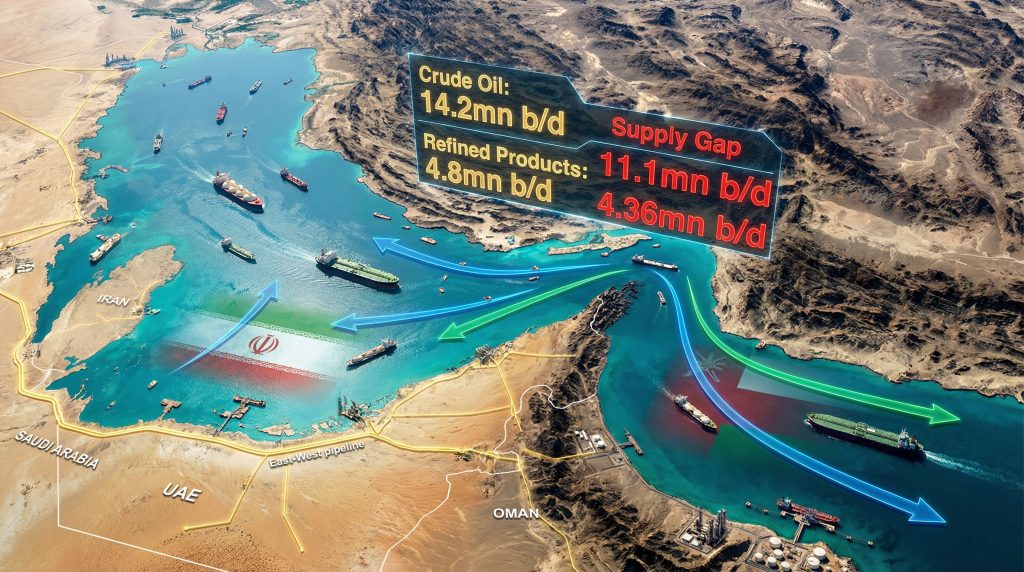
The complexity of Strait of Hormuz recovery extends beyond traditional chokepoint analysis, encompassing infrastructure assessment, maritime security protocols, and production capacity restoration. Industry operators report that approximately 19 million barrels per day of crude oil and refined products previously transited through this critical waterway, representing roughly 18% of total global oil supply and 25% of seaborne volumes.
Infrastructure Damage Assessment Framework
Systematic evaluation of refinery and terminal destruction requires comprehensive on-ground assessment capabilities currently unavailable during active conflict conditions. Energy infrastructure facilities face daily attacks according to industry reports, with refineries and export terminals bearing the brunt of sustained military action.
The assessment methodology for post-conflict infrastructure damage involves several critical phases. Structural integrity evaluation of loading terminals and port facilities represents the primary concern for operators planning future resumption. Additionally, production capacity analysis for major refining complexes will determine actual throughput capabilities versus pre-war levels.
Pipeline network assessment including inter-facility connections remains equally important for comprehensive recovery planning. Storage tank evaluation and capacity restoration timelines complete the framework necessary for accurate recovery timeline assessment.
Port facility reconstruction timelines vary significantly based on damage severity and specialised equipment availability. Historical precedents suggest that major terminal reconstruction can require 12-24 months for full operational capacity restoration, assuming immediate access to construction materials and technical expertise.
Maritime Security Risk Assessment
Mine clearance operations represent the most significant uncertainty factor for commercial shipping resumption. Naval mines suspected of deployment throughout the Strait require comprehensive removal and verification before vessel operators will resume transit operations. This no clear path to pre-war return presents fundamental challenges for energy market recovery.
The mine clearance process involves multiple technological and operational challenges. Detection technology deployment using advanced sonar and underwater vehicles represents the first phase of operations. Removal operations requiring specialised naval mine warfare capabilities follow detection activities.
Verification protocols ensuring complete area clearance become essential before commercial vessel resumption. International coordination between multiple naval forces adds complexity to operational timelines and resource allocation requirements.
Insurance market response to post-conflict operations involves fundamental recalculation of risk premiums and coverage availability. War risk insurance premiums have already prompted shipping operators to cancel contracts rather than accept elevated risk exposure, demonstrating the economic threshold where operations become unviable.
When big ASX news breaks, our subscribers know first
Critical Energy Supply Route Analysis
Energy supply disruption affects different product categories with varying severity levels, creating asymmetric impacts across global markets. Consequently, the following analysis examines flow patterns and alternative capacity by product type.
| Product Category | Pre-War Daily Volume | Alternative Route Capacity | Supply Gap |
|---|---|---|---|
| Crude Oil | 14.2mn b/d | 3.54mn b/d (Red Sea pipelines) | 10.66mn b/d |
| Refined Products | 4.8mn b/d | 0.44mn b/d (limited alternatives) | 4.36mn b/d |
| LNG/LPG | 2.1mn b/d equivalent | Minimal rerouting options | 1.9mn b/d |
Regional Production Constraints
Saudi exploration licenses provide context for understanding regional production capabilities during disruption periods. Saudi Arabia's East-West pipeline system provides the most significant alternative routing capacity, capable of handling approximately 3.54 million barrels per day through Red Sea loading terminals.
However, this represents only about 19% of typical Hormuz crude oil flows, leaving substantial supply gaps even with maximum alternative utilisation. The Trans-Arabian Pipeline infrastructure faces several operational constraints affecting recovery planning.
Throughput limitations based on current pipeline diameter and pumping capacity restrict maximum flow rates. Loading terminal bottlenecks at Red Sea export facilities create additional capacity constraints for alternative routing strategies.
Storage capacity constraints for crude oil accumulation become critical during transition periods. Vessel scheduling limitations due to reduced terminal capacity further complicate alternative supply arrangements.
UAE strategic petroleum reserves offer limited short-term supply augmentation, though specific drawdown rates and maximum deployment levels remain undisclosed by authorities. Kuwait's northern export terminals face particular vulnerability due to geographic proximity to conflict zones.
Product-Specific Vulnerability Assessment
Refined products face significantly greater routing constraints compared to crude oil, with minimal pipeline alternatives available for gasoline, diesel, and jet fuel exports. This creates disproportionate supply pressure on refined product markets globally.
LNG and LPG infrastructure presents unique challenges due to specialised terminal requirements and limited alternative loading facilities outside the Persian Gulf region. The time-charter implications for LNG vessels attempting alternative routing can extend voyage duration by 8-12 days, substantially increasing delivery costs.
Shipping Industry Risk Management Evolution
Maritime operators have fundamentally altered risk assessment protocols in response to Strait closure, with some companies choosing contract cancellation over elevated exposure. Fleet deployment strategies now prioritise alternative loading terminals, particularly Red Sea facilities handling pipeline-transported crude oil.
Fleet Reallocation Strategies
Medium-range tankers face different economic pressures compared to long-range vessels when adapting to extended routing requirements. Charter rate implications vary significantly based on vessel class and alternative route economics.
Current fleet positioning strategies include proactive contract cancellation for high-risk Persian Gulf loading. Red Sea terminal prioritisation for available pipeline volumes represents the primary alternative strategy for many operators.
Extended voyage planning incorporating additional fuel and time costs requires comprehensive route optimisation analysis. Alternative supplier engagement outside traditional Middle Eastern sources provides additional risk mitigation options.
Insurance and Operational Cost Structure
War risk premiums have reached levels making certain operations economically unviable, leading to widespread route avoidance rather than elevated premium acceptance. Vessel operators report requiring complete mine clearance verification before resuming Strait transits.
Operational cost escalation factors include extended voyage duration increasing fuel consumption and crew costs. Alternative fuel procurement at potentially higher-cost locations adds financial pressure to shipping economics.
Enhanced safety protocols requiring additional crew training and equipment increase operational complexity. Insurance coverage modifications addressing mine damage and war risk exposure complete the cost structure challenges facing maritime operators.
Economic Recovery Scenario Modelling
Recovery timeline scenarios present dramatically different economic implications based on infrastructure damage assessment and mine clearance duration. Industry analysis suggests that no clear path to pre-war Hormuz return exists without addressing multiple constraint layers simultaneously.
Rapid Recovery Scenario (6-12 months)
This optimistic timeline assumes minimal infrastructure damage and efficient mine clearance operations, though industry assessments suggest significant challenges to achieving rapid production resumption. Critical requirements for rapid recovery include international coordination for mine clearance and infrastructure assessment.
Immediate construction material availability for damaged facility repair becomes essential for meeting accelerated timelines. Technical expertise deployment for complex refinery and terminal restoration requires coordinated international resource allocation.
Strategic reserve coordination to bridge supply gaps during reconstruction provides market stabilisation mechanisms. Market rebalancing mechanisms would require unprecedented international cooperation and resource allocation to achieve pre-war flow levels within 12 months.
Extended Disruption Scenario (12-24 months)
This scenario aligns more closely with industry pessimism regarding production facility restoration and infrastructure complexity. Alternative supply chain establishment becomes permanent rather than temporary during this timeframe.
Key developments under extended disruption include permanent market share shifts as consumers establish alternative supplier relationships. Investment acceleration in non-Middle Eastern production capacity provides long-term supply security improvements.
Infrastructure development for alternative routing and supply sources gains strategic importance. Demand destruction at elevated price levels sustained over extended periods affects global consumption patterns fundamentally.
Consumer behaviour adaptation during this scenario involves structural changes in energy consumption patterns and supplier preferences that may persist beyond conflict resolution. Moreover, the oil price rally 2025 demonstrates how market dynamics evolve during extended supply disruptions.
Structural Change Scenario (24+ months)
Extended disruption creates permanent alterations in global energy infrastructure and supply relationships. This scenario assumes that the combination of infrastructure damage and security concerns creates lasting changes in energy trade patterns.
Structural changes include permanent shipping route diversification away from Persian Gulf dependence. Energy security policy reforms prioritising supply source diversification become institutionalised responses to chokepoint vulnerability.
Technology adoption acceleration for supply chain resilience and monitoring provides enhanced operational capabilities. Alternative energy infrastructure development reducing fossil fuel dependence gains momentum from security considerations.
Alternative Energy Infrastructure Acceleration
Crisis conditions create unique opportunities for alternative energy infrastructure development, with energy security concerns driving accelerated investment in renewable capacity and strategic pipeline expansion. The energy security transition becomes increasingly important during supply disruption periods.
Strategic Pipeline Development Priorities
Pipeline infrastructure projects gain strategic importance during supply disruption, with several key development priorities emerging. Trans-Arabian Pipeline expansion to increase Red Sea outlet capacity represents the most immediately viable alternative routing option.
Iraq-Turkey pipeline rehabilitation providing alternative crude export routes offers medium-term supply diversification benefits. East Mediterranean gas corridor development reducing dependence on traditional suppliers provides regional energy security improvements.
Central Asian pipeline network expansion connecting alternative supply sources completes the strategic infrastructure development framework. These infrastructure developments require substantial capital investment and multi-year construction timelines, though energy security concerns may accelerate traditional project approval processes.
Renewable Energy Investment Surge
Energy security concerns drive accelerated renewable energy deployment as nations seek supply source diversification. Solar and wind project financing becomes strategically prioritised during periods of conventional energy supply uncertainty.
Investment acceleration areas include grid-scale solar deployment with integrated battery storage systems. Offshore wind development in previously marginal economic locations gains financial viability through security premium considerations.
Hydrogen production infrastructure for long-term energy security provides strategic fuel alternatives. Grid modernisation projects supporting renewable energy integration receive enhanced policy support during crisis periods.
Battery storage deployment gains particular importance for grid stability during conventional supply disruptions. Governments potentially providing accelerated permitting and financial support creates investment opportunities in energy storage infrastructure.
Corporate Strategic Positioning Framework
Energy companies require comprehensive risk assessment frameworks incorporating geopolitical stability factors and supply chain diversification strategies. Traditional supplier relationships face fundamental reassessment during extended disruption periods.
Supply Chain Diversification Imperatives
Geographic risk assessment becomes critical for energy sourcing decisions, with companies developing multi-source procurement strategies to reduce concentration risk. Alternative supplier identification outside traditional Middle Eastern sources provides operational resilience improvements.
Strategic partnership development with non-Persian Gulf producers reduces dependency on vulnerable supply routes. Inventory management optimisation for extended supply chain disruptions requires enhanced storage capabilities.
Transportation route diversification reducing chokepoint dependence becomes essential for supply security planning. The energy exports challenges highlight the importance of diversified supply arrangements.
Investment Allocation During Market Volatility
Capital expenditure decisions require scenario-based planning incorporating multiple recovery timelines and market structure changes. Merger and acquisition opportunities may emerge from distressed energy assets during extended disruption periods.
Investment priorities include supply chain visibility technology for real-time disruption monitoring. Alternative energy asset acquisition reducing fossil fuel exposure provides portfolio diversification benefits.
Storage infrastructure development providing supply security buffers becomes strategically important. Risk management system enhancement incorporating geopolitical analysis improves operational planning capabilities.
The next major ASX story will hit our subscribers first
Government Intervention and Market Stabilisation
Strategic petroleum reserve coordination becomes critical for market stabilisation during extended supply disruptions. The International Energy Agency's collective action framework provides mechanisms for coordinated reserve releases, though effectiveness depends on member country participation levels.
Strategic Reserve Management
National strategic petroleum reserves face drawdown pressures during extended supply disruptions, requiring careful coordination between reserve releases and market impact assessment. Release timing optimisation for maximum market stabilisation impact requires sophisticated analysis.
International coordination protocols preventing market manipulation ensure fair distribution of available supplies. Replenishment strategies during volatile pricing periods require strategic timing considerations.
Reserve capacity expansion for future supply security provides long-term resilience improvements. However, the global oil futures market reflects ongoing uncertainty about reserve deployment strategies.
Regulatory Response Frameworks
Emergency regulatory modifications may include fuel standard relaxations and export restriction considerations, though such measures require careful economic consequence assessment. Temporary fuel standard modifications allowing alternative supply sources provide operational flexibility.
Export restriction evaluation balancing domestic supply and international cooperation requires careful policy consideration. Price stabilisation mechanisms preventing excessive consumer impact protect economic stability.
Infrastructure development acceleration through expedited permitting processes supports alternative energy development. These policy responses create opportunities for strategic energy infrastructure investment.
Market Recovery Monitoring Indicators
Early warning signals for recovery timeline acceleration or delays require comprehensive monitoring of multiple market and operational factors. Key performance metrics provide insight into alternative supply route effectiveness and infrastructure restoration progress.
Critical Monitoring Metrics
Market participants should track several key indicators for recovery timeline assessment. Mine clearance operation progress and verification protocols provide insight into maritime safety restoration timelines.
Infrastructure damage assessment completion and repair timeline estimates offer production capacity recovery visibility. Alternative route utilisation rates and capacity optimisation demonstrate supply chain adaptation effectiveness.
Strategic reserve drawdown levels and replenishment planning indicate government intervention sustainability. These metrics combined provide comprehensive market recovery assessment capabilities.
Policy Development Tracking
Long-term energy security policy initiatives provide insight into permanent market structure changes and investment opportunities. Energy security legislation prioritising supply diversification creates regulatory framework changes.
Infrastructure investment programs supporting alternative energy development offer strategic positioning opportunities. International cooperation agreements for crisis response coordination improve global supply security.
Renewable energy acceleration policies reducing fossil fuel dependence provide investment direction guidance. Policy monitoring across these areas enables strategic planning optimisation.
Strategic Planning Recommendations
Energy market participants require scenario-based planning methodologies incorporating multiple recovery timelines and permanent market structure changes. The current crisis demonstrates that no clear path to pre-war Hormuz return exists without addressing infrastructure, security, and supply chain resilience simultaneously.
Investment timing strategies should consider both immediate supply security needs and long-term energy transition acceleration. The intersection of geopolitical risk and energy security creates unique opportunities for alternative energy infrastructure development and supply source diversification.
Risk assessment frameworks must incorporate geopolitical stability factors alongside traditional market analysis. Recognising that energy chokepoint vulnerabilities extend beyond temporary disruptions to fundamental supply chain architecture changes becomes essential for strategic planning.
Furthermore, the challenges facing energy transition require comprehensive understanding of infrastructure resilience and security considerations. No clear path to pre-war Hormuz return necessitates fundamental reassessment of global energy supply architecture.
The integration of geopolitical risk assessment with traditional energy market analysis provides enhanced strategic planning capabilities. Energy companies must balance immediate operational requirements with long-term structural market changes affecting investment allocation decisions.
Disclaimer: This analysis involves forecasts and scenarios based on current market conditions and industry assessments. Actual recovery timelines and market impacts may vary significantly based on geopolitical developments, infrastructure damage assessment results, and international cooperation effectiveness. Energy market investments involve substantial risks, and this analysis should not be considered investment advice.
Ready to Capitalise on Energy Market Disruptions?
Discovery Alert's proprietary Discovery IQ model delivers real-time alerts on significant ASX mineral discoveries, instantly empowering subscribers to identify actionable opportunities ahead of the broader market during volatile energy conditions. Begin your 14-day free trial today and secure your market-leading advantage in an increasingly complex global energy landscape.