June 25, 2026
The Strait That Cannot Be Owned: Why the Hormuz Governance Question Changes Everything
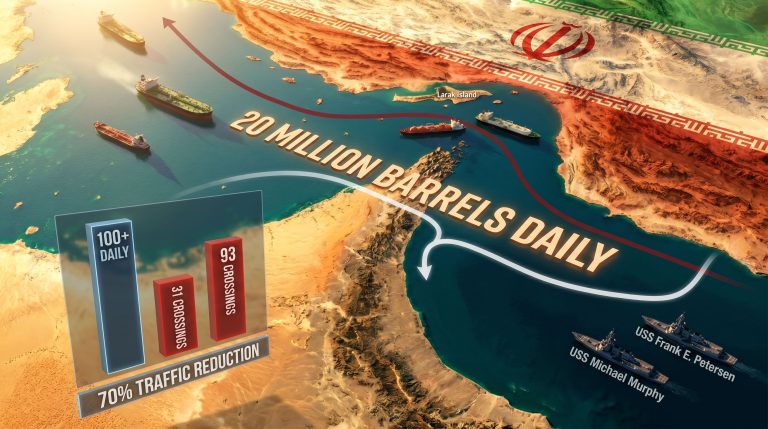
Every critical infrastructure system has a single point of failure. For approximately one-fifth of the world's daily oil supply, that point is a 21-nautical-mile-wide channel between Iran and Oman. Iran and Oman to coordinate Hormuz transits has always carried geopolitical weight, but what is now unfolding between Tehran and Muscat is something qualitatively different from past tensions. Rather than a temporary standoff or a short-term military posture, the two nations are constructing what appears to be a durable administrative architecture over a waterway that international law has long treated as a global commons.
The consequences of this shift extend well beyond shipping logistics. They reach into energy pricing, insurance markets, maritime legal doctrine, and the foundational assumptions underpinning freedom-of-navigation principles that have governed commercial trade for decades. Furthermore, understanding the crude oil geopolitical risks at play here is essential for anyone tracking energy market stability.
When big ASX news breaks, our subscribers know first
What Iran and Oman Are Actually Building at Hormuz
A Permit System Dressed as a Safety Framework
The coordination framework being negotiated between Iran and Oman is structured, at least publicly, as a maritime safety mechanism. Ships transiting the strait would be required to obtain advance clearance from both Iranian and Omani authorities before proceeding through the waterway. Iran's Deputy Foreign Minister has confirmed that this protocol is in its final stages of preparation, describing it in terms of facilitation and orderly transit management.
However, the architecture of the arrangement tells a more complex story. Requiring bilateral permits from sovereign coastal authorities to traverse a waterway previously governed by unconditional transit passage rights is not a safety measure in the conventional sense. It is a governance claim, formalised through administrative process rather than military assertion.
The Numbers Behind the Chokepoint
Understanding the weight of this negotiation requires internalising the scale of what passes through Hormuz every day.
| Metric | Estimate |
|---|---|
| Share of global oil trade through Hormuz | ~20% |
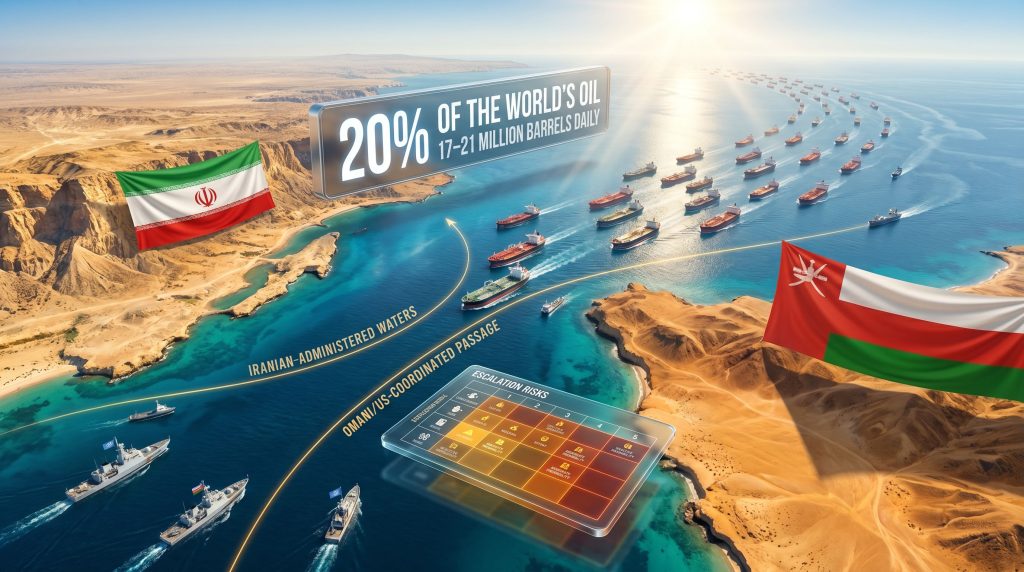
| Daily oil flow through the strait | 17 to 21 million barrels |
| Seafarers stranded during peak disruption | 11,000+ |
| Coastal jurisdictions with territorial claims | Iran (north), Oman (south) |
These figures are not abstract. Over 11,000 seafarers found themselves stranded in the Middle East during the disruption period, making the International Maritime Organization's coordinated evacuation effort one of the most operationally complex maritime humanitarian responses in recent decades. The IMO secured safety guarantees from Iran, Oman, regional coastal states, the United States, and the broader commercial shipping industry to enable the gradual movement of vessels out of the area.
How the Transit Coordination Process Works in Practice
The IMO-coordinated process for Iran and Oman to coordinate Hormuz transits follows a structured sequence designed to prevent collisions and manage the unprecedented volume of vessels awaiting passage.
- Standby directive: Shipmasters are explicitly instructed not to move independently and must wait to be contacted by designated coordinating agencies before taking any action.
- Coastal authority contact: Vessels are reached by the relevant authority, either Iranian or Omani, depending on the corridor they intend to use.
- Waiting area assignment: Ships receive routing instructions directing them to a designated staging zone, where they hold position ahead of sequenced departure.
- Route selection: Each vessel indicates its preferred corridor. The northern passage runs through Iranian-administered waters; the southern route is coordinated with Omani and United States maritime authorities.
- Coordinated departure: Iranian and Omani authorities jointly manage traffic sequencing to prevent congestion and collision incidents.
- Exit confirmation: Vessels report safe passage upon clearing the strait's boundaries.
This process is deliberate and deliberately slow. The IMO has been explicit that the operation will be drawn out, reflecting both the number of vessels involved and the sensitivity of managing ship movements through militarily active waters. Consequently, the broader oil market disruption stemming from these delays continues to reverberate across global energy supply chains.
The Legal Fault Line Running Beneath the Framework
UNCLOS, Innocent Passage, and Iran's Strategic Ambiguity
The most consequential dimension of the Iran-Oman coordination framework is not operational but legal. The Strait of Hormuz qualifies under international maritime law as an international strait, which means it is subject to transit passage rights under the United Nations Convention on the Law of the Sea. Transit passage, unlike innocent passage, is non-suspendable and unconditional for commercial vessels.
Iran has never ratified UNCLOS. This single fact creates a legal asymmetry that the proposed permit system is designed to exploit.
| Legal Framework | Iran's Position | Oman's Position | International Norm |
|---|---|---|---|
| UNCLOS ratification status | Not ratified | Ratified | Global standard for transit rights |
| Applicable passage doctrine | Innocent passage only | Prior permission required for warships | Transit passage (open, non-suspendable) |
| Commercial vessel permit requirement | Proposed under new protocol | Under negotiation | Not required under UNCLOS |
By operating outside UNCLOS while simultaneously constructing a bilateral treaty framework with a UNCLOS-ratified partner, Iran gains a degree of legal insulation. Any challenge to the permit regime must navigate the contested terrain between what UNCLOS mandates and what Iran is legally obligated to observe, which, in Tehran's interpretation, is nothing.
"The permit system, if formalised, would transform what is currently an unconditional right of passage into a conditional privilege subject to bilateral administrative approval, a precedent with no modern equivalent in international maritime law."
Wartime Architecture Seeking Peacetime Permanence
Iranian officials have framed the coordination framework in terms that extend beyond the immediate crisis. The protocol is being described by Iranian authorities as a post-conflict governance model intended to outlast any ceasefire arrangement and institutionalise Tehran's co-administrative role in the strait on an ongoing basis.
This is a deliberate conversion of operational necessity into geopolitical permanence. The distinction matters enormously. A crisis response mechanism dissolves when the crisis ends. A treaty-based bilateral governance framework does not. Bloomberg's reporting on the Hormuz transit pact confirms both parties have acknowledged ongoing work on such an arrangement, reinforcing concerns that this is designed to endure well beyond any immediate conflict resolution.
Oman's Complicated Role: Moderator, Partner, or Constrained Ally?
The Southern Coastline as Diplomatic Leverage
Oman's geographic position along Hormuz's southern shore gives it an irreplaceable role in any viable transit governance arrangement. No framework that excludes Muscat can claim functional legitimacy over the full width of the waterway. Oman has historically served as a back-channel intermediary between Washington and Tehran, and its presence in the bilateral framework reflects both this diplomatic tradition and its own sovereign interests in maintaining commercial shipping flows.
Deputy minister-level negotiations are ongoing, focused on structuring the transit arrangement and preserving continuity of commercial activity. Oman's publicly stated position has been notable for its specificity: Muscat has emphasised the importance of maintaining freedom of navigation through the strait without the imposition of transit fees, a signal that it intends to moderate the more expansive elements of Iran's governance agenda.
The Transit Fee Question: Governance or Revenue?
The bilateral discussions reportedly include consideration of the cost of managing transits, a phrase that opens the door to fee-based structures without explicitly committing to them. This creates a significant unresolved tension within the framework itself.
Oman opposes fees. Iran has not confirmed or denied a fee ambition. The language of "cost recovery" sits in between. Palestine Chronicle's analysis has described this dynamic as wartime rules being applied to reshape peacetime navigation norms, a characterisation that underscores the broader stakes.
Precedent from other strategically managed waterways is instructive here. Both the Panama Canal and the Suez Canal began as operational infrastructure and evolved into substantial revenue-generating frameworks over time. A Hormuz permit system, once normalised, would possess the same structural potential, particularly given that Iran would be positioned as a co-administrator of one of the world's most inelastic energy trade routes.
Market Risks and Energy Security Implications
What Shippers Are Facing Right Now
Despite the coordination framework being presented as a stabilising mechanism, operational conditions in the strait remain genuinely hazardous. The Joint Maritime Information Center has issued active warnings that Iran continues to hail and surveil commercial vessels even as diplomatic processes advance. Shipmasters are navigating a gap between official diplomatic assurances and real-time on-water experiences.
Millions of barrels of oil have continued to move through the waterway during the coordination period, demonstrating that the strait has not been sealed. However, the combination of active Iranian surveillance, mandatory coordination protocols, and unresolved legal status creates a structurally elevated risk environment. Those monitoring current crude oil prices will recognise that this uncertainty is already feeding through to market volatility.
Scenario Analysis: How Markets Should Think About Hormuz Risk
| Scenario | Near-Term Probability | Market Impact |
|---|---|---|
| Protocol formalised, no fee structure | Moderate | Elevated shipping insurance costs |
| Protocol includes transit fees | Lower near-term | Significant freight rate pressure |
| Oman withdraws from framework | Low | Diplomatic collapse, blockade risk returns |
| US challenges under UNCLOS | Moderate to high | Naval escalation, geopolitical risk premium |
| Framework becomes permanent governance model | Moderate, medium-term | Structural repricing of Hormuz transit risk |
Energy importers in Asia, particularly those heavily dependent on Persian Gulf crude, face the greatest structural exposure. If the permit framework becomes permanent, their energy supply chains would be subject to the political relationship between their governments and Tehran in a way that has no current parallel. The broader geopolitical risk landscape across the region compounds this exposure considerably.
The next major ASX story will hit our subscribers first
What the IMO's Crisis Role Reveals About Institutional Limits
The IMO's performance during this disruption period has been genuinely impressive in scope. Coordinating safety guarantees across Iran, Oman, the United States, and multiple regional coastal states while simultaneously managing the humanitarian evacuation of over 11,000 stranded seafarers represents a multilateral achievement of considerable complexity.
However, the IMO's structural limitation is equally important to understand. The organisation holds advisory and facilitative authority, not enforcement power. It cannot compel Iran to honour any commitment it makes within the coordination framework. The durability of the transit arrangement rests entirely on the political will of the sovereign parties involved, and that political will is subject to change.
This is the fundamental vulnerability of multilateral institutions when confronted with sovereign assertion. The IMO can broker. It cannot bind. In addition, this represents a global trade shock that multilateral institutions were never designed to absorb unilaterally.
FAQ: Iran, Oman, and the Future of Hormuz Transit Governance
Why does Hormuz matter more than other maritime chokepoints?
Unlike the Suez Canal or the Malacca Strait, Hormuz has no viable alternative routing for Persian Gulf oil exports. Any disruption cannot be rerouted; it must be absorbed as a supply reduction.
What makes the Iran-Oman permit proposal legally controversial?
UNCLOS grants commercial vessels unconditional transit passage rights through international straits. Iran's non-ratification of UNCLOS allows it to dispute this framework, creating a legal grey zone that the permit system would institutionalise.
How does Oman's position protect commercial shipping interests?
Oman's explicit opposition to transit fees and its emphasis on freedom of navigation serve as a moderating constraint on Iran's more expansive governance ambitions, at least for as long as Muscat remains engaged in the framework.
What should energy markets be pricing in right now?
Regardless of near-term diplomatic outcomes, the existence of the permit framework as a proposal represents a structural shift in Hormuz risk. Insurance markets, freight rate models, and energy supply chain planning should all reflect an elevated and more complex risk environment than existed before this coordination framework was conceived.
Key Takeaways: Why This Is Not a Temporary Arrangement
The decision by Iran and Oman to coordinate Hormuz transits through a formal bilateral framework is not simply a practical response to a maritime emergency. It is a deliberate attempt to reshape the legal and operational assumptions governing the world's most consequential oil transit corridor.
- The framework converts an unconditional legal right of passage into a permission-based system subject to bilateral administrative control.
- Over 11,000 stranded seafarers illustrate the human dimension of treating critical maritime infrastructure as a geopolitical instrument.
- Oman's moderating role is the primary structural check on Iran's ambitions, and its durability within the framework is not guaranteed.
- The IMO's facilitative success does not resolve the underlying sovereignty dispute, which remains legally unresolved and politically volatile.
- Energy markets should treat a structurally elevated Hormuz risk premium as a baseline assumption, not a temporary condition tied to the current crisis period.
For ongoing developments in global oil and gas shipping markets and Hormuz transit dynamics, Rigzone provides regular industry coverage at Rigzone.com.
Want to Stay Ahead of Commodity Market Shifts Driven by Geopolitical Disruption?
When Hormuz transit risks reshape global energy supply chains and drive commodity price volatility, Discovery Alert's proprietary Discovery IQ model delivers real-time alerts on significant ASX mineral discoveries, helping investors identify actionable opportunities before the broader market reacts — explore historic examples of major discovery returns or begin your 14-day free trial today to position yourself ahead of the next market-moving event.