June 25, 2026
The World's Most Dangerous Bottleneck: Inside the Iran Strait of Hormuz Shipping Route Warning
Every barrel of oil has a story, and for roughly one in five barrels produced globally, that story runs through a narrow sliver of water barely wider than a mid-sized city. The Iran Strait of Hormuz shipping route warning issued in mid-2026 represents something qualitatively different from the periodic threats of prior decades. Iran's Islamic Revolutionary Guard Corps has moved beyond rhetoric into active enforcement, and the consequences for global energy markets, shipping operators, and commodity supply chains are only beginning to be understood.
When big ASX news breaks, our subscribers know first
Why No Other Waterway Can Replace Hormuz
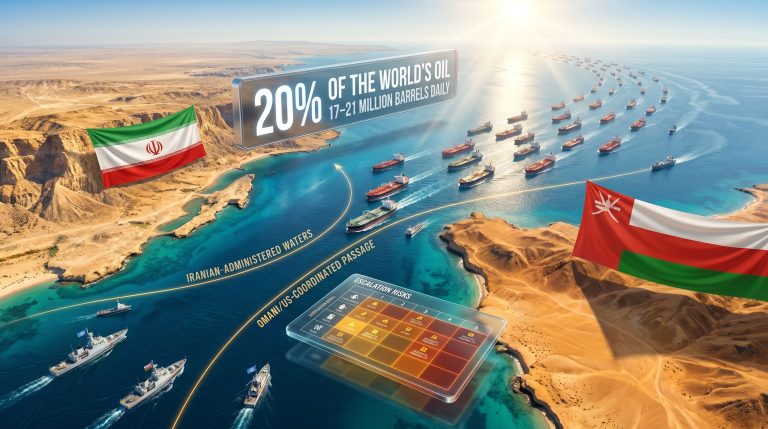
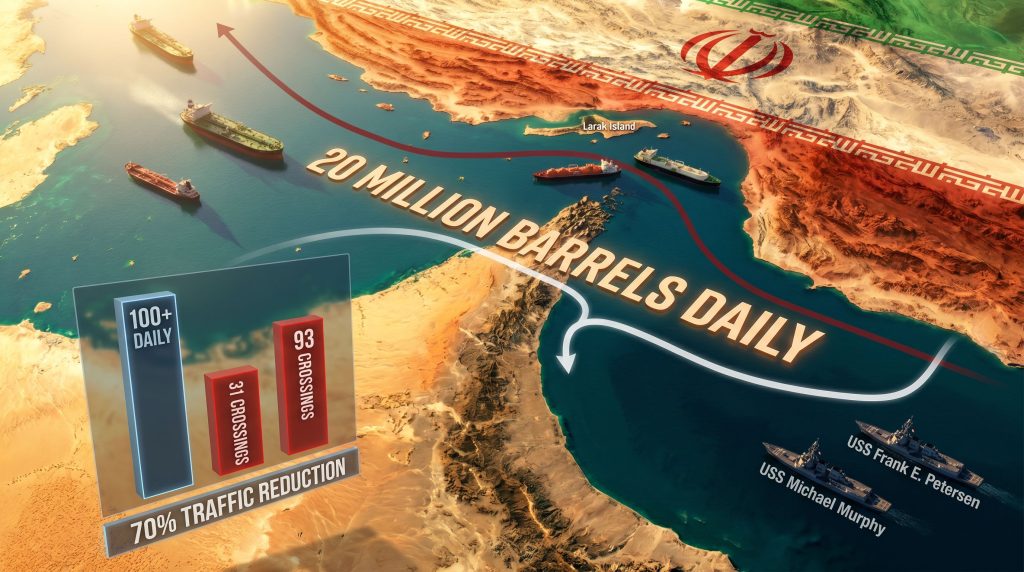
The raw arithmetic of Hormuz dependency is striking. Prior to the current conflict, approximately 20 million barrels of oil moved through the strait every single day, representing close to 20% of total global petroleum supply. No pipeline network, no overland alternative, no combination of rerouting options comes close to replicating that volume.
The strait itself narrows to approximately 21 nautical miles at its tightest point, but navigable shipping lanes within that corridor are far more constrained once territorial water boundaries are factored in. The geography creates an unavoidable concentration of maritime traffic that has no practical workaround at scale.
What makes Hormuz truly irreplaceable, however, is not just oil. The waterway functions as a systemic node across multiple commodity categories:
| Commodity Category | Strait Dependency | Key Disruption Risk |
|---|---|---|
| Crude Oil and Petroleum Products | ~20% of global daily supply | Immediate price spikes; refinery feedstock gaps |
| Liquefied Natural Gas (LNG) | Major Gulf producer export corridor | European and Asian energy security exposure |
| Fertilizer Precursors | Ammonia and urea export route | Agricultural input cost inflation globally |
| Pharmaceutical Raw Materials | Chemical feedstock transit | Generic drug supply chain disruption |
Saudi Arabia and the UAE maintain overland pipeline capacity, but these carry a fraction of the strait's daily throughput. Furthermore, any sustained Hormuz disruption does not simply redirect oil flows — it triggers compounding failures across refining capacity, petrochemical supply chains, and agricultural input markets simultaneously. The LNG supply outlook for major importing nations in Europe and Asia is particularly exposed given their deep reliance on Gulf producer export routes.
Decoding Iran's IRGC Position and the Southern Route Dispute
The Iran Strait of Hormuz shipping route warning issued on 24 June 2026 by the IRGC Navy was not a vague diplomatic signal. It was a precise operational directive: all commercial and energy vessels must contact Iranian naval forces via a designated communication channel before attempting transit. Vessels navigating outside Iran-designated corridors were explicitly warned they face enforcement action.
The trigger for this warning was a proposal by a prominent naval information body suggesting an alternative southern transit corridor running along Omani territorial waters, confirmed clear of naval mines. Iran's IRGC rejected this outright, characterising it as unauthorised and dangerous.
Iran's preferred routing directs vessels along a more northerly path near the Iranian coastline, passing either side of Larak Island, a strategically monitored position that gives Iranian naval forces maximum oversight of all transiting traffic. The International Maritime Organization has maintained its own advisory framework for the region, creating a further layer of jurisdictional complexity for operators.
The coexistence of multiple competing route authorities — Iranian, Omani, and IMO — creates a form of operational ambiguity that is deeply uncomfortable for risk managers. Operators are not choosing between a safe route and a dangerous one; they are choosing between competing jurisdictional claims, each carrying its own risk profile.
A Timeline of Escalation: How the Crisis Developed
The current situation did not emerge overnight. It is the product of a compressed but severe escalation sequence beginning in early 2026:
| Date | Event | Shipping Impact |
|---|---|---|
| 28 February 2026 | US-Israel air strikes on Iran following the assassination of Supreme Leader Ali Khamenei | IRGC issued passage prohibitions; 70% traffic reduction recorded |
| March to April 2026 | Iran alternated between partial closures and full shutdowns | Most operators suspended transits |
| 17 April 2026 | Iran's foreign minister briefly declared the strait open | Short-lived relief; restrictions reimposed within days |
| 18 April 2026 | Iran re-closed the strait in retaliation for US military actions | Full commercial shipping suspension resumed |
| Late May 2026 | US Treasury sanctioned Iran's Persian Gulf Strait Authority | Designated as an instrument of maritime extortion |
| Mid-June 2026 | US and Iran signed a memorandum of understanding to reopen the waterway | Tentative recovery began; volumes remained far below normal |
| 24 June 2026 | IRGC issued formal warning against unauthorised route proposals | Jurisdictional dispute over southern corridor escalated |
One of the most persistently underappreciated dimensions of the crisis is the mine threat. Naval mines may have been positioned in the strait as early as late February 2026, and the IRGC Navy formally designated a central zone as an official Area of Danger. US Navy destroyers, including the USS Frank E. Petersen and the USS Michael Murphy, have been deployed specifically to conduct mine-clearance operations — a fact that underscores just how physically dangerous the waterway has become, independent of any IRGC enforcement action.
Traffic Recovery Data: Impressive Headlines, Sobering Reality
Ship-tracking data offers a nuanced picture of where the strait stands operationally. Recent weekend transits tripled to 93 crossings compared with the prior equivalent period, a figure that sounds like meaningful recovery in isolation. The context, however, matters enormously.
Pre-conflict baseline traffic exceeded 100 ship transits per day. The tripling of weekend crossings, while directionally positive, represents throughput that remains dramatically below historical norms. MarineTraffic confirmed 31 verified commercial and energy-laden crossings on a single Tuesday in late June 2026, with operators drawing simultaneously from Iranian-designated lanes, Omani territorial waters, and IMO-recommended patterns — a routing strategy driven by uncertainty rather than confidence.
Current transit volumes represent a fraction of the operational capacity that existed before the conflict began. The statistical recovery narrative obscures the structural gap that persists beneath it.
The reasons for continued caution are concrete and well-documented:
- At least two vessels came under fire during transit attempts since the conflict escalated
- Prior to the formal closure, Iran was reported to have charged ad hoc transit tolls of up to $2 million per vessel for ships deemed friendly
- Mine hazards in designated danger zones create physical risk that exists independently of any political agreement
- Lloyd's of London and specialist marine insurers have applied conflict zone surcharges to all Gulf of Oman and Hormuz transits
What Operators Must Do Before Attempting Transit
For shipping companies still willing to transit the strait, the compliance burden has grown substantially. A responsible pre-transit protocol now involves the following sequence:
- Monitor IRGC Navy communications on the designated channel for current corridor designations
- Cross-reference the IRGC-approved route against IMO and UKMTO advisory notices
- Confirm mine-clearance status of the intended corridor with naval authorities
- Activate AIS transponder and maintain a continuous signal throughout the entire transit
- Notify flag state and cargo insurers of the intended route and timing before departure
- Establish emergency contact protocols with the nearest naval support vessel
- Assess force majeure provisions in charter party agreements before committing to the voyage
Many major operators have concluded this process is too burdensome and risky, opting instead to reroute cargo via the Cape of Good Hope, which adds approximately 10 to 14 days to voyage times and substantially increases fuel and insurance costs. For high-frequency energy shipments, this is economically unsustainable as a long-term solution.
The next major ASX story will hit our subscribers first
The Geopolitical Stakes: US Countermeasures and Allied Responses
The United States has responded on multiple fronts. The US Treasury Department sanctioned Iran's Persian Gulf Strait Authority in May 2026, describing it as a mechanism designed to extract payments from global maritime trade. Treasury Secretary Scott Bessent publicly stated that Washington would aggressively target any actors involved in tolling arrangements on the strait, drawing a direct line between the transit fee collection system and what Treasury characterised as economic coercion.
At the naval level, US destroyers are conducting active mine-clearance operations, while the United Kingdom and France have announced plans for a multinational peaceful navigation protection mission, contingent on conditions permitting safe deployment.
What makes the current situation particularly analytically interesting is the self-defeating dimension of Iran's strategy. Blocking Hormuz simultaneously halts Iran's own oil export revenues, which represent a critical fiscal lifeline for the Iranian economy. This internal contradiction historically constrained Tehran from executing full closures despite decades of periodic threats. The fact that Iran has proceeded anyway suggests the political calculus in Tehran has shifted in ways that conventional deterrence models did not fully anticipate. Consequently, the broader geopolitical risk landscape across commodity markets has deteriorated materially as a result.
Long-Term Structural Implications for Oil Markets
The most consequential analytical question is not whether the strait reopens in the near term, but what the waterway's operational status looks like over a multi-year horizon. RBC Capital Markets has assessed that any conflict resolution leaving Iran with operational control over the strait will result in meaningfully lower oil flows through the waterway on a sustained basis. Pre-conflict transit volumes may represent the high-water mark for Hormuz throughput for the foreseeable future if Tehran retains strategic authority over the chokepoint.
The implications cascade across global energy markets in several distinct ways:
- A sustained reduction in Hormuz throughput to even 50% of pre-conflict levels would constitute the largest sustained supply shock since the 1973 oil embargo
- Energy-importing nations in Asia, particularly Japan, South Korea, India, and China, face disproportionate exposure given their structural reliance on Gulf crude
- Strategic petroleum reserve drawdowns by the US, EU, and IEA member states provide short-term buffer capacity but cannot substitute for sustained throughput recovery over months or years
- The crisis is accelerating policy discussions around LNG terminal development, pipeline diversification, and renewable energy transition timelines in affected import economies
The oil market impact of a prolonged Hormuz disruption extends well beyond energy prices, rippling through freight rates, refinery margins, and petrochemical feedstock costs globally. In addition, the oil price shock dynamics already experienced by Canadian energy executives in 2025 may prove to be a precursor to a far more severe and sustained repricing event.
If Iranian strategic influence over Hormuz persists beyond any formal ceasefire, the consequence may not be a temporary disruption but a permanent recalibration of the global oil price floor, with lasting risk premiums embedded into energy markets for years.
The Precedent Problem: What This Crisis Signals Beyond Iran
Perhaps the least discussed but most strategically significant dimension of the Hormuz crisis is the precedent it sets. If Iran successfully establishes operational control over a globally critical maritime chokepoint and sustains that control through a combination of mine deployment, naval enforcement, and tolling systems, it demonstrates a replicable model for other state actors controlling maritime bottlenecks.
The Strait of Hormuz is one of several critical chokepoints in global maritime trade, alongside the Strait of Malacca, the Bab el-Mandeb, and the Suez Canal corridor. Each of these represents a point of extreme concentration risk in global logistics. Furthermore, the global trade disruptions triggered by Hormuz uncertainty have exposed how inadequately the international system is prepared to manage the deliberate weaponisation of such chokepoints by state actors willing to absorb significant domestic economic pain in pursuit of strategic leverage.
As reported by the ABC, Iran's threats against shipping in the strait have drawn intense international scrutiny, reinforcing concerns about the long-term security of this critical passage. For commodity markets, shipping insurers, and energy-importing governments, the lesson from the Iran Strait of Hormuz shipping route warning in 2026 may ultimately be less about this specific conflict and more about the systemic vulnerability it has revealed at the heart of global energy logistics architecture.
Disclaimer: This article contains forward-looking analysis and market commentary drawn from publicly available sources. It does not constitute financial or investment advice. Readers should conduct independent research before making decisions based on geopolitical risk assessments or energy market forecasts. Situations involving active conflict are inherently fluid and subject to rapid change.
Want to Stay Ahead of Commodity Market Shifts Driven by Geopolitical Disruptions Like Hormuz?
Discovery Alert's proprietary Discovery IQ model delivers real-time alerts on significant ASX mineral discoveries, instantly translating complex market signals into actionable opportunities — whether energy supply shocks are reshaping commodity valuations or major new discoveries are emerging. Explore historic examples of exceptional discovery outcomes and begin your 14-day free trial today to position yourself ahead of the market.