August 13, 2026
The Vanishing Universe of Independent Copper Scale
The mining industry operates on geological timescales that financial markets rarely price in correctly. From the moment a meaningful copper discovery is confirmed to the day the first tonne of metal leaves a concentrator, an average of 21 years typically elapses. That single statistic reframes everything about the current copper supply debate: no exploration campaign launched today, however well-funded, will meaningfully contribute to the supply picture before the mid-2040s at the earliest.
This geological reality sits at the heart of why the Hot Chili Costa Fuego La Verde resource story is attracting serious attention beyond the usual junior mining audience. With global annual fine copper consumption currently running at approximately 26 million tonnes and widely cited projections pointing toward 35 to 40 million tonnes within the next eight to ten years, the arithmetic of supply response is becoming increasingly uncomfortable for the market to ignore.
When big ASX news breaks, our subscribers know first
The Structural Copper Deficit: Why Scale Matters More Than Ever in 2026
Demand Drivers and the Supply-Side Squeeze
Three converging forces are driving copper demand beyond historical precedents:
- Renewable energy infrastructure buildout requiring copper-intensive grid expansion and storage systems
- AI data centre construction creating a new and rapidly growing category of industrial copper consumption
- Electric vehicle adoption continuing to recover and accelerate across multiple major markets
On the supply side, the traditional buffer that mining operations have relied upon during previous price cycles has largely been exhausted. Operations typically respond to higher prices by lowering cut-off grades, processing lower-quality ore to increase throughput volumes. However, some operations are already running cut-off grades as low as 0.12 to 0.15% copper, leaving almost no room for further grade dilution as a demand response mechanism. The lever has effectively been pulled as far as it can go.
The M&A Pivot and the Independent Developers Left Standing
Major mining houses have drawn a rational conclusion from this supply arithmetic: it is faster and more capital-efficient to acquire an advanced development project than to discover and permit one from scratch. This explains the premium paid in the OZ Minerals acquisition at approximately US$10 billion, as well as the ongoing mining industry consolidation dynamics visible across the Teck and Anglo American corporate landscapes.
The combined potential annual output from the world's five remaining independent copper developers capable of producing more than 100,000 tonnes of copper-equivalent per year totals only approximately 620,000 to 650,000 tonnes. That figure falls dramatically short of closing the projected demand gap, underscoring how acute the scarcity of investable independent scale genuinely is.
The concept of supply inelasticity is central to understanding this cycle. Unlike oil, where production can be ramped relatively quickly from existing fields, copper supply responds to price signals over decades, not quarters. Furthermore, every year that passes without significant new project development narrows the realistic supply response window further. Consequently, the copper supply crunch is becoming an increasingly urgent structural challenge for the global economy.
What Is the Costa Fuego Copper-Gold Project and Where Does It Stand Today?
Project Overview: Location, Deposits, and Development Stage
Costa Fuego is a coastal Chilean copper-gold project assembling multiple porphyry and IOCG-style deposits into a single centrally processed operation. The project draws on four distinct deposit areas: Cortadera, Productora, Alice, and San Antonio, each contributing to a combined mineral resource base that, as of the resource statement dated 26 February 2024, stands at:
| Resource Category | Tonnes | Grade (CuEq) |
|---|---|---|
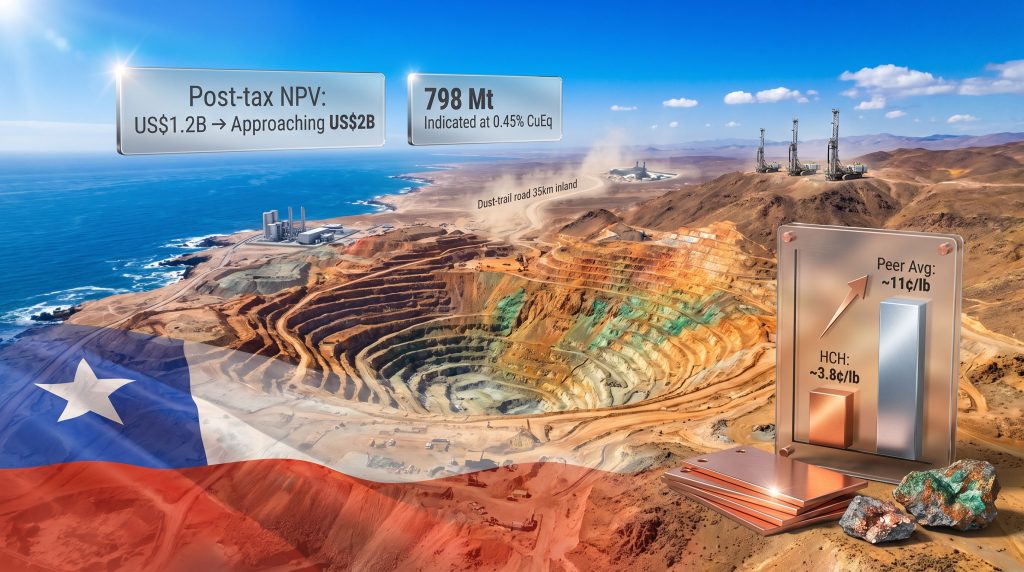
| Indicated | 798 Mt | 0.45% |
| Inferred | 203 Mt | Not separately specified |
| Total | ~1 billion tonnes | Combined base |
The project is advancing beyond its Preliminary Feasibility Study, with an Environmental Impact Assessment submission targeted for Q2 2027. In addition, the broader Chile copper outlook continues to support development timelines for projects of this nature.
Costa Fuego PFS Economics at a Glance
The March 2025 PFS represents the most recently published economics for the project. Importantly, both the copper and gold price assumptions embedded in that study have since moved materially higher, creating a layer of unbooked upside not visible in the headline numbers:
| Metric | Published PFS Figure |
|---|---|
| Mine life | 20 years (14 years primary production) |
| Average annual CuEq output | ~116,000 tonnes |
| Post-tax NPV | US$1.2 billion |
| Post-tax IRR | 19% |
| Long-term copper price assumption | US$4.30/lb |
| Start-up capital requirement | US$1.27 billion |
| Payback period | ~4.5 years |
Long-term consensus copper price has shifted from US$4.30/lb at the time of PFS publication toward approximately US$4.79 to US$4.90/lb today. Long-term consensus gold has moved from roughly US$2,280/oz to around US$3,600/oz over the same period. Neither adjustment is reflected in the currently published PFS, meaning the project's economics are being presented to the market on assumptions that are materially stale relative to current consensus.
What Is the La Verde Discovery and Why Is It a Potential Game-Changer for Costa Fuego?
La Verde: Discovery Profile and Strategic Positioning
Acquired in November 2024 and located approximately 35 kilometres southeast of Costa Fuego's planned central processing hub, the Hot Chili Costa Fuego La Verde resource is a copper-gold porphyry target with geological characteristics consistent with large-scale porphyry systems common to Chile's productive copper belts. Three drill rigs are currently active at the site, with a fourth being mobilised as the programme accelerates.
What makes La Verde's positioning particularly significant from an operational standpoint is the proximity to existing planned infrastructure. Integrating a new deposit 35 kilometres from an already-designed central processing hub is a materially different engineering challenge than developing a standalone operation. The capital efficiency of feed integration versus standalone development is, furthermore, one of the underappreciated valuation arguments for large, multi-deposit copper systems.
Critical Distinction for Investors: La Verde does not yet have a formally reported mineral resource estimate. Management has guided toward a maiden resource of approximately 500 million tonnes before year-end 2026, but this figure represents a forward-looking management expectation based on drilling progress, not an independently verified resource. Investors should evaluate this projection against the risk that drilling outcomes may deliver a resource above, below, or compositionally different from management's current working assumption.
How La Verde Integration Could Transform Costa Fuego's Economics
The proposed integration of La Verde into Costa Fuego's resource base and mine plan creates a potential step-change in project economics. The projected impact across key metrics is substantial:
| Economic Metric | Current PFS | Projected Post-La Verde |
|---|---|---|
| Post-tax NPV | US$1.2 billion | Approaching US$2 billion |
| Post-tax IRR | 19% | Toward mid-30s% |
| Payback period | ~4.5 years | ~2.5 years |
| Cost curve position | Second quartile | First quartile |
| NPV-to-capex ratio | ~0.9:1 | Approaching 2:1 |
The shift from second to first quartile on the industry cost curve is not merely a presentational improvement. Cost curve positioning determines a project's resilience through price cycles: first-quartile operations remain cash-generative at copper prices that would put second-quartile projects under significant financial pressure. That margin of safety matters enormously to the financing institutions and potential strategic partners who will ultimately decide whether a project reaches Final Investment Decision.
The higher-grade feed contribution from La Verde is the primary mechanism driving payback compression. When blended with existing Costa Fuego ore, La Verde's feed profile is expected to improve average head grade, increasing recovery per tonne processed and reducing unit operating costs. A reduction in payback from 4.5 years to approximately 2.5 years represents a meaningful shift in how project financiers and potential acquirers model downside protection.
Potential Resource Ranking Implications
If the maiden La Verde resource meets management's approximate 500 Mt target and is formally integrated with the existing Costa Fuego base:
- Total combined resource would approach 1.5 billion tonnes
- Costa Fuego would move from approximately the 10th-largest undeveloped copper resource globally among independently held projects to approximately the 6th-largest
- This ranking shift would place the project within a category of assets that historically attracts qualitatively different attention from major mining M&A teams
How Does Hot Chili's Valuation Compare to Its Peer Group?
Understanding the EV/lb Reserve Metric in Copper Development
EV/lb Explained: Enterprise Value per pound of copper reserve measures how much the market is pricing each pound of copper held in the ground. It strips out project size differences to allow standardised comparison between copper developers at different stages. Lower EV/lb relative to peers may signal undervaluation, though it can also reflect genuine differences in project quality, jurisdictional risk, permitting progress, or capital structure complexity.
The Valuation Gap: Where Hot Chili Currently Sits
As of 31 July 2026, the key financial metrics for the company were:
- Market capitalisation: approximately A$285 million
- Cash position: A$46 million
- Shares outstanding: 202.8 million
| Valuation Metric | Hot Chili (HCH) | Large-Scale Copper Developer Peer Average | Implied Gap |
|---|---|---|---|
| EV/lb reserve | ~3.8 cents/lb | ~11 cents/lb | 2.9x |
| P/NAV (vs. recent sector transactions) | At discount | Peer average | 2.3x |
The share price has already re-rated four to five times over the preceding 15 months, suggesting the market has partially recognised the La Verde opportunity and the improving macro backdrop. However, the EV/lb gap to peers remains substantial. Whether that gap closes further depends on execution against the upcoming catalyst calendar, particularly the maiden La Verde resource estimate and the restated PFS. Those exploring copper investment strategies at scale will find this valuation gap worth examining closely.
What Is the Huasco Water Asset and How Does It Solve the Financing Challenge?
The Core Financing Problem for Independent Copper Developers
The gap between Hot Chili's approximately A$285 million market capitalisation and Costa Fuego's US$1.27 billion start-up capital requirement is the central structural challenge of the investment case. For most smaller developers, bridging that gap requires either material equity dilution, debt at punishing rates, or a strategic partner who extracts value in exchange for capital commitment. Each path carries a cost to existing shareholders.
Huasco Water: A Non-Dilutive Financing Mechanism
The Huasco Water business represents an unconventional solution to a conventional financing problem. The company holds the only maritime licence for permitted seawater access in Chile's Huasco Valley, an exclusive position in a region where water scarcity is a defining constraint for mining operations.
The business is structured in two stages:
Stage 1 (Already incorporated in PFS)
- Seawater supply to Costa Fuego at 500 L/s capacity
- Construction capital: US$151 million
- Post-tax IRR: 19%
- Funded within the existing Costa Fuego project economics
Stage 2 (Pending second maritime licence)
- Multi-user desalination operation at 1,300 L/s capacity
- Post-tax NPV: US$977 million
- Would supply water to neighbouring regional operations, potentially including projects associated with BHP and Lundin's Vicuña district
- If realised, could contribute US$600 to US$700 million toward Costa Fuego's equity requirement
The strategic elegance of this structure is that Stage 2, if it proceeds as planned, could address a substantial portion of the project's equity requirement without requiring Hot Chili to issue shares at a discount to fund construction. For a company of this size targeting a capital project of this scale, that distinction is not marginal: it is the difference between a financing strategy that preserves and one that permanently redistributes shareholder value.
The second maritime licence has been advancing through Chilean administrative processes for approximately five years. Chilean authorities have confirmed the licence application remains on track following a delay associated with a change of administration.
Additional Untapped Financing Levers
Beyond Huasco Water, two further financing mechanisms remain uncommitted:
- Gold credit forward sales: Costa Fuego is projected to produce 48,000 to 70,000 ounces of gold per year once La Verde is integrated, with gold currently trading near multi-year highs. None of this production has been forward-sold.
- Concentrate offtake: Approximately 40% of total concentrate production (an estimated 160,000 tonnes per year) remains uncontracted. Glencore holds an agreement covering up to 60% of concentrate for the first eight years on benchmark terms, providing a credibility anchor. The remaining volume in a structurally tight concentrate market represents potential for value-accretive deal-making ahead of FID.
The next major ASX story will hit our subscribers first
What Competitive Advantages Does Hot Chili Hold Among Independent Copper Developers?
Scarcity, Scale, and Strategic Positioning
The competitive moat for large-scale copper developers is geological and regulatory, not commercial. You cannot build a 1-billion-tonne copper resource through operational excellence or financial engineering: the ore either exists or it does not, and the permitting framework either supports development or it does not. Hot Chili's structural advantages include:
- One of only five independent (non-major-controlled) copper developers globally with confirmed potential for more than 100,000 tonnes per year of annual production
- Dual-listed on the ASX and TSXV, providing access to both Australian and Canadian resource capital markets
- Glencore's 7.5% equity stake and existing offtake arrangement function as both strategic validation and a credibility signal to other potential financing and offtake partners
- Priority status from Chilean authorities for permitting, a formal mechanism that reduces timeline uncertainty relative to comparable-stage projects operating through standard permitting queues
Key Permitting and Development Milestones
| Milestone | Target Date |
|---|---|
| Maiden La Verde resource estimate | Before year-end 2026 |
| Restated Costa Fuego PFS (incorporating La Verde) | Following MRE release |
| EIA submission | Q2 2027 |
| Second Huasco Water maritime licence approval | Expected within coming months |
| Final Investment Decision | 2029 |
| First production | 2031 |
Chile's position as the world's largest copper-producing nation provides the regulatory context for this timeline. The country operates established permitting pathways for large-scale copper projects, and the Huasco Valley's proximity to BHP and Lundin's Vicuña district positions Costa Fuego within an emerging multi-project copper corridor where infrastructure sharing and water supply synergies are becoming increasingly commercially relevant.
Key Risks and Watch Items for the Costa Fuego Investment Case
Critical Catalysts to Monitor
Investor Checklist: Key Upcoming Triggers
- La Verde maiden resource estimate targeting approximately 500 Mt, expected before year-end 2026
- Second Huasco Water maritime licence approval, pending and expected within months
- Restated Costa Fuego PFS incorporating La Verde and updated commodity price assumptions
- Progress on strategic partnering process ahead of 2029 FID
- EIA submission targeted for Q2 2027
Execution Risks That Could Affect the Investment Thesis
Investors should weigh the following risks against the opportunity presented:
- La Verde resource delivery: If the maiden estimate materially underperforms the approximately 500 Mt management target, the NPV uplift toward US$2 billion narrows or disappears. Drilling results to date have not yet been independently verified through a formal resource estimation process.
- Stage 2 water licence: Denial or indefinite delay of the second Huasco Water maritime licence would remove the primary non-dilutive financing mechanism, forcing the company to rely more heavily on equity markets, strategic partners, or project-level debt.
- Commodity price assumptions: The restated PFS will be priced at updated consensus copper and gold assumptions. If commodity prices retreat from current elevated levels before the restated study is published, headline economics could moderate from current management projections.
- Capital markets execution: Bridging from an approximately A$285 million market capitalisation to a US$1.27 billion construction project still requires successful execution across multiple financing channels simultaneously.
- Timeline sensitivity: A 2029 FID and 2031 first production target spans a multi-year execution window during which permitting, commodity markets, and global capital flows can shift in ways that are difficult to model with confidence today.
What Successful Execution Would Mean
If La Verde delivers a maiden resource in the vicinity of 500 Mt, and that resource is successfully integrated into a restated PFS at updated commodity price assumptions:
- Costa Fuego's post-tax NPV would approach US$2 billion, against a current market capitalisation of approximately A$285 million
- The post-tax IRR would move toward the mid-30s percentage range, placing the project among the highest-returning large-scale copper developments currently in the market
- The NPV-to-capex ratio would approach 2:1, a level that historically unlocks materially different conversations with institutional capital and strategic acquirers
Furthermore, the Hot Chili Costa Fuego La Verde resource narrative continues to evolve rapidly as drilling programmes advance, meaning the next formal resource estimate represents a near-term, high-impact inflection point for investors monitoring the project.
This article is for informational purposes only and does not constitute financial advice. All forward-looking projections, resource targets, and economic estimates referenced herein involve material uncertainty and may not be achieved. Investors should conduct their own due diligence and seek independent financial advice before making investment decisions. Further analysis and company commentary on the Hot Chili Costa Fuego La Verde resource is available at cruxinvestor.com.
Want to Stay Ahead of the Next Major Copper Discovery on the ASX?
Discovery Alert's proprietary Discovery IQ model scans ASX announcements in real time, instantly identifying significant mineral discoveries across copper and more than 30 other commodities — turning complex data into clear, actionable insights for investors at every level. Explore how historic discoveries have generated substantial returns on Discovery Alert's dedicated discoveries page, and begin your 14-day free trial today to position yourself ahead of the broader market.