August 13, 2026
The Grinding Bottleneck That Has Long Constrained Large-Scale Copper Production
Vale Base Metals coarse particle flotation Salobo represents one of the most strategically significant processing technology commitments in the contemporary copper industry. For decades, copper processing operations have been caught in an uncomfortable paradox. The more aggressively an operation scales up ore throughput, the more energy it must pour into grinding that ore down to the fine particle sizes demanded by conventional flotation circuits. At the world's largest porphyry copper deposits, this comminution bottleneck has acted as a hard ceiling on capacity growth.
Furthermore, operators have been forced to choose between expensive new grinding infrastructure or accepting suboptimal recovery rates. Understanding why this constraint exists, and how a new generation of flotation technology is dismantling it, is essential context for appreciating what Vale Base Metals is attempting at its Salobo Copper Complex in the Brazilian state of Pará.
The physics of conventional flotation are unforgiving. Mineral surfaces must be sufficiently exposed before air bubbles can attach and carry them upward through a flotation cell. Achieving that surface liberation historically required grinding ore to a P80 particle size typically below 150 micrometres, a process that is both energy-intensive and water-hungry. At a site processing tens of millions of tonnes of ore annually, the cumulative cost of that fine-grinding requirement is enormous, both in operating expenditure and in carbon emissions. The copper processing benefits of emerging technologies challenge this foundational assumption, and the Salobo project is poised to become the most significant commercial-scale test yet undertaken.
When big ASX news breaks, our subscribers know first
What Coarse Particle Flotation Actually Does Differently
The Physics of Recovery at Coarser Particle Sizes
Conventional mechanical flotation cells rely on turbulent agitation to keep particles suspended while air bubbles seek out mineral surfaces. This turbulence, however, is deeply hostile to larger particles. Coarse particles carry more inertia, making bubble attachment less stable, and they tend to detach before reaching the froth layer and reporting to concentrate. Consequently, operators must grind more finely than the mineralogy strictly demands, simply to keep particles light enough for the conventional circuit to handle efficiently.
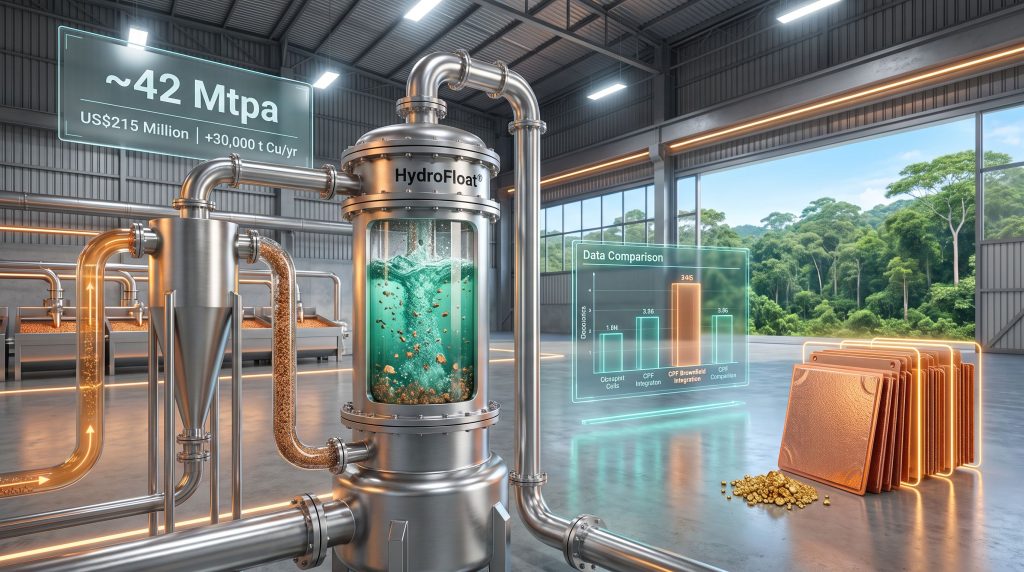
HydroFloat technology, developed by Eriez Manufacturing, solves this problem through a fundamentally different operating environment. Rather than turbulent agitation, the technology employs a fluidised-bed chamber through which an upward water current keeps particles in a semi-suspended state. This gentler hydraulic environment dramatically reduces the detachment forces acting on bubble-particle aggregates, enabling recovery of mineral-bearing particles at sizes that would be lost or poorly recovered in a conventional cell.
The technology has been demonstrated at pilot scale across multiple commodities, but copper-gold porphyry deposits represent its most strategically significant application given the scale of ore bodies involved. In addition, the energy transition demand for copper is placing enormous pressure on operators to unlock every available tonne of incremental production efficiently.
Particle Size Thresholds: Where the Boundaries Sit
The distinction between conventional and coarse particle flotation is not merely qualitative. It is defined by measurable particle size thresholds with direct implications for circuit design and energy consumption.
| Flotation Type | Typical Optimal P80 Range | Primary Limitation |
|---|---|---|
| Conventional mechanical flotation | Below ~150 µm | Coarse particle detachment |
| Coarse particle flotation (HydroFloat) | Up to ~250 µm and beyond | Liberation completeness at coarser sizes |
| Ultra-fine flotation | Below 20 µm | Bubble-particle collision probability |
The liberation trade-off embedded in coarse particle flotation is worth understanding carefully. At coarser grind sizes, some mineral grains remain locked within gangue matrix, meaning that not every recoverable atom of copper is accessible to flotation. CPF circuits therefore tend to target particles where sufficient liberation has occurred at the grain boundary, rather than demanding complete liberation as conventional circuits do. This pragmatic approach trades marginal recovery completeness for substantial throughput and energy gains, a trade-off that is increasingly compelling at large-scale, lower-grade porphyry deposits.
Vale Base Metals Coarse Particle Flotation at Salobo: The Project in Detail
A Reserve Base That Justifies Long-Term Capital Commitment
Salobo is not a marginal asset. It hosts one of the largest copper reserve bases of any single complex globally, underpinning the economic rationale for a major processing technology upgrade. The scale parameters of the CPF project are summarised below.
| Project Parameter | Detail |
|---|---|
| Copper Reserve Base | 1.15 billion tonnes |
| Pre-CPF Processing Capacity | ~36 Mtpa |
| Post-CPF Target Capacity | ~42 Mtpa |
| Incremental Capacity from CPF | ~6 Mtpa |
| Expected Copper Production Uplift | ~30,000 tonnes per annum |
| Expected Gold Byproduct Uplift | ~15,000 ounces per annum |
| Gross Project Capital Cost | US$215 million |
| VBM Net Capital Contribution | ~US$175 million |
| Wheaton Precious Metals Contribution | ~US$40 million |
| Targeted Start-Up | H1 2028 |
| Schedule Advance vs. Original Plan | ~12 months |
The 1.15-billion-tonne reserve base is critical context. A processing technology upgrade of US$215 million is relatively modest in the context of a deposit of this scale, particularly when it delivers a 17% throughput increase. The long reserve life means the incremental copper and gold production from this upgrade will compound over many decades, substantially improving the project's lifetime return on capital invested.
The Four-Stage CPF Flowsheet at Salobo
The circuit design at Salobo represents a carefully integrated modification of existing infrastructure rather than a wholesale replacement. This is what gives the project its brownfield capital efficiency advantage. According to Vale Base Metals' project documentation, the flowsheet is structured across four distinct stages.
Stage 1: Primary Grind Adjustment
The foundational change is deliberate. The primary grinding target is raised to approximately P80 250 µm, significantly coarser than the sub-150 µm specification that conventional flotation demands. This single design decision is what unlocks the throughput gain. By reducing the fineness of grind required from the primary mills, the same grinding assets can process a larger volume of ore in the same time period without adding new mill capacity.
Stage 2: Classification and Stream Splitting
Mill discharge is directed through cyclone or screening classification equipment to separate the particle population into two streams. Fine particles below the threshold are routed directly to the existing conventional mechanical flotation circuit, while the coarse fraction above the threshold is diverted to the new CPF circuit. This bifurcated approach allows the plant to extract value from both populations simultaneously without compromising the recovery performance of either circuit.
Stage 3: HydroFloat Recovery of Coarse Minerals
The coarse fraction enters the HydroFloat unit, where sufficiently liberated mineral particles are recovered under fluidised-bed conditions. Minerals that would have historically reported to tailings due to poor bubble-particle attachment in a conventional cell are now captured, improving overall resource utilisation from a fixed ore body.
Stage 4: Concentrate Re-Grind and Circuit Integration
CPF concentrate is re-ground to approximately P80 106 µm before re-entering the conventional flotation circuit. This step is essential, ensuring that the coarse-recovered material achieves the fine liberation and grade consistency required for downstream smelting specifications. Without this re-grind, coarse concentrate grades would likely fall short of the purity standards demanded by copper smelters.
The two-stage philosophy of coarse recovery followed by selective re-grind effectively decouples throughput capacity from the energy-intensive fine-grinding bottleneck. The plant processes more ore, extracts more metal, and does so without proportional increases in grinding energy per tonne of output.
Why Brownfield Integration Changes the Capital Economics Entirely
Comparing Expansion Pathways on Capital Intensity
The decision to expand Salobo through CPF integration rather than conventional mill expansion or new greenfield development has profound capital efficiency implications. Adding 6 Mtpa of capacity at a gross cost of US$215 million equates to a capital intensity of roughly US$35 to US$36 per annual tonne of incremental capacity. Greenfield copper processing expansions, by contrast, routinely carry capital intensity figures exceeding US$100 to US$200 per incremental tonne of capacity.
| Expansion Pathway | Typical Timeline | Capital Intensity | Permitting Risk | Execution Certainty |
|---|---|---|---|---|
| CPF Brownfield Integration | 2 to 4 years | Low to Moderate | Low | High |
| Conventional Mill Expansion | 3 to 5 years | Moderate | Moderate | Moderate to High |
| New Concentrator (Greenfield) | 8 to 15 years | High | High | Low to Moderate |
| Satellite Deposit Development | 5 to 10 years | Moderate to High | Moderate to High | Moderate |
The 12-month acceleration in Salobo's CPF timeline, now targeting start-up in H1 2028 rather than the original schedule, reflects the simplified project scope that brownfield integration enables. Existing tailings handling systems, water circuits, and reagent infrastructure can be partially shared with the CPF circuit, reducing total new construction scope. It is worth noting that mining industry research consistently shows major capital projects frequently overspend their original budgets by significant margins, making the brownfield model's reduced scope a material risk management advantage.
Energy, Water, and Emissions: The Sustainability Dimension
Grinding typically accounts for between 30% and 50% of total mine-site energy consumption at hard-rock processing operations. By raising the primary grind target and reducing the volume of material requiring fine comminution, the Salobo CPF circuit directly reduces the site's specific energy consumption per tonne of ore processed. This translates into lower operating costs, reduced electricity demand, and a measurable reduction in Scope 1 and Scope 2 greenhouse gas emissions intensity per tonne of copper produced.
Water consumption also improves. Coarser flotation feeds generally require less process water per unit of recovery than ultra-fine grinding circuits. Given that Salobo operates in the Carajás region of Pará State, one of Brazil's most ecologically significant and water-sensitive regions, reduced process water demand per tonne of ore has both operational and community relations value.
Streaming Finance and the Gold Byproduct Economy at Salobo
How Wheaton Precious Metals' Contribution Restructures Project Economics
Copper-gold porphyry deposits occupy a unique position in the mining finance landscape. Their gold byproduct streams are sufficiently material to attract streaming finance, which allows operators to monetise future precious metal production in exchange for upfront capital contributions. Wheaton Precious Metals' US$40 million contribution to the Salobo CPF project follows this well-established model, reducing VBM's net capital exposure to approximately US$175 million.
The gold arithmetic here is instructive. The CPF expansion is projected to add approximately 15,000 ounces of gold per year as a byproduct of incremental copper processing. With gold prices trading above US$3,000 per ounce through 2025 into 2026 market conditions, this byproduct stream carries annual gross revenue potential approaching US$45 million at spot prices. The streaming arrangement effectively pre-monetises a defined portion of this future gold production at project inception, improving the return profile on VBM's net capital contribution.
Disclaimer: Gold price projections and revenue estimates are illustrative and depend on future spot prices, which are subject to significant volatility. Streaming contract terms determine actual realised proceeds and are not equivalent to full spot market exposure.
Could CPF Unlock Further Capacity Expansion at Salobo?
A question less commonly asked in mainstream analysis is whether the Salobo CPF installation represents a first stage rather than a final destination. Porphyry copper deposits of Salobo's scale often contain ore of varying hardness and mineralogical complexity across different mining zones. If the current CPF installation demonstrates strong recovery performance relative to design assumptions, there is a plausible technical argument for further CPF circuit capacity additions beyond the initial 6 Mtpa module, though no such expansion has been announced or confirmed by VBM.
The Broader Industry Signal: CPF Moving from Experimental to Standard
What Salobo Means for Circuit Design Conventions Globally
The Vale Base Metals coarse particle flotation Salobo installation carries significance well beyond the boundaries of a single project. Commercial-scale CPF deployments at major copper operations have historically been limited, with most published case studies drawing on pilot plants or smaller demonstration installations. At 6 Mtpa of incremental capacity, Salobo is positioned to generate the kind of operational data that engineering firms, mine operators, and technology developers need to confidently specify CPF as a standard circuit option.
The competitive implication for the copper processing industry is significant. As CPF reference cases accumulate operating hours and validate their energy and throughput performance claims, operators who continue to design purely conventional fine-grinding circuits for high-tonnage porphyry deposits will face increasing pressure to justify that choice. The combination of throughput uplift, energy reduction, capital efficiency, and improved resource utilisation creates a multi-dimensional value proposition that is difficult to dismiss once large-scale commercial performance data becomes available. For further technical context, industry analysis of CPF in base metals provides useful perspective on where this technology is heading.
Copper Supply and the Energy Transition Imperative
Global copper consumption is structurally increasing. Electric vehicles, grid-scale battery storage, offshore wind transmission infrastructure, and solar photovoltaic installation all require substantially more copper per unit of energy capacity than the fossil fuel systems they are replacing. The copper supply crunch deepening through the late 2020s and into the 2030s is exacerbated by long permitting timelines, declining ore grades at existing operations, and rising development costs.
Furthermore, the copper demand drivers underpinning this structural shift make brownfield CPF expansions at established operations a structurally faster supply response than new mine construction. The Salobo CPF project adds approximately 30,000 tonnes of copper per annum, equivalent to a meaningful fraction of a mid-tier new mine, without the 10 to 15 year development cycle that new greenfield copper projects typically require. For commodity markets seeking supply relief within realistic planning horizons, this speed advantage is as commercially important as the capital efficiency story.
The next major ASX story will hit our subscribers first
Frequently Asked Questions About the Salobo CPF Project
What is Salobo's total processing capacity after the CPF expansion completes?
Once the CPF circuit reaches nameplate throughput, Salobo's total ore processing capacity is targeted at approximately 42 million tonnes per year, representing a 17% increase over the pre-CPF baseline of roughly 36 Mtpa. The CPF circuit contributes approximately 6 Mtpa of this additional capacity.
Who is funding the project and what are the capital contributions?
The gross project capital cost is approximately US$215 million. VBM's net capital contribution is expected to be approximately US$175 million, with the remaining US$40 million funded through a contribution from Wheaton Precious Metals under an existing streaming arrangement covering Salobo's gold byproduct production.
What copper and gold production does the CPF circuit add to Salobo's output?
The CPF expansion is projected to add approximately 30,000 tonnes of copper per year and approximately 15,000 ounces of gold per year once fully operational, based on VBM's published project parameters.
Why is the project scheduled 12 months ahead of the original timeline?
The acceleration to an H1 2028 start-up target reflects scope simplification achieved during the project's engineering phase. Brownfield integration leverages existing plant infrastructure, reducing the volume of new construction and the associated scheduling risks that typically extend project timelines.
How does coarse particle flotation reduce energy consumption?
By raising the primary grind target from below 150 µm to approximately P80 250 µm, the CPF circuit reduces the proportion of ore that must be ground to fine particle sizes. Since grinding accounts for a substantial share of total mine-site energy consumption, processing more tonnes through a coarser grind pathway directly lowers the specific energy input required per tonne of copper produced. The cut-off grade economics of this approach also affect which ore zones become viable for processing under the revised circuit configuration.
Key Takeaways for Industry Observers and Investors
- Capital efficiency at scale: Adding 6 Mtpa at approximately US$35 per incremental annual tonne demonstrates the structural cost advantage of brownfield CPF integration over greenfield development
- Energy and sustainability gains: Coarser primary grinding reduces specific energy consumption and process water demand, supporting both cost management and ESG performance metrics
- Accelerated timeline: A 12-month schedule pull-forward reduces financing costs and brings forward the copper production ramp-up, improving project-level returns
- Streaming finance as capital leverage: Wheaton Precious Metals' US$40 million contribution illustrates how gold byproduct streams can be monetised to reduce net capital exposure without surrendering copper production upside
- Commercial-scale reference case: At 6 Mtpa of incremental CPF capacity, Vale Base Metals coarse particle flotation Salobo is positioned to become the defining large-scale demonstration of HydroFloat technology in the global copper industry
- Supply chain relevance: The 30,000 tpa copper production uplift contributes meaningful incremental supply at a time when energy transition demand is placing structural upward pressure on copper markets globally
This article is intended for informational purposes only and does not constitute financial, investment, or engineering advice. Production estimates, capital cost figures, and timeline projections reflect Vale Base Metals' published project parameters and are subject to change. Investors and industry professionals should conduct independent due diligence before making decisions based on the information presented here.
Want to Track the Next Major Copper Discovery Before the Market Does?
Discovery Alert's proprietary Discovery IQ model delivers real-time alerts on significant ASX mineral discoveries — instantly translating complex geological data into actionable investment insights for both short-term traders and long-term investors. Explore Discovery Alert's dedicated discoveries page to understand how historic mineral discoveries have generated substantial returns, and begin your 14-day free trial today to position yourself ahead of the broader market.