July 23, 2026
When Three Chokepoints Break at Once: The Architecture of a Global Oil Crisis
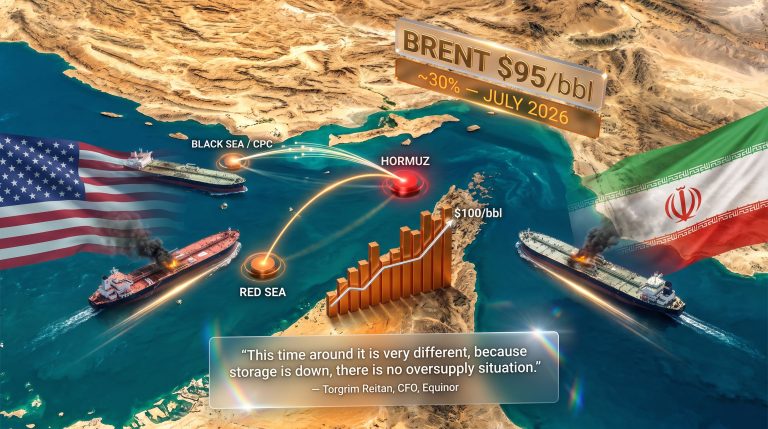
Energy markets are built on a quiet assumption: that even when one major supply route fails, others absorb the load. The system is designed with redundancy in mind. Tankers reroute. Pipelines compensate. Strategic reserves bridge the gap. That assumption is now being stress-tested in real time, as the Houthi Red Sea blockade and oil prices collide at the worst possible moment, with global buffers already depleted and multiple export corridors simultaneously under threat.
Understanding what this moment actually means requires stepping back from the daily price movements and examining the underlying architecture of global crude supply, specifically where it is most fragile and why the current configuration of threats is genuinely without modern precedent. Furthermore, the crude oil price trends emerging from this environment are unlike anything seen in recent memory.
When big ASX news breaks, our subscribers know first
The Bab el-Mandeb Strait: From Secondary Lane to Primary Artery
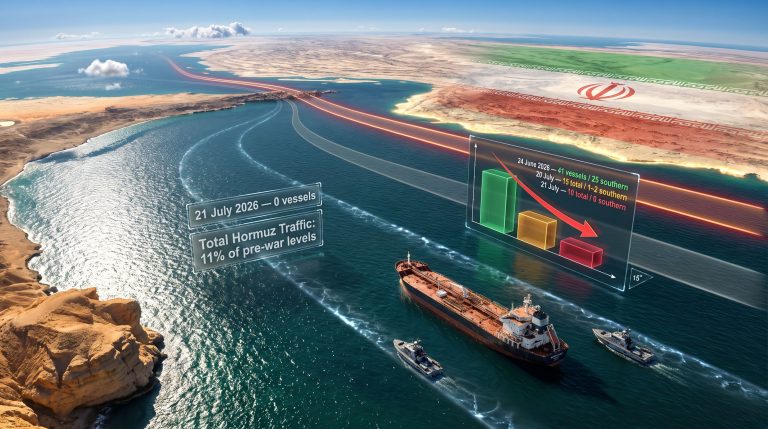
Most market participants know the Strait of Hormuz as the world's most consequential oil chokepoint. Roughly 20 million barrels per day transited it under pre-conflict conditions, representing approximately one-fifth of global petroleum liquids consumption. By comparison, the Bab el-Mandeb Strait, which links the southern Red Sea to the Gulf of Aden, moved roughly 7 million barrels per day under normal baseline conditions, a meaningful volume but not an existential one.
That calculus changed fundamentally when U.S.-Iran tensions escalated and Hormuz transit became effectively disrupted. Saudi Arabia, unable to rely on its primary eastern export route, pivoted crude flows westward through the Red Sea port of Yanbu, redirecting an estimated 4 million barrels per day of Saudi crude onto shipping lanes that previously carried far less Gulf oil. The Bab el-Mandeb, once a secondary corridor, became the primary functioning artery for Middle Eastern crude reaching global markets.
This is the critical context that makes the Houthi naval blockade declaration so consequential. The threat is not targeting a peripheral shipping lane. It is targeting the rerouted export corridor that Saudi Arabia has been relying on precisely because Hormuz is already compromised.
Critical framing: The Houthi blockade threat is not a standalone event. It is a second disruption layered on top of an already constrained primary route, targeting the workaround that markets had priced in as a stabilising factor.
Three Corridors Under Simultaneous Pressure
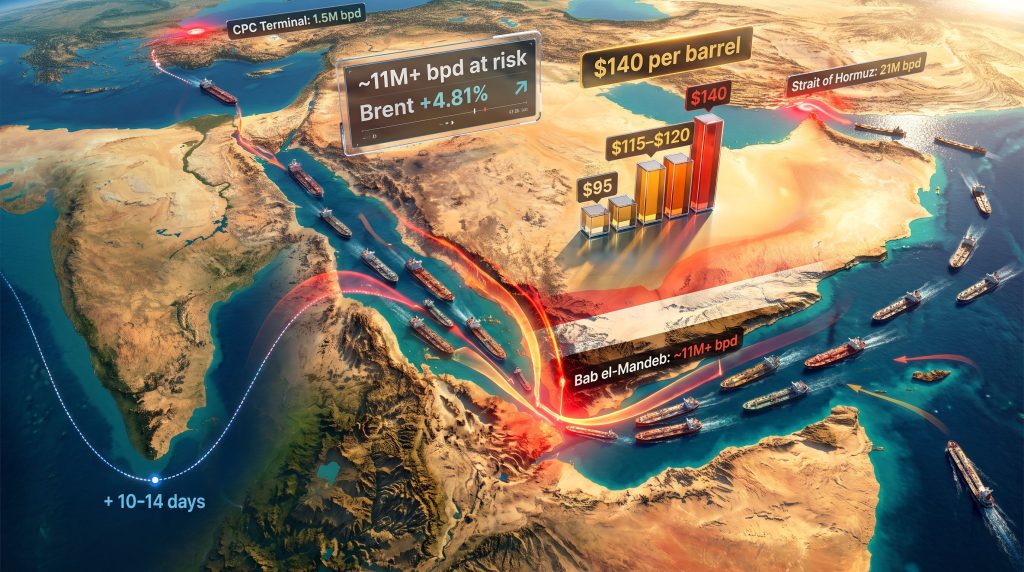
The scale of the current supply-side challenge becomes clearer when all three disrupted export corridors are viewed together rather than in isolation.
| Chokepoint | Pre-Conflict Daily Flow | Current Status | Volume at Risk |
|---|---|---|---|
| Strait of Hormuz | ~20 million bpd | Severely constrained | Primary disruption |
| Bab el-Mandeb (Red Sea) | ~7 million bpd baseline | Under active blockade threat | Up to 4M bpd Saudi rerouted flows |
| CPC Terminal (Black Sea) | ~1.7 million bpd | Loadings suspended | Full Kazakhstan export volume |
Kazakhstan's Caspian Pipeline Consortium terminal in the Black Sea has suspended crude loadings following ongoing tanker attacks in the region. The CPC pipeline system is the sole major export route for Kazakh crude, carrying approximately 1.7 million barrels per day to international markets. A prolonged suspension creates upstream pressure, as Kazakhstan may eventually be forced to reduce production at the wellhead if export capacity remains unavailable.
In aggregate, the worst-case simultaneous disruption scenario places 6 to 7 million barrels per day of crude at risk across three geographically dispersed corridors. Prior supply shocks have typically centred on a single geographic event. The current configuration is structurally different, requiring geopolitical de-escalation across multiple independent conflict zones rather than a single diplomatic resolution. Consequently, the trade war impact on oil markets adds yet another layer of complexity to an already volatile picture.
What the Price Scenarios Actually Look Like
Rather than a single price outcome, markets are navigating a branching set of scenarios depending on how effectively the Houthi blockade translates from declaration to enforcement.
Scenario 1: Threat Without Enforcement
- Houthi interdiction capacity proves limited; blockade remains largely rhetorical
- Tankers reroute via the Cape of Good Hope, adding 10 to 14 days of voyage time per round trip
- Brent crude sustains a risk premium of $5 to $15 per barrel above pre-announcement levels
- War-risk insurance premiums surge for Red Sea transit, creating a cost barrier even without physical interdiction
- Market outcome: elevated volatility, not a structural supply shortfall
Scenario 2: Partial Enforcement
- Houthi forces successfully interdict a meaningful share of Bab el-Mandeb traffic
- Saudi Yanbu exports face significant delays or volume reductions
- Brent crude pushes toward the $115 to $120 per barrel range, consistent with Reuters analysis
- Refined product prices follow crude higher with a lag of approximately 2 to 4 weeks
- Asia-Pacific importers absorb the sharpest cost increases due to route dependency on Red Sea transit
Scenario 3: Full Blockade Enforcement
- Bab el-Mandeb effectively closes to commercial tanker traffic
- Combined with Hormuz constraints and CPC suspension, the market faces a structural crude shortfall
- Bloomberg Economics modelling suggests Brent could approach $140 per barrel under severe disruption assumptions
- Recession risk re-enters mainstream economic forecasting
- Downstream: U.S. gasoline prices above $4 per gallon become entrenched; European diesel inventories face a genuine supply crisis
Analyst perspective (Stratas Advisors): If Saudi flows through the Red Sea are severely curtailed, the impact extends beyond crude pricing. The downstream consequence is a broad undermining of global economic activity, with recession an increasingly realistic endpoint if the outage persists.
How Markets Are Responding Right Now
Price action across benchmarks has already begun reflecting the blockade risk premium. Brent crude has surged approximately 4.81% in recent sessions, trading above $95 per barrel. WTI has climbed close to 2.95%, approaching $87 per barrel. Crude oil is up more than 65% year-to-date according to Saxo Bank, citing Bloomberg data, and both Brent and WTI have appreciated by more than 50% over the trailing twelve-month period.
In a single session following the Houthi blockade declaration, oil prices jumped close to 4%, reflecting how quickly physical supply concerns can override diplomatic optimism. Multiple tankers have already altered course to avoid Bab el-Mandeb passage, with some now routing exclusively through the Suez Canal, which creates its own congestion and scheduling complications.
Goldman Sachs has flagged $120 per barrel as a realistic ceiling if Middle East hostilities persist, a projection that assumes continued Hormuz constraints combined with partial Red Sea disruption, not a full dual-chokepoint closure. The $120 level is significant because it represents a threshold beyond which demand destruction historically becomes a meaningful market counterforce, moderating prices through reduced consumption rather than increased supply.
ING commodity analysts Warren Patterson and Ewa Manthey have noted that rerouting tankers through the Suez Canal adds substantial time and cost to voyages serving Asian buyers, costs that ultimately flow through to end consumers via higher fuel and delivered goods prices. For a broader view of current crude oil prices and how they are shifting, market observers are closely tracking every new development.
Regional Exposure: Which Economies Bear the Greatest Risk
The distributional impact of the current disruption is not uniform. Asia-Pacific economies, as the primary destination for Middle Eastern crude, carry the most acute near-term exposure.
India has seen crude import costs surge approximately 60% as conflict-driven price increases compound volume risk. The IMF has flagged elevated oil prices as a key downside risk to India's GDP growth trajectory. India has also reduced purchases of Iraqi crude as Hormuz transit risk intensifies, forcing a realignment of its import sourcing.
Japan is facing power prices at a 3.5-year high, with its import bill climbing to unprecedented levels. Yen weakness amplifies the cost of dollar-denominated crude, creating a double-compounding effect on energy affordability.
Pakistan is scrambling to secure alternative supply sources as both Hormuz and Red Sea routes face simultaneous disruption, paying record spot LNG premiums as Qatar supply availability tightens.
In Europe, diesel inventories are trending toward multi-year lows, with the Red Sea blockade threatening to worsen refined product availability heading into winter. The continent is entering the colder months with its weakest natural gas storage cushion in 15 years, a compounding energy security vulnerability. Ryanair has reported a 36% profit decline attributed to unhedged jet fuel costs that have effectively doubled, an early-indicator signal of the airline sector's systemic exposure.
In the United States, retail gasoline prices have climbed back above $4 per gallon, while U.S. crude inventories are building as Hormuz shipping disruptions slow import flows. China has reportedly slashed Iranian oil purchases by 40%, reshaping the discount crude flows that had previously provided a cushioning effect for Asian buyers.
The next major ASX story will hit our subscribers first
The Workaround Problem: Why Rerouting Has Hard Limits
The Cape of Good Hope alternative is real, but its capacity to absorb a full Red Sea closure is limited by several structural constraints:
- Adding 10 to 14 days of transit time per voyage effectively reduces the productive throughput of the global tanker fleet without adding a single new vessel
- Tighter vessel availability drives freight rates higher, embedding additional cost into every barrel delivered
- Saudi Arabia's East-West Pipeline connects eastern production fields to Yanbu, the very terminal now under Houthi threat. If Yanbu becomes untenable, the only alternative is to redirect flows back through Hormuz, which is itself severely constrained
- No pipeline infrastructure exists that simultaneously bypasses both Hormuz and Bab el-Mandeb
Kpler's commodity research director Matt Smith has assessed that the first month of a genuine blockade would be the most disruptive period, with Saudi crude flows bearing the brunt of the immediate impact before the market can implement longer-term adaptations.
Strategic Reserves: The Buffer That Is No Longer Available
One of the less-discussed dimensions of the current crisis is the condition of strategic petroleum reserves across major consuming nations. Governments drew down SPR volumes aggressively over the past year to suppress retail fuel prices, reducing storage levels in several key markets to critically low thresholds.
Replenishing those reserves is now structurally difficult. Tighter supply conditions mean that any SPR buying programme competes directly with commercial demand at elevated prices, simultaneously supporting prices higher and leaving the market without its traditional shock-absorber. This removes the primary policy instrument governments typically deploy to smooth through supply disruptions, leaving both consumers and central banks more exposed to the full force of any physical shortfall.
Commodity strategist Jeff Currie has stated publicly that the illusion of oil abundance is gone, a structural assessment extending beyond the current crisis to reflect longer-term underinvestment in upstream production capacity globally.
Inflation, Recession, and the Policy Trap
The macro consequences of a sustained high-price environment extend well beyond the pump. Diesel, as the primary fuel for freight logistics, functions as an embedded cost multiplier across virtually all supply chains. A diesel price spike is effectively a broad-based inflation tax affecting manufactured goods, agricultural products, and services alike.
Historical analysis suggests that sustained Brent prices above $120 to $130 per barrel materially increase the probability of demand-side recession in oil-importing economies. The current environment differs from prior oil shocks in one critical respect: the SPR buffer has already been deployed, removing the primary policy tool governments use to smooth energy price spikes.
Central banks facing renewed inflation from energy costs would then confront a difficult trade-off: tightening monetary policy to suppress inflation risks choking growth, while looser policy to support economic activity risks entrenching elevated price levels. There is no clean exit from that policy trap.
On the producer side, the asymmetric distributional impact is illustrated by Equinor's recent 93% profit surge driven directly by oil and gas price spikes. The current price environment is generating extraordinary windfalls for producers while simultaneously compressing margins across every oil-importing sector of the global economy. In addition, OPEC's influence on oil markets continues to shape how producers respond to these extraordinary conditions.
FAQ: Houthi Red Sea Blockade and Oil Prices
What is the Houthi Red Sea blockade?
Yemen's Houthi movement has declared a naval blockade targeting Saudi Arabia's Red Sea port infrastructure, specifically the shipping lanes through the Bab el-Mandeb Strait. The strategic objective is to restrict Saudi crude exports that were redirected to Red Sea routes after the Strait of Hormuz became effectively disrupted by escalating U.S.-Iran tensions. Analysts studying oil trade and geopolitics have described this as one of the most complex energy security situations in decades.
How much oil is actually at risk from the blockade?
Under normal pre-conflict conditions, approximately 7 million barrels per day transited Bab el-Mandeb. With Saudi Arabia having rerouted exports through Yanbu to avoid Hormuz, the effective volume at risk has increased substantially, with redirected Saudi flows alone estimated at up to 4 million barrels per day.
What price levels are analysts projecting?
- Partial disruption: Brent crude toward $115 to $120 per barrel (Reuters analysis)
- Severe disruption: Approaching $140 per barrel (Bloomberg Economics modelling)
- Goldman Sachs baseline warning: $120 per barrel under sustained Middle East hostilities
Why can't tankers simply go around Africa?
They can, but the Cape of Good Hope route adds approximately 10 to 14 days of transit time, reduces effective tanker fleet capacity globally, and significantly raises freight and insurance costs. These costs pass through to consumers via higher fuel and goods prices. The route is a partial mitigant, not a full solution. Researchers at UTS have examined why these new Houthi threats could spell wider trouble for global oil prices and inflation beyond just rerouting costs.
Is a global recession a realistic outcome?
Analysts have raised the possibility directly. If Saudi Red Sea flows are severely curtailed, and no adequate supply workaround exists, the combination of physical shortfall, depleted strategic reserves, and elevated costs across energy and freight markets could generate sufficient inflationary pressure to push major oil-importing economies into recession.
The Bigger Picture: Volatility as the New Baseline
The Houthi Red Sea blockade and oil prices are now inseparable variables in a global energy equation that has grown structurally more fragile over the past year. The simultaneous disruption of Hormuz, Bab el-Mandeb, and the Black Sea CPC terminal represents a qualitative shift in the nature of global energy risk, moving from manageable single-point disruptions to cascading, geographically dispersed vulnerabilities that cannot be resolved by any single diplomatic or logistical intervention.
For market participants, the key variables to watch are:
- Whether Houthi enforcement capability translates the blockade declaration into actual tanker interdiction
- The trajectory of U.S.-Iran diplomatic engagement and whether a ceasefire framework emerges
- Saudi Arabia's ability to redirect export volumes through alternative channels if Yanbu becomes untenable
- The pace of SPR depletion in major consuming nations and political appetite for further releases
- China's crude purchasing behaviour, given that a 40% reduction in Iranian oil imports reshapes discount crude flows that had previously cushioned Asian buyers
Bottom line: The current energy market environment is not a geopolitical headline cycle. It is a supply-architecture stress test occurring at the worst possible moment, when global energy buffers are structurally thin, multiple chokepoints are simultaneously constrained, and the traditional policy tools available to governments have already been deployed. Price volatility is not a temporary condition to be traded through. It is the new baseline until the underlying physical and geopolitical realities change.
This article is intended for informational purposes only and does not constitute financial or investment advice. All price projections and scenario analysis referenced reflect third-party analyst forecasts and carry inherent uncertainty. Readers should conduct their own due diligence before making any investment decisions related to energy markets.
Want to Stay Ahead of ASX Mineral Discoveries Shaping the Energy Sector?
As commodity price volatility reshapes global markets, Discovery Alert's proprietary Discovery IQ model delivers real-time alerts on significant ASX mineral discoveries — transforming complex market signals into actionable investment opportunities the moment they are announced. Explore how historic discoveries have generated substantial returns on Discovery Alert's dedicated discoveries page, then begin your 14-day free trial to position yourself ahead of the broader market.