July 23, 2026
When Commercial Operators Stop Trusting Naval Deterrence
Maritime deterrence has always functioned as a psychological construct as much as a physical one. Naval powers do not need to intercept every hostile vessel to maintain authority over a waterway — they need commercial operators to believe that the risk of transit is manageable. The moment that belief erodes, authority collapses not through military defeat but through behavioural withdrawal. Shipping companies, charterers, and insurers do not wait for formal policy announcements. They watch what happens to the vessels ahead of them.
That psychological threshold appears to have been crossed in the Strait of Hormuz's southern corridor during the final week of July 2026. The point at which US-assisted Hormuz transits drop to zero is not simply a traffic statistic — it is a credibility event with structural implications for global energy logistics, insurance markets, and the geopolitical contest over one of the world's most consequential waterways.
When big ASX news breaks, our subscribers know first
Understanding the Architecture of the Strait's Three-Lane System
Northern, Central, and Southern: Three Routes, Three Risk Profiles
The Strait of Hormuz operates under a three-lane transit configuration that most market observers treat as a navigational footnote but which has become the central theatre of the US-Iran maritime confrontation. Furthermore, geopolitical trade tensions have only intensified scrutiny of which powers exercise genuine authority over these lanes.
- The northern lane runs adjacent to the Iranian coastline. Iran exercises strong operational familiarity with this corridor and effectively directs traffic through it via a combination of presence, signalling, and demonstrated willingness to use force against vessels that deviate from its preferred patterns.
- The central lane was historically the dominant commercial corridor for supertankers and product carriers moving between the Persian Gulf and the Indian Ocean. Since the outbreak of hostilities in late February 2026, suspected Iranian mine placement has rendered this route commercially unviable. Traffic here has been negligible since early in the conflict.
- The southern lane, running along the Omani coastline, became the focal point of US-coordinated transit operations. Promoted as the commercially secure alternative, it attracted peak usage in late June 2026 before collapsing entirely in late July.
What is analytically significant about this three-lane structure is that route selection is never purely navigational. Which lane a vessel chooses carries an implicit geopolitical signal — it communicates which power the operator believes controls the strait and whose protection framework they are operating within.
What "US-Assisted Transit" Actually Means in Practice
The Difference Between Escort and Guidance
A critical distinction that most coverage conflates is the difference between physical naval convoy escort and guidance-based coordination. US assistance for commercial Hormuz transits has primarily involved the latter — navigational guidance, presence signalling, and coordination with naval assets — rather than physically accompanying vessels through the strait.
This distinction carries enormous analytical weight. It means the effective reach of US maritime authority depends entirely on whether commercial operators perceive that coordination as genuinely risk-reducing. When that perception evaporates, the corridor empties without a single US naval vessel being withdrawn or a single policy being formally changed.
The drop to zero in observable AIS-tracked traffic on the southern corridor does not necessarily mean the US ceased offering assistance — it means commercial operators stopped accepting it. This is a demand-side collapse of US maritime authority, not merely a supply-side withdrawal.
What the Vessel Tracking Data Actually Shows
Parsing the Traffic Numbers: A Fact-Checked Timeline
The trajectory of the southern corridor's collapse is best understood through the sequential vessel tracking data recorded across the relevant period.
| Date | Total Hormuz Transits | Southern Lane Usage | Northern Lane Usage | Central Lane Usage |
|---|---|---|---|---|
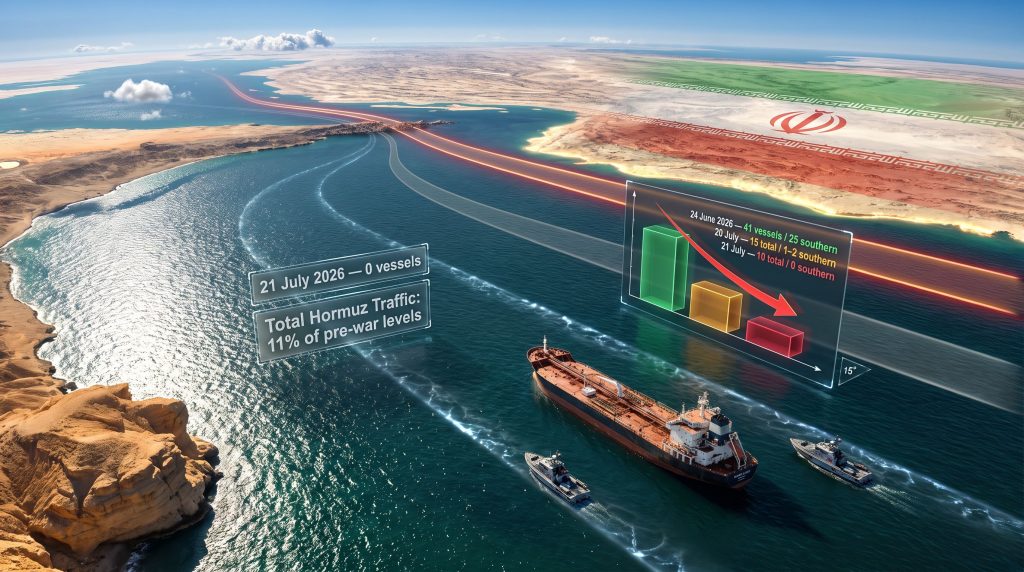
| 24 June 2026 (peak) | 41 outbound vessels | 25 vessels (61%) | Remainder | Negligible |
| 20 July 2026 | 15 total transits | 1-2 vessels | 10+ vessels | 0 |
| 21 July 2026 | 10 total transits | 0 vessels | 8 vessels | 2 vessels |
Source: Windward vessel tracking data; Tradewind data as reported in market coverage (Argus Media, July 2026)
The 24 June figure represents the high-water mark of US corridor authority in the post-memorandum period. The signing of a US-Iran memorandum of understanding had temporarily paused hostilities, enabling a brief restoration of commercial confidence. At that peak, 25 out of 41 outbound vessels transiting the strait — approximately 61% — selected the US-supported southern route.
By 20 July, that figure had collapsed to near zero — one or two vessels out of 15 total transits, according to Tradewind data. By 21 July, according to Windward, zero observable AIS-tracked commercial vessels used the southern lane.
The 11% Threshold: Total Hormuz Traffic Against Pre-War Baselines
Critically, the southern lane collapse does not exist in isolation from a broader Hormuz traffic crisis. Overall vessel transit volumes through the strait have fallen to approximately 11% of pre-war levels, according to Windward vessel tracking data. This macro figure contextualises the southern lane abandonment within a wider commercial retreat from the strait as a viable transit corridor under current conflict conditions.
Why AIS Data Has Inherent Limitations
Vessel tracking services rely on Automatic Identification System transponder data, which creates a meaningful caveat for analysis:
- Vessels operating with AIS transponders switched off or spoofed are not captured in publicly available tracking datasets.
- Zero observable AIS traffic on the southern lane does not constitute an absolute operational fact that zero transits occurred.
- However, the directional signal — a near-complete commercial abandonment of the US-supported corridor — carries strong analytical validity regardless of the precise vessel count.
The Operational Timeline: How the Southern Corridor Collapsed
Phase One: The Memorandum and the Transit Peak
The brief resurgence in Hormuz commercial traffic following the US-Iran memorandum of understanding demonstrated that operator confidence, once restored, can rapidly translate into meaningful throughput recovery. The 41-vessel outbound transit day on 24 June 2026 confirmed that commercial appetite for Hormuz transits remained intact when the security environment was perceived as manageable.
This phase established the southern corridor's peak authority position, with the US-guidance framework attracting the majority of commercial traffic.
Phase Two: Resumed Hostilities and the Erosion of Operator Confidence
Following the resumption of US-Iran hostilities, attack frequency on southern lane vessels escalated sharply. The UK Trade Maritime Organisation (UKTMO) documented three separate tanker attacks in the southern transit lane between 20 and 21 July 2026 alone. UKTMO's advisory notes for the period recorded that heightened operator risk assessments — specifically citing recent attacks on tankers in Omani waters — contributed to significantly reduced traffic density in the US-assisted corridor.
Commercial operators began systematically redirecting to the Iranian-controlled northern route. Consequently, from a pure risk-minimisation standpoint, this was rational operator behaviour — but it simultaneously transferred de facto navigational authority to Iran without any formal geopolitical negotiation. The resulting oil price volatility has further unsettled global energy markets already under pressure.
Phase Three: The Seizure Precedent and Its Market-Chilling Effect
The qualitative escalation point arrived with the detention of the tanker Kavomaleas, part of Greek shipowner Dynacom's fleet. The vessel was attacked by Iranian forces on 20 July 2026. What followed was unprecedented in the context of this conflict.
Satellite imagery and vessel tracking analysis confirmed the presence of IRGC fast inshore attack craft positioned directly alongside the tanker — a configuration assessed as consistent with a coerced escort toward Iranian territorial waters near Larak rather than uncontrolled post-attack drift. This marked the first confirmed instance of an Iran-attacked vessel being physically brought into Iranian waters during the current conflict period.
The escorted seizure of a commercially operated tanker into Iranian waters represents a structural shift in Iranian tactics, moving from deterrence-by-attack to deterrence-by-capture. This raises the legal and operational stakes for any vessel attempting the southern corridor under US guidance, fundamentally altering the risk calculus for insurers, charterers, and operators.
Iran's Institutional Rhetoric as De Facto Maritime Regulation
How IRGC-N Statements Function as Operational Warnings
The Iranian Revolutionary Guard Corps Naval branch issued a formal positional statement asserting complete directional authority over the strait's transit entry and exit points, framing this control as definitive rather than contested. Iranian Parliamentary Speaker Mohammad Bagher Ghalibaf — who had previously led negotiations with the US — stated publicly that current conditions in the strait should be understood as a permanent structural change rather than a temporary wartime measure.
These are not conventional diplomatic communications. Analysed through a regulatory framework lens, they function as operational warnings to commercial shipping — informal maritime regulatory pronouncements that carry practical weight because Iran has demonstrated the willingness and capability to enforce them kinetically.
The Warning on Alternative Routes
The IRGC-N explicitly characterised alternative transit routes — including the southern Omani corridor — as unsafe and warned that their use would carry severe consequences. This language constitutes an assertion of extraterritorial navigational authority over a waterway that international maritime law, under UNCLOS Article 38, designates as a strait used for international navigation where transit passage rights apply.
Iran's position directly challenges the legal framework that underpins US maritime coordination in the strait. By framing its control as legitimate and permanent, Tehran is not merely conducting a military operation — it is advancing a competing legal and operational claim over international waterspace.
Trump's Counter-Deterrence Framework and Its Market Reception
US President Donald Trump's publicly stated policy of targeting Iranian power plants and bridges in response to commercial shipping strikes introduced a counter-escalation framework intended to restore deterrence credibility. However, the commercial shipping market did not respond by returning to the southern corridor. This indicated that operators and insurers assessed the US counter-deterrence posture as insufficient to offset the demonstrated Iranian attack and seizure capability.
The next major ASX story will hit our subscribers first
Global Energy Market Exposure: What the Southern Corridor Collapse Means for Commodity Flows
The Scale of Hormuz's Energy Throughput
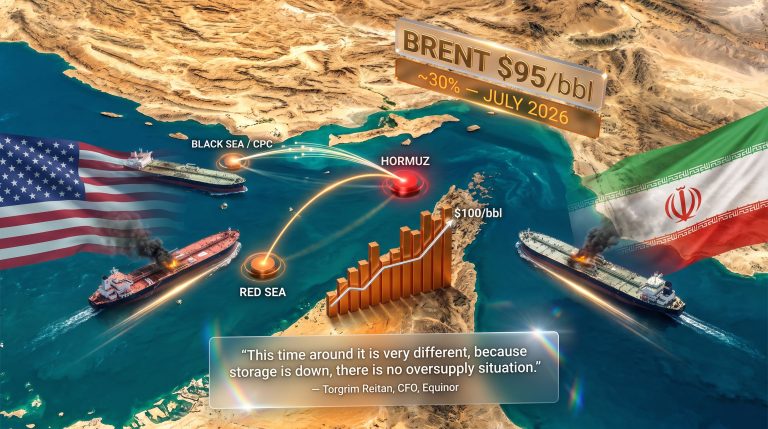
The Strait of Hormuz serves as the primary maritime exit for an estimated 20-21% of global oil trade, in addition to a substantial share of LNG exports from Qatar and other Persian Gulf producers. Monitoring the LNG supply outlook is therefore critical for understanding how sustained disruptions to Hormuz throughput will cascade into broader energy markets. A sustained degradation of commercially viable transit options creates the following cascading market effects:
- War risk insurance premium escalation for any vessel declaring a Gulf of Oman or Strait of Hormuz waypoint
- Tanker freight rate volatility across Middle East Gulf crude and product export routes
- Cargo rerouting costs for operators diverting around the Cape of Good Hope, adding voyage durations of 10-15 days and materially higher fuel and charter costs
- Upward price pressure on Middle East Gulf crude benchmarks, particularly for grades reliant on Hormuz exit capacity
The War Risk Premium Trajectory
War risk insurance premiums were already elevated across the broader region before the southern corridor collapse. Premiums for Bab el-Mandeb transits were recorded at 0.20-0.30% of hull and machinery value for a seven-day period in mid-June 2026, according to market participants cited in Argus Media reporting. Hormuz-specific premiums have tracked higher given the direct military confrontation dynamic, and the southern corridor's effective commercial closure is likely to accelerate premium escalation further. In addition, crude oil price trends suggest that benchmark prices remain highly sensitive to any deterioration in Hormuz transit conditions.
The Dual-Chokepoint Risk Framework
The Hormuz situation does not operate in isolation. A convergence of simultaneous regional disruptions is compounding supply chain pressure across Middle East energy flows:
- The Houthi navigation ban on Saudi Arabia-linked vessels, announced 20 July 2026, threatens Red Sea crude exports from Yanbu and steel imports into the kingdom
- Gulf Keystone's shutdown of the Shaikan oil field in Kurdistan — producing 45,000 barrels per day — reflects a widening security perimeter as Iran's retaliatory operations extend into northern Iraq
- Attacks on Kuwait and Bahrain energy and power infrastructure signal further regional escalation beyond the strait itself
The simultaneous degradation of both the Strait of Hormuz and Bab el-Mandeb creates a dual-chokepoint scenario with no direct peacetime precedent in modern energy market history. Vessels rerouting around Africa face voyage extensions of 10-15 days alongside significantly higher fuel and charter costs — a structural cost addition that will ultimately be absorbed by end consumers of petroleum products.
The Blockade Enforcement Gap: Claims vs. Tracking Reality
What Centcom Reported vs. What Vessel Tracking Showed
US Central Command reported redirecting seven commercial vessels and disabling one to enforce the Iranian port blockade as of 20 July 2026. However, vessel tracking data from Vortexa indicated that nine vessels with Iranian port origins or destinations had transited the strait since the blockade was reimposed on 14 July 2026 — of which six were empty inbound tankers with a combined carrying capacity of approximately 2.35 million barrels.
The divergence between official enforcement claims and independent tracking data raises substantive questions about blockade coverage effectiveness. Notably, reports indicate that a US-sanctioned Chinese tanker passed through the strait despite the blockade — further highlighting the inherent limitations of AIS-based monitoring as a verification tool in an adversarial environment where transponder manipulation is a known countermeasure.
Iran-Flagged Vessels as the Dominant Transit Category
On 20 July 2026, Iran-flagged vessels accounted for six out of 15 total Hormuz transits — the single largest national flag category on that date, per Windward data. This data point encapsulates the strategic paradox at the heart of current Hormuz dynamics: Iranian maritime operations continue largely unimpeded while the commercial operators nominally operating under US guidance have retreated from the corridor. The resulting commodity market volatility underscores just how deeply this structural shift is reverberating through global trade.
Frequently Asked Questions: US-Assisted Hormuz Transits and the Southern Corridor Collapse
What does US-assisted transit through the Strait of Hormuz mean in practice?
US assistance for commercial Hormuz transits involves navigational guidance, coordination with naval assets, and deterrence through presence signalling rather than physical convoy escort. Vessels electing the southern Omani corridor have operated within this framework, which provides risk mitigation through deterrence rather than guaranteed physical protection.
Why did US-assisted Hormuz transits drop to zero on the southern corridor?
The collapse reflects a demand-side withdrawal by commercial operators rather than a formal US policy change. Three documented tanker attacks in the southern lane between 20 and 21 July 2026, combined with the unprecedented seizure of the tanker Kavomaleas into Iranian territorial waters, made the risk-reward calculus untenable for most commercial operators and their underwriters.
Has total shipping through the Strait of Hormuz stopped?
No. Total transit volumes have fallen to approximately 11% of pre-war levels, but vessels continue to move through the strait — predominantly via the Iranian-controlled northern route. Iranian-flagged vessels remain the most active category of transiting ships.
What is the difference between the northern and southern Hormuz transit lanes?
The northern lane runs close to the Iranian coastline and is operationally controlled by Iran. The southern lane runs along the Omani coast and has been promoted by the US as the commercially secure alternative. The central lane, historically the primary commercial corridor, has been largely abandoned since February 2026 due to suspected mine activity.
What are the implications for global oil prices?
A sustained closure of commercially viable Hormuz transit options creates upward price pressure on Middle East Gulf crude benchmarks, elevated freight rates on tanker routes, and escalating war risk insurance premiums. Full market impact depends on conflict duration and whether alternative supply sources can offset reduced Gulf export volumes.
Key Takeaways: What the Southern Corridor's Collapse Signals for Maritime Policy
The effective abandonment of the US-supported southern transit lane by commercial operators represents a credibility test failure for US maritime deterrence doctrine within the strait. It is not a military defeat in a conventional sense, but it is a demonstrated authority vacuum with measurable consequences.
- Iran's combination of kinetic attacks, seizure operations, and institutional rhetoric has successfully redirected commercial traffic to the Iranian-preferred northern route, achieving de facto navigational control without formally closing the strait.
- The 11% of pre-war traffic figure is the most important macro indicator: it reflects not just lane preference shifts but a near-total collapse of commercial confidence in Hormuz as a viable transit corridor.
- The dual-chokepoint risk created by simultaneous Hormuz and Bab el-Mandeb degradation represents an unprecedented supply chain stress scenario for energy markets dependent on Middle East Gulf exports.
- Zero observable AIS traffic on the southern lane should be interpreted as a powerful directional signal about commercial risk perception, even accounting for the inherent limitations of transponder-based tracking methodologies.
Disclaimer: This article contains analysis based on vessel tracking data, publicly available market intelligence, and geopolitical assessments. Commodity price projections, insurance premium trajectories, and conflict escalation scenarios involve inherent uncertainty. Readers should not construe this analysis as financial, investment, or operational advice. Market conditions in active conflict zones can change rapidly and materially.
Want to Track the Commodity Market Fallout From Hormuz in Real Time?
The dual-chokepoint disruption unfolding across the Strait of Hormuz and Bab el-Mandeb is already cascading through energy benchmarks, freight markets, and resource equities — and Discovery Alert's proprietary Discovery IQ model scans ASX announcements in real time, instantly identifying mineral and resource opportunities that emerge from exactly this kind of structural market dislocation. Explore historic discoveries and their market returns to understand the scale of opportunity, then begin your 14-day free trial at Discovery Alert to position yourself ahead of the next major move.