
August 4, 2026
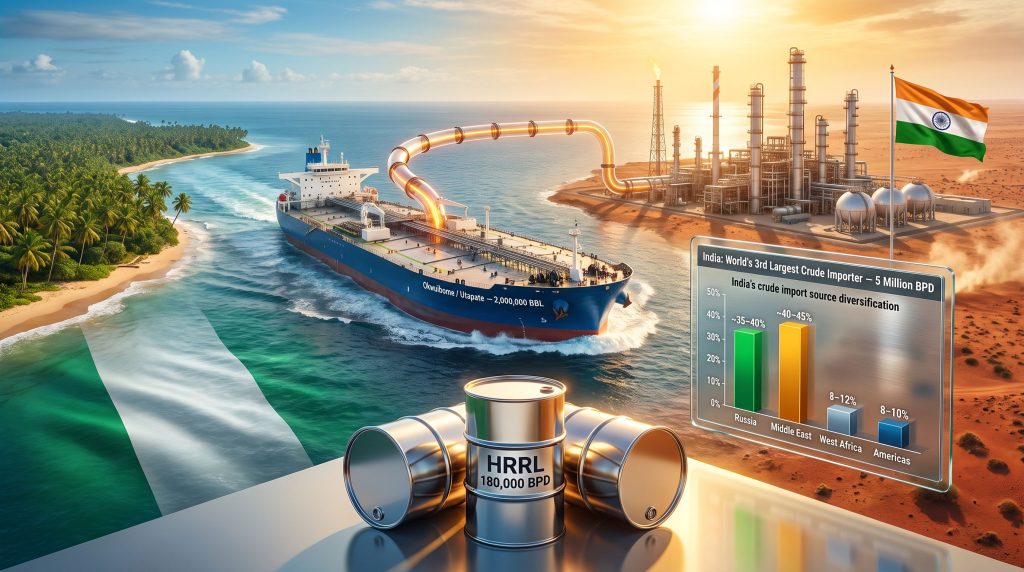
The Crude Economics Driving India's Atlantic Basin Pivot
Global oil markets rarely operate on simple bilateral logic. When a refinery deep in the Indian interior begins systematically pulling crude from the coastlines of West Africa, it signals something more complex than a single purchasing decision. It reflects a recalibration of margin economics, supply chain resilience, and refinery-specific technical requirements playing out simultaneously across one of the world's fastest-growing energy systems.
India consumes over 5 million barrels of crude oil per day across its refining network, making it the third-largest crude importer on the planet. The geographic composition of that import stream has been in constant flux since 2022, shaped by sanctions regimes, pricing volatility, and the structural demands of refineries engineered for specific crude quality profiles. Understanding why HPCL buys West Africa crude for Rajasthan refinery operations requires unpacking all three of these forces at once.
When big ASX news breaks, our subscribers know first
HRRL: The Inland Refinery Redefining India's Supply Map
Most of India's major refining capacity clusters around its coastline, where crude tankers can offload directly into refinery feedstock systems. The HPCL Rajasthan Refinery Limited (HRRL) breaks from this model entirely. Situated in Barmer, in the heart of Rajasthan, it is one of India's most strategically distinct downstream assets, built to serve landlocked interior demand whilst reducing the country's reliance on coastal processing infrastructure.
| Feature | Detail |
|---|---|
| Processing Capacity | 180,000 barrels per day |
| Location | Barmer, Rajasthan |
| Ownership | HPCL 74% / Government of Rajasthan 26% |
| Crude Design Basis | Blended domestic and imported grades |
| Strategic Role | Inland supply security and coastal load relief |
What makes HRRL particularly interesting from a crude procurement standpoint is its designed ability to process a blend of domestically extracted Rajasthan crude alongside internationally sourced grades. The Barmer basin produces a relatively heavy, waxy crude that benefits from being blended with lighter imported grades to optimise the overall feedstock slate and maximise yields of high-value refined products like gasoline, diesel, and jet fuel.
This blending requirement is not incidental. It is the technical foundation that makes light sweet West African grades so commercially attractive for this specific facility, and it consequently explains why HPCL's procurement team returns to that supply corridor with notable regularity.
Breaking Down the West African Cargo: Grades, Volumes, and Counterparty
The most recent transaction involves approximately 2 million barrels of Nigerian crude, sourced through commodity trader Glencore via a competitive tender process, with the cargo scheduled for late September arrival at HRRL. According to reporting from Reuters, this procurement reflects HPCL's ongoing strategy to diversify its crude feedstock beyond Gulf and Russian supply corridors.
The parcel comprises two distinct Nigerian grades, each with characteristics well-suited to a complex refinery configuration:
- Okwuibome crude – a light, sweet Nigerian grade produced from the Niger Delta region, characterised by very low sulphur content and strong gasoline and middle distillate yields
- Utapate crude – another Nigerian light sweet grade, similarly low in sulphur, with a processing profile compatible with inland refinery configurations that require high product quality margins
| Crude Grade | Origin | Classification | Sulphur Content | Processing Suitability |
|---|---|---|---|---|
| Okwuibome | Nigeria | Light Sweet | Very Low | High yield premium products |
| Utapate | Nigeria | Light Sweet | Low | Compatible with complex refinery units |
| Bonny Light | Nigeria | Light Sweet | Low | West African benchmark grade |
| Pazflor | Angola | Medium Sweet | Moderate | Suitable for complex conversion units |
Pricing terms for the transaction have not been made public, which is consistent with standard practice for state-owned refiner tenders in India. HPCL, Glencore, and the Nigerian upstream operators involved do not typically comment on individual commercial arrangements of this nature.
A Recurring Pattern, Not a One-Off Decision
Context is critical here. Analysing HPCL's procurement history reveals that this transaction is not opportunistic. It fits within a clearly identifiable pattern of West African crude purchasing tied specifically to HRRL's operational requirements:
- An earlier procurement round secured 2 million barrels of Angolan crude via tender for early May delivery
- A mid-cycle purchase combined 2 million barrels from Brazilian and West African sources simultaneously
- A subsequent transaction secured 2 million barrels of West African crude for end-October delivery, comprising Bonny Light and Pazflor grades
- The current August 2026 deal adds another 2 million barrels of Nigerian Okwuibome and Utapate crude via Glencore for late September processing
The consistent 2-million-barrel parcel size across every documented West African transaction is unlikely to be coincidental. It almost certainly reflects HRRL's tankage capacity constraints, pipeline throughput scheduling, and the operational cadence of the refinery's blending programme rather than market opportunism.
This pattern transforms what might appear to be an isolated market transaction into evidence of a systematic sourcing strategy. Furthermore, HRRL appears to have established West African crude as a structural component of its import slate, with procurement occurring at regular intervals tied to refinery scheduling cycles.
Why West Africa? The Four Forces Reshaping Indian Crude Slate Construction
Several macro-level dynamics are converging to make West African grades increasingly competitive for Indian refiners in 2025 and 2026. Understanding these forces requires looking beyond any single transaction.
Does Middle Eastern Pricing Drive the Pivot?
Middle Eastern Official Selling Price Volatility
Saudi Aramco and other Gulf producers set Official Selling Prices (OSPs) monthly for their crude grades. When these OSPs rise relative to Atlantic Basin spot market prices, the economic case for Middle Eastern crude weakens for price-sensitive buyers like Indian state refiners. During periods of elevated Gulf OSPs, the arbitrage opportunity from sourcing Nigerian or Angolan grades widens materially, and Indian procurement desks respond by increasing West African tender activity. Monitoring current crude oil prices alongside OSP movements is therefore central to understanding when these procurement shifts occur.
Has the Russian Discount Window Closed?
Russian Crude Discount Compression
Following India's aggressive pivot toward discounted Russian Urals and ESPO Blend crude post-2022, a structural problem has gradually emerged. As Indian refiners became the dominant buyers of sanctioned Russian barrels, their collective market power as discount-seekers diminished. Sellers repriced the risk premium, and Russian crude discounts narrowed considerably from their 2022 peaks. This compression has progressively restored the relative competitiveness of West African grades for margin-conscious refiners.
Crude Quality Mismatch with Russian Grades
This point is frequently overlooked in mainstream coverage. Russian Urals is a medium sour crude, meaning it carries higher sulphur content and a heavier density profile than Nigerian light sweet grades. For HRRL, which is blending with waxy domestic Rajasthan crude, adding a medium sour Russian grade may not optimise the overall feedstock slate as effectively as a light sweet West African barrel. The refinery's hydrotreating and desulphurisation unit capacities, along with its catalytic cracker configuration, are key determinants of which crude grades deliver the best yield economics.
West African Spot Market Liquidity and Trader Access
Nigerian and Angolan crude grades are among the most actively traded in the global spot market, particularly through the Dated Brent pricing benchmark system. Movements in WTI and Brent oil futures directly influence the relative attractiveness of these Atlantic Basin barrels for Indian buyers. This liquidity means Indian refiners can access these grades flexibly through competitive tender processes without committing to long-term offtake agreements that reduce procurement agility.
The Role of Commodity Traders in India's State Refiner Supply Chain
A lesser-understood aspect of Indian crude procurement is the structural dependence on international commodity traders as intermediaries, even for large state-owned refiners with extensive direct government-to-government energy relationships. In this context, commodity trading giants like Glencore continue to play an indispensable role that state-owned entities cannot easily replicate internally.
Traders like Glencore serve several functions that state refiners cannot easily replicate internally:
- Cargo aggregation – consolidating smaller upstream liftings from multiple Nigerian operators into commercially viable 2-million-barrel parcels
- Competitive price discovery – the tender process HPCL uses forces multiple traders to compete simultaneously, driving pricing efficiency
- Logistics management – vessel chartering, blending coordination, and delivery scheduling across complex multi-port supply chains
- Counterparty risk absorption – traders bridge credit and pricing risk between upstream producers and downstream buyers
- Grade blending flexibility – traders can blend two or more crude grades into a single cargo parcel to meet a refinery's exact specification requirements
The selection of Glencore for this transaction reflects that company's deep West African crude trading infrastructure, including established offtake relationships with Nigerian upstream operators across both onshore and offshore producing assets in the Niger Delta and deepwater blocks.
The next major ASX story will hit our subscribers first
India's Crude Import Geography: Where the Numbers Stand
The broader context for HPCL buys West Africa crude for Rajasthan refinery decisions is a material shift in India's crude import geography over the past four years. The table below captures the approximate directional change:
| Supply Region | Approx. Share (2022) | Approx. Share (2025-26) | Direction |
|---|---|---|---|
| Russia | ~2% | ~35-40% | Sharply higher |
| Middle East (Gulf) | ~65% | ~40-45% | Declining |
| West Africa | ~10-12% | ~8-12% | Stabilising |
| Americas (Latin America, USA) | ~5-8% | ~8-10% | Gradually rising |
| Others | ~5% | ~5% | Stable |
Note: These figures represent approximate estimates derived from publicly available trade data and industry reporting. They should not be treated as precise official statistics.
West Africa's share of Indian crude imports is not dominant by volume, but its strategic role is disproportionate to its percentage weight. West African grades serve as the quality counterweight to the heavier, sourer Russian barrels that now dominate India's import portfolio by volume. Without Atlantic Basin light sweet crude in the slate, refinery product yield quality and hydrotreating economics can deteriorate.
What This Signals for India's Long-Term Energy Procurement Strategy
Five structural insights emerge from analysing HPCL's West African procurement pattern in full:
- Inland refinery economics are actively reshaping import geography – HRRL's landlocked location and blending requirements create specific crude quality needs that Atlantic Basin grades satisfy more efficiently than many alternatives
- The standardised 2-million-barrel parcel indicates systematic planning – this is not opportunistic buying but scheduled procurement aligned with refinery operational cycles and tankage constraints
- Commodity traders remain structurally essential – even as India deepens direct government-to-government energy relationships globally, traders like Glencore continue to provide indispensable aggregation, logistics, and price discovery services
- West African crude functions as a portfolio quality anchor – it balances the sulphur and density profile of the overall import slate in ways that Russian grades structurally cannot
- Crude import diversification is operational policy, not strategic rhetoric – HPCL is executing across multiple supply corridors simultaneously, demonstrating that multi-source procurement is embedded in daily refinery management
In addition, understanding how commodity hedging strategies interact with these procurement decisions is increasingly important for analysts tracking India's evolving energy market positioning. Furthermore, the broader fiscal framework, including the import tax structure in India, plays a role in shaping how cost-competitive Atlantic Basin barrels ultimately become when landed at Indian ports.
As industry analysis from S&P Global highlights, the completion of HRRL represents a landmark shift in how India's inland refining capacity will be supplied going forward, with West African crude likely to remain a recurring feature of its feedstock slate.
This article is intended for informational purposes only and does not constitute financial or investment advice. Crude oil price forecasts, import share estimates, and procurement pattern analyses involve inherent uncertainty and should not be relied upon as the basis for investment decisions. Readers should conduct independent research and consult qualified professionals before acting on any information presented here.
Frequently Asked Questions
What crude grades did HPCL purchase from West Africa for the Rajasthan refinery?
HPCL secured approximately 2 million barrels of Nigerian crude comprising Okwuibome and Utapate grades through commodity trader Glencore via a competitive tender process. Both are light sweet grades with low sulphur content and processing characteristics well-matched to the HRRL facility's refinery configuration.
When is the West African crude cargo expected to arrive at HRRL?
The cargo is scheduled to arrive in late September 2026 for processing at the HPCL Rajasthan Refinery Limited facility in Barmer, Rajasthan.
Why does HPCL source crude from West Africa rather than relying exclusively on Middle Eastern or Russian supply?
Middle Eastern OSP volatility, the narrowing of Russian crude discounts from their post-2022 peaks, and HRRL's specific requirement for light sweet grades to blend with heavier domestic Rajasthan crude all contribute to making West African barrels economically and technically attractive on a recurring basis.
What is HRRL's processing capacity and ownership structure?
HRRL operates with a processing capacity of 180,000 barrels per day. HPCL holds a 74% stake in the joint venture, with the remaining 26% owned by the Government of Rajasthan.
How does the competitive tender process work for Indian state refiner crude procurement?
HPCL issues tenders inviting multiple commodity traders to submit competing bids for a specified crude grade, volume, and delivery window. This process drives pricing efficiency by creating simultaneous competition among potential suppliers, with the winning counterparty selected based on price and delivery reliability.
Want to Know Which ASX Energy and Resources Discoveries Could Deliver Exceptional Returns?
Discovery Alert's proprietary Discovery IQ model scans ASX announcements in real time, instantly transforming complex commodity and resources data into actionable investment insights — much like the supply chain shifts and margin economics reshaping India's crude import strategy. Explore historic mineral discoveries and their market-defining returns, then begin your 14-day free trial at Discovery Alert to position yourself ahead of the next major ASX resources opportunity.