
July 8, 2026
Understanding the HRC-Rebar Price Divergence Phenomenon
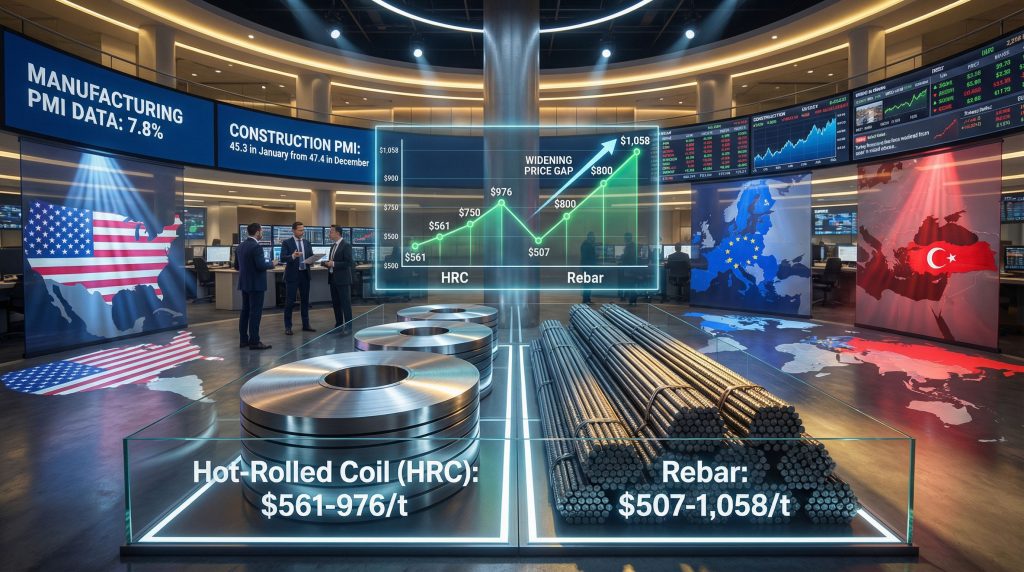
Global steel markets reflect an accelerating structural transformation as manufacturing resilience increasingly contrasts with construction sector volatility. Hot-rolled coil (HRC) and rebar pricing trajectories have established the widest divergence pattern since mid-2025, revealing fundamental shifts in regional demand characteristics and trade policy effectiveness across steel product categories. Furthermore, these global HRC prices and rebar prices dynamics demonstrate how iron ore price trends influence downstream steel product valuations.
Current Global Steel Product Price Comparison
| Product Category | Global Price Range | Regional Premium | Key Driver |
|---|---|---|---|
| Hot-Rolled Coil (HRC) | $561/t | US: +82% vs Asia | Manufacturing demand + tariffs |
| Rebar (Construction) | $507/t | Regional variation | Seasonal construction cycles |
| Price Gap | $55/t premium | Widening trend | Sectoral demand shift |
The current premium spread of $54.67 per tonne between global HRC and rebar trackers represents more than simple seasonal adjustment patterns. This divergence operates through distinct market access mechanisms where flat products experience more severe tariff barrier impacts, creating scarcity premiums in protected markets while long products face smaller import quota protections and greater oversupply dynamics.
Near-parity pricing between Asian HRC and slab markets at $464/t HRC versus $463/t slab on an FOB China/Asia basis indicates intermediate product bottlenecks supporting downstream flat product pricing through production cost constraints. This technical factor demonstrates how supply chain tightness in semi-finished materials creates structural support for finished flat steel products.
When big ASX news breaks, our subscribers know first
What Manufacturing Indicators Drive Flat Steel Product Premiums?
Manufacturing sector fundamentals across developed economies create durable demand characteristics that differentiate flat steel products from construction-dependent categories. German fabricated metal orders surged 7.8% month-over-month in December 2025, driven specifically by machinery and equipment manufacturing sectors that directly consume HRC inputs through progressive die stamping and fabrication processes.
Key Manufacturing Demand Metrics:
- Eurozone manufacturing PMI recovery trends supporting industrial capacity expansion
- US industrial capacity utilisation maintaining steady HRC consumption patterns
- Asian export manufacturing indices demonstrating regional demand resilience
- Equipment replacement cycles creating multi-year demand visibility beyond seasonal factors
Regional capacity utilisation data supports this manufacturing demand thesis, with EU blast furnaces operating at approximately 85% capacity while strategically emphasising flat product production. In addition, US electric arc furnace facilities maintain 81% capacity utilisation rates, reflecting sustained industrial demand for steel inputs in automotive, machinery, and appliance manufacturing applications.
Manufacturing demand operates on fundamentally different cyclical patterns compared to construction activity. Automotive production facilities require continuous HRC supply for body panel stamping operations, utilising just-in-time inventory systems that create consistent quarterly demand regardless of weather conditions or seasonal building constraints.
The December 2025 surge in German manufacturing orders demonstrates renewed industrial investment momentum, particularly in sectors producing pumps, compressors, and hydraulic components that utilise fabricated metal products containing HRC inputs. However, this industrial equipment production represents capital formation cycles extending beyond immediate economic uncertainties, directly influenced by tariff impact dynamics across different steel product categories.
Why Are Construction Steel Prices Lagging Despite Infrastructure Spending?
Construction steel demand exhibits pronounced cyclicality due to weather-dependent building activity across northern hemisphere markets, creating structural headwinds for rebar pricing during winter months regardless of infrastructure spending announcements. The eurozone construction PMI declined to 45.3 in January from 47.4 in December, indicating accelerating contraction beyond typical seasonal patterns.
Construction Market Dynamics:
- Q1 seasonal weakness: Winter construction slowdown reduces active building days
- Weather constraints: Site accessibility problems and labour availability issues
- Project financing delays: Multi-year infrastructure timelines distribute material purchases
- Permit processing bottlenecks: Regulatory constraints compound seasonal factors
Turkish export rebar demonstrates this pricing pressure, trading at an $11 per tonne discount to HRC, representing the widest spread since May 2025. At least four mills have reduced output in recent weeks due to rising scrap costs, building finished product inventories, and softening demand conditions.
Public infrastructure project announcements create limited immediate rebar demand because these initiatives operate with multi-year completion schedules and staged material procurement processes. Unlike manufacturing equipment purchases with predictable replacement cycles, construction projects face permitting uncertainties, financing approval delays, and weather-dependent execution timelines.
Italian rebar pricing demonstrates defensive mechanisms through the Carbon Border Adjustment Mechanism (CBAM), which makes imports more expensive and provides domestic producers competitive protection from five-year price lows experienced during previous seasonal downturns.
How Do Trade Policies Create Regional Steel Price Disparities?
Trade protection measures fundamentally reshape global steel flow patterns by creating artificial scarcity in protected markets while enabling domestic and preferred-source mills to maintain substantial price premiums. Consequently, US tariff effects ranging from 25-50% on steel imports combine with EU quota reductions and 50% out-of-quota tariffs to limit third-country penetration more effectively in flat products than long product categories.
Regional Trade Policy Effects:
- US market protection: 25-50% tariff barriers limiting import competition
- EU quota system: Reduced import volumes with punitive out-of-quota rates
- UK vulnerability: Facing potential dumping ground status without adequate protection
- Chinese export pressure: 119 million tonnes in 2025 exceeds EU and US consumption combined
The UK steel industry faces existential challenges with import quotas potentially halved from July 1, 2026. Industry executives characterise this as creating dumping ground conditions where excess global supply concentrates in unprotected markets, threatening domestic production viability.
Chinese steel exports totalling 119 million tonnes in 2025 exceed the combined consumption of the EU (140 million tonnes) and US (90 million tonnes), creating structural oversupply pressure that protected markets can partially deflect through trade barriers while unprotected regions absorb excess volumes.
Turkish producers demonstrate strategic adaptation by shifting toward slab casting rather than finished long products, responding to export market constraints and quota changes that reduce access to traditional European customers. This production strategy adjustment reflects broader industry reconfiguration under altered trade policy frameworks, particularly regarding Trump tariff implications on global steel trade flows.
What Production Capacity Trends Explain Current Price Dynamics?
Mill utilisation patterns reveal strategic production shifts favouring flat steel products in protected markets while long product producers face margin compression and output reductions. European blast furnaces operating at 85% capacity focus increasingly on flat products that benefit from stronger tariff protection and manufacturing demand stability.
Regional Steel Production Capacity Analysis
| Region | Blast Furnace Utilisation | EAF Utilisation | Strategic Focus |
|---|---|---|---|
| EU | 85% capacity | Rising | Flat products emphasis |
| US | Variable | 81% capacity | Import substitution |
| China | Declining trend | Softening | Raw material cost pressure |
| Turkey | Reduced output | 4+ mills cutting | Long products struggling |
Chinese blast furnace production softening contributes to raw material price weakness, potentially improving margins for non-Chinese flat steel producers as input costs decline. This development creates competitive advantages for mills in protected markets that can capture both reduced raw material costs and maintained selling price premiums.
Raw material cost pressures demonstrate through Asian slab market dynamics, where tight intermediate product availability supports downstream flat product pricing. For instance, the convergence of HRC and slab prices at near-parity levels indicates production bottlenecks in semi-finished materials that constrain flat steel supply expansion despite strong demand conditions.
Scrap cost increases compound challenges for long product producers, particularly those dependent on electric arc furnace technology. Rising input costs combined with softening finished product prices compress margins and force output reductions across multiple Turkish mills serving export markets, reflecting broader mining industry evolution challenges.
How Do Seasonal Patterns Affect Steel Product Price Relationships?
Historical analysis reveals predictable cyclical patterns in HRC-rebar price relationships, with winter months consistently favouring manufacturing steel demand over construction-dependent categories. The current premium represents the widest spread since mid-June 2025, with seasonal convergence typically occurring during spring construction season activation.
Seasonal Steel Demand Patterns:
- January-March: Winter slowdown benefits manufacturing steel through weather-independent demand
- April-September: Construction season supports rebar demand recovery and price convergence
- October-December: Industrial restocking cycles favour flat products before year-end
- Multi-year cycles: Infrastructure project timing creates irregular demand distribution
European construction activity demonstrates pronounced seasonality, with the PMI reading of 45.3 in January indicating severe contraction territory. This pattern repeats annually as northern hemisphere weather constrains active construction days, reduces site accessibility, and limits labour availability for outdoor building activities.
Turkish rebar exports historically recover around April as major public housing projects commence and seasonal construction demand accelerates. However, mounting trade barriers and quota restrictions limit export relief prospects despite domestic seasonal improvements expected in coming months.
The divergence pattern from 2025 reached a $58 per tonne gap by end-March before seasonal convergence reduced spreads during peak construction months. Industry participants anticipate similar seasonal dynamics for 2026, though trade policy changes may alter traditional convergence timing and magnitude.
The next major ASX story will hit our subscribers first
What Investment Implications Emerge from Steel Market Restructuring?
Sectoral performance differentiation creates distinct investment opportunities between construction-focused and manufacturing-focused steel operations, with flat product producers benefiting from higher margins and more predictable demand patterns. Regional market access becomes critical for producer profitability under evolving trade policy frameworks.
Key Investment Considerations:
- Mill location advantages: Proximity to protected markets enhances pricing power
- Product mix flexibility: Ability to shift between flat and long products during market cycles
- Raw material cost management: Vertical integration benefits during input price volatility
- Export market diversification: Reducing dependence on quota-constrained destinations
Supply chain resilience factors gain importance as trade policies create artificial market segmentation. Producers with access to multiple regional markets demonstrate superior adaptation capabilities compared to those dependent on single export destinations facing quota restrictions or tariff barriers.
Manufacturing sector digitisation and automation trends support consistent flat steel demand through equipment replacement cycles and industrial capacity expansion requirements. This demand characteristic provides more stable cash flow patterns than construction-dependent operations subject to seasonal variations and project financing uncertainties.
Carbon Border Adjustment Mechanism implementation creates structural competitive advantages for domestic European producers while increasing costs for import competition. This regulatory framework establishes long-term protective mechanisms beyond traditional tariff and quota systems.
How Will Regulatory Changes Shape Future Steel Pricing?
Environmental regulations through CBAM create permanent cost structures favouring domestic production over imports by incorporating carbon content into trade competitiveness calculations. This mechanism provides insulation from traditional dumping practices while encouraging lower-carbon production technologies.
Critical Policy Timeline Milestones:
- July 2026: UK quota decisions affecting domestic industry survival prospects
- April 2026: Turkish construction season expected to support regional rebar demand
- Ongoing developments: EU quota refinements and trade remedy case progressions
- CBAM expansion: Potential coverage extension to additional steel product categories
Trade policy evolution demonstrates permanent structural shifts rather than cyclical adjustments, with major economies implementing comprehensive protection frameworks covering tariffs, quotas, and environmental standards. These multi-layered approaches create complex competitive landscapes favouring regionally integrated supply chains.
Regulatory compliance costs increasingly differentiate producer competitiveness, particularly as environmental standards expand beyond carbon content to include broader sustainability metrics. Mills with advanced environmental technologies gain competitive advantages through both compliance cost management and market access preservation.
What Long-Term Structural Changes Are Reshaping Steel Markets?
Geographic production shifts reflect permanent alterations in global steel industry structure, with Chinese blast furnace production softening while protected market producers expand capacity utilisation. This rebalancing creates opportunities for non-Chinese producers to capture market share through regional supply chain localisation.
Market Structure Transformation Factors:
- Regional supply chain resilience: Reduced dependence on long-distance trade relationships
- Technology-driven demand evolution: Manufacturing digitisation supporting flat steel consumption
- Environmental regulation compliance: Creating permanent cost structure differentials
- Trade policy permanence: Multi-decade protection frameworks replacing temporary measures
Demand pattern evolution favours manufacturing sectors utilising consistent steel inputs over cyclical construction applications. Industrial automation expansion, automotive production modernisation, and machinery equipment replacement cycles create multi-year demand visibility that construction projects cannot match due to financing and permitting uncertainties.
The convergence of trade protection, environmental regulation, and technological advancement establishes new competitive parameters where regional integration, environmental compliance, and product mix flexibility determine long-term producer viability. Traditional cost-based competition models face disruption from these multi-dimensional competitive factors.
Market Intelligence and Pricing Outlook
Global HRC prices and rebar prices divergence reflects fundamental industry restructuring rather than temporary market dislocations. According to global steel price forecasts, the current spread between flat and long products may persist through 2026 as manufacturing demand resilience contrasts with construction sector volatility.
Furthermore, steel market analysis indicates that trade protection measures create artificial scarcity in protected markets while long products face structural oversupply conditions. Global HRC prices and rebar prices therefore reflect distinct demand fundamentals where manufacturing steel benefits from weather-independent consumption patterns and stronger tariff protection mechanisms.
Investment Analysis Framework:
Investors seeking exposure to steel industry dynamics should evaluate regional market access, environmental compliance capabilities, and product mix flexibility as primary competitive determinants. Manufacturing demand stability increasingly outweighs construction market cyclicality in determining sustainable profitability patterns across steel product categories.
Important Disclaimer: This analysis involves forecasts and speculation regarding steel market developments, trade policy impacts, and industry structural changes. Market conditions can change rapidly due to economic, political, or regulatory factors beyond current visibility. Investment decisions should incorporate comprehensive due diligence and professional financial advice appropriate to individual circumstances and risk tolerance levels.
Looking to Capitalise on Steel Commodity Market Shifts?
Discovery Alert's proprietary Discovery IQ model delivers real-time alerts on significant ASX mineral discoveries, instantly empowering subscribers to identify actionable opportunities in iron ore, steel-making commodities, and related mining stocks ahead of the broader market. Visit Discovery Alert's dedicated discoveries page to understand why historic mineral discoveries can generate substantial returns, then begin your 14-day free trial today to secure your market-leading advantage in commodity investing.