August 6, 2026
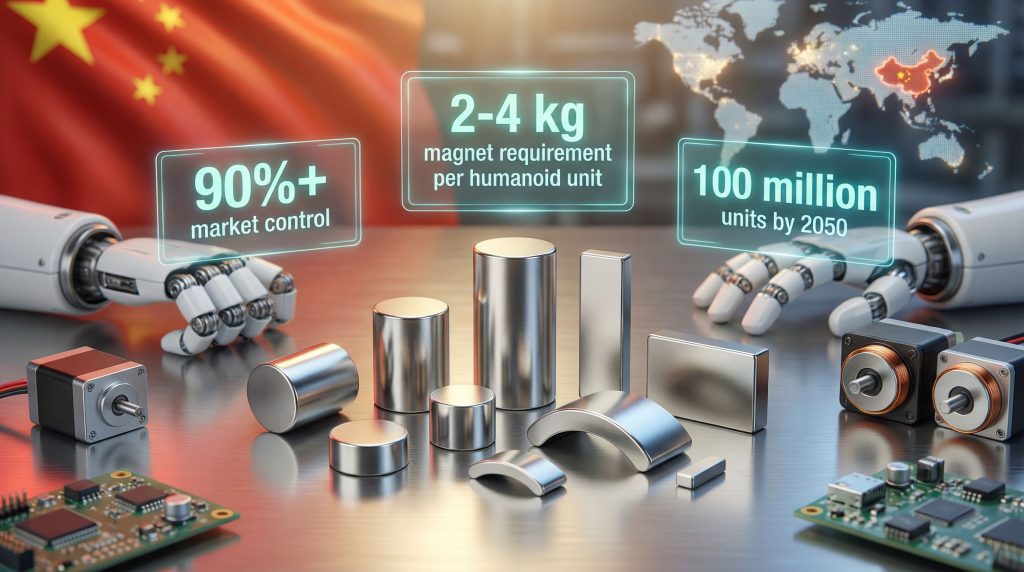
The emergence of humanoid robotics as a commercial reality rests on a foundation most consumers never see: an intricate network of rare earth permanent magnets embedded within every joint, actuator, and servo motor. These microscopic powerhouses represent the difference between theoretical robotics and practical automation at human scale. Furthermore, the critical minerals supply challenges facing this emerging industry highlight broader concerns about technological sovereignty.
What Makes Rare Earth Elements Critical for Advanced Robotics?
Neodymium-iron-boron (NdFeB) magnets dominate high-performance robotics applications due to their exceptional magnetic properties that conventional materials simply cannot match. These rare earth magnets deliver energy product values exceeding 50 MGOe (mega-gauss-oersteds), compared to ferrite magnets that typically achieve only 3-5 MGOe.
| Magnet Type | Energy Product (MGOe) | Operating Temperature (°C) | Cost Relative to NdFeB |
|---|---|---|---|
| Neodymium-Iron-Boron | 48-52 | 80-200 | 1.0x |
| Samarium Cobalt | 26-32 | 250-350 | 8.0x |
| Ferrite | 3-5 | 250 | 0.1x |
| Alnico | 5-9 | 525 | 2.5x |
The physics behind this dominance becomes clear when examining power density requirements. Humanoid robots demand approximately 150-200 watts per kilogram of actuator weight to achieve human-like movement patterns. This specification pushes conventional magnetic materials beyond their operational limits.
Understanding the Material Foundation of Modern Automation
Modern humanoid robots require precise torque control across 20-40 individual joints operating simultaneously. Each joint actuator must deliver consistent performance while maintaining compact dimensions that fit within anatomically proportioned limbs. Consequently, this constraint creates an engineering challenge where magnetic field strength directly correlates with robot capability.
Motor density calculations reveal the critical relationship between rare earth content and robot performance:
- Torque-to-weight ratio: NdFeB magnets enable 8-12 Nm/kg compared to 2-3 Nm/kg for ferrite alternatives
- Energy efficiency: Rare earth motors achieve 92-96% efficiency versus 85-88% for conventional designs
- Heat generation: Superior magnetic properties reduce resistive losses by approximately 40%
The cumulative effect across multiple joints means that alternative magnet technologies would require robots to carry substantially more weight in motors and cooling systems. This fundamentally alters their mobility characteristics and overall performance capabilities.
When big ASX news breaks, our subscribers know first
Why Do Humanoid Robots Require Such Massive Rare Earth Inputs?
Recent market analysis indicates that each humanoid robot incorporates approximately 1.3 kilograms of neodymium-praseodymium (NdPr) elements, primarily concentrated in high-performance permanent magnets distributed throughout the mechanical systems. However, understanding the critical minerals recycling potential becomes crucial for managing these intensive material requirements.
Material Intensity Analysis by Robot Component
| Robot System | Magnet Weight Distribution | NdPr Content (kg) | Primary Function |
|---|---|---|---|
| Joint Actuators | 65-70% | 0.85-0.90 | Limb movement and positioning |
| Servo Motors | 20-25% | 0.26-0.33 | Precision control systems |
| Sensor Systems | 10-15% | 0.13-0.20 | Navigation and feedback |
This material intensity stems from the fundamental engineering requirements of human-scale robotics. Unlike industrial robots that operate in fixed positions with external power sources, humanoid robots must carry their entire motor system whilst maintaining battery life sufficient for practical applications.
Engineering Constraints That Drive Magnet Dependency
The relationship between size constraints and power requirements creates a materials bottleneck that currently has no viable alternative. Key engineering factors include:
- Space limitations: Actuators must fit within limb proportions matching human dimensions
- Weight distribution: Motor placement affects robot balance and energy consumption
- Heat dissipation: Compact motors generate concentrated thermal loads requiring efficient designs
- Precision requirements: Human-robot interaction demands positional accuracy within 0.5-1.0 degrees
Cost implications reveal that rare earth magnets represent approximately 15-20% of total robot manufacturing expenses. For a robot with a target manufacturing cost of $50,000, magnet-related expenses typically range from $7,500 to $10,000 per unit.
How Has China Established Dominance in the Robotics Material Supply Chain?
China's strategic position in rare earth processing extends far beyond raw material extraction, encompassing the entire value chain from oxide separation to finished magnet production. This vertical integration creates multiple chokepoints that affect global robotics manufacturing. Furthermore, the broader critical minerals strategy implications become evident when examining this concentrated supply structure.
Vertical Integration Strategy Across the Value Chain
The rare earth processing pipeline demonstrates China's systematic approach to supply chain control:
- Raw Material Processing: China processes over 85% of global rare earth oxides
- Metal Production: Chinese facilities refine 95% of rare earth metals worldwide
- Magnet Manufacturing: Chinese companies produce 90% of NdFeB permanent magnets
- Motor Assembly: Domestic motor manufacturers integrate magnets for robotics applications
This concentration means that even rare earths mined in other countries typically require processing through Chinese facilities. The technical complexity and environmental considerations of rare earth separation create substantial barriers to establishing alternative processing capacity.
Export Control Mechanisms as Market Leverage Tools
Recent regulatory developments have introduced new licensing requirements for rare earth-containing products, including robotics components. These controls create potential supply disruption points that extend beyond traditional commodity trading relationships. For instance, China's rare earth export controls have already begun impacting international robotics development projects.
The impact on robotics manufacturers becomes evident when examining the global market structure. Chinese companies captured 71% of global humanoid robot shipments in 2025, with leading manufacturers Agibot/Zhiyuan and Unitree accounting for approximately 9,300 of the total 13,000 units shipped globally.
This market dominance reflects more than competitive pricing or technical capability. It represents the culmination of coordinated industrial policy that aligns upstream material control with downstream manufacturing capacity.
What Are the Long-Term Supply Security Implications?
Demand projections for humanoid robotics suggest a fundamental shift in rare earth consumption patterns that could strain existing supply networks and processing infrastructure. Consequently, understanding how this relates to China's humanoid robot surge helps illustrate the strategic implications of china rare earths in humanoid robots.
Demand Projection Scenarios Through 2050
| Scenario | Global Robot Units | Total NdPr Demand (tonnes) | Percentage of Current Production |
|---|---|---|---|
| Conservative | 100 million | 130,000 | 650% |
| Moderate | 500 million | 650,000 | 3,250% |
| Aggressive | 1 billion | 1,300,000 | 6,500% |
These projections assume current magnet efficiency levels and do not account for potential technological improvements that might reduce material requirements per unit. However, they illustrate the magnitude of supply chain expansion necessary to support widespread robot deployment.
Current global NdPr production capacity hovers around 20,000 tonnes annually, with approximately 60% allocated to automotive applications, 25% to industrial motors, and 15% to consumer electronics. The conservative robotics scenario alone would require expanding total rare earth processing capacity by more than sixfold.
Geopolitical Risk Assessment Framework
Supply vulnerability analysis reveals multiple potential disruption points that extend beyond traditional trade relationships:
- Processing bottlenecks: Limited alternative separation facilities outside China
- Technology transfer restrictions: Controlled access to processing equipment and expertise
- Environmental regulatory barriers: Substantial permitting challenges for new processing facilities
- Capital intensity requirements: Processing plants require $500 million to $2 billion in initial investment
The strategic implications extend to national security considerations, as humanoid robots may eventually serve in critical infrastructure, healthcare, and defence applications where supply chain resilience becomes paramount. For example, Europe's critical materials initiatives reflect growing recognition of these vulnerabilities.
Which Alternative Technologies Could Reduce Rare Earth Dependency?
Research into alternative motor technologies and magnet materials offers potential pathways to reduce rare earth dependency. However, each approach involves significant performance trade-offs or technological uncertainties.
Emerging Magnet Technologies Under Development
| Technology | Development Status | Performance vs NdFeB | Timeline to Commercial Scale |
|---|---|---|---|
| Iron-Nitride (FeN) | Laboratory phase | 80-90% | 8-12 years |
| Manganese-Aluminium | Pilot production | 60-70% | 5-8 years |
| Advanced Ferrites | Commercial testing | 40-50% | 2-4 years |
| Hybrid Designs | Prototype stage | 75-85% | 4-6 years |
Iron-nitride magnets represent the most promising alternative, potentially achieving magnetic properties approaching those of NdFeB materials without rare earth content. However, manufacturing challenges include maintaining crystal structure stability and achieving consistent magnetic orientation during production processes.
Motor Design Innovations to Minimise Material Requirements
Alternative motor architectures offer potential reductions in magnet dependency through design optimisation rather than material substitution:
- Electrically excited synchronous motors: Replace permanent magnets with electromagnetic field generation
- Reluctance motors: Utilise magnetic reluctance rather than permanent magnet fields
- Hybrid propulsion systems: Combine multiple motor types to optimise efficiency across operating ranges
- Advanced control algorithms: Maximise performance from lower-grade magnetic materials
These approaches typically involve trade-offs in control complexity, power consumption, or overall system weight. Such limitations may restrict their applicability in humanoid robotics applications where performance requirements remain stringent.
How Are Leading Robotics Companies Responding to Supply Chain Risks?
The concentration of global humanoid robot production within Chinese manufacturers creates both competitive advantages and supply chain vulnerabilities. Companies are beginning to address these concerns through diversification strategies that reflect broader mining investment strategies across the sector.
Diversification Strategies in Material Sourcing
Major robotics manufacturers are implementing multiple approaches to reduce supply chain concentration:
- Long-term supply agreements: Multi-year contracts with magnet suppliers to ensure price stability
- Inventory stockpiling: Strategic material reserves to buffer against supply disruptions
- Supplier qualification programmes: Development of alternative magnet sources outside China
- Recycling initiatives: Recovery programmes for magnets from end-of-life robotic systems
Recycling represents a particularly promising avenue, as NdFeB magnets retain their magnetic properties even after mechanical disassembly. Current recycling efficiency rates achieve approximately 85-95% recovery of rare earth content, though processing costs remain elevated compared to primary production.
Regional Production Capacity Building Initiatives
Government and industry initiatives are beginning to address processing capacity limitations through targeted investments:
- North American facilities: Several rare earth processing projects in development with combined capacity targeting 5,000-8,000 tonnes annually
- European strategic programmes: EU critical materials initiatives allocating funding for domestic processing capability
- Australia-Japan partnerships: Collaborative agreements linking Australian mining with Japanese processing expertise
These initiatives face substantial challenges in scaling to commercially relevant production levels. Furthermore, the timeframes involved must align with projected robotics market growth to remain relevant.
The next major ASX story will hit our subscribers first
What Investment Opportunities Emerge from This Material Bottleneck?
The structural mismatch between growing rare earth demand and limited processing capacity outside China creates multiple investment opportunities across the materials value chain. This situation particularly affects china rare earths in humanoid robots, where demand growth trajectories exceed current supply expansion plans.
Upstream Rare Earth Mining and Processing Plays
| Project | Location | Development Stage | Projected Capacity (tonnes/year) | Estimated Timeline |
|---|---|---|---|---|
| Round Top | Texas, USA | Pilot plant | 15,000 NdPr | 2027-2029 |
| Nechalacho | Canada | Pre-production | 2,000 NdPr | 2026-2027 |
| Browns Range | Australia | Feasibility study | 3,000 NdPr | 2028-2030 |
| Kvanefjeld | Greenland | Permitting phase | 5,000 NdPr | 2030+ |
Capital requirements for establishing competitive processing facilities typically range from $800 million to $1.5 billion. This creates high barriers to entry but potentially substantial returns for successful projects. The technical complexity of rare earth separation requires specialised expertise that remains concentrated among a limited number of engineering firms globally.
Technology Development Investment Themes
Innovation-focused investment opportunities span multiple technological approaches to addressing rare earth supply constraints:
- Magnet recycling technology: Advanced separation and purification systems for end-of-life magnets
- Alternative motor designs: Development of high-efficiency motors with reduced magnet requirements
- Processing efficiency improvements: Technologies to reduce costs and environmental impact of rare earth separation
- Robotics optimisation software: AI-driven control systems maximising performance from alternative materials
Venture capital and strategic investment in these sectors has increased substantially. Funding for rare earth technology companies grew from approximately $50 million annually in 2020 to over $300 million in 2025.
Strategic Implications for Global Technology Leadership
The intersection of china rare earths in humanoid robots represents more than a supply chain challenge. It illustrates how material dependencies can influence technological sovereignty and competitive positioning in emerging industries.
The current market structure, where Chinese manufacturers control both upstream material processing and downstream robot production, creates a reinforcing cycle. This may prove difficult for Western competitors to disrupt through traditional market mechanisms alone.
Long-term Competitive Positioning in Advanced Manufacturing
The strategic implications extend beyond robotics to encompass broader questions about technological independence in critical sectors. Nations developing autonomous robotics capabilities for defence, healthcare, or infrastructure applications must consider whether reliance on foreign-controlled supply chains creates unacceptable vulnerabilities.
Historical precedents from the solar panel and electric vehicle industries suggest that early material supply advantages can translate into sustained market dominance. This occurs even as technology and manufacturing capabilities mature globally.
Investment Portfolio Implications
For investors, the rare earth-robotics nexus presents both opportunities and risks that require careful analysis of multiple interconnected factors:
- Material price volatility: Rare earth pricing may experience increased volatility as robotics demand scales
- Supply chain security premiums: Companies with diversified material sourcing may command valuation premiums
- Technology disruption potential: Breakthrough alternative technologies could rapidly shift competitive dynamics
- Geopolitical risk factors: Trade relationships and export controls may influence market access and pricing
The optimal investment approach likely involves exposure across multiple points in the value chain. This strategy proves more effective than concentration in any single sector or geography.
"The emergence of humanoid robotics as a commercial reality fundamentally alters the strategic calculus around critical material supplies, creating new interdependencies that policymakers and investors must carefully navigate in the years ahead."
Investment Disclaimer: The information presented in this analysis is for educational purposes only and does not constitute investment advice. Rare earth and robotics investments involve substantial risks including commodity price volatility, technological obsolescence, and geopolitical uncertainty. Prospective investors should conduct independent research and consult qualified financial advisors before making investment decisions.
Are You Positioned to Capitalise on the Rare Earth Investment Opportunities Emerging from This Robotics Revolution?
The structural mismatch between exploding rare earth demand and constrained global supply chains creates compelling investment opportunities across mining, processing, and technology development sectors. Discovery Alert's proprietary Discovery IQ model delivers real-time alerts on significant ASX mineral discoveries, including critical metals projects that could benefit from this unprecedented demand surge. Begin your 30-day free trial today to identify actionable opportunities in this rapidly evolving market landscape ahead of mainstream recognition.