June 9, 2026
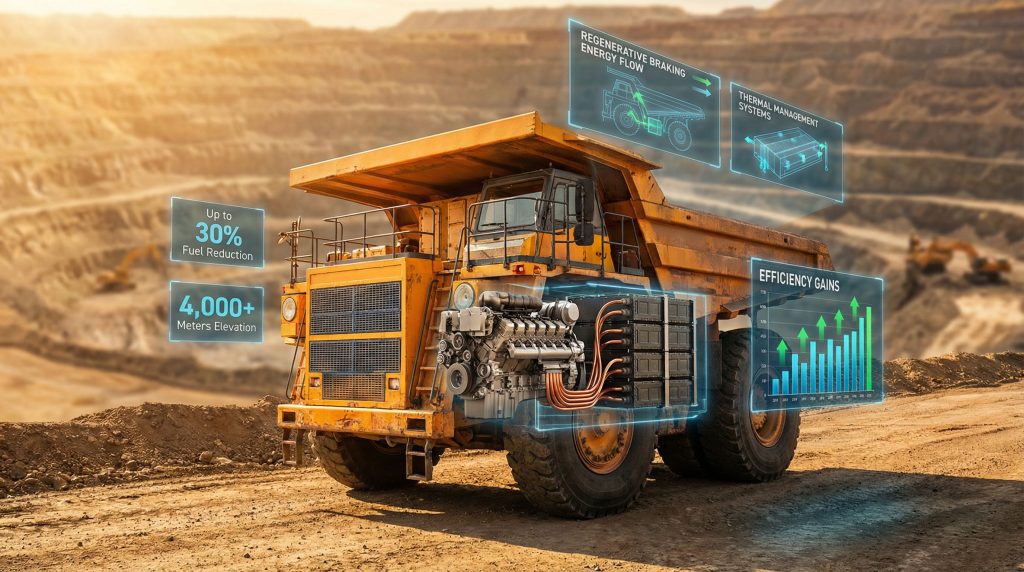
Ultra-class mining operations have long relied on diesel powertrains to move massive quantities of material across challenging terrain. However, the convergence of energy storage advances, emissions regulations, and operational efficiency demands is creating new pathways for heavy-duty vehicle electrification in mining environments. The hybrid-electric mining truck Cummins has pioneered represents a significant advancement in addressing these industry evolution trends.
Understanding the Engineering Framework of Mining Vehicle Hybridization
The technical architecture underlying hybrid-electric mining truck systems represents a fundamental shift in how ultra-class vehicles manage power distribution. These systems integrate modular battery configurations specifically designed for 300-tonne capacity vehicles, where power management algorithms must balance diesel and electric propulsion under extreme operating conditions.
At the core of these systems lies regenerative braking technology that captures kinetic energy during loaded downhill operations. The Cummins First Mode hybrid system demonstrates this approach through its integration of a Cummins QSK60 diesel engine with modular, interchangeable high-power electric battery systems. Energy generated during loaded downhill hauls is captured and stored onboard, while intelligent control software manages power flow between engine and battery components.
Power Management in Extreme Environments
High-altitude performance optimization presents unique challenges for hybrid-electric mining truck operations. At elevations exceeding 4,000 meters, reduced atmospheric pressure affects both diesel engine combustion efficiency and battery thermal management systems. The Caserones deployment in Chile's Andes mountains validates hybrid system performance under these extreme conditions, where steep haul profiles provide optimal regenerative energy capture opportunities.
Thermal management becomes critical in environments where ambient temperatures can range from sub-zero conditions at altitude to extreme heat in desert mining locations. Battery durability under continuous heavy-duty cycles requires sophisticated cooling systems and power electronics capable of maintaining performance across temperature extremes, which is essential for data-driven mining operations.
Integration Complexity with Fleet Operations
Retrofit hybrid systems must integrate seamlessly with existing fleet management protocols without disrupting production schedules. The modular design approach allows for component replacement and maintenance accessibility in remote mining locations where specialized technical support may be limited.
Maintenance accessibility considerations include component positioning for field service, diagnostic system integration, and operator training requirements for hybrid system management. Predictive maintenance scheduling must adapt to incorporate both traditional diesel engine service intervals and battery system monitoring protocols.
When big ASX news breaks, our subscribers know first
Economic Analysis of Retrofit Versus New Vehicle Acquisition
The economics of hybrid-electric mining truck adoption varies significantly between retrofit solutions and complete fleet replacement strategies. Current market data indicates that retrofit hybrid systems can achieve up to 30 percent fuel and emissions reductions while requiring substantially lower capital investment compared to new electric vehicle purchases.
| Performance Metric | Retrofit Hybrid | New Electric | Conventional Diesel |
|---|---|---|---|
| Capital Investment | $500K-$800K per unit | $2M-$3M per unit | $1.5M-$2M per unit |
| Implementation Period | 6-12 months | 18-36 months | Immediate |
| Fuel Cost Reduction | 20-30% annually | 60-80% annually | Baseline |
| Production Disruption | Minimal | Significant | None |
| Technical Risk | Moderate | High | Low |
Compatibility Assessment Protocols
Successful retrofit implementation requires comprehensive compatibility assessment across different truck manufacturers and model configurations. The Cummins collaboration with Komatsu and Lundin Mining demonstrates the multi-party coordination necessary for hybrid system integration into existing 300-ton haul truck platforms.
Electrical system upgrades must accommodate high-power battery charging and discharging cycles while maintaining safety certifications for hazardous mining environments. This includes explosive atmosphere ratings, electromagnetic compatibility, and fault tolerance systems that prevent operational disruption during power system failures.
Performance Validation Under Real-World Conditions
The world's first commercial hybrid-electric mining truck Cummins deployment at Caserones provides critical performance data for ultra-class vehicle hybridization. Operating under real haulage conditions at elevations exceeding 4,000 meters, the retrofitted 300-ton Komatsu haul truck validates hybrid technology performance across the full duty cycle of mining operations.
Energy Recovery Metrics in Steep Terrain
Regenerative braking systems demonstrate optimal performance in operations with significant elevation changes, where loaded vehicles descending steep grades can capture substantial kinetic energy. The Caserones location's steep haul profiles create ideal conditions for regenerative energy capture, with terrain characteristics that maximize energy recovery potential.
Energy storage optimisation requires battery systems capable of rapid charge acceptance during braking events while maintaining power availability for traction assistance during loaded climbs. Power distribution efficiency between diesel and electric systems must account for varying load conditions, grade changes, and operational duty cycles.
Reliability Performance in Harsh Environments
High-altitude operations present unique challenges for hybrid system components, including reduced cooling efficiency due to lower air density and temperature cycling effects on battery performance. Load capacity maintenance becomes critical when hybrid system integration adds weight and complexity to existing vehicle platforms.
The extreme conditions of the Andes provide a comprehensive testing environment for hybrid system durability, with temperature variations, altitude effects, and challenging terrain conditions that stress both mechanical and electrical components. Furthermore, validation of performance consistency across daily operational cycles informs commercial deployment strategies and addresses energy transition challenges.
Industry Collaboration Models Driving Technology Adoption
The mining industry's approach to hybrid-electric mining truck adoption reflects collaborative partnerships between equipment manufacturers, technology providers, and mining operators. Lundin Mining's participation in the Caserones pilot represents early adopter engagement with hybrid technology validation.
Technology Provider Acquisitions
Cummins' acquisition of First Mode demonstrates strategic consolidation within the mining electrification sector. This acquisition model allows established power technology providers to integrate specialised mining electrification capabilities while leveraging existing customer relationships and support infrastructure.
The collaboration involves three primary stakeholders: Cummins providing power technology expertise, Komatsu contributing vehicle integration knowledge, and Lundin Mining offering real-world operational validation. This partnership structure reduces implementation risks while accelerating technology development timelines.
Pilot Program Implementation Strategies
Joint pilot programs enable risk distribution across multiple industry participants while generating shared performance data. The Caserones deployment focuses on validating performance, durability, and energy recovery under real-world operating conditions, with results informing future commercial hybrid solutions.
Open-pit copper-molybdenum operations provide optimal applications for hybrid technology due to consistent grade variations that maximise regenerative braking opportunities. Fleet size considerations become important for hybrid system cost-effectiveness, with larger operations better positioned to absorb retrofit investment costs and implement sustainable mining practices.
Total Cost of Ownership Impact Analysis
Hybrid-electric mining truck systems demonstrate measurable economic benefits through fuel consumption reduction and operational efficiency improvements. Commercial hybrid solutions targeting up to 30 percent fuel and emissions reductions create significant operational cost savings over equipment lifecycles.
Operational Cost Reduction Calculations
Fuel cost reductions of 20-30 percent annually represent substantial savings for mining operations consuming hundreds of thousands of gallons of diesel fuel per vehicle per year. At current fuel prices, a single 300-ton haul truck consuming 200,000 gallons annually could achieve $60,000-$90,000 in annual fuel cost savings through hybrid system implementation.
Maintenance cost implications include both additional complexity from hybrid components and potential reductions in diesel engine operating hours. Battery system maintenance protocols require specialised technical capabilities, while reduced diesel engine runtime can extend traditional maintenance intervals.
Environmental Compliance Benefits
Emissions reduction quantification becomes increasingly important for Environmental, Social, and Governance (ESG) reporting requirements. Up to 30 percent emissions reductions translate to significant carbon footprint improvements for mining operations facing regulatory pressure and corporate sustainability commitments.
The Cummins Destination Zero strategy aligns hybrid technology deployment with broader industry transitions toward lower-carbon operations. Carbon footprint improvements support regulatory compliance in environmentally sensitive regions while enhancing corporate sustainability metrics through renewable mining solutions.
Technical Barriers and Implementation Challenges
Large-scale hybrid-electric mining truck Cummins deployment faces several technical and operational challenges that must be addressed for widespread adoption. Battery technology limitations for continuous heavy-duty applications remain a primary concern for mining operations requiring 24-hour productivity cycles.
Infrastructure Development Requirements
Charging infrastructure requirements in remote mining locations present logistical challenges for hybrid and electric vehicle deployment. While retrofit hybrid systems reduce infrastructure demands compared to fully electric vehicles, battery maintenance and replacement capabilities must be established at mining sites.
Supply chain dependencies for specialised components include battery cells, power electronics, and control systems that may have limited availability in remote mining regions. Risk management during technology transition periods requires contingency planning for hybrid system failures and traditional diesel operation fallback capabilities.
Skilled Technical Support Availability
Hybrid system maintenance requires technicians trained in both traditional diesel engine service and high-voltage electrical systems. The combination of mechanical and electrical expertise necessary for hybrid vehicle maintenance may be limited in remote mining locations.
System reliability concerns in harsh operating environments include dust, vibration, temperature extremes, and electromagnetic interference that can affect sensitive electronic components. Integration complexity with existing mine management systems requires software compatibility and data communication protocols, as highlighted in Global Mining Review's coverage of the deployment.
The next major ASX story will hit our subscribers first
Implementation Timeline and Adoption Projections
The hybrid-electric mining truck market is positioned for significant growth as mining companies balance sustainability commitments with operational efficiency requirements. Technology cost reduction projections indicate that hybrid systems will become increasingly competitive with conventional diesel powertrains.
Market Development Roadmap
Next-generation battery technologies focused on increased energy density and improved cycle life will enhance hybrid system performance and reduce total cost of ownership. Autonomous operation integration with hybrid powertrains represents a convergence of mining industry technology trends.
Predictive maintenance AI systems optimising hybrid performance can maximise fuel efficiency and component longevity through data-driven operational adjustments. Wireless charging systems for continuous operation capability may eliminate infrastructure constraints for electric mining vehicle deployment.
Regulatory Drivers and Market Forces
Adoption rate forecasts for different mining segments indicate that copper and other base metal operations will lead hybrid technology implementation due to favourable operational characteristics and ESG pressures. Underground mining applications may follow as battery technology and thermal management systems improve.
Regulatory pressures accelerating electrification timelines include carbon pricing mechanisms, emissions standards, and permit conditions that favour lower-emission mining operations. However, infrastructure development requirements supporting fleet transitions will drive collaborative investment between mining companies and equipment suppliers.
Disclaimer: This analysis contains forward-looking statements and projections based on current market information and technology development trends. Actual results may vary significantly due to technological, economic, and regulatory factors. Investment and operational decisions should be based on comprehensive due diligence and professional consultation.
Ready to Capitalise on Mining Technology Breakthroughs?
Discovery Alert's proprietary Discovery IQ model delivers real-time alerts on significant mining technology and exploration discoveries, instantly empowering subscribers to identify actionable opportunities ahead of the broader market. Understand why historic discoveries can generate substantial returns by exploring Discovery Alert's dedicated discoveries page, then begin your 14-day free trial today to position yourself ahead of the competition.