May 13, 2026
The Invisible Emissions Problem That Full Electrification Cannot Yet Solve
The mining industry's decarbonisation conversation has long been dominated by two competing visions: the grid-connected electric future and the diesel-powered present. Between these poles sits a commercially underexplored middle ground that is now, for the first time, being validated under genuine production conditions. The hybrid truck deployed at Caserones mine in Chile represents something more significant than a technology trial. It is the first commercially operating hybrid ultra-class haul truck anywhere in the world, and its early results are beginning to shift how mine operators think about the practical timeline for heavy haulage decarbonisation.
Understanding why this matters requires appreciating the specific engineering constraints that make ultra-class trucks so difficult to decarbonise in the first place.
When big ASX news breaks, our subscribers know first
Why Ultra-Class Haul Trucks Are Mining's Hardest Emissions Problem
Open-pit mines depend on ultra-class haul trucks as their central production asset. These machines operate continuously across multi-kilometre haul routes, carrying payloads measured in hundreds of tonnes, burning diesel at rates that dwarf almost every other piece of equipment on site. In aggregate, the haul fleet at a large open-pit mine typically accounts for the majority of on-site fuel consumption and greenhouse gas emissions, making it the logical first target for decarbonisation investment.
The problem is that the dominant electrification approaches face meaningful constraints in this specific application. Furthermore, the broader mining electrification transition reveals just how complex these constraints can be across the industry:
-
Full battery-electric trucks require substantial charging infrastructure, impose significant payload penalties from heavy battery packs, and have yet to demonstrate proven commercial deployments at scale in ultra-class open-pit operations.
-
Trolley-assist systems deliver strong emissions reductions on trolley segments but require substantial overhead line infrastructure, are geometrically constrained to specific haul route configurations, and represent a large fixed capital commitment.
-
Hybrid diesel-electric systems require no new energy infrastructure, can be retrofitted to existing trucks, and are now demonstrating measurable fuel savings in commercial production.
The following comparison illustrates where hybridisation sits within the broader electrification spectrum:
| Technology | Infrastructure Required | Emissions Reduction Potential | Fleet Retrofit Viable | Commercial Readiness |
|---|---|---|---|---|
| Full Battery-Electric | High (charging grid) | Up to 100% on renewables | Limited | Early-stage |
| Trolley-Assist | High (overhead lines) | 50-90% on trolley segments | Partial | Established (niche) |
| Hybrid Diesel-Electric | Low | ~20-30% | Yes | Now commercial |
| Standard Diesel | None | Baseline | N/A | Fully mature |
Hybridisation occupies a strategically important middle ground, delivering measurable emissions reductions without demanding the infrastructure overhaul that full electrification requires.
The result is a commercially viable decarbonisation pathway that works with existing fleets, in real production conditions, without waiting for charging networks, grid upgrades, or purpose-built electric equipment to reach scale. In addition, the growing momentum behind renewable energy in mining is providing a complementary backdrop that makes hybrid adoption increasingly attractive.
What the Hybrid Truck at Caserones Mine Actually Is
The World's First Commercial Hybrid Ultra-Class Haul Truck
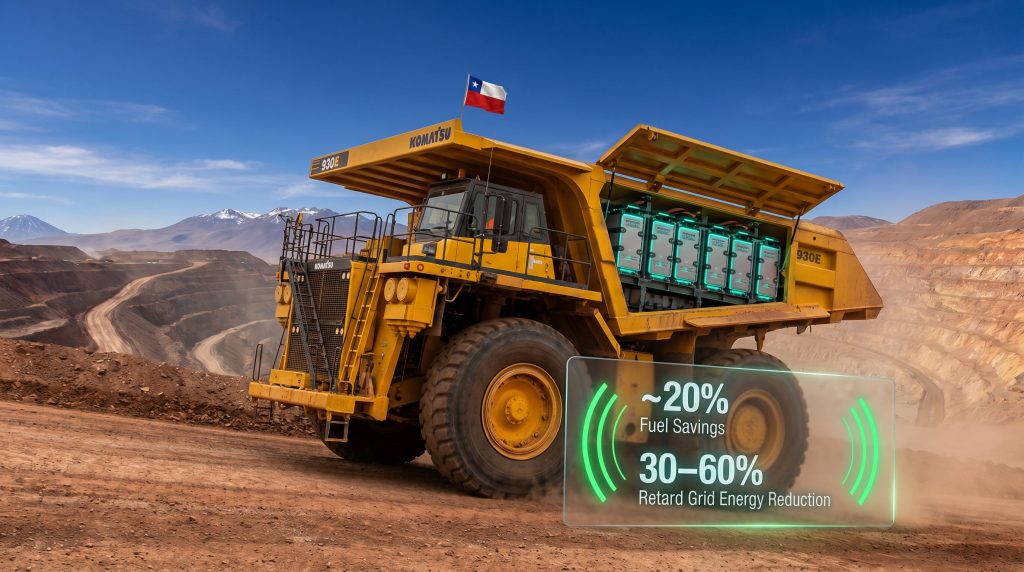
The hybrid truck deployed at Caserones mine is a 300 short ton (272.2 tonne) Komatsu 930E, one of the most widely used ultra-class platforms in global mining, retrofitted with the Cummins First Mode hybrid system. The pilot commenced in February 2026 at the Caserones copper-molybdenum mine in Tierra Amarilla, Chile, located approximately 4,000 to 4,500 metres above sea level in the Atacama region. Caserones is 70 per cent owned by Lundin Mining, a Canadian mining company.
This deployment marks the first time a hybrid-electric ultra-class mining haul truck has entered commercial production haulage anywhere in the world, according to reporting by CIM Magazine (May 13, 2026).
How the Cummins First Mode System Works
The First Mode system integrates six independent battery modules, power electronics, a thermal management system, and intelligent control software into a single consolidated assembly. This assembly connects directly into the Komatsu 930E's existing drive systems, preserving the base truck's mechanical and operational architecture rather than replacing it.
At the heart of the powertrain is a Cummins QSK60 diesel engine, a proven ultra-class powerplant that operates in tandem with the battery system. The diesel engine is not replaced by the hybrid system but instead works alongside it, with intelligent software continuously determining the optimal power split in real time.
Regenerative braking is the system's core energy recovery mechanism. Conventional ultra-class haul trucks dissipate braking energy as heat through a retard grid, an electric braking component that slows the truck on downhill hauls without overloading the wheel brakes. The First Mode system redirects this energy into the battery modules, converting wasted thermal energy into stored electrical power.
Critically, the system's high-power battery architecture supports discharge and recharge rates significantly above conventional hybrid configurations. This characteristic is specifically optimised for the steep, winding haul profiles common at high-altitude Andean mines, where hard braking events, tight cornering, and extended descents generate frequent, high-intensity energy recovery opportunities.
Why Haul Route Geometry Is a Performance Multiplier
One of the less widely appreciated aspects of hybrid mining truck performance is how dramatically route geometry influences energy recovery. Winding routes generate materially more regenerative energy than straight haul paths. Steep gradients combined with directional changes produce frequent high-energy braking events, each of which represents a capture opportunity for the battery system.
Consequently, the Caserones mine's complex, high-altitude haul profile is not simply a challenge to overcome. It is actually a performance amplifier. Cummins is actively mapping how specific route characteristics at Caserones correlate with energy recovery rates, with these operational insights informing performance models that will guide deployment decisions at future customer sites, according to CIM Magazine.
What the First 500 Hours of Operation Revealed
Early operational results from the Caserones pilot provide the most concrete performance data yet available for a commercial hybrid ultra-class truck operating in a genuine production environment.
Reported Performance Benchmarks (First 500 Hours of Operation):
- Fuel savings: Approximately 20% reduction versus a comparable standard diesel truck
- Retard grid energy reduction: 30 to 60 per cent lower energy throughput
- Altitude of operation: Successfully operating above 4,500 metres above sea level
- Battery temperature range: Nominal limits maintained across a daily swing of approximately 5°C to 30°C
The 20 per cent fuel saving figure reflects the current trial version of the technology. Cummins has indicated that subsequent system versions are specifically designed to push performance further, suggesting the first-generation result represents a floor rather than a ceiling.
The Operational Significance of Retard Grid Reduction
The 30 to 60 per cent reduction in retard grid energy throughput carries operational implications that extend well beyond emissions accounting. Retard grid fires are a documented cause of unplanned fleet downtime at high-altitude mines, driven by the thermal stress of continuous energy dissipation on steep haul routes. Reducing the thermal load on the retard grid directly lowers fire risk, which in turn improves fleet availability and reduces unscheduled maintenance expenditure.
For mine operators, this creates a secondary economic case for hybrid adoption that sits alongside the fuel savings argument. Improved uptime on an ultra-class truck, with a capital cost typically running into the millions of dollars per unit, translates directly into production throughput and operating cost per tonne.
Engineering Challenges That the Caserones Deployment Resolved
Structural Integration on an Ultra-Class Platform
Retrofitting a hybrid system onto an ultra-class truck already operating at the upper limits of its design envelope required precise structural engineering. The Caserones deployment required replacing the truck's right-hand wing with a reinforced structural component and strengthening deck connection points on the same side. Importantly, Komatsu independently validated that all structural modifications remained within acceptable engineering limits.
The hybrid assembly is designed to be removable. The original deck configuration can be restored if the system is ever decommissioned, which protects the residual value of the base truck and reduces the risk profile for operators considering hybrid adoption.
Structural Safety Constraints Specific to Mining Trucks
The engineering team navigated a specific set of interacting safety and performance constraints:
-
Remaining within rollover protective structure (ROPS) limits, the safety frameworks designed to protect operators in the event of a rollover.
-
Managing chassis stress to prevent cracking under added battery mass.
-
Staying within tyre performance parameters that govern load distribution and safe operating speed.
-
Maintaining all original drive system safety barriers and operational functionality.
Meeting all four requirements simultaneously while accommodating the additional mass and power capacity of the hybrid system was identified as the primary integration engineering challenge, according to Molly Puga, General Manager of Cummins First Mode, in an interview with CIM Magazine.
High-Altitude Thermal Engineering
Operating above 4,500 metres introduces thinner air, which affects diesel engine combustion efficiency and places additional demand on battery thermal management systems. Extreme diurnal temperature variation, from near-freezing overnight to close to 30°C during daylight hours, places continuous stress on battery cell chemistry and longevity.
Cummins engineered a dedicated thermal management system for high-altitude deployment, providing cooling at both the individual battery module level and across each battery string. Battery temperature management is not only critical for daily performance but for long-term cell lifespan. Under normal duty cycles, the battery system is projected to operate for six to ten years before a first replacement is considered, with the truck able to continue operating until the cells are no longer economically viable.
According to Puga, speaking to CIM Magazine, the thermal management system provides significant performance margin and highly efficient cooling across both individual modules and battery strings, with early operational data confirming that battery temperatures have remained within nominal limits throughout the pilot.
The Commercial Roadmap: From Single Truck to Fleet Conversion
Phase 1: Caserones Scale-Up
By the conclusion of the six-month pilot at Caserones, the mine is expected to be positioned to initiate a full-fleet conversion starting with five to six trucks. This phased approach allows mine operators to build internal change management capability, train maintenance personnel, and develop local service provider networks before committing to full-scale deployment.
Phase 2: Multi-Site Americas Expansion
Cummins's current commercialisation roadmap targets five to seven retrofitted Komatsu trucks across multiple customer sites in the Americas. A second Chilean pilot is planned within the near term, with additional sites across the broader Americas region in parallel development. The objective is to build a portfolio of mines that have completed the operational and organisational change management process, alongside a network of trained local service providers with the skills and experience to support scaled deployment.
Version 2: The Next-Generation System
Cummins began developing Version 2 of the hybrid kit in 2025, with a manufacturing release targeted for Q1 2027. The following table summarises the key differences:
| Feature | Version 1 (Current) | Version 2 (Target: Q1 2027) |
|---|---|---|
| Peak Output | Not publicly disclosed | Over 1 megawatt |
| Continuous Charge/Discharge Rate | Standard | Exceeds 1 megawatt |
| Target Altitude | Up to ~4,500 m | 5,000 m and above |
| Additional Markets | Chile, Americas | Peru, Canada (high-altitude sites) |
| Availability | Retrofit only | Retrofit + new build dealer option |
| Key Engineering Focus | Integration, thermal management | Electrical creepage/clearance at altitude |
The expanded altitude capability in Version 2 is specifically designed to open markets in Peru's high-altitude copper belt and Canada's northern mining operations, where many existing haul fleets face similar decarbonisation challenges without viable near-term electrification pathways.
A less commonly understood engineering challenge at extreme altitude is electrical creepage and clearance, the minimum distances required between live electrical conductors and between conductors and grounded surfaces. At higher elevations, reduced air pressure lowers the dielectric strength of air, meaning electrical arcing can occur at shorter distances than at sea level. Designing high-voltage power electronics for reliable operation above 5,000 metres requires fundamentally different insulation and spacing specifications compared to low-altitude deployments, a detail that underscores the genuine engineering complexity behind the Version 2 development programme.
The next major ASX story will hit our subscribers first
Is Hybrid the Most Practical Decarbonisation Strategy for Open-Pit Mining Right Now?
The Case for Hybrid-First Decarbonisation
For the majority of existing ultra-class fleets, hybridisation currently offers a combination of attributes that no competing technology can match. Furthermore, when considered alongside the broader mining energy transition, the case for a hybrid-first approach becomes even more compelling:
-
No new infrastructure required. Unlike trolley-assist or battery-electric solutions, hybrid retrofits integrate into existing fleet management systems, maintenance workflows, and fuelling infrastructure.
-
Fleet life extension compatibility. The First Mode system pairs particularly well with trucks undergoing glider rebuilds or engine overhaul programmes, common lifecycle management strategies for ultra-class fleets with capital costs in the millions per unit. Pairing a hybrid retrofit with a scheduled life-extension event allows operators to capture both emissions reduction and extended productive life from a single maintenance intervention.
-
Scalability without stranded asset risk. Because the hybrid system is removable and the base truck retains full functionality, operators face minimal stranded asset risk if technology preferences shift over time. This optionality is particularly valuable during a period of rapid technological evolution across the mining electrification landscape.
-
Retard grid safety benefits. Reduced thermal stress on the retard grid directly lowers fire risk and unscheduled maintenance, improving fleet availability independently of the fuel savings argument.
In addition, the decarbonisation economic benefits emerging across the sector reinforce the financial logic of pursuing hybrid adoption as an interim step rather than waiting for fully electric alternatives to mature.
Where Full Electrification Remains Superior
Hybridisation is not positioned as the permanent end-state for all operations. Mines with access to abundant, low-cost renewable electricity and haul routes suited to overhead line infrastructure may find that trolley-assist or battery-electric solutions deliver superior total cost of ownership over longer time horizons. Puga acknowledged this directly in her comments to CIM Magazine, noting that different truck classes and mine conditions will favour different technologies.
The more nuanced industry view is that hybridisation represents the natural evolutionary step between diesel-dependent fleets today and fully electrified operations in the future. Where diesel remains, hybridisation will follow, extracting emissions and efficiency value from the existing technology base while the broader electrification ecosystem matures. The parallel development of hydrogen-powered mining trucks further illustrates the diversity of technological pathways emerging across the heavy haulage segment.
What the Caserones Pilot Means for the Mining Industry
Key Considerations for Fleet Managers Evaluating Hybrid Adoption
The operational and technical insights generated at Caserones have direct relevance for mine operators across the copper, gold, and iron ore sectors globally:
-
Haul route geometry matters more than most operators realise. Mines with steep, winding haul profiles will generate the highest regenerative energy yields and the strongest economic case for hybridisation. Flat or straight haul routes will see more modest returns.
-
High altitude is an advantage, not a barrier. Operations that previously struggled to identify viable electrification pathways due to altitude constraints now have a proven commercial option specifically engineered for their conditions.
-
Change management is as critical as engineering. Building internal capability and local service provider networks is a prerequisite for successful fleet-scale deployment. The partnership structure at Caserones, involving Cummins, Komatsu, Lundin Mining, and local distributors, reflects a deliberate ecosystem-building strategy, not just a bilateral supplier relationship.
-
The retard grid fire risk reduction may justify hybrid adoption independently of fuel savings at high-altitude mines where grid fires represent a significant source of unplanned downtime. This is a less commonly discussed dimension of the economic case.
Broader Industry Signals
The involvement of Komatsu as a leading global OEM, Cummins as a major engine and power technology manufacturer, and Lundin Mining as a significant international operator signals that the industrial ecosystem required for scaled deployment is beginning to coalesce. This ecosystem development, encompassing OEM validation, service provider training, and operational proof points, is typically the rate-limiting factor in the commercialisation of new mining technologies.
The hybrid truck deployed at Caserones mine establishes a commercial proof point that hybrid ultra-class trucks can operate reliably in some of the world's most demanding mining environments. It accelerates the credibility of hybridisation as a mainstream decarbonisation strategy and may influence procurement decisions at operations globally, particularly at high-altitude copper and gold mines in the Andean region and at remote northern operations in Canada.
Frequently Asked Questions: Hybrid Mining Trucks at Caserones
What mine is the hybrid truck operating at?
The hybrid truck is deployed at the Caserones copper-molybdenum open-pit mine in Tierra Amarilla, Chile, located in the Atacama region at approximately 4,000 to 4,500 metres above sea level.
Who owns Caserones mine?
Caserones is 70 per cent owned by Lundin Mining, a Canadian mining company.
What truck platform is being used?
The deployment uses a 300 short ton (272.2 tonne) Komatsu 930E haul truck retrofitted with the Cummins First Mode hybrid system.
How much fuel does the hybrid truck save?
Early operational data from the first 500 hours of operation showed approximately 20 per cent fuel savings compared to a standard diesel equivalent. This figure reflects the current trial version of the technology.
How long do the batteries last?
Under normal duty cycles, the battery system is expected to operate for six to ten years before a first replacement is considered.
Can the hybrid system be installed on any ultra-class truck?
Currently, the First Mode system is offered as a retrofit kit for existing Komatsu 930E trucks. However, future versions are planned as a dealer option for new truck builds.
When will Version 2 of the system be available?
Cummins is targeting a Q1 2027 manufacturing release for Version 2, which will deliver over one megawatt of output and be rated for altitudes above 5,000 metres.
Does the hybrid retrofit affect the truck's original functionality?
The structural modifications required do not affect the base truck's core function, and the original deck configuration can be restored if the hybrid system is ever removed, protecting the residual value of the underlying asset.
This article is based on reporting by Ashley Fish-Robertson published in CIM Magazine on May 13, 2026, and publicly available technical information. Performance figures cited reflect early-stage pilot data from the first 500 hours of operation and should not be taken as indicative of guaranteed long-term outcomes. Forward-looking statements regarding Version 2 development timelines, fleet conversion plans, and commercialisation strategies are subject to change. This content is intended for informational purposes only and does not constitute financial or investment advice.
Want to Invest in the Companies Pioneering Mining's Next Transformation?
As hybrid haul trucks, electrification, and decarbonisation reshape the economics of open-pit mining, the exploration companies developing tomorrow's copper, gold, and critical minerals deposits stand to benefit directly from this industrial shift. Discovery Alert's proprietary Discovery IQ model delivers real-time alerts the moment significant ASX mineral discoveries are announced, turning complex geological data into actionable investment insights — explore historic discoveries and their market-moving returns, then start your 14-day free trial at Discovery Alert to position yourself ahead of the market.