May 13, 2026
The Economics of Resurrection: Why Dormant Copper Mines Are Returning to Life
Across Latin America's mining corridors, a quiet but consequential shift is underway. Copper operations that fell silent during the brutal commodity price contraction of 2014 to 2016 are now being dusted off, re-engineered, and walked back through regulatory channels. The economics driving this revival are not speculative — they reflect a structural realignment in global copper demand that has fundamentally altered what constitutes a viable mining operation. Underground oxide deposits that were marginal at $2.00 per pound copper are materially different propositions when long-run price expectations settle persistently above $3.50 to $4.00 per pound, underpinned by electrification infrastructure, renewable energy buildout, and electric vehicle manufacturing at scale.
The Operational Continuity and Modification of the Sagasca Mining Project in northern Chile sits squarely within this broader narrative. It is not merely a story about one underground mine seeking environmental approval — it is a case study in how structural commodity cycles, regulatory architecture, and technical reassessment converge to bring dormant assets back into the production pipeline.
When big ASX news breaks, our subscribers know first
Underground Copper Oxide Mining: A Distinct Technical Category
Before examining Sagasca specifically, understanding what sets underground copper oxide deposits apart from their sulphide counterparts is essential context that shapes every economic and technical assumption in this project. Furthermore, these distinctions directly influence the regulatory and investment frameworks applied to operations like Sagasca.
Copper sulphide deposits — which account for the majority of global copper production — require milling, flotation, smelting, and electrorefining to produce finished copper. This processing chain demands substantial capital expenditure and generates complex waste streams. Copper oxide deposits, by contrast, are amenable to hydrometallurgical processing: crushing the ore, stacking it on lined pads, and applying dilute sulphuric acid to dissolve copper minerals (primarily malachite and azurite) directly from the rock matrix.
The resulting copper-bearing solution then passes through solvent extraction and electrowinning (SX-EW) circuits to produce refined copper cathodes of London Metal Exchange Grade A specification — directly tradeable on global commodity markets without further refining. The copper leaching process involved here is a mature and well-understood technology, widely deployed across northern Chile's arid mining districts.
This processing architecture carries a critical implication: oxide heap leach operations can achieve economic viability at smaller production scales than sulphide milling operations, because daily operating costs per tonne of ore processed are substantially lower when intensive grinding circuits are removed from the equation. For mid-tier operations targeting 10,000 to 20,000 tonnes of annual copper cathode production, the heap leach and SX-EW pathway often represents the only economically rational processing route.
Sagasca's Location and Geological Context
The Sagasca Mine occupies a well-established copper-producing corridor. Located approximately 100 kilometres east of Iquique within the Quebrada of Sagasca, Pozo Almonte commune, in Chile's Tarapacá First Region, the deposit sits at 1,700 metres above sea level — a moderate altitude by Andean mining standards, where many comparable operations function at elevations exceeding 3,000 metres. More details about the Sagasca mine site provide further context on its operational infrastructure and location.
The Tarapacá Region forms part of northern Chile's broader metalliferous belt, a geological province characterised by porphyry copper systems and associated oxide mineralisation zones that have supported continuous mining activity since the nineteenth century. Underground copper oxide deposits in this terrain typically occur in oxidised zones above sulphide ore bodies, where surface weathering processes have transformed primary sulphide minerals into leachable oxide phases over geological timescales.
The practical mining implication is that underground development is required to access mineralisation that does not outcrop at surface, distinguishing Sagasca from simpler open-pit oxide operations that characterise the lower-elevation portions of the same geological province. Consequently, the capital requirements and operational complexity of Sagasca exceed those of many comparable regional assets.
A Production Record and a Long Silence: 2004 to 2025
The Sagasca Mine operated actively from 2004 through 2015, achieving peak annual production of approximately 15,000 tonnes of copper cathodes. The processing infrastructure deployed during this period was consistent with the technological standard of the era: heap leach pads constructed on impermeable geomembrane liner systems, SX-EW circuits using commercially available organic extractants, and acid management systems for sulphuric acid supply and spent solution handling.
To contextualise the acid consumption dynamics of an operation of this scale: copper oxide heap leaching typically consumes between 1.5 and 2.0 tonnes of sulphuric acid per tonne of copper produced. At 15,000 tonnes annual output, this implies acid demand of approximately 22,500 to 30,000 tonnes per year — a substantial logistical and cost variable that directly influences whether on-site acid generation or external procurement is the more economical supply strategy.
The mine's transition to care-and-maintenance status in 2015 aligned with a well-documented industry-wide contraction. Copper prices, which had reached approximately $4.00 USD per pound during the 2011 commodity supercycle peak, declined progressively to around $2.00 per pound by early 2016. This 50% price compression squeezed margins across mid-tier operations globally, with particular severity for underground operations carrying higher unit costs than open-pit equivalents.
The decade between 2015 and the formal proposal to reopen represents the gestation period during which reassessment, engineering review, updated environmental baseline studies, and indigenous consultation preparation would have been conducted.
The dormancy period of a mothballed mine is rarely static. Technical teams frequently continue updating geological models, reassessing reserve classifications, and benchmarking processing designs against technological improvements — all of which position the asset for faster reactivation when commodity economics shift favourably.
Technical Architecture of the Proposed Modification
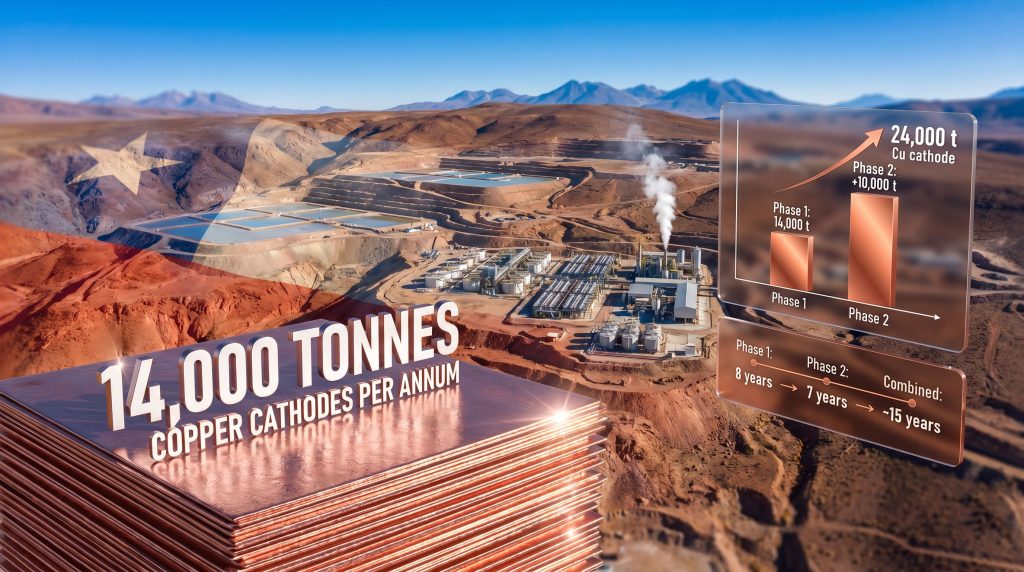
The proposed Operational Continuity and Modification of the Sagasca Mining Project advances a structured two-phase production programme with distinct parameters:
| Parameter | Phase 1 | Phase 2 Expansion |
|---|---|---|
| Annual copper cathode output | 14,000 tonnes | Additional 10,000 tonnes |
| Operational duration | 8 years | 7 years |
| Daily ore processing capacity | 4,000 tonnes crushed | To be confirmed |
| Sulphuric acid plant capacity | 340 tonnes per day | To be confirmed |
| Combined production horizon | 15 years | 15 years total |
Why the Sulphuric Acid Plant Is the Critical Throughput Variable
The proposed 340-tonne-per-day on-site sulphuric acid plant is arguably the most technically significant infrastructure component in the modification proposal. In copper oxide heap leaching, sulphuric acid performs dual functions: it dissolves copper from oxide minerals and maintains the pH conditions necessary for efficient copper ion transfer into the pregnant leach solution (PLS). Insufficient acid supply directly limits the rate of copper extraction from heap pads, creating a production ceiling that no amount of additional ore throughput can overcome.
On-site acid generation offers several advantages over external procurement in northern Chile's remote mining districts:
- Cost stability: Eliminates exposure to spot acid pricing fluctuations driven by sulphur availability and smelter by-product volumes
- Logistics security: Reduces dependence on road transport of a corrosive hazardous material across arid terrain
- Operational continuity: Ensures acid availability during periods of regional supply disruption
- Environmental accountability: Allows direct management of acid storage, handling, and emissions within the project's environmental management framework
The trade-off is capital expenditure: on-site sulphuric acid plants require significant upfront investment, typically involving sulphur combustion units, heat recovery systems, and associated emission control infrastructure. For a 340-tonne-per-day facility, this represents a material component of total project capital cost. The decision to include this infrastructure in the Phase 1 scope signals long-term operational confidence rather than a minimum-viable approach to reopening.
Daily Throughput and Underground Mining Considerations
Achieving 4,000 tonnes of crushed ore per day from an underground operation requires sustained development of ore handling, crushing, and surface conveyance systems. Underground copper oxide mining at moderate depth generally employs either room-and-pillar or cut-and-fill methods, with ore extraction via development headings and ore passes to underground crushing stations or surface-level primary crushers.
Rehabilitation of infrastructure dormant since 2015 adds a pre-production capital requirement not present in greenfield developments but substantially smaller than constructing equivalent infrastructure from scratch. The 4,000-tonne daily processing rate across an 8-year Phase 1 implies total mineral throughput of approximately 11.7 million tonnes — a substantial ore inventory requirement that the feasibility case must support through demonstrated geological continuity at economic grades.
Regulatory Pathway Under Chile's Environmental Assessment System
The Operational Continuity and Modification of the Sagasca Mining Project is subject to Chile's formal environmental review process administered by the Servicio de Evaluación Ambiental (SEA). Under Chilean environmental law (Law 19,300 and its modifications), mining project modifications that materially alter the operational scope, processing capacity, or environmental footprint of previously approved projects must undergo environmental assessment.
This assessment proceeds either through an Environmental Impact Declaration (DIA) for projects with manageable impacts, or a full Environmental Impact Study (EIA) for projects with potentially significant environmental consequences. The distinction matters considerably for project timelines. A DIA process typically takes 60 days to resolve, while a full EIA process can extend to 120 days for the formal review period, with additional time required for citizen participation, indigenous consultation, and potential addenda responses.
The complexity of the Sagasca modification — which includes a new on-site acid plant, wastewater treatment infrastructure, and expanded underground mining footprint — may indicate the EIA pathway is applicable, though the specific classification would be determined by the SEA's initial review of the project submission.
Citizen Participation and Indigenous Consultation
A formal citizen participation process for the Sagasca project commenced on September 23, 2025, through the SEA portal. As of the available project timeline, this phase has concluded and the project has advanced to formal evaluation review stages.
Indigenous consultation obligations under ILO Convention 169, ratified by Chile in 2008, represent a non-negotiable procedural requirement for mining projects in northern Chile's Tarapacá Region, where Aymara communities maintain established presence and cultural connections to highland territories. The consultation process is distinct from citizen participation: it is a rights-based procedure that requires good-faith dialogue with affected indigenous communities on project impacts, mitigation measures, and potential benefit-sharing arrangements.
Outcomes of indigenous consultations can range from formal agreement to proceed with conditions, to objections that require project modifications, and in some cases result in significant scope changes. However, well-prepared operators typically engage with communities well in advance of formal submission to reduce the likelihood of material regulatory delays.
Under Chilean environmental law, projects classified as modifications to existing operations must demonstrate that proposed changes do not materially worsen the environmental baseline established during the original approval process. For Sagasca, this means the operator must justify the expanded acid plant capacity, wastewater management systems, and modified underground footprint against the environmental baseline documented during the 2004-era approval.
Water and Waste Management in an Arid High-Altitude Environment
Heap leach SX-EW operations in northern Chile's arid regions face heightened water management scrutiny. The Tarapacá Region receives minimal annual precipitation, and water sourcing for heap irrigation, dust suppression, and processing circuits must be reconciled against the water rights and hydrological constraints of the local watershed. Evaporation losses from open heap pads can be substantial in arid, high-solar-radiation environments.
Wastewater treatment infrastructure for SX-EW operations must address: (1) spent leach solution management, including residual acid neutralisation; (2) organic extractant containment in the SX circuit; (3) electrowinning cell acid mist management; and (4) stormwater contamination prevention across lined heap pad areas. These requirements are central to the SEA's assessment of the modification proposal.
The next major ASX story will hit our subscribers first
Economic Significance and Production Context
Situating 14,000 Tonnes Within Chile's Copper Profile
Chile consistently produces approximately 5.5 to 5.7 million tonnes of copper annually, representing roughly 25 to 27% of global mine production. The Chile copper outlook for 2025 and beyond remains broadly positive, underpinned by sustained electrification demand and constrained new supply pipelines. Within this volume, copper cathodes from SX-EW operations account for a meaningful but minority share.
A 14,000-tonne annual SX-EW cathode operation represents a modest but real contribution to national output. More significantly, it contributes to the domestic cathode production profile that serves export markets requiring finished copper products rather than concentrates requiring further processing. Copper cathodes are priced against LME Grade A benchmarks, providing direct market price exposure without the discount structures that affect concentrate sales tied to treatment and refining charges.
The Phase 2 Signal: What Expansion Plans Reveal About Long-Term Confidence
The inclusion of a Phase 2 expansion targeting an additional 10,000 tonnes per annum over seven years is strategically revealing. Mining companies do not typically disclose expansion phases in environmental submissions without reasonable geological and economic confidence in their deliverability. The combined production scenario — up to 24,000 tonnes annually at full Phase 2 capacity, sustained across a 15-year operational horizon — positions Sagasca as a medium-term copper cathode supply asset with meaningful volume and longevity.
| Metric | Sagasca Proposed | Typical Mid-Tier Chilean SX-EW Operation |
|---|---|---|
| Phase 1 annual output | 14,000 t Cu cathode | 10,000 to 30,000 t Cu cathode |
| Processing method | Heap leach / SX-EW | Heap leach / SX-EW |
| Mine type | Underground oxide | Open-pit or underground |
| Combined operational life | ~15 years | 10 to 20 years |
| Altitude | 1,700 m above sea level | Variable: 1,000 to 4,000 m |
The Broader Trend: Dormant Mine Reactivation as a Supply Strategy
Sagasca's proposed reopening reflects a capital efficiency logic that is gaining traction across Latin American mining. Reactivating a previously permitted operation with existing infrastructure — heap pad foundations, processing buildings, access roads, power connections, and water supply systems — requires substantially less capital expenditure than constructing equivalent greenfield capacity. This cost advantage can reduce capital payback periods by several years compared to new project development.
Understanding the copper supply crunch currently shaping global markets helps clarify why reactivating dormant assets like Sagasca has become an increasingly attractive strategy. In addition, the copper price drivers underpinning this trend — electrification demand, grid investment, and EV manufacturing — are structural rather than cyclical, which supports longer-dated investment decisions.
Furthermore, Chile's copper supply gap remains a pressing concern for global markets, making projects like Sagasca all the more consequential. The regulatory dimension reinforces this advantage: a modification to an existing environmental approval typically involves shorter review timelines and a more defined consultation scope than a new project declaration. However, this efficiency is not guaranteed, particularly where indigenous consultation obligations apply.
For investors and industry observers tracking the Operational Continuity and Modification of the Sagasca Mining Project, the key monitoring variables over coming months include:
- Progress through the SEA formal evaluation review stage and the timeline to an environmental resolution
- Outcomes of indigenous consultation with Aymara communities in the Tarapacá Region and any conditions attached
- Sulphuric acid plant design approvals and acid supply chain arrangements for northern Chilean operations
- Phase 2 expansion trigger conditions relative to Phase 1 production performance and prevailing copper prices
- Wastewater treatment plant design specifications and their compliance with updated Chilean environmental discharge standards
Disclaimer: This article contains forward-looking statements and projections regarding production timelines, copper prices, and project development outcomes. These represent informed analysis based on publicly available information and should not be construed as financial or investment advice. Mining projects are subject to regulatory, technical, geological, and commodity price risks that may cause actual outcomes to differ materially from those described. Readers should conduct independent due diligence before making any investment decisions related to mining sector assets.
Frequently Asked Questions: Sagasca Mining Project
What is the Operational Continuity and Modification of the Sagasca Mining Project?
It refers to a formal proposal submitted through Chile's Environmental Assessment Service to reopen and modify the Sagasca underground copper oxide mine in the Tarapacá First Region. The proposal covers expanded production infrastructure including a new on-site sulphuric acid plant, wastewater treatment facilities, and a phased production ramp-up targeting 14,000 tonnes of copper cathodes annually in Phase 1.
What processing technology does the Sagasca Mine use?
The operation uses a heap leach, solvent extraction, and electrowinning (SX-EW) circuit — a mature hydrometallurgical process suited to copper oxide ores. Crushed ore is stacked on lined pads, irrigated with dilute sulphuric acid to dissolve copper minerals, and the resulting copper-bearing solution is processed through SX-EW circuits to produce refined copper cathodes meeting LME Grade A specifications.
Why did Sagasca enter care-and-maintenance in 2015?
While specific internal closure decisions have not been publicly detailed, the 2015 transition aligns with a broad industry contraction driven by copper price declines from approximately $4.00 per pound in 2011 to around $2.00 per pound in 2016. This price environment rendered many mid-tier oxide operations uneconomical, particularly those with rising unit costs or declining ore grades.
What is the current regulatory status of the project?
As of late 2025, the project completed its citizen participation phase (initiated September 23, 2025, via the SEA portal) and advanced into formal evaluation review within Chile's environmental assessment system.
How long would the reopened Sagasca Mine operate?
The proposal covers an initial eight-year Phase 1 production period at 14,000 tonnes annually, followed by a potential seven-year Phase 2 expansion producing an additional 10,000 tonnes per year, representing a combined operational horizon of approximately 15 years.
Want To Stay Ahead of the Next Major Copper Discovery on the ASX?
Discovery Alert's proprietary Discovery IQ model delivers real-time alerts the moment significant ASX mineral discoveries are announced, transforming complex commodity data into clear, actionable opportunities — explore historic discoveries and their returns to understand what's possible, then begin your 14-day free trial at Discovery Alert to position yourself ahead of the broader market.