May 10, 2026
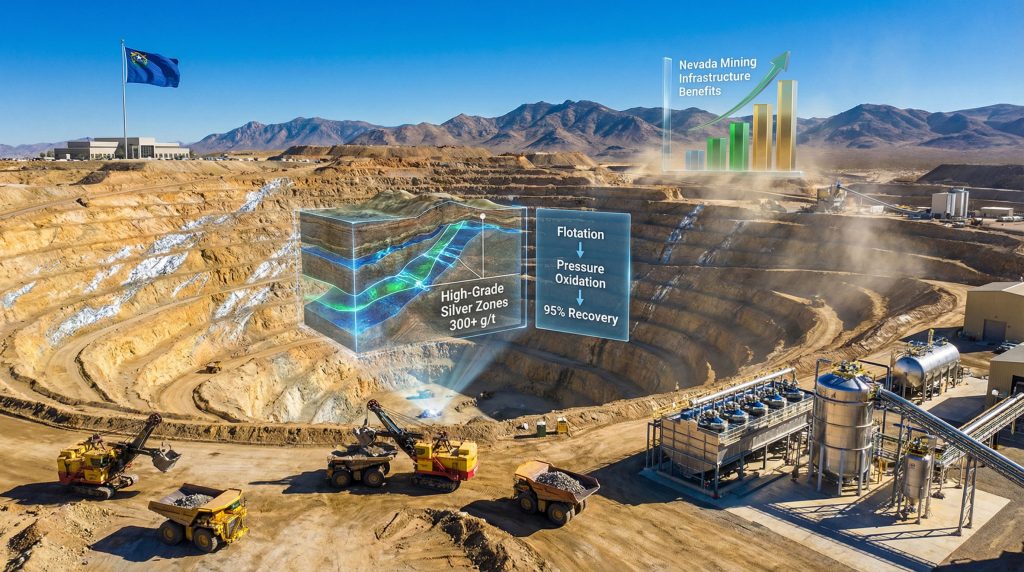
The global mining sector witnesses intensifying competition for high-grade precious metal deposits as declining ore quality challenges traditional extraction economics. Hycroft expands Vortex high-grade silver system through systematic exploration and advanced metallurgical programs, demonstrating the strategic value of developing concentrated mineralisation within large-scale Nevada operations. Furthermore, this expansion occurs against a backdrop of silver market squeeze dynamics that amplify the importance of primary silver production capabilities.
Strategic Value of High-Grade Silver Systems in Large-Scale Operations
Concentrated silver zones within large precious metal deposits fundamentally alter project economics through enhanced margin profiles and operational flexibility. Unlike uniform grade distributions requiring consistent processing volumes, high-grade systems enable selective mining strategies that prioritise early cash flow generation and capital efficiency. Consequently, this selectivity becomes critical when commodity prices remain volatile and capital markets demand accelerated payback periods.
Silver Grade Impact on Processing Economics:
| Grade Category | Typical Range (g/t) | Processing Priority | Capital Efficiency |
|---|---|---|---|
| Low-grade bulk | 15-50 | Volume-focused | High tonnage required |
| Medium-grade | 50-150 | Balanced approach | Moderate selectivity |
| High-grade zones | 300+ | Margin-optimised | Maximum selectivity |
Modern silver demand composition reflects structural changes in industrial applications. Solar photovoltaic manufacturing represents approximately 55% of global silver demand, requiring approximately 20 grams per standard panel according to International Energy Agency analysis. In addition, global photovoltaic installations reached 258 GW cumulatively by 2023, with annual additions of 112 GW demonstrating accelerating renewable energy deployment.
Industrial applications consuming silver include electronics manufacturing at approximately 235 million ounces annually, photovoltaic systems at 95-100 million ounces growing at 12-15% annually, and medical applications requiring 45 million ounces. Moreover, this demand profile contrasts sharply with gold's primarily monetary function, creating distinct investment dynamics for silver-focused projects.
However, silver supply deficits continue mounting pressure on primary producers. High-grade silver systems provide direct leverage to these industrial consumption trends while maintaining precious metal characteristics during economic uncertainty. Unlike base metal by-product silver representing 70-75% of global production, primary silver projects respond directly to silver-specific supply and demand fundamentals rather than copper, zinc, or lead mining cycles.
When big ASX news breaks, our subscribers know first
Advanced Metallurgical Processing for Complex Sulphide Ores
Sulphide processing employs multiple extraction methodologies optimised for varying ore characteristics and mineralogical associations. Flotation concentration followed by pressure oxidation or roasting represents current industry standards for complex silver-bearing sulphide systems. For instance, technology selection depends on ore mineralogy, environmental constraints, and economic factors specific to each deposit.
Metallurgical Recovery Performance Standards:
- Flotation processing: 85-95% silver recovery from complex polymetallic ores
- Pressure oxidation: 90-98% gold recovery when feed grades exceed 50 g/t
- Combined systems: Enhanced liberation of refractory minerals through staged processing
Recent metallurgical test work demonstrates flotation recovery rates of 89% for gold and 93% for silver from Hycroft's Vortex high-grade material. These results align with industry benchmarks for complex polymetallic sulphide processing, indicating predictable metallurgical behaviour suitable for engineering design parameters.
Processing Technology Comparison:
| Processing Method | Temperature Range | Pressure Requirements | Environmental Impact |
|---|---|---|---|
| Pressure Oxidation | 180-230°C | 20-35 bar | Lower emissions |
| Roasting | 500-700°C | Atmospheric | Higher emissions |
Pressure oxidation systems operate through autoclaves at elevated temperature and oxygen partial pressure, oxidising pyrite and refractory sulphides to liberate encased precious metals. This technology achieves superior recovery rates and environmental performance but requires higher capital investment and sophisticated process control systems compared to conventional roasting approaches.
Flotation circuit optimisation focuses on particle size distribution control, with optimal separation occurring at 70-80% passing 200 mesh for complex polymetallic ores. Furthermore, residence times typically range from 8-15 minutes in primary cells and 3-8 minutes in scavenger cells, while reagent dosages vary from 50-200 grams per tonne depending on ore mineralogy.
Ongoing roasting test work provides alternative processing pathways for refractory minerals, generating comprehensive metallurgical data for economic modelling. This dual-track approach reduces technical risk while optimising capital and operating cost profiles across different processing scenarios.
Nevada's Mining Infrastructure and Regulatory Advantages
Nevada's established mining infrastructure provides significant development advantages through existing power transmission networks, transportation systems, and skilled workforce availability. The regulatory framework offers predictable permitting timelines through 150+ years of continuous mining operations, establishing precedent-based approval processes that reduce ambiguity and accelerate decision-making.
Nevada Mining Infrastructure Components:
- Power grid connectivity: Western Interconnect provides 120+ GW total capacity
- Transportation access: Union Pacific operates 900+ miles of Nevada track serving 12+ mining operations
- Workforce availability: Approximately 9,300 direct mining employees plus contractor networks
- Regulatory framework: Historical permitting timelines average 24-36 months versus national 36-60 month averages
Nevada's mining workforce maintains specialised expertise in large-scale precious metal operations, reducing training requirements and operational startup risks compared to emerging mining jurisdictions. Consequently, the established supplier network includes specialised contractors, equipment fabricators, and reagent suppliers maintaining permanent Nevada operations.
Environmental compliance operates through integrated permitting involving Nevada Division of Water Resources for water rights allocation, Nevada Division of Environmental Protection for air quality permits, and bonded reclamation requirements. This integrated approach enables concurrent rather than sequential permitting, reducing overall approval timelines.
Nevada mining operations maintain superior safety performance, with statewide Total Recordable Injury Frequency Rate averaging 1.8 per 200,000 hours worked. Hycroft's performance of 0.00 TRIFR and Lost Time Injury Frequency for more than 2.5 consecutive years significantly exceeds state benchmarks, demonstrating operational discipline and safety culture alignment with institutional investment criteria.
Existing site infrastructure at Hycroft includes laboratory facilities for on-site assay capability, maintenance buildings with truck shop and warehouse facilities, processing infrastructure from historical oxide operations, and a Merrill-Crowe processing facility for gold recovery from solution circuits. This infrastructure positioning provides material advantages over greenfield projects requiring complete site development.
Advanced Exploration Methodologies and Resource Expansion
Modern exploration programs integrate geophysical, geochemical, and geological techniques to identify high-grade mineralisation within large deposit systems. Directional drilling enables efficient testing of target areas while minimising surface disturbance, supporting environmental compliance and operational efficiency.
Recent Vortex Discovery Results:
Standout Intercepts:
- Hole 6070: 30.8 metres grading 438.58 g/t silver, 0.41 g/t gold
- Included section: 6.1 metres at 739.58 g/t silver
- Hole H25D-6072: 26.4 metres grading 565.31 g/t silver, 0.46 g/t gold
- Included section: 6.9 metres at 802.96 g/t silver
- Multiple intervals: 960-1,545 g/t silver
System Geometry (December 2025):
- Lateral extent: Approximately 1,000 metres east-west
- Vertical extent: 500 metres downdip
- Expansion potential: Open in all directions and at depth
- Recent extension: 65-metre northwest offset extending mineralisation 35 metres westward
The consistent silver-to-gold ratio of approximately 3,000:1 at both Vortex and Brimstone targets suggests distinct mineralising events rather than grade variations within single alteration phases. This metallogenic signature indicates structural or geochemical controls that concentrated silver preferentially, creating economic leverage to silver price movements without gold by-product dilution.
However, Hycroft expands Vortex exploration reveals geophysical work has identified potential feeder systems with strike lengths exceeding 600 metres, representing structural conduits that delivered mineralising fluids to high-grade zones. Feeder system confirmation through ongoing assay work could anchor long-life, high-grade mining fronts supporting sustained production from prioritised zones.
Resource Classification Protocols:
- Measured Resources: Highest confidence through detailed sampling and geological modelling
- Indicated Resources: Reasonable confidence with adequate sampling density
- Inferred Resources: Limited confidence requiring additional drilling for classification upgrade
Current resource estimates follow internationally recognised standards (JORC, NI 43-101) providing measured and indicated resources totalling 10.6 million ounces gold and 360.7 million ounces silver, with inferred resources of 3.4 million ounces gold and 96.1 million ounces silver. Updated resource estimates incorporating recent drilling target early Q1 2026 completion.
Sulphide Processing Development and Technical Risk Mitigation
Flotation circuit design optimisation maximises recovery while minimising reagent consumption and environmental impact. Circuit variables affecting performance include pH management with optimal windows for copper-lead flotation separation ranging from 8.5-9.5, temperature control, and residence time calculations based on ore characteristics.
Flotation Process Variables:
- Particle size optimisation: 70-80% passing 200 mesh for complex ores
- Reagent management: Collector dosages 50-200 g/tonne based on mineralogy
- Circuit residence time: 8-15 minutes primary cells, 3-8 minutes scavenger cells
- pH control: Maintains optimal separation chemistry
- Temperature regulation: Enhances flotation kinetics and recovery
Pressure oxidation technology employs autoclaves operating at 180-230°C and 20-35 bar oxygen partial pressure to oxidise refractory sulphides. Commercial implementation since the 1990s demonstrates proven technology status, with installations at major operations including Barrick Gold's Cortez Complex and other Nevada facilities processing refractory ores.
Roasting technology provides alternative processing pathways through atmospheric pressure operation at 500-700°C. While generating higher emissions requiring sophisticated air pollution control systems, roasting offers simpler operational requirements and lower capital intensity compared to pressure oxidation systems.
Technology Selection Framework:
- Preliminary flotation scenarios: Baseline economic cases without secondary processing
- Pressure oxidation scenarios: Enhanced recovery for refractory minerals
- Roasting scenarios: Lower capital cost positioning with emission controls
- Combined processing: Integrated circuits maximising liberation and recovery
This tiered approach enables metallurgical risk mitigation through multiple processing pathways, supporting robust economic modelling and engineering design flexibility. Ongoing test work completion in 2026 will provide comprehensive data for definitive technology selection and cost optimisation.
What are the Benefits of Multiple Processing Options?
Multiple processing pathways reduce technical risk while providing economic optimisation opportunities across different commodity price scenarios. For instance, flotation-only processing offers lower capital intensity during commodity price weakness, while pressure oxidation maximises recovery during favourable price environments.
Mine Planning Integration for High-Grade Zone Development
Sequential mining strategies for deposits containing high-grade zones require sophisticated grade control systems optimising extraction sequencing. Early access to high-grade material improves project economics through accelerated payback periods while generating cash flow funding subsequent development phases.
Mine Planning Considerations:
- Grade distribution mapping: Three-dimensional modelling of high-grade zone geometry
- Access development sequencing: Infrastructure positioning for early high-grade extraction
- Processing capacity allocation: Throughput optimisation across varying ore types
- Waste rock management: Integrated planning for efficient material handling
- Infrastructure timing: Coordinated development supporting production sequencing
Development projects benefit from phased approaches prioritising high-grade zones for early production. This strategy reduces capital intensity per ounce while providing operational cash flow supporting continued exploration and development activities. Furthermore, grade optionality enables tactical production adjustments responding to market conditions without compromising long-term mine planning.
High-grade zones alter project internal rate of return sensitivity through improved margin profiles. Net present value calculations benefit from early cash flow generation reducing exposure to commodity price volatility during capital-intensive development phases. This mathematical advantage becomes significant when high-grade material processing occurs during initial production years.
Capital Allocation Benefits:
- Reduced capital intensity: Higher margins per ounce processed
- Accelerated payback: Early cash flow generation improves project metrics
- Market responsiveness: Tactical mining enables price cycle optimisation
- Development funding: Internal cash flow supports continued expansion
- Risk reduction: Lower capital exposure during commodity price volatility
The next major ASX story will hit our subscribers first
Financial Positioning and Development Funding Strategy
Strong balance sheet positioning enables development companies to advance projects without dilutive financing during critical study phases. Cash reserves provide operational flexibility and strategic optionality, particularly valuable in selective capital market environments where project financing demands proof of concept before commitment.
Hycroft maintains approximately $175 million in unrestricted cash with debt-free balance sheet positioning as of December 2025. Additional warrant exercise proceeds of $41.3 million expected in January 2026 provide extended runway through value-definition phases including resource updates, technical studies, and continued exploration programs.
Financial Strength Indicators:
- Unrestricted cash: $175 million providing multi-year operational runway
- Debt-free structure: No financial leverage or servicing requirements
- Warrant proceeds: Additional $41.3 million enhancing liquidity position
- Study funding: Complete coverage for planned technical work
- Exploration support: Sustained drilling and metallurgical programs
This financial positioning substantially exceeds typical development-stage precious metals companies facing recurring dilution pressures. Capital markets have become increasingly selective, demanding demonstrated economic viability before committing additional funding. However, self-funded development pathways command valuation premiums as external financing risk represents material discount factors.
Market timing alignment with commodity price cycles and capital market conditions enables strategic advancement without external financing constraints. Strong financial positioning provides development optionality independent of equity market volatility or debt market accessibility, supporting continuous project advancement through study completion and permitting phases.
Technical Study Progression and Economic Assessment Timeline
Technical study advancement follows established industry protocols from preliminary economic assessments through feasibility studies. Each stage provides increasing confidence in project economics and technical viability while supporting engineering design and equipment procurement processes.
Study Timeline and Milestones:
- Resource Estimate Update: Early Q1 2026 incorporating recent drilling results
- Technical Report: Late Q1 2026 with preliminary economic assessment
- Metallurgical Completion: Ongoing roasting test work through 2026
- Pre-Feasibility Study: Future timeline dependent on technical report outcomes
- Definitive Feasibility: Final engineering and economic validation
Comprehensive metallurgical programs validate processing assumptions through pilot-scale testing and process optimisation. Test work results support engineering design parameters, equipment selection, and economic modelling for accurate cost estimation and recovery projections.
Test Work Components:
- Ore characterisation: Mineralogical analysis and metallurgical mapping
- Comminution testing: Grinding and crushing parameter optimisation
- Flotation optimisation: Recovery maximisation and reagent consumption
- Pressure oxidation trials: Refractory ore processing validation
- Environmental assessment: Waste characterisation and management protocols
Resource estimate updates convert drilling results into measured and indicated categories supporting engineering studies and economic assessments. Technical reports provide net present value calculations, internal rate of return analysis, and capital cost estimates enabling comparative analysis against peer development assets.
Additional evaluation includes potential heap leach operations restart, with analysis completion expected during H1 2026. Higher precious metal prices improve residual leach material economics, potentially generating near-term cash flow supporting continued study work and exploration programs.
Silver Market Fundamentals and Industrial Demand Drivers
Silver's dual functionality as precious and industrial metal creates multiple demand drivers through technology adoption and infrastructure development. Solar panel manufacturing represents the largest industrial application with continued growth potential driven by renewable energy policy mandates and cost competitiveness versus traditional energy sources.
Primary Silver Demand Sectors:
- Solar photovoltaic: 95-100 million ounces annually, 12-15% growth rate
- Electronics manufacturing: 235 million ounces annually across consumer and industrial applications
- Medical applications: 45 million ounces in healthcare and antimicrobial uses
- Investment demand: Traditional precious metal monetary characteristics
- Industrial processes: Chemical catalysts, brazing alloys, and specialised applications
Nevertheless, global silver supply faces structural constraints through limited new mine development and declining grades at existing operations. Approximately 70-75% of silver production derives from base metal operations where silver functions as by-product rather than primary economic driver, creating supply inflexibility unresponsive to silver-specific price signals.
Supply Constraint Factors:
- Limited primary development: Few new silver-focused mining projects
- Grade decline: Industry-wide ore quality deterioration at existing operations
- By-product dependency: Silver supply following copper, zinc, lead production cycles
- Capital constraints: Reduced exploration budgets limiting new discoveries
- Permitting complexity: Extended development timelines in key mining jurisdictions
Primary silver projects provide direct leverage to silver price movements without base metal production dependencies. This characteristic appeals to investors seeking specific commodity exposure as industrial demand growth potentially outpaces by-product supply availability through renewable energy deployment and technological advancement.
Consequently, silver tariffs impact on trade flows could further constrain supply chains. Additionally, sophisticated investors increasingly implement silver squeeze strategies recognising these fundamental supply-demand imbalances in the physical market.
Large-Scale Deposit Strategic Advantages and Operational Flexibility
Large-scale deposits offer economies of scale through infrastructure amortisation over extended mine lives and sustained cash flow generation supporting strategic planning flexibility. Production longevity enables long-term supplier relationships, workforce stability, and technology implementation benefits unavailable to shorter-life operations.
Scale Economics Benefits:
- Infrastructure amortisation: Fixed costs distributed across extended production periods
- Workforce expertise: Skill development and retention through operational continuity
- Supply chain optimisation: Long-term contracts and supplier relationship advantages
- Technology implementation: Advanced systems justified through extended operational periods
- Strategic positioning: Market presence supporting premium realisation and customer relationships
Large deposits with internal grade variation provide operational flexibility responding to market conditions through selective mining strategies. High-grade zones enable tactical production adjustments without compromising long-term mine plans, optimising margins during favourable price environments while maintaining base production during challenging periods.
Nevada mining projects typically command 15-25% valuation premiums relative to equivalent-quality projects in emerging jurisdictions, reflecting reduced permitting risk, regulatory certainty, and accelerated development timelines. This jurisdictional advantage becomes increasingly valuable as global mining faces heightened environmental scrutiny and infrastructure constraints.
Hycroft expands Vortex high-grade silver system through systematic exploration and metallurgical advancement, positioning the project for economic assessment and development decision-making. The combination of geological upside, technical progress, financial strength, and jurisdictional advantages creates multiple value drivers as silver's strategic importance continues expanding across industrial and monetary applications.
Furthermore, detailed silver squeeze analysis demonstrates how primary silver producers benefit disproportionately from supply-demand imbalances. Additionally, higher grade intercepts from recent drilling continue validating the Vortex system's exceptional mineral endowment.
Investment Considerations:
High-grade silver systems within large-scale deposits provide grade optionality enabling selective mining strategies that prioritise margin optimisation over volume maximisation, particularly valuable during volatile commodity price environments.
The technical progression toward sulphide processing through completed flotation and pressure oxidation test work, combined with ongoing roasting studies, reduces metallurgical uncertainty while providing multiple processing pathway options for economic optimisation.
Strong financial positioning eliminates near-term dilution risks while providing sustained funding for technical studies, resource expansion, and development activities independent of external capital market conditions or commodity price volatility.
Nevada's Tier-1 jurisdiction status supports permitting confidence and operational advantages through established infrastructure, regulatory frameworks, and skilled workforce availability, commanding valuation premiums relative to emerging jurisdiction alternatives.
Catalyst concentration through Q1 2026 resource updates and technical reports provides near-term value inflection opportunities as geological success transitions toward economic visibility and development pathway clarity.
Ready to capitalise on the next major mineral discovery?
Discovery Alert's proprietary Discovery IQ model delivers real-time alerts on significant ASX mineral discoveries, instantly empowering subscribers to identify actionable opportunities ahead of the broader market. Understand why major mineral discoveries can lead to substantial market returns by exploring Discovery Alert's dedicated discoveries page, showcasing historic examples of exceptional outcomes, and begin your 30-day free trial today to position yourself ahead of the market.