May 21, 2026
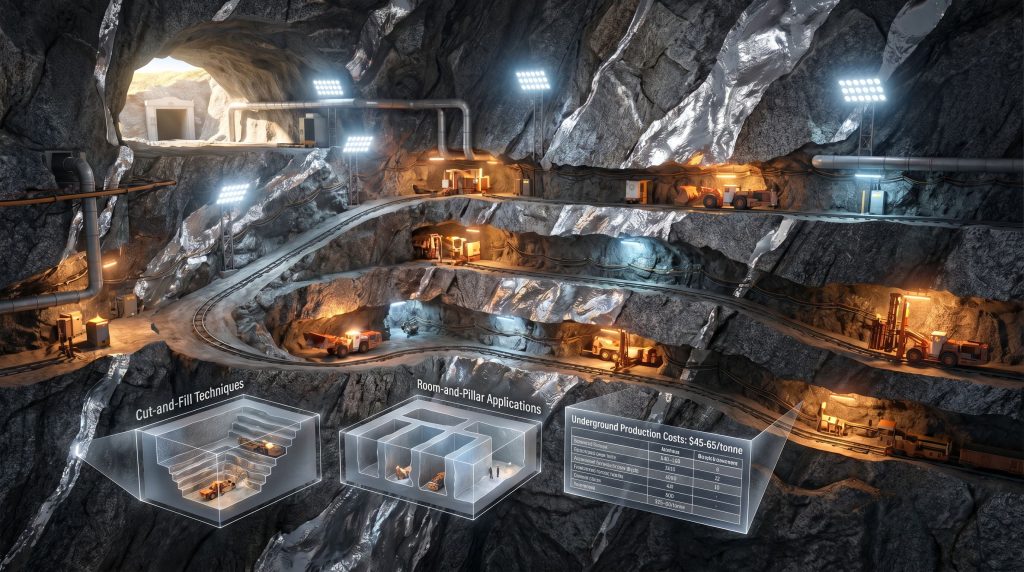
The Hycroft underground mining options evaluation represents a significant strategic shift towards subsurface extraction for high-grade silver deposits. Underground mining presents sophisticated engineering solutions for accessing mineral deposits that surface operations cannot efficiently exploit, particularly when dealing with shallow, high-grade ore bodies like those found at the Brimstone and Vortex systems.
The integration of underground access systems with existing mining infrastructure creates unique opportunities while considering the geological characteristics that define optimal extraction methods. Engineering firms must balance immediate exploration objectives with long-term production potential through comprehensive mining permitting process evaluation.
Understanding Underground Access Methods for Shallow Silver Systems
Shallow underground deposits require specialised access strategies that differ significantly from deep mining applications. The proximity to surface operations creates unique design parameters for portal positioning and decline development that must account for both geological stability and operational efficiency.
Decline Development for Optimal Access
Portal positioning strategies for shallow silver systems focus on minimising development costs while maximising ore body accessibility. The Brimstone deposit demonstrates this principle, located 30 metres beneath the existing open pit. This shallow positioning allows for decline development that serves dual purposes of exploration advancement and future production infrastructure.
Decline gradient calculations must balance equipment efficiency with geological constraints. Standard industry practice maintains gradients between 8% to 15% for equipment accessibility while considering ventilation requirements and ore transportation logistics.
Ventilation requirements for underground silver extraction typically demand minimum air flows of 200 cubic feet per minute per person underground. The shallow nature of deposits creates opportunities for natural ventilation assist that reduces operational costs compared to deep mining scenarios.
Infrastructure integration capabilities become critical when underground development occurs adjacent to existing open-pit operations. The ability to utilise existing power distribution and maintenance facilities can reduce capital requirements by 15% to 25% compared to standalone underground developments.
Mining Method Selection Criteria
Cut-and-fill techniques prove most suitable for high-grade narrow veins where selective extraction maximises ore grade recovery. This method allows miners to extract ore in horizontal slices while maintaining structural stability through planned backfilling sequences.
Room-and-pillar applications find optimal use in stable rock formations where ore bodies have sufficient continuity. This method typically achieves extraction ratios of 60% to 80% depending on pillar requirements and ore body geometry.
Sublevel stoping considerations become relevant for larger ore bodies where production rates justify infrastructure investment for multiple access levels. Furthermore, this method requires careful blast design and draw control to maintain ore quality.
Hybrid approaches combining multiple extraction methods allow operations to optimise recovery based on varying geological conditions within a single ore body. These flexible designs accommodate zone-specific mining where different areas warrant different extraction techniques.
When big ASX news breaks, our subscribers know first
How Do Engineering Firms Evaluate Underground Mining Feasibility?
Engineering evaluation methodology follows established protocols that integrate geological, technical, and economic assessment components. The RESPEC Company LLC assessment for Hycroft underground mining options illustrates comprehensive feasibility analysis that includes evaluation of mining methods, conceptual mine design, and schedule development.
Technical Assessment Framework
Geotechnical analysis forms the foundation of underground mining feasibility evaluation. Rock mass characterisation through core logging and laboratory testing provides essential data for mining method selection and infrastructure design. Engineers evaluate rock quality designation values and structural orientation to determine pillar requirements.
Ore body modelling using three-dimensional geological data enables optimisation of extraction sequencing and infrastructure placement. However, modern geological modeling software integrates drill hole data and surface mapping to create detailed resource models that guide mining method selection.
Equipment accessibility assessment examines the physical constraints of moving mining equipment through decline systems. Standard mining equipment requires minimum opening dimensions of 4.5 metres by 4.5 metres for safe operation, with additional clearance for ventilation systems.
Production scheduling optimisation models integrate ore reserve distribution and equipment capacity considerations. These models account for development lead times, equipment procurement cycles, and workforce training requirements.
Economic Evaluation Components
Capital expenditure estimates for development infrastructure include portal construction, decline development, and ventilation systems. Shallow deposits like the Brimstone system benefit from reduced development costs due to shorter access requirements.
Operating cost projections per tonne of ore extracted typically range from $45 to $65 per tonne for underground silver operations, compared to $25 to $35 per tonne for open-pit mining. However, higher grade selectivity often justifies increased operating costs through improved metal recovery.
Net present value calculations for underground scenarios must account for the time value of capital investment. The ability to access high-grade zones selectively can significantly improve project economics despite higher operating costs.
Payback period analysis compares underground development timelines with production cash flow generation. Projects with payback periods under 3 years generally receive favourable investment consideration when combined with resource expansion potential.
What Factors Influence Underground Mining Design for Silver Operations?
Underground mine design optimisation requires integration of geological characteristics with operational requirements and safety protocols. The high-grade silver systems at Brimstone and Vortex represent typical design challenges where ore grade distribution patterns significantly influence extraction methodology selection, particularly in the context of modern mining industry innovation.
Geological Considerations
Ore grade distribution patterns within high-grade silver deposits typically exhibit significant variability that influences stope design and dilution control strategies. Vein-hosted silver mineralisation often shows grade variations of 2:1 to 5:1 over distances of several metres, requiring careful grade control during extraction.
Structural geology impact on mining method selection becomes particularly important in vein systems where fault orientation influences pillar stability. Structural mapping data guides decisions on stope orientation, pillar placement, and support requirements.
Hydrogeological conditions affect water management systems and operational costs. Nevada's arid climate generally results in groundwater inflows under 50 gallons per minute for shallow underground workings, though local aquifer conditions can create variations.
Metallurgical characteristics of underground ore may differ from surface materials due to weathering effects. Underground ore typically exhibits different processing behaviour that can impact recovery rates and processing costs.
Operational Requirements
Production rate targets for underground silver operations typically range from 500 to 2,000 tonnes per day depending on ore body size and market conditions. Equipment selection must support planned production rates while maintaining operational flexibility.
Safety protocols for underground environments require enhanced emergency response capabilities compared to surface operations. Modern underground mines maintain emergency escape routes within 300 metres of all working areas and comprehensive communication systems.
Environmental compliance standards for subsurface operations include groundwater protection and surface subsidence monitoring. Underground operations typically generate 60% to 80% less waste rock per tonne of ore compared to open-pit methods.
Workforce training requirements for underground mining include specialised certifications for equipment operation and emergency response. Training programmes typically require 40 to 80 hours of underground-specific instruction before workers can operate independently.
How Do Exploration Declines Support Future Mining Operations?
Exploration decline development provides strategic advantages that extend beyond immediate drilling access to encompass long-term operational benefits. The Hycroft evaluation specifically examines how an exploration decline enables underground drill access while maximising drilling efficiencies and delivering savings in both time and cost.
Dual-Purpose Infrastructure Benefits
Underground drilling platforms offer geometric advantages for ore body delineation that surface-based drilling cannot achieve. Underground positions allow drilling at optimal angles to intersect vein systems and provide superior sample quality through reduced drill hole deviation.
Early production capabilities during the development phase can generate cash flow to offset infrastructure development costs. Limited production through decline development can provide 10% to 15% of total project cash flow during the construction phase.
Geological validation through direct ore body access enables engineers to verify resource models. Direct observation of ore body characteristics provides data quality superior to drill core interpretation alone through enhanced data-driven operations.
Infrastructure foundation establishment through exploration decline creates the basis for full-scale operations without requiring complete infrastructure replacement. Well-designed exploration declines can accommodate 70% to 80% of production-phase infrastructure requirements.
Cost-Efficiency Advantages
Reduced drilling expenses compared to surface-based programmes result from shorter drill hole requirements and improved drilling conditions. Underground drilling platforms can reduce total drilling requirements by 20% to 30% through optimal hole positioning.
Improved sample quality through underground access eliminates surface weathering effects and provides representative samples of fresh ore. This improved data quality reduces resource estimation uncertainty and supports more confident production planning.
Accelerated exploration timelines result from year-round access and reduced weather dependency. Underground exploration programmes can operate continuously regardless of surface weather conditions, potentially reducing exploration schedules by 3 to 6 months.
Multi-phase development spreads capital costs over extended timeframes while maintaining project advancement. This approach reduces initial capital requirements by 25% to 40% compared to full production infrastructure development.
What Are the Key Engineering Considerations for Nevada Silver Mines?
Nevada's mining environment presents specific technical and regulatory considerations that influence underground mine design decisions. The state's Tier 1 mining jurisdiction status provides regulatory clarity and established permitting processes that support underground development planning.
Regional Mining Conditions
Seismic activity considerations require evaluation of ground motion potential and its impact on underground stability. Nevada's location in an active seismic zone necessitates design for potential ground accelerations up to 0.3g in underground excavations.
Climate factors affecting year-round operations include temperature variations and seasonal accessibility challenges. Nevada's high desert climate provides advantages for underground ventilation with consistent year-round air temperatures and low humidity levels.
Regulatory framework specific to Nevada mining operations includes established protocols for underground mine permitting and environmental compliance. The state's experience provides clear regulatory pathways for project approval.
Labour availability benefits from Nevada's established mining industry presence. Consequently, the state maintains training programmes and experienced workforce pools that support underground mining operations development.
Technical Challenges and Solutions
Water management in underground environments typically involves pumping capacities of 100 to 500 gallons per minute for shallow workings in Nevada's arid climate. Dewatering systems require careful design to prevent surface water impact.
Ore transportation systems from underground to surface must accommodate production rates while minimising development costs. Modern conveyor systems can handle 1,000 to 3,000 tonnes per day through decline systems with appropriate design specifications.
Power distribution requirements for underground equipment include primary electrical systems capable of supporting mining equipment and ventilation needs. Underground electrical systems require redundant safety systems and specialised grounding for worker protection.
Emergency evacuation protocols and safety systems must meet federal and state requirements for underground worker protection. Modern systems include automated atmospheric monitoring and emergency communication networks.
How Do Underground Options Compare to Open-Pit Mining for Silver?
Comparative analysis between underground and open-pit extraction methods reveals distinct operational and economic characteristics that influence mining method selection. The implementation of AI in mining operations enhances both methods but provides particular advantages for underground precision mining.
| Performance Factor | Underground Mining | Open-Pit Mining |
|---|---|---|
| Grade Selectivity | High (minimal dilution) | Moderate (planned dilution) |
| Operating Costs | $45-65/tonne | $25-35/tonne |
| Recovery Efficiency | 85-95% | 75-85% |
| Environmental Footprint | 60% smaller surface impact | Larger waste rock volumes |
| Weather Dependency | Year-round operations | Seasonal limitations |
| Capital Requirements | Higher initial investment | Lower development costs |
Production Efficiency Analysis
Grade recovery advantages in underground operations result from selective extraction capabilities that minimise waste rock dilution. Underground methods typically achieve ore grade recoveries 10% to 15% higher than comparable open-pit operations through precise extraction control.
Operating cost structures reflect the increased complexity of underground operations but must be evaluated against improved ore quality. Higher-grade feed materials can justify increased extraction costs through improved metal recovery and reduced processing requirements.
Environmental impact considerations favour underground operations for surface disturbance minimisation. Underground mining typically disturbs 75% to 85% less surface area compared to open-pit operations of equivalent production scale.
Weather dependency effects show significant advantages for underground operations in challenging climates. In addition, continuous operation capability can increase effective production days by 15% to 25% compared to weather-affected surface operations.
Strategic Considerations
Resource optimisation through selective mining enables operators to prioritise high-grade zones and defer lower-grade areas. This flexibility supports market-responsive production strategies that maximise project value.
Extended mine life potential results from accessing deeper ore bodies that open-pit operations cannot economically reach. Underground access can extend project life by 3 to 7 years depending on ore body geometry.
Market timing flexibility through controlled production rates allows operators to adjust output in response to metal price cycles. Underground operations can vary production rates by 20% to 40% with operational adjustments.
Asset value enhancement occurs through proven underground reserves that provide long-term production potential and resource expansion opportunities through continued underground exploration.
The next major ASX story will hit our subscribers first
What Timeline Considerations Apply to Underground Mining Development?
Underground mining development requires careful scheduling coordination across multiple project phases. The Hycroft assessment timeline indicates that findings from the engineering report are expected in the coming months, establishing the foundation for subsequent development phases.
Development Phase Scheduling
Engineering study completion typically requires 3 to 6 months for comprehensive feasibility assessment including mining method evaluation and conceptual design development. The RESPEC assessment for Hycroft falls within this standard timeframe for technical evaluation.
Permitting and approvals processes in Nevada generally require 6 to 12 months for underground mining permits and environmental compliance documentation. The state's established permitting framework provides predictable timelines for project advancement.
Infrastructure construction phases encompass portal development and decline excavation requiring 12 to 18 months depending on development scope. The shallow depth of deposits like Brimstone may reduce development timelines through reduced excavation requirements.
Production ramp-up periods typically span 6 to 12 months as operations achieve planned production rates through equipment optimisation and workforce development. Early production through exploration infrastructure can accelerate cash flow generation.
Risk Mitigation Strategies
Phased development approaches reduce initial capital exposure while maintaining project advancement. Exploration decline development allows validation of technical assumptions before committing to full production infrastructure investment.
Contingency planning for geological uncertainties incorporates alternative mining methods based on underground observation. Flexible infrastructure design accommodates adjustments based on actual geological conditions encountered during development.
Market condition adaptability through flexible production schedules enables operators to respond to metal price variations. Underground operations provide superior production rate control compared to fixed open-pit systems.
Technology integration opportunities during development phases allow implementation of modern mining systems that improve operational efficiency throughout project life.
How Do Underground Mining Economics Impact Silver Project Valuation?
Underground mining economics significantly influence project valuation through capital intensity, operating margins, and cash flow timing considerations. The evaluation of Hycroft underground mining options demonstrates how technical feasibility assessment directly impacts project financial modelling and investment decisions.
Financial Modelling Components
Capital intensity requirements for underground development typically range from $50 to $150 million for medium-scale silver operations, depending on development depth and infrastructure requirements. Shallow deposits like Brimstone benefit from reduced capital requirements through shorter development distances.
Operating margin improvements through grade selectivity can offset higher extraction costs in underground operations. High-grade silver extraction typically achieves operating margins 15% to 25% higher than comparable open-pit operations despite increased per-tonne costs.
Cash flow timing during development and production phases requires careful modelling of capital expenditure schedules against production revenue generation. Underground development often delays initial production by 12 to 24 months but can provide superior long-term cash flows.
Sensitivity analysis for silver price fluctuations shows underground operations generally exhibit greater leverage to metal prices due to higher operating leverage. Price sensitivity typically ranges from 1.2:1 to 1.8:1 for underground versus surface operations.
Investment Considerations
Resource confidence levels for underground reserves require sufficient drilling density to support production planning. Underground development typically requires reserve confidence levels above 85% to justify infrastructure investment.
Technical risk assessment encompasses geological uncertainty and operational complexity factors that influence project success probability. Underground projects typically carry technical risk premiums of 2% to 4% in financial modelling.
Operational scalability potential allows for expansion through additional decline development. Well-designed underground operations can increase production capacity by 50% to 100% through infrastructure expansion.
Exit strategy options include asset sale to larger operators or joint venture development based on market conditions and corporate strategy considerations.
What Role Does Technology Play in Modern Underground Silver Mining?
Technology integration transforms underground silver mining through automated systems and digital monitoring capabilities. Modern underground operations incorporate advanced technologies that improve safety and efficiency while reducing operational costs, particularly through effective waste management solutions.
Digital Mining Solutions
Automated equipment systems for underground operations include remote-controlled drilling rigs and computerised ventilation control. These systems can improve operational efficiency by 15% to 30% while reducing worker exposure to hazardous conditions.
Real-time monitoring systems provide continuous data on air quality, ground stability, and production metrics. Integration of sensor networks with central control systems enables immediate response to operational changes and safety concerns.
Predictive maintenance programmes using equipment monitoring data can reduce maintenance costs by 20% to 35% through optimised maintenance scheduling. These systems prevent unexpected equipment failures that can significantly impact production.
Data analytics for resource planning integrates geological models with production data to optimise extraction sequencing. Advanced analytics can improve ore grade consistency by 10% to 20% through enhanced blast design and extraction planning.
Innovation Opportunities
Remote operation capabilities enable control of underground equipment from surface locations, reducing underground workforce requirements while maintaining production capability. Remote systems can operate during shift changes that would otherwise halt production.
Energy efficiency improvements through electric equipment reduce diesel consumption and ventilation requirements. Electric underground vehicles can reduce operating costs by $5 to $15 per tonne through decreased fuel consumption.
Waste reduction through precision mining techniques minimises ore dilution and reduces processing volumes. Advanced grade control systems can reduce waste generation by 15% to 25% through improved ore boundary definition.
Environmental monitoring systems provide continuous compliance tracking for groundwater quality and air emissions. Automated monitoring reduces compliance costs while providing superior environmental protection compared to manual monitoring programmes.
The analysis of Hycroft's underground mining assessment demonstrates the sophisticated engineering evaluation required for successful subsurface silver extraction projects.
This analysis is based on publicly available information and should not be considered as investment advice. Mining operations involve significant technical, financial, and regulatory risks that require professional evaluation. Actual project outcomes may vary significantly from projections due to geological, market, and operational factors beyond current assessment scope.
Are You Ready to Capitalise on the Next Underground Mining Discovery?
Discovery Alert's proprietary Discovery IQ model delivers instant notifications when significant ASX mining discoveries are announced, including underground development announcements that can drive substantial share price movements. Whether it's breakthrough feasibility studies or major resource upgrades, subscribers receive actionable insights that transform complex mining data into investment opportunities ahead of the broader market. Begin your 14-day free trial today and secure your market-leading advantage in the rapidly evolving mining sector.